This connected home solutions cloud FAQ is for teams building a platform behind sensors, lights, locks, thermostats, appliances, energy systems or home-care devices. The service spans embedded hardware, local radios and hubs, mobile applications, cloud APIs, identity, automation and support. A design must remain understandable when internet access fails, a household changes members, a device is resold or a vendor ends support. Convenience is valuable, but home systems can expose intimate activity or affect physical conditions, so safety, privacy and lifecycle support belong in product architecture from the first requirement.
The answers complement Edilec's home solutions cloud delivery plan and connected-home implementation checklist. NIST's IoT cybersecurity guidance FAQ describes technical and non-technical baselines that manufacturers can tailor to product risk. That lifecycle view is essential because cloud security cannot repair a device that lacks secure identity, update or state-awareness capabilities.
What is a connected home cloud system?
The system includes the device and firmware, local network or hub, onboarding mechanism, mobile and web clients, cloud messaging, device registry, digital twin or state store, rules, notification, analytics, support tools and update service. Third-party voice assistants, installers and automation partners may also act on household data or devices. Draw trust and responsibility boundaries across all of them. Name which component is authoritative for current state and how conflicting commands are resolved. A cloud dashboard showing desired state is not proof that a physical lock, alarm or thermostat reached it.
Classify product functions by consequence. A delayed energy report differs from an unavailable door lock or false safety alert. Define availability, command latency, state freshness and recovery objectives by function. Identify users such as owner, resident, child, guest, installer, property manager and support agent, and give each a bounded lifecycle. Design for multi-person households without assuming one account owns every decision. Provide clear transfer, guest expiry and emergency access processes that preserve privacy and prevent orphaned devices.
| System element | Authoritative responsibility | Key failure | Required evidence |
|---|---|---|---|
| Device | Sense or act and report verifiable state | Unsafe or stale physical behavior | Identity, state, diagnostics and safe defaults are tested. |
| Local controller | Coordinate low-latency and offline functions | Split state or unavailable automation | Conflict, recovery and offline scenarios pass. |
| Cloud platform | Registry, remote access, policy and lifecycle services | Cross-household exposure or control-plane outage | Tenant isolation, authorization and continuity tests pass. |
| Client app | Make identity, state, consent and action clear | Misleading status or accidental authority | Usability, accessibility and confirmation tests pass. |
| Support | Diagnose with bounded, consented access | Permanent privileged surveillance | Approval, audit, expiry and customer notice are verified. |
Which functions should remain local or use the cloud?
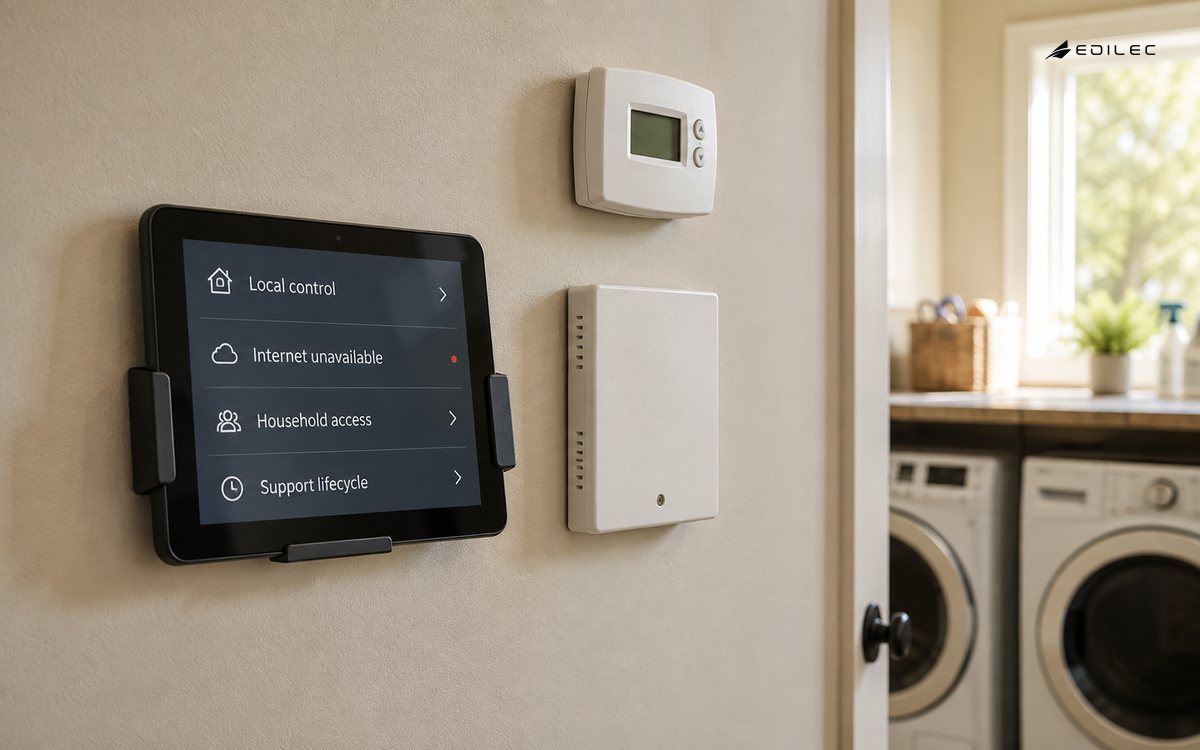
Keep safety-critical, latency-sensitive and basic continuity functions local where feasible. Cloud services are useful for remote access, fleet management, notifications, cross-device automation, analytics and updates, but the home should degrade predictably during internet or provider outage. Define which schedules and manual controls continue, how long credentials remain valid, and how state reconciles after reconnect. Avoid designs where a cloud round trip is required to operate a nearby device without a business or safety reason.
Use explicit command identifiers, sequence or version rules, acknowledgements and expiry. Distinguish requested, accepted, executed, failed and unknown states in APIs and user interfaces. Timeouts should not be displayed as success. Prevent duplicate execution when mobile clients or brokers retry. Local and cloud clocks may diverge, so design reconciliation from causal identifiers rather than timestamps alone. Provide a manual physical path for essential functions where product safety permits, and test restoration after router replacement, hub reset and prolonged disconnection.
How should device identity and onboarding work?
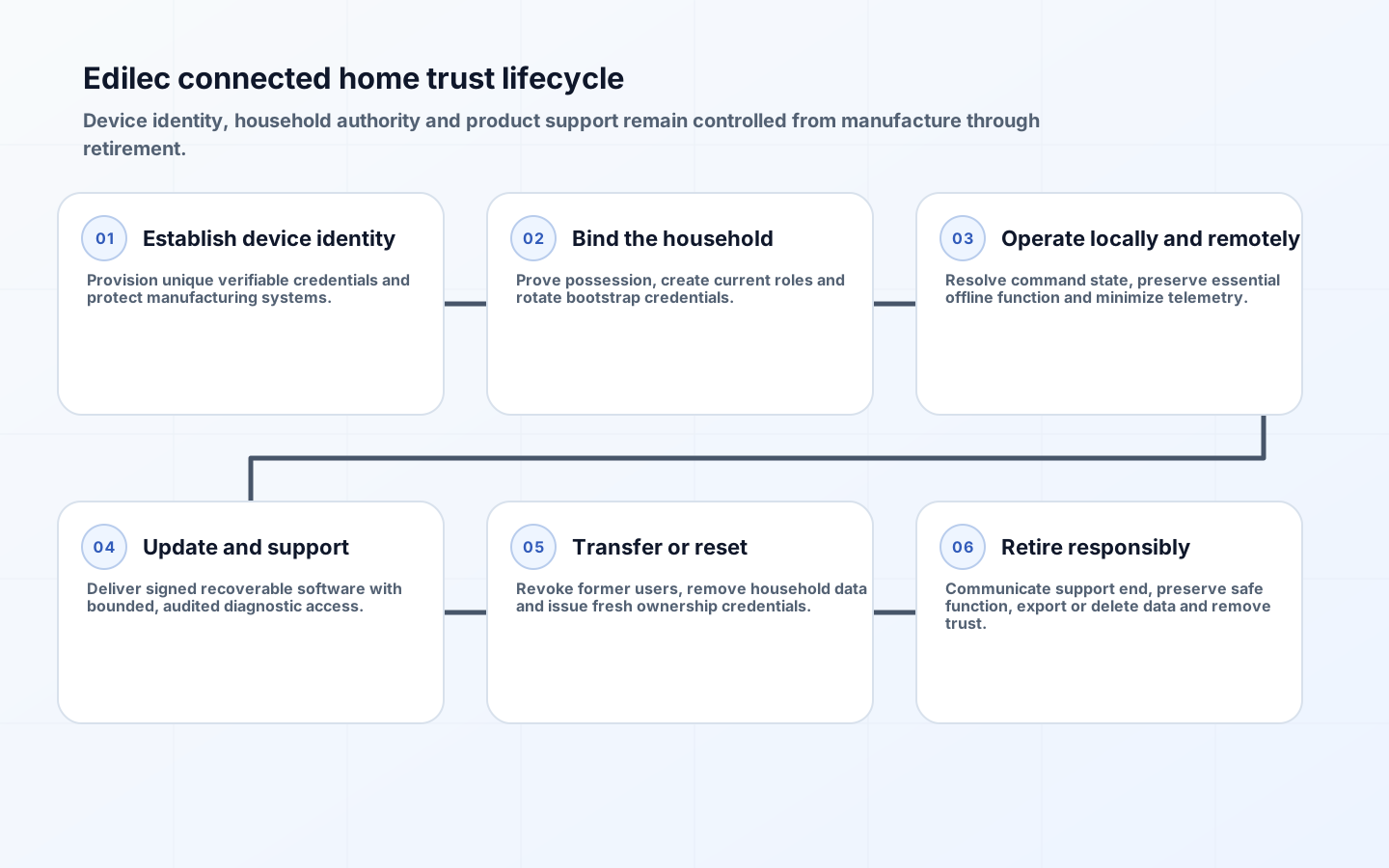
Give each device a unique, verifiable identity rooted in protected hardware or manufacturing credentials where proportionate. Onboarding should prove possession or proximity, bind the device to the correct household and establish fresh operational credentials. Do not use universal default passwords or identifiers that grant control. Protect manufacturing and provisioning systems because compromise there scales across the fleet. Separate device, household, user and application identity, and authorize every command against current relationships rather than trusting network location.
Plan reset, transfer, resale, loss, theft and end-of-life. A factory reset should remove household data and credentials without enabling unauthorized takeover of a stolen product. Ownership transfer must revoke prior remote access and preserve only data the new owner lawfully needs. Installers need temporary, attributable permissions that expire. The NIST IoT capabilities catalog covers device identification, configuration, data protection, interface access, software update and state awareness, useful categories for acceptance tests.
How should household privacy be protected?
Map telemetry and inferences, not just obvious personal fields. Motion, power, temperature, voice events, network identifiers and command history can reveal occupancy, routines, health or relationships. Collect only what a named feature or security purpose needs, use appropriate sampling and retention, and process locally when cloud collection adds little value. Explain data use at the moment it matters, provide household controls, and separate essential operation from optional analytics or marketing. Consent by one account holder may not resolve the interests of every resident or visitor.
Restrict staff and support access with least privilege, case-based approval, strong authentication, time limits and audit. Mask or aggregate fleet analytics. Prevent logs from capturing voice, video, secrets or full household histories by default. Define deletion across primary storage, backups, derived features and third-party processors, and communicate practical limits accurately. Security telemetry may require retention, but its purpose and access should be narrow. A privacy mode must change actual collection and processing, not merely hide information in the app.
| Lifecycle event | Security action | Privacy action | Customer communication |
|---|---|---|---|
| First install | Prove device and household binding; rotate bootstrap credentials. | Present feature-specific collection choices. | Show who can control the device and current state. |
| Guest added | Grant scoped, expiring permissions. | Limit history and sensitive sensor access. | Notify owner and make revocation simple. |
| Support session | Use approved temporary access with audit. | Expose only diagnostic data required. | State access scope, duration and completion. |
| Ownership transfer | Revoke old users and issue new credentials. | Delete or separate prior household data. | Confirm both release and successful new claim. |
| End of support | Disable unsafe dependencies and publish final guidance. | Offer export and deletion paths. | Provide dates, residual function and disposal advice. |
How are updates and vulnerabilities managed?
Use signed updates, verified boot or equivalent integrity controls where supported, anti-rollback rules appropriate to safety, staged rollout and recoverable installation. The device should handle power or network interruption without becoming unusable. Record firmware inventory and update status without exposing households. Provide a vulnerability reporting channel, triage process, remediation targets and coordinated communication. NIST IR 8259 Revision 1 emphasizes foundational manufacturer activities before sale that reduce the cybersecurity burden placed on customers.
Publish a support period and design economics around maintaining cloud APIs, certificates, dependencies and update infrastructure for that period. End-of-support planning should state which local functions remain, which remote functions stop, how data can be exported or deleted and how the device is safely reset or recycled. Do not silently strand hardware because a cloud endpoint is retired. Maintain a software and component inventory, monitor upstream vulnerabilities and test update load across realistic fleet connectivity. Emergency updates still require safety checks and staged observation.
How should interoperability and reliability be tested?
Adopt open or industry protocols where they meet product needs, but validate semantics, versions and failure behavior rather than assuming certification guarantees the whole experience. Third-party controllers may expose only a subset of states or permissions. Define a canonical capability model and test unknown fields, duplicate messages, out-of-order events, expired authorization and partner outage. Limit partner tokens, provide revocation and monitor unusual command patterns. Contract terms should address security notice, compatibility change and customer data handling.
Test crowded wireless networks, router replacement, weak signal, clock drift, cloud-region loss, broker backlog, notification delay, mobile offline use and partial fleet update. Load tests should reflect reconnect storms after power or provider outages. Set service indicators for command success, state freshness, onboarding, notification delivery and update completion by device generation. Run incident exercises that include customer support and safety communication. The NISTIR 8259 series combines technical device capability with non-technical manufacturer support, mirroring this complete product responsibility.
What operating model supports a long-lived fleet?
Assign product, device, cloud, mobile, security, privacy and support owners. Use a fleet registry that connects hardware revision, firmware, certificates, region and support status without making household data broadly accessible. Review onboarding failures, offline devices, command success, update adoption, vulnerabilities, privacy requests, support access and cloud unit cost. Segment by device generation because old hardware may behave differently. Track customer impact and physical safety, not only API uptime. Maintain playbooks for credential compromise, bad update, cross-tenant defect, provider outage and unsafe behavior.
Control cost by device-month and meaningful events, including messaging, storage, notifications, analytics, support and update delivery. Fleet economics must fund the promised support period. Rate limits and quotas should protect the platform without preventing essential recovery after outage. Archive or delete inactive-device data according to lifecycle rules. Review architecture whenever scale, radio technology, partner ecosystem or safety use changes. The cloud innovation implementation guide can help frame wider product investment and operating trade-offs.
Connected home cloud takeaways
- Treat device, local controller, apps, cloud, partners and support as one product system.
- Keep essential and latency-sensitive behavior local where feasible and define offline reconciliation.
- Use unique device identity, secure onboarding and explicit household role lifecycles.
- Minimize household telemetry and govern derived inferences, support access and deletion.
- Design signed, staged, recoverable updates and fund a published support lifecycle.
- Measure physical state, customer impact and fleet behavior rather than cloud API health alone.
Frequently asked questions
Does a smart home product need the cloud? Not always. Remote access, fleet updates and cross-location services often benefit from cloud capability, while local control can improve latency, privacy and continuity. Choose the boundary per function and make degraded behavior explicit.
Who owns data in a multi-person household? Legal answers vary, and technical ownership should not be reduced to the first account created. Model residents, guests, installers and property roles separately; minimize collection and provide clear access, transfer and deletion processes.
How long should connected devices receive security updates? Set and publish a support period appropriate to product life, risk and market obligations, then resource it. Communicate end-of-support early and preserve safe local function or provide responsible retirement guidance where possible.
Conclusion
A trustworthy connected home cloud respects the physical household beyond the screen. Clear local and cloud authority, secure device identity, minimized data, recoverable updates, predictable offline behavior and long-term support turn connected features into a durable product. These answers give teams architecture and acceptance criteria that remain useful across device generations and changing partnerships.