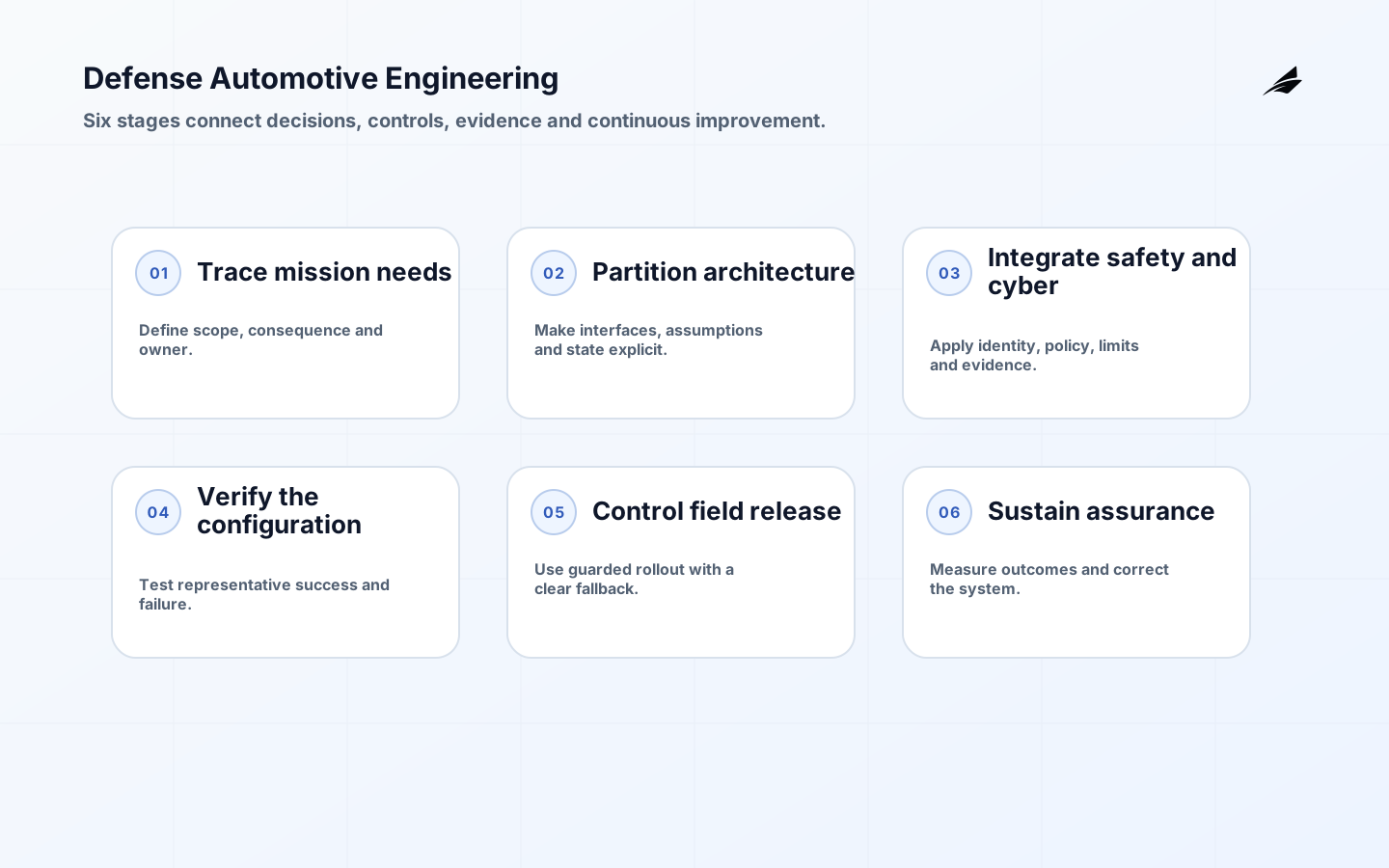
Defense automotive engineering brings mission systems, vehicle platforms, embedded software, electronics, mechanics, safety, cybersecurity, logistics and supply chains into one lifecycle. Road-vehicle standards can provide useful engineering patterns, but defense programs must tailor them to mission, acquisition, classification, environmental and operational requirements. The central need is traceable assurance across interacting hazards and changes.
Use this FAQ with the defense automotive engineering guide, integrated assurance checklist, digital vehicle delivery guide and automotive construction checklist. Apply contract, export-control, safety and security obligations specific to the program and jurisdiction.
What defense automotive engineering covers
Define mission threads, vehicle variants, operating environments, users, maintainers, interfaces and loss consequences. Requirements should include mobility, payload, power, thermal, communications, autonomy, human factors, safety, security, maintainability and support. Connect each requirement to rationale, verification and configuration. Avoid treating software as a late component added after mechanical architecture.
NIST SP 800-160 Volume 1 Revision 1 applies systems security engineering across the system lifecycle and emphasizes trustworthy secure systems. Use multidisciplinary hazard, threat and failure analysis to resolve tradeoffs. A safety mitigation may create a security interface; a security lockout may impede emergency maintenance. Record the decision and residual risk.
Use modular architecture with controlled interfaces
Partition mission, safety-critical, infotainment, diagnostics and maintenance functions according to trust, timing and failure needs. Define physical, electrical, network, data and software interfaces with ownership and versioning. Select platform patterns for hard real-time, safety-critical and high-performance computing according to verified program requirements, timing evidence, assurance needs and applicable licensing constraints.
A modular open systems approach needs technical and business alignment: modular design, published or governed interfaces, conformance testing, data rights and upgrade strategy. Modularity is not maximum decomposition. Choose boundaries that isolate change and fault while meeting latency, power and assurance. Maintain an authoritative architecture model linked to requirements, interfaces and verification evidence.
| Evidence thread | Must connect | Failure if disconnected |
|---|---|---|
| Requirement | Mission need, architecture and verification | Feature passes test but misses mission |
| Hazard | Scenario, control, configuration and result | Safety claim uses stale baseline |
| Cyber risk | Threat, mitigation, monitor and response | Design control has no field detection |
| Release | Artifact, signature, vehicle and approval | Fleet state cannot be proven |
Integrate functional safety and mission assurance
ISO 26262-6:2018 remains current for road-vehicle software product development, covering software safety requirements, architecture, unit work, integration and verification. Its scope is series-production road vehicles, so do not claim automatic defense compliance. Tailor applicable lifecycle rigor and complement it with program-specific safety standards and hazard analysis.
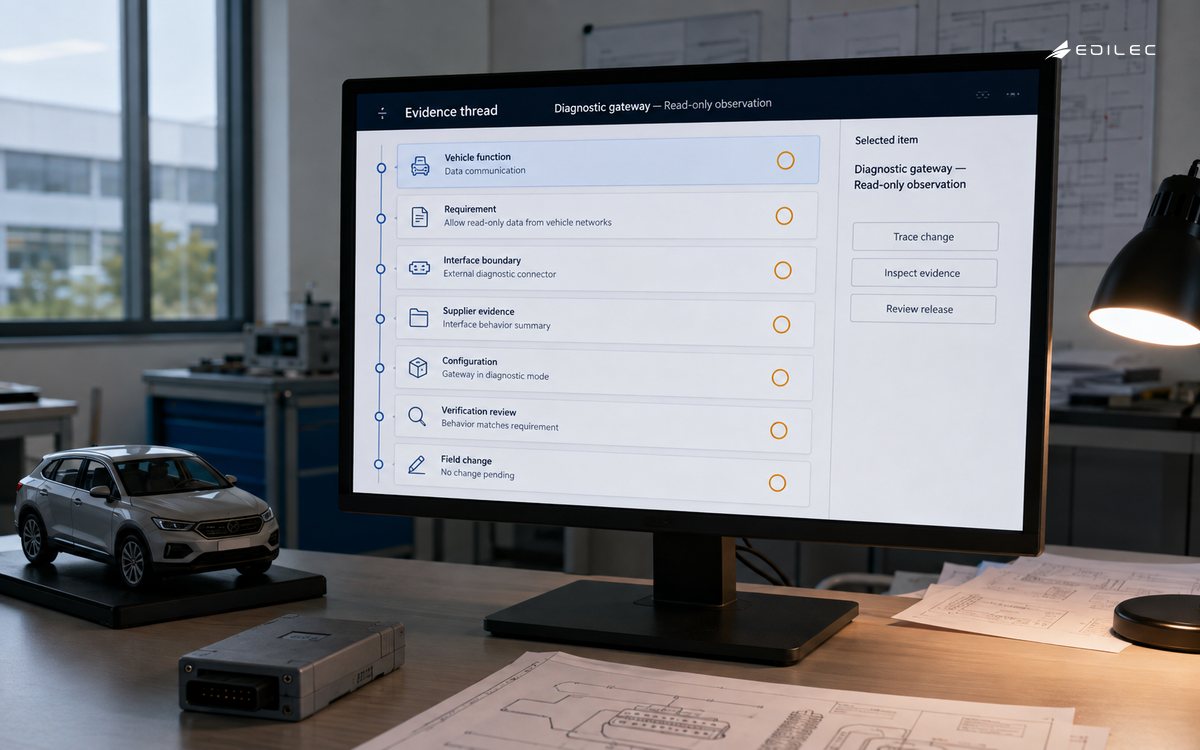
Maintain a hazard log with operational scenario, cause, effect, severity, controls, verification and owner. Analyze common-cause and dependent failures across power, network, sensors, compute and software. Verify degraded modes and human takeover under realistic load and environment. Safety cases must reflect field configuration; evidence for a laboratory build cannot support an unknown software and hardware combination.
Engineer vehicle cybersecurity through the lifecycle
UNECE describes UN Regulation No. 155 and its cybersecurity management system for covered type approvals, including audited manufacturer processes and current risk assessment. Even when not legally applicable, its lifecycle and supplier concepts are useful comparison points. Determine actual applicability with program and legal authorities.
NHTSA’s 2022 cybersecurity best practices describe voluntary risk-based practices for vehicle systems and software. Build threat models around remote, diagnostic, maintenance, supply-chain and physical access. Use authenticated communications, least privilege, segmentation, secure boot, protected keys, logging, vulnerability response and tested recovery.
Control software configuration and field updates
UNECE's official overview of cybersecurity and software-update regulations explains the management-system approach and software identification expected for applicable vehicles. Defense fleets may use different approval regimes and disconnected delivery, but still need unique software identification, integrity, compatibility, authorization, update records and safe failure handling.
Define the complete configuration baseline: hardware, firmware, calibration, software, models, data and cryptographic material. Sign releases, verify before install and prevent rollback to prohibited versions. Test interrupted update, low power, partial fleet deployment and recovery. Preserve mission readiness and safety during rollout. Know which vehicles received which release and which evidence supports it.
| Change | Minimum review | Field safeguard |
|---|---|---|
| Software patch | Impact, regression, security and safety evidence | Pilot, signed delivery and recovery |
| Supplier component | Interface, provenance, obsolescence and qualification | Configuration tracking and alternate plan |
| Mission payload | Power, thermal, network, hazard and threat analysis | Variant-specific baseline |
| Calibration update | Range, interaction and scenario verification | Version identity and rollback policy |
Manage suppliers, components and data rights
Flow requirements, interface controls, evidence, vulnerability notice, configuration data and change approval through the supplier chain. Assess component provenance, obsolescence, counterfeit risk, support horizon and hidden software dependencies. Require a bill of materials appropriate to the program and a route for vulnerability coordination. Validate supplier evidence against the delivered configuration.
Acquire sufficient technical data and rights for integration, maintenance, competition and mission continuity. Avoid interfaces that are “open” in name but unusable without proprietary tools or undisclosed semantics. Plan alternate components and recertification effort. Supplier replacement is an engineering change with safety, security, performance and logistics consequences.
Build an integrated verification strategy
Map every requirement and risk control to analysis, inspection, demonstration or test. Use model, software, hardware-in-the-loop, vehicle and operational testing at appropriate fidelity. Preserve test environment, tools, data, configuration and result. Include fault injection, adversarial testing, timing, thermal, electromagnetic, network and human factors where relevant.
Independence should match consequence. Reproduce failures and track corrective action to closure. Automate regression where stable, while retaining expert evaluation for emergent mission behavior. Define acceptance for degraded operation, maintenance and recovery, not only nominal performance. A passing test count is not assurance if critical scenarios or interfaces lack coverage.
Sustain assurance in the field
Monitor incidents, vulnerabilities, parts, software versions, repairs and operational feedback. Reassess hazards and threats when mission, environment, supplier or configuration changes. Keep field logs useful while protecting operational sensitivity and personnel privacy. Train maintainers on secure diagnostics and configuration confirmation.
Use controlled pilots for updates and new capability. Measure mission availability, safety events, cyber findings, update success, mean repair, false alarms and configuration divergence. Retire unsupported components before risk becomes urgent. Disposal must remove sensitive data, keys and mission configuration while preserving required records.
Example: add a connected diagnostic gateway
A program proposes remote diagnostics to reduce maintenance delay. Model mission and maintenance workflows, remote and physical attack paths, safety effects of diagnostic commands, connectivity loss and classified-data boundaries. Partition observation from command authority. Require device and operator identity, explicit command authorization, rate limits, logging and a local safe mode.
- Trace each diagnostic command to maintenance authority and vehicle state.
- Separate read-only telemetry from state-changing functions.
- Test compromised credentials, replay, network loss and malformed messages.
- Protect keys and support revocation in disconnected environments.
- Record gateway, vehicle software and interface versions together.
- Pilot on a bounded fleet with maintainers and cyber defenders.
Acceptance includes maintenance-time improvement, false diagnostic rate, cyber detection, safety behavior and recovery. The update plan proves interrupted installation and local restoration. Supplier contracts deliver interface semantics, vulnerability notice and lifecycle support. The resulting assurance thread ties the mission benefit to field configuration and evidence.
Review evidence before expanding scope
Before expanding defense automotive engineering, the accountable owner should review representative outcomes, exceptions, access, changes, operating cost, user feedback and recovery evidence. Confirm that metrics still reflect the intended business result, that known limitations are visible to users and that suppliers have not changed material behavior without evaluation. Exercise one realistic failure and reconcile the resulting records. Record the decision to scale, narrow, correct or retire the capability, including assumptions and a review date. This review keeps implementation evidence connected to authority and prevents a successful pilot from becoming an unmanaged dependency.
Program reviews should examine assurance completeness and configuration divergence, not only schedule and defect totals. Sample a fielded vehicle and trace its hardware, software, calibration, keys and modifications to approved baselines and verification. Confirm that open hazards, cyber risks, supplier waivers and temporary repairs have owners and operational restrictions. Exercise a vulnerability response from notification through fleet identification, engineering assessment, release authorization, deployment and closure. Include operator and maintainer feedback because documented procedures may fail under time, weather, connectivity or equipment constraints. When evidence is classified or supplier-restricted, design controlled access and releasable summaries so authorized decision makers can still understand the claim and its limits. These reviews keep the digital thread connected to actual mission condition.
Key takeaways
- Connect mission, safety, security, human and sustainment requirements in one assurance thread.
- Use modular interfaces with conformance evidence, configuration control and adequate data rights.
- Tailor automotive standards to actual defense applicability rather than claiming automatic compliance.
- Secure and identify every field update, including recovery and fleet state.
- Maintain verification and risk evidence as suppliers, missions and configurations change.
Frequently asked questions
Does ISO 26262 certify a defense vehicle?
No. ISO 26262 addresses functional safety for covered series-production road vehicles and specific electrical or electronic scope. A defense program may reuse relevant methods, but must satisfy its own safety, acquisition and mission requirements and document tailoring.
Are over-the-air updates appropriate for defense fleets?
Sometimes. The decision depends on mission, connectivity, classification, threat, authorization and recovery. Connected and disconnected delivery both need signed artifacts, compatibility checks, configuration identity, audit, interrupted-update handling and a way to restore safe operation.
What should remain in the authoritative digital thread?
Requirements, architecture, interfaces, hazards, threats, models, supplier evidence, configuration, software identity, verification, approvals, field changes and incidents should be linked at useful fidelity. Access must respect classification, export and contract controls while keeping decisions traceable.
Conclusion
Defense automotive engineering depends on integrated lifecycle evidence. Keep mission requirements, modular interfaces, safety, cybersecurity, suppliers, releases and field configuration connected. Standards provide valuable methods and comparison points, but program authorities must tailor them to the real mission and obligations. Assurance remains credible only while it follows the deployed vehicle.