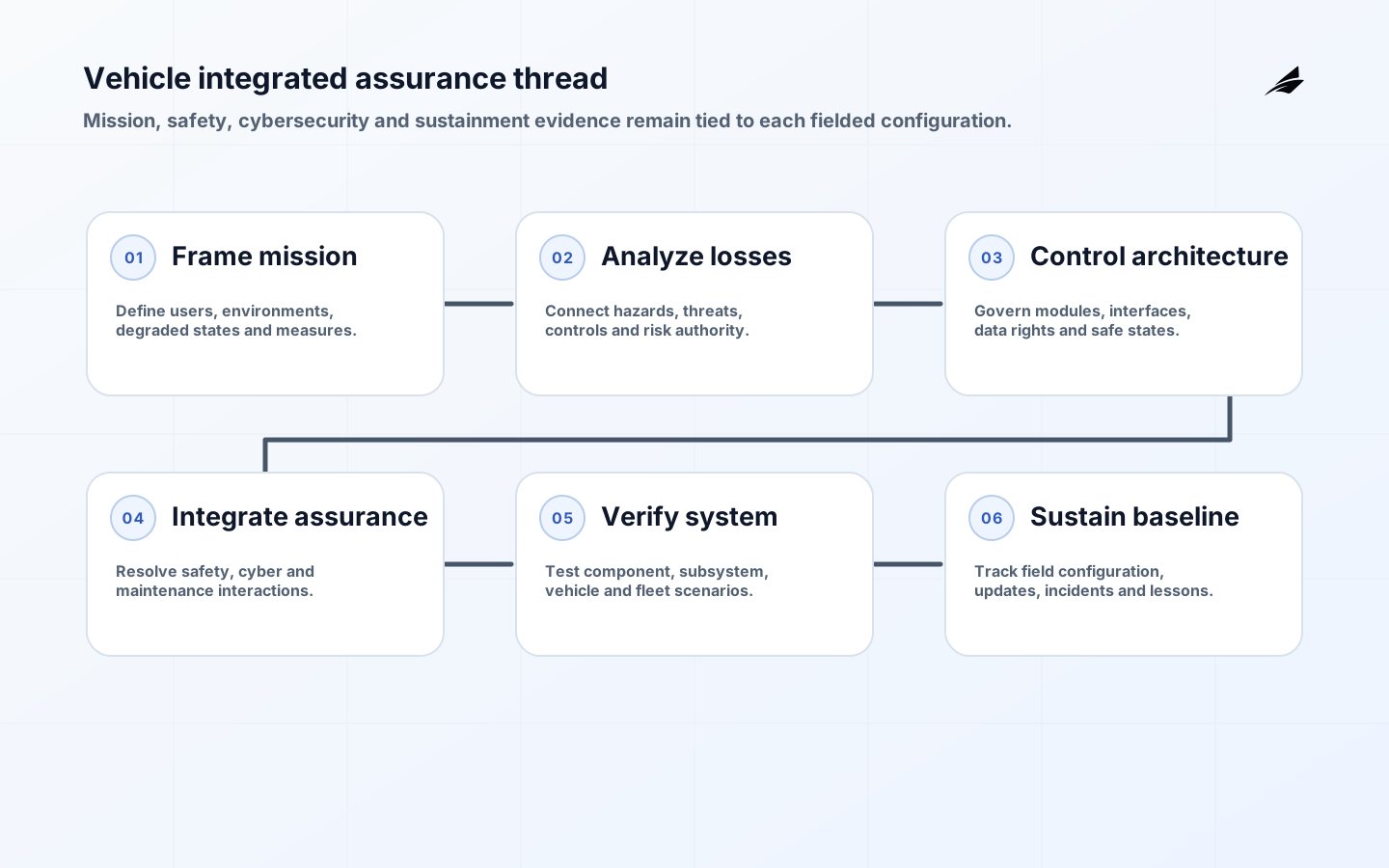
Defense automotive engineering joins two demanding systems disciplines. A vehicle must perform its mission in physical conditions while software, electronics, networks, people, suppliers and maintenance organizations change around it. The practical goal is not to run separate safety, cyber and acquisition checklists. It is to maintain one evidence thread from mission need through hazards, threats, requirements, architecture, verification, field configuration and sustainment.
This defense automotive engineering guide complements the integrated assurance implementation checklist, the defense automotive FAQ and the digital vehicle delivery guide. Applicable military, export, safety, spectrum, environmental and type-approval obligations depend on vehicle, customer and market; the program assurance plan must identify the exact baseline.
Start with mission context and loss scenarios
Describe operating environments, users, payloads, interfaces, maintenance levels, expected life and degraded missions. Convert broad capabilities into measurable scenarios: who acts, under what conditions, with which system state and acceptable result. Include cold start, dust, vibration, electromagnetic effects, intermittent positioning, damaged networks, partial power, towing, depot maintenance and unauthorized physical access where relevant. Assumptions must be owned and testable.
Analyze losses across safety, mission, security, privacy and logistics. A cyber event can produce a safety hazard; a safety fallback can expose a mission vulnerability; a maintenance shortcut can break both. Link each unacceptable loss to hazards or threats, controls, requirements and verification. Record residual risk and the person authorized to accept it. Classification is not a substitute for traceability: evidence still needs stable identifiers and controlled access.
| Engineering view | Core question | Representative evidence | Change trigger |
|---|---|---|---|
| Mission | Can the crew complete the task in expected and degraded states? | Operational scenarios and measures | Doctrine, payload or environment |
| Safety | How can behavior cause harm? | Hazard analysis and safety case | Function, architecture or exposure |
| Cybersecurity | How can access or data be abused? | Threat analysis and mitigation evidence | Interface, threat or supplier change |
| Sustainment | Can the field identify, repair and restore the configuration? | BOM, software inventory and procedures | Part, software or tool replacement |
Design a modular vehicle architecture with controlled interfaces
Partition mission computing, vehicle control, safety-critical functions, diagnostics, communications and external equipment according to trust and failure containment. Define electrical, mechanical, network, data, timing, thermal and diagnostic interfaces. The Department of Defense describes a Modular Open Systems Approach as an integrated business and technical strategy for affordable acquisition and sustainment. Modularity needs governed interface standards, conformance evidence and data rights; drawing boxes around proprietary subsystems does not create substitutability.
Allocate requirements to hardware, software, people and procedures. Document timing budgets, resource margins, startup order, safe states, authority arbitration and degraded modes. Treat gateways as policy enforcement points with explicit permitted messages and rates. Separate development and diagnostic capability from normal operation. Architecture decisions should state their assumptions and the evidence needed if a supplier, processor, operating system or network changes.
Plan configuration identity from the beginning. A fielded vehicle is a combination of hardware serials, firmware, application software, calibration, keys, mission data and installed equipment. The program must be able to determine what is present, which requirements and tests apply, and whether an update path is authorized. Without that configuration graph, fleet risk, recall scope and regression evidence become guesses.
Integrate functional safety and vehicle cybersecurity
ISO 26262 addresses safety-related electrical and electronic systems in series-production road vehicles; defense programs must determine applicability and tailoring, but its software lifecycle concepts are useful. NHTSA's 2022 vehicle cybersecurity guidance treats vehicles as cyber-physical systems and recommends a layered, risk-based approach. Run safety and threat analyses with shared architecture and operating scenarios, then resolve conflicting controls explicitly.
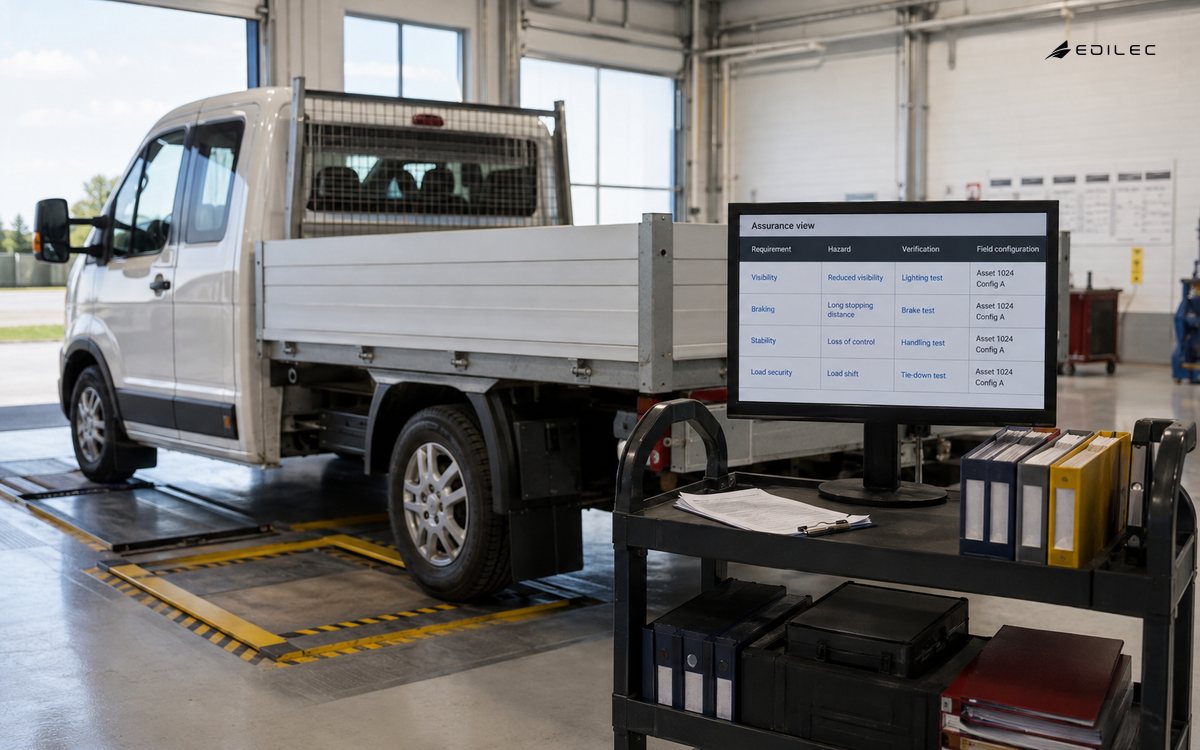
UNECE Regulation No. 155 establishes a cybersecurity management system and vehicle-type evidence model for covered type approvals. Even when it does not legally govern a defense platform, its lifecycle emphasis is instructive: identify and manage risks, verify mitigations, monitor attacks and keep assessments current. Establish vulnerability intake, fleet impact analysis, secure update, incident response and forensic support before fielding. A penetration test near acceptance cannot provide lifecycle governance.
Apply the NIST SSDF to development infrastructure and product software: protect source and build systems, review dependencies, generate attributable artifacts, test security requirements and prepare vulnerability response. Hardware and firmware need equivalent provenance. Secure boot, authenticated update, protected keys and anti-rollback may be important, but their failure and recovery behavior must support safety and maintenance. A bricked vehicle is not a secure outcome.
Contract for supplier evidence and change visibility
Flow requirements and assurance objectives to every relevant tier. Define required interface data, hazard and threat contributions, software and component inventories, test results, vulnerability notification, tool confidence, configuration records and change notice periods. Specify rights to use evidence for integration, investigation, repair and recompete. A supplier certificate without scope, version and assumptions is weak integration evidence.
Review evidence incrementally at architecture and integration points. Maintain an assumption register for supplied items and verify each assumption at the vehicle boundary. When a component changes, assess affected requirements, hazards, threats, interfaces, tests, spares and training before approval. Counterfeit and obsolete parts, unsupported libraries and unavailable test equipment are sustainment risks that belong in engineering decisions, not only procurement reports.
Verify the system, then field by controlled configuration
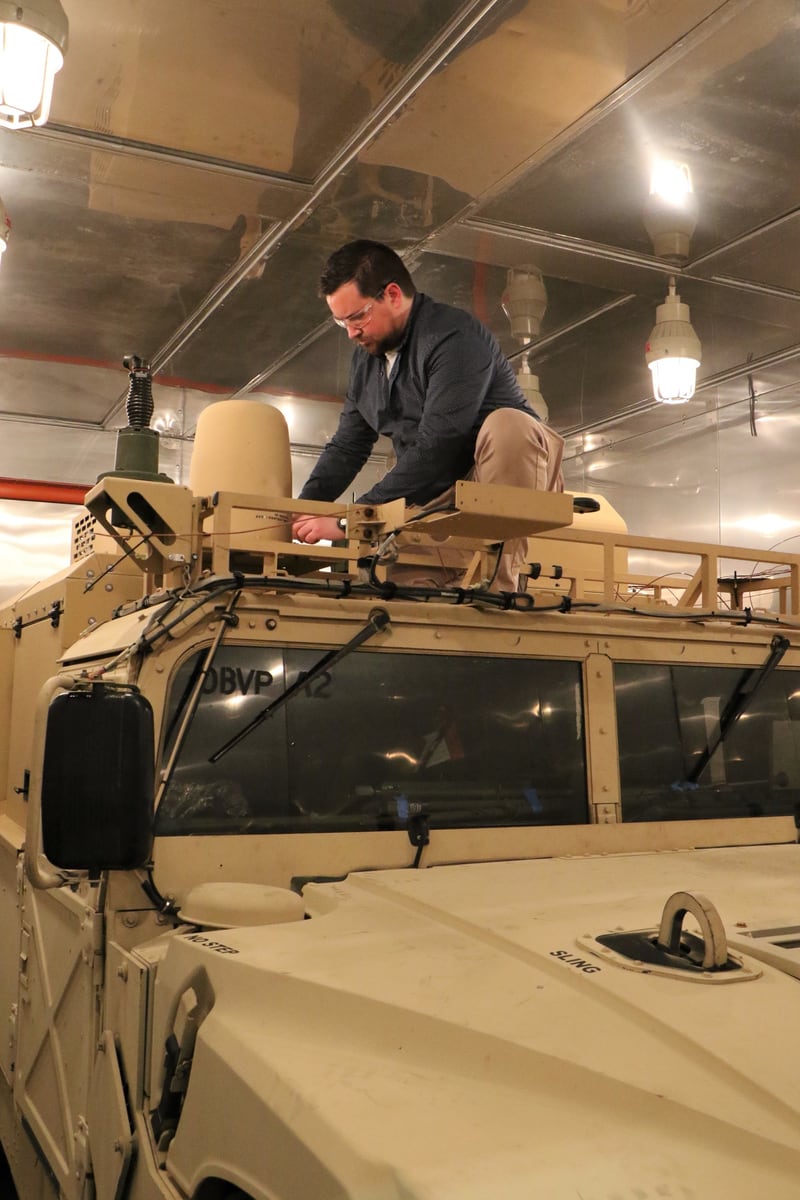
Build verification from mission scenarios and assurance claims. Use analysis, inspection, simulation, software- and hardware-in-the-loop, proving-ground tests, environmental tests, cyber exercises and maintainability demonstrations. Include sensor disagreement, bus flooding, corrupted update, low power, failed gateway, substituted component and recovery during interrupted maintenance. Independence and rigor should increase with consequence and uncertainty.
| Test layer | Example | Evidence retained | Release blocker |
|---|---|---|---|
| Component | Boundary, timing and fault behavior | Versioned result and tool chain | Unexplained critical failure |
| Subsystem | Network load and degraded operation | Interfaces and trace results | Unsafe or mission-breaking interaction |
| Vehicle | Mission, environment and cyber scenario | Configuration and observed outcome | Unaccepted residual risk |
| Fleet | Update, rollback and incident containment | Target list and reconciled status | Unknown or mixed configuration |
Field in bounded cohorts with known baselines, trained maintainers, spares, support and rollback or recovery. Record the as-maintained configuration after every authorized change. Monitor faults, cyber signals, operator reports and maintenance removals together because weak signals can cross disciplines. Feed lessons into requirements, analyses and tests. Sustainment is continued engineering under operational evidence.
Trace a component replacement through assurance
When a network gateway becomes unavailable, procurement equivalence is only the beginning. Compare electrical and environmental limits, timing, diagnostics, safe-state behavior, cryptography, updates, vulnerabilities, provenance and support life. Identify every vehicle configuration using the part and each requirement, hazard, threat and test linked to its interfaces.
A bench test may miss saturation, fault containment or interrupted update. Run targeted hardware-in-the-loop and vehicle scenarios; update maintenance procedures, spares, training and diagnostic tools. If mixed fleets will exist, define compatibility and visible identification. Preserve approved and rejected evidence so maintainers and investigators understand the decision.
Modularity makes impact tractable only when interfaces, data rights and configuration records are strong. Rehearse this process before obsolescence becomes urgent. Confirm that field installation produces an authoritative as-maintained record and that rollback does not leave incompatible software, keys or calibration.
Close the change only after fleet targeting, supply, installation, verification and monitoring agree. Early removals, fault codes and operator reports should feed the assurance case. A technically acceptable replacement can still fail if tools, training or inventory cannot sustain it.
The change pack should identify the need, affected configurations, interface differences, analysis updates, verification rationale, test assets, deviations, acceptance, field instructions and monitoring. Reviewers should reproduce why tests were sufficient. Link supplier evidence to delivered serial and software baselines, not a generic part number.
Before fleet release, demonstrate maintenance with representative tools, publications and personnel. Include interrupted installation, wrong-part attempt and recovery. Verify configuration reporting reaches the fleet record and removed items are handled correctly. This catches assurance failures laboratory teams cannot see.
Key takeaways
- Maintain one trace from mission losses through requirements, controls, tests and field configuration.
- Use modular interfaces with conformance evidence, data rights and change governance.
- Coordinate safety, cybersecurity and maintenance analyses on the same architecture.
- Require suppliers to deliver usable lifecycle evidence and timely change visibility.
- Field and sustain vehicles by verified configuration, with secure recovery and fleet feedback.
Frequently asked questions
Do commercial automotive standards apply to defense vehicles?
Sometimes directly, sometimes by contract or tailoring, and sometimes only as useful engineering references. Applicability depends on jurisdiction, vehicle type and acquisition requirements. Create a standards applicability matrix that records scope, tailoring, equivalence and approval authority rather than claiming blanket compliance.
Are over-the-air updates appropriate for mission vehicles?
They can be, if authorization, targeting, authenticity, confidentiality, bandwidth, interruption, rollback, safe state and audit are engineered for the mission. Some environments will require staged or physical updates. The update system itself is safety-, cyber- and configuration-critical and must be verified as such.
What should a vehicle digital twin contain?
Only models and data that support defined decisions, such as integration, performance prediction, maintenance or configuration impact. Record fidelity, validity range, uncertainty, version and authoritative sources. A visualization without validated decision use is not assurance evidence.
Keep an assurance debt register for missing evidence, temporary waivers, obsolete tools and unsupported components. State affected configurations, consequence, compensating control, owner and expiry. Review it with readiness and sustainment decisions; debt that cannot be traced to a fielded baseline is likely to remain invisible until a change or incident.
Conclusion
Defense vehicle programs succeed when evidence survives organizational and lifecycle boundaries. Anchor design in mission and loss scenarios, control modular interfaces, unite safety and cybersecurity, contract for supplier evidence and know every fielded configuration. That integrated assurance thread makes adaptation faster because change impact can be understood rather than rediscovered.
At readiness events, review temporary waivers, obsolete tools and unsupported parts with affected configurations, consequence, compensating control, owner and expiry. Assurance debt that is not tied to fielded baselines remains invisible until an urgent change or incident.