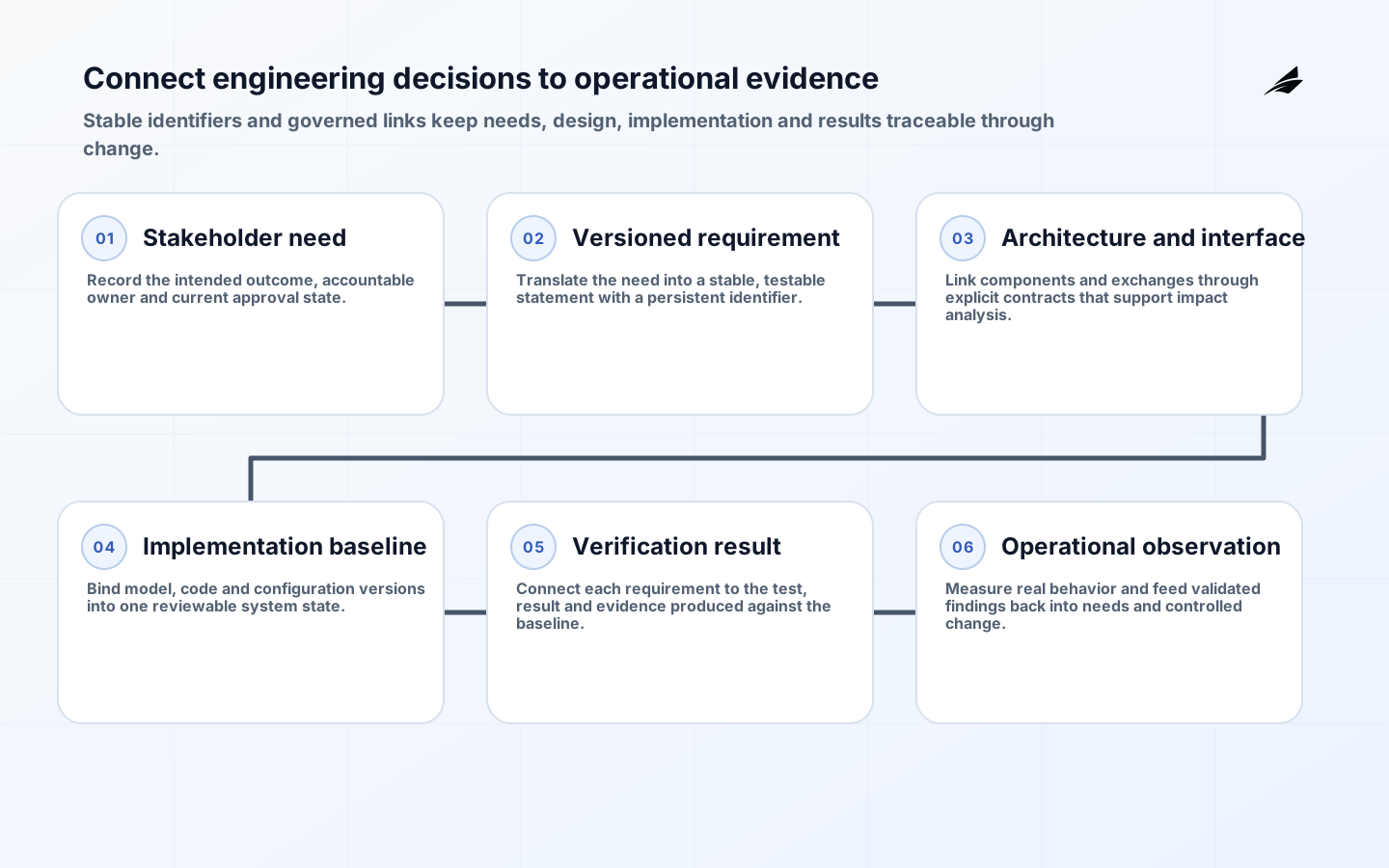
Digital engineering connects business intent, system requirements, models, software, data, verification evidence and operating feedback so teams can make better decisions across a system's life cycle. It is broader than digitizing documents and more disciplined than adding a modeling tool. The practical outcome is a usable chain of evidence: a stakeholder need can be traced to a design decision, an implemented capability, a test result and an operational measure.
For a buyer, the central question is not whether a provider uses fashionable tooling. It is whether the engagement will reduce uncertainty around a real system while leaving behind authoritative information that engineers, operators and decision makers can maintain. This guide explains how to frame that work without assuming a specific industry, platform or delivery vendor.
What digital engineering services should cover
A useful scope begins with the system of interest and its life cycle. ISO/IEC/IEEE 15288:2023 spans conception, development, production, use, support and retirement, and it permits processes to be applied iteratively. That matters because digital engineering is not a one-time model handoff. Models and evidence need owners, review points and updates as the system changes.
Depending on the problem, the engagement may include stakeholder analysis, requirements engineering, architecture, interface management, simulation, software development, data engineering, cybersecurity, verification planning, configuration management and operational analytics. Not every project needs every discipline. The scope should explain which decisions each activity supports and what evidence will make those decisions reviewable.
| Workstream | Useful outputs | Acceptance question |
|---|---|---|
| Needs and requirements | Outcome map, scenarios, constraints, traceable requirements | Can stakeholders distinguish required outcomes from proposed solutions? |
| Architecture and interfaces | System context, logical and physical views, interface contracts | Are boundaries, assumptions and failure behavior explicit? |
| Implementation | Versioned software, infrastructure definitions, model transformations | Can a controlled build reproduce the reviewed design? |
| Verification and validation | Test strategy, results, exceptions, validation evidence | Does evidence show the right system was built and requirements were met? |
| Operations and evolution | Telemetry model, runbooks, change records, retirement plan | Can operators detect drift and feed learning into the next decision? |
Scope a decision thread, not a tool rollout
Start with one consequential decision thread. For example, a manufacturer replacing a manual inspection station might trace throughput and safety needs through sensor selection, control logic, operator workflow, acceptance tests and production telemetry. The first release need not model the whole plant. It must prove that the selected thread can remain consistent as information moves between disciplines.
Write the boundary in plain language: users and operators, external systems, environments, regulated constraints, expected decisions, data sensitivity and life-cycle stage. Then list authoritative sources. A requirements repository may own approved requirements, a model repository may own architecture, source control may own implementation and a test system may own evidence. Calling everything a single source of truth hides legitimate ownership; define an authoritative source for each information class instead.
- Name the business outcome and the decision owner.
- Identify system boundaries, external actors and operating environments.
- Select the requirements, interfaces and hazards that must be traceable in the first slice.
- Define model purpose, fidelity, notation and review audience.
- Specify configuration baselines and how changes propagate between repositories.
- Agree verification, validation and operational evidence before build begins.
Design the engineering information architecture
The information architecture should describe entities and relationships before tools are integrated. Common entities include needs, requirements, functions, components, interfaces, risks, changes, tests, results and operational observations. Give each a stable identifier and lifecycle state. Define permitted links, such as a test verifying a requirement, and reject vague links that cannot support impact analysis.
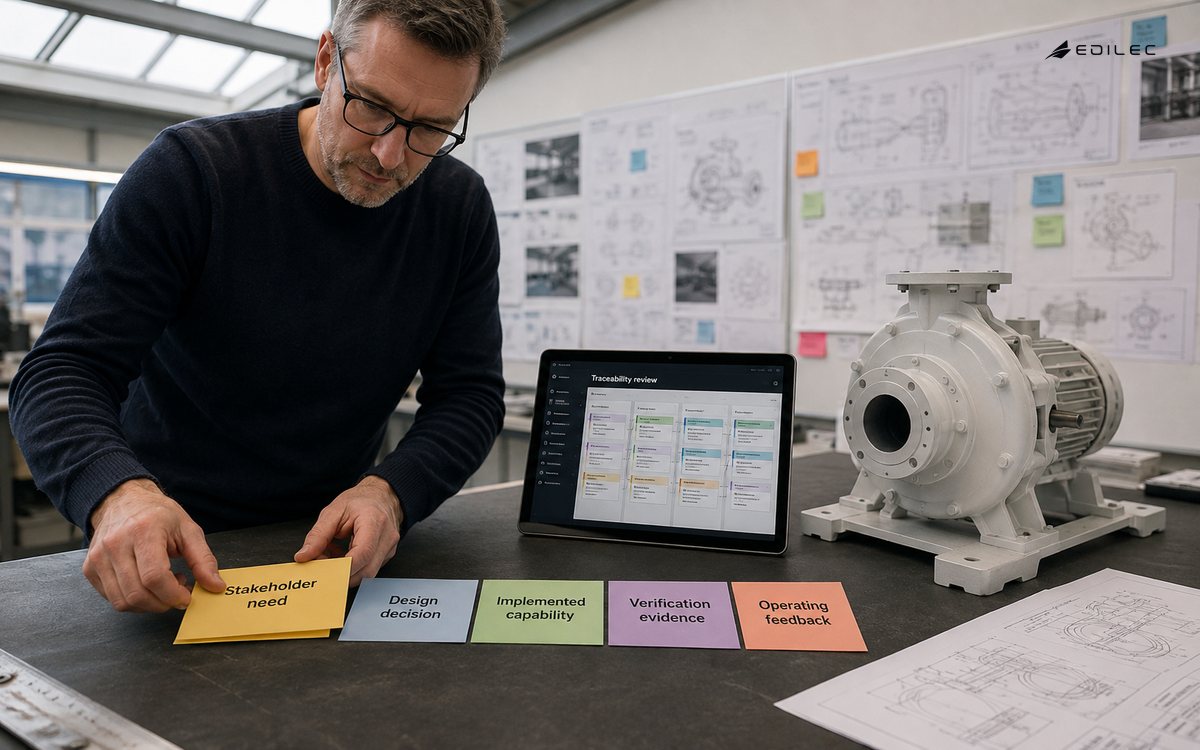
Integration can use APIs, files or events, but every exchange needs a contract, provenance and failure path. A nightly export may be sufficient for low-frequency planning; a release gate may require a current, validated query. Preserve source identifiers rather than matching records by display name. Record transformation versions so reviewers know which rules produced a derived artifact.
Build security and assurance into the thread
Digital engineering repositories can reveal architecture, vulnerabilities and operational behavior. Apply least privilege, strong identity, protected build and model pipelines, audit logging, backup, retention and tested recovery. NIST's SSDF is useful because it frames secure software work across preparation, protection, production and vulnerability response rather than treating security as a late test.
Assurance must separate verification from validation. Verification asks whether an output satisfies specified requirements; validation asks whether the resulting system serves stakeholder needs in its intended environment. A requirement can pass its test and still produce an unusable operator workflow. Plan both kinds of evidence, including simulations, reviews, automated tests and representative operational trials.
Estimate cost from uncertainty, interfaces and assurance
There is no responsible universal price for digital engineering services. Estimate the work from deliverables, information maturity and assurance burden. Discovery is larger when requirements conflict or current configurations are unknown. Integration grows with repository count, proprietary formats and weak identifiers. Verification grows with safety, availability, performance and regulatory expectations.
| Cost area | What drives effort | Evidence for an estimate |
|---|---|---|
| Discovery and framing | Stakeholder count, ambiguity, legacy evidence, operating scenarios | Interview plan, artifact inventory, known-unknown register |
| Models and architecture | Number of views, fidelity, interfaces, analysis depth | Model plan, interface inventory, representative complexity |
| Software and integration | Custom transformations, APIs, environments, automation | Contract list, proof results, deployment topology |
| Assurance | Criticality, test environments, independence, traceability depth | Verification matrix, acceptance strategy, review obligations |
| Transition and operation | Migration, training, parallel processes, support, licenses | Rollout plan, role map, run-cost assumptions |
Separate one-time transition cost from recurring operation. Include platform subscriptions, specialist administration, model and code repository maintenance, integration monitoring, training, data storage and change governance. Also expose retained cost: an old spreadsheet or repository does not disappear merely because a new model exists. Estimate ranges should state assumptions and identify which discovery activities will narrow them.
Control the risks that commonly derail delivery
| Risk | Practical control | Early signal |
|---|---|---|
| Modeling without a decision purpose | Give every model a question, owner and review event | Artifacts grow while unresolved decisions remain |
| Broken traceability | Use stable identifiers and automated relationship checks | Teams reconcile exports manually before reviews |
| Tool lock-in | Define export formats, ownership and exit tests | Critical history or semantics cannot be extracted |
| False confidence in simulation | Document assumptions, calibration and validity range | Results are reused outside the tested conditions |
| Configuration drift | Baseline models, code, tests and deployed versions together | Production cannot be matched to reviewed evidence |
| Low adoption | Co-design workflows and remove duplicate entry | Teams maintain shadow records after rollout |
Use a staged digital engineering delivery plan
Phase one frames the outcome, system boundary and governance. Phase two inventories information and proves access to current configurations. Phase three designs the information model and a representative decision thread. Phase four implements that thread with controlled transformations, security and verification. Phase five pilots the workflow with the people who will review, build and operate it. Phase six expands only after the pilot demonstrates traceability, recoverability and useful decision support.
Each gate should require evidence, not slide completion. A proof gate might require one requirement change to flow through impact analysis, implementation and a repeatable test. A pilot gate might require operators to identify the deployed configuration and explain an exception from recorded evidence. Keep rollback simple: preserve prior repositories, freeze risky migrations, and make synchronization reversible until reconciliation is trusted.
Operate the capability as a product
After launch, assign a product owner for the engineering environment and stewards for requirements, models, interfaces and evidence. Publish contribution rules, review service levels and change windows. Track model freshness, broken relationships, build reproducibility, verification exceptions, time to assess a change and the proportion of releases whose deployed configuration is traceable.
DORA measures can help evaluate software delivery performance, but they do not replace system outcomes. Pair delivery measures with mission or business measures, defect escape, operator burden and assurance findings. Review whether teams make faster, better-supported decisions; counting model elements or repository users rewards activity rather than value.
Procure outcomes and preserve engineering continuity
A request for digital engineering services should describe the system boundary, priority decisions, required evidence, current repositories and acceptance authority. Ask bidders to explain how they will establish configuration baselines, validate transformations and transfer maintainable artifacts. Tool certifications and staff resumes matter only in relation to the proposed work. A useful response identifies assumptions, client dependencies, proof activities and the information that remains uncertain.
Commercial terms should address ownership and usable export of models, code, schemas, automation, test evidence and decision records. Identify proprietary formats and runtime dependencies before they become embedded in delivery. Require a practical exit demonstration for critical information: the enterprise should be able to retrieve current and historical baselines with identifiers and relationships intact, subject to agreed security and retention controls.
| Handoff area | Readiness evidence | Continuity test |
|---|---|---|
| Engineering information | Current baseline, ownership and schema documentation | A receiving engineer traces one requirement to implementation and evidence |
| Automation | Source, dependencies, credentials procedure and build instructions | The client environment reproduces a controlled output |
| Operations | Dashboards, runbooks, backup and incident contacts | An operator diagnoses a simulated stale or failed exchange |
| Skills | Role-based learning and paired delivery | Client staff complete review and change tasks without hidden provider access |
Plan knowledge transfer throughout delivery instead of scheduling a final presentation. Client engineers should review models, run builds, assess change impact and participate in incident exercises during the pilot. Record unresolved limitations and technical debt with owners. Transition is complete when the receiving team can operate the bounded capability and make a safe change, not when documents have been uploaded.
For long programs, review whether the original decision thread still represents current priorities. Digital continuity is valuable only when maintained information supports live decisions. Archive superseded baselines according to policy, retire unused transformations and measure the effort required to keep relationships current. This prevents the engineering environment from accumulating authoritative-looking material that nobody can safely use.
Include suppliers and external engineering partners in the information rules they actually need. Define approved exchange packages, classification, review status and return procedures rather than granting broad repository access by convenience. Test that a received package can be matched to the correct baseline and that supplier changes enter the same impact and approval process as internal changes.
Key takeaways
- Define digital engineering around a bounded system decision and its evidence chain.
- Assign an authoritative source, owner and lifecycle state to each information class.
- Estimate discovery, modeling, integration, assurance and transition separately.
- Pilot one end-to-end thread with configuration control and reversible migration.
- Operate models, software and evidence as maintained products throughout the life cycle.
Frequently asked questions
Is digital engineering the same as software engineering?
No. Software engineering is often part of the work, but digital engineering can coordinate hardware, people, processes, facilities, data and software across a system life cycle. The exact scope should follow the system and decisions involved.
Do we need a model-based systems engineering platform?
Not always. Use modeling where relationships, behavior or analysis justify it. A controlled repository and clear contracts may solve a narrower problem. Select tools after defining model purpose, interoperability, governance and exit requirements.
What should the first deliverable be?
A strong first result is a representative, reviewable decision thread with real identifiers and evidence. It should expose integration and governance problems early without requiring an enterprise-wide migration.
How should success be measured?
Measure decision quality and speed, traceability integrity, reproducibility, escaped defects, operational outcomes and adoption of the governed workflow. Tool usage by itself is not proof of value.
Conclusion
Digital engineering works when it creates durable continuity between intent, design, implementation, evidence and operation. A focused scope, explicit information ownership and staged proof reduce the risk of an expensive repository program that does not change decisions. Start with one meaningful thread, make authority and assumptions visible, and expand only when the workflow survives real change.