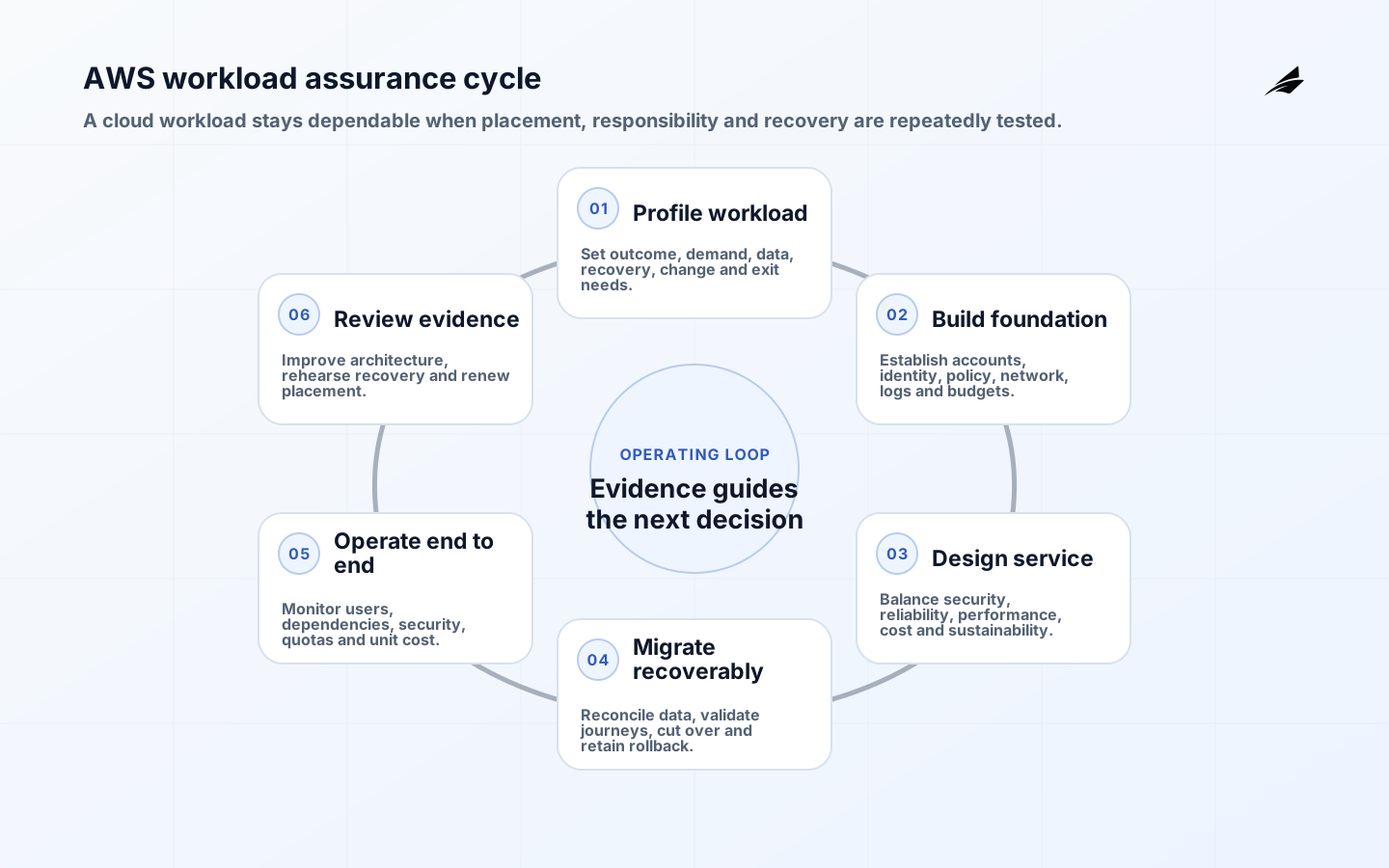
This Amazon Web Services FAQ addresses the decisions behind a dependable AWS workload, not a catalog of service definitions. AWS supplies global cloud infrastructure and managed capabilities; the customer still owns workload architecture, configuration, identity, data use, resilience and operating outcomes. Begin with a business service and its constraints, establish a governed account foundation, then select the smallest service set that the team can secure, recover and afford.
The AWS scope and delivery guide helps build the business case, while the AWS implementation checklist turns it into gates. For ongoing ownership, see the application management services FAQ. AWS changes continually, so architecture records should include region, service, configuration, quotas, data classification and the date on which assumptions were verified.
When is AWS a good fit?
AWS is useful when a workload benefits from elastic infrastructure, managed services, automation, broad geographic reach or an existing AWS operating capability. It is not automatically cheaper or simpler. Data residency, latency, licensing, specialized hardware, legacy coupling and internal skills may favor hybrid operation or another placement. Compare options against service outcomes, regulatory constraints, recovery needs, change frequency and total lifecycle responsibility rather than using a cloud-first slogan as the analysis.
Choose managed services when their operating model and limits fit. They can remove undifferentiated work, but they also introduce service-specific APIs, quotas, upgrade behavior and exit effort. Keep architecture decision records for material choices. The AWS Well-Architected Framework organizes review around operational excellence, security, reliability, performance efficiency, cost optimization and sustainability; use those pillars to expose tradeoffs, not to award a generic compliance badge.
| Workload question | Evidence | Placement implication |
|---|---|---|
| Demand | Baseline, peaks, growth and seasonality | Elastic or steady capacity model |
| Data | Classification, residency, gravity and transfer volume | Region and service eligibility |
| Recovery | RTO, RPO, dependency and restore proof | Availability and backup design |
| Change | Release frequency and automation maturity | Managed service and deployment pattern |
| Exit | Export format, data volume and replacement route | Portability cost and contract terms |
What foundation is needed before workloads?
Create a multi-account structure that separates production, nonproduction, security, logging and shared services according to risk. Centralize identity federation, require strong authentication, constrain organization policies, protect the root user and define tested emergency access. Establish approved regions, baseline logging, configuration monitoring, network patterns, encryption defaults, tagging and budget controls through automation. A landing zone is a maintained product; it is not complete when the first set of accounts is created.
Assign owners to accounts, data, workloads and controls. Inventory resources continuously because console experiments, old snapshots and orphaned identities can outlive the project that created them. Store infrastructure definitions and deployment artifacts in controlled repositories, review changes and detect configuration drift. Quotas and service availability vary by region, so request increases and test dependencies before a launch. Document support plans and escalation because service health dashboards alone do not resolve workload incidents.
Who is responsible for AWS security?
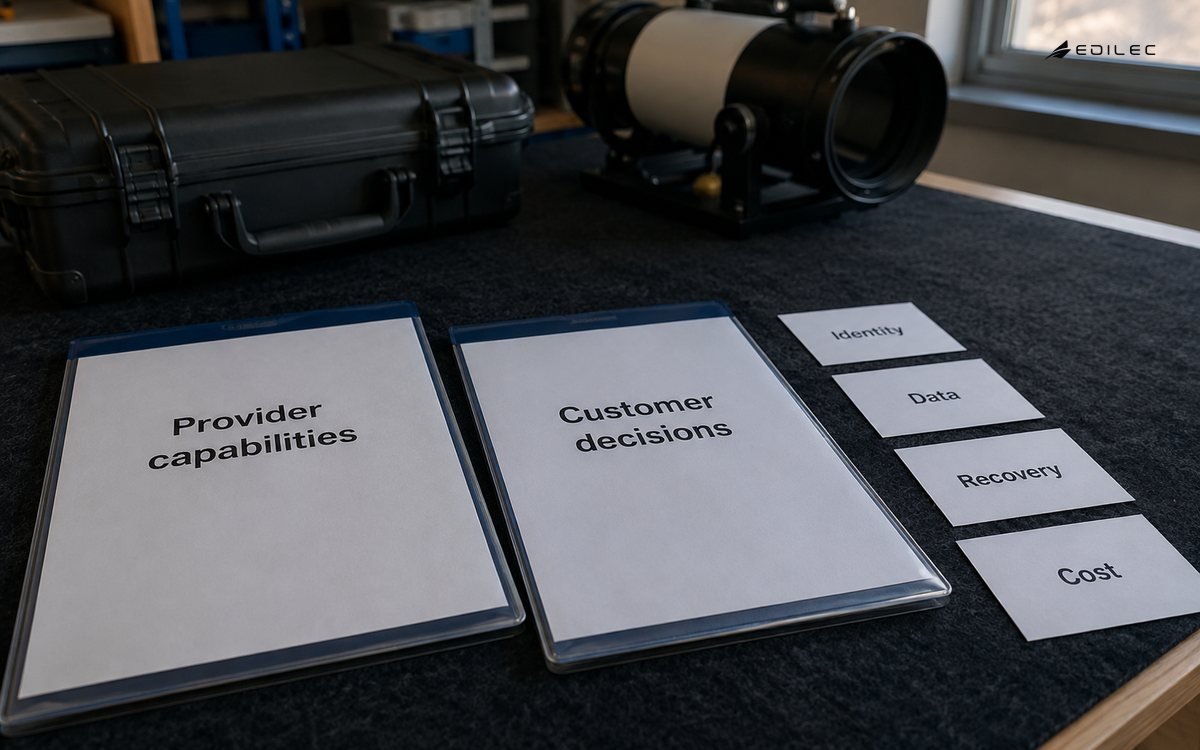
AWS describes security and compliance as shared responsibility. AWS secures the underlying cloud infrastructure; customers secure their use of services, with the boundary changing across infrastructure, platform and software services. The official shared responsibility model should become a service-specific matrix: identify who configures identity, patches guest systems, protects data, monitors events, manages keys, tests applications and reports incidents. Never leave a row marked simply shared without a named action owner.
Apply least privilege to humans and workloads, prefer short-lived credentials and separate deployment from runtime roles. Encrypt data according to classification and decide who controls keys, rotation and recovery. Centralize relevant activity, network, identity and application logs in a protected account with time synchronization and retention rules. Guard public access with preventive policies and continuous detection. Test that responders can correlate a user action, API event, workload trace and affected record under pressure.
| Area | AWS provides | Customer must prove |
|---|---|---|
| Facilities and hardware | Physical infrastructure controls | Appropriate service and region selection |
| Managed service | Documented service boundary and features | Secure configuration, identity and data use |
| Identity | IAM capabilities | Role design, federation, review and emergency access |
| Encryption | Cryptographic services | Classification, key policy and recovery |
| Resilience | Regions, zones and service features | Workload architecture, backup and recovery test |
How should reliability be designed?
Define service-level objectives from user impact, then trace each dependency and failure mode. Availability Zones can isolate many failures within a region, but multi-zone deployment does not repair a corrupt release, deleted record or exhausted quota. Use timeouts, bounded retries, idempotency, backpressure and controlled degradation. The AWS Reliability Pillar emphasizes foundations, workload architecture, change management and failure management. Convert each relevant practice into a tested workload requirement.
Backups are only evidence after restoration. Protect them from workload credentials, monitor completion, validate retention and rehearse recovery into a clean environment. Multi-region architecture should follow a justified recovery or latency requirement because it adds data-consistency, routing, deployment and incident complexity. Exercise zone loss, dependency timeout, key unavailability, bad deployment and operator error. Record actual recovery time and data loss, then resolve the constraints that made results differ from policy.
How should workloads migrate to AWS?
Discover applications, data, dependencies, traffic, licenses, batch schedules, certificates and recovery behavior before selecting a migration pattern. Retire what no longer creates value. For remaining workloads, decide whether to rehost, relocate, replatform, repurchase, refactor or retain. A large wave may improve coordination only after discovery quality and landing-zone capacity are proven. Otherwise it multiplies unknown dependencies and support demand.
Create acceptance criteria for functionality, data reconciliation, security, performance, observability, backup, support and cost. Rehearse migration with production-like volume, measure transfer and cutover time, freeze or replicate changes deliberately, and preserve an actionable rollback point. After cutover, validate user journeys and downstream consumers before decommissioning. The AWS Cloud Adoption Framework is useful because migration spans business, people, governance, platform, security and operations rather than infrastructure alone.
How is AWS cost controlled?
Estimate compute, storage, requests, data transfer, observability, backup, security, support, licenses and engineering. Use the AWS Pricing Calculator for a transparent baseline, then document usage assumptions and uncertainty. Instrument actual unit cost per transaction, customer, environment or data volume where possible. Budgets and anomaly alerts need accountable responders. A cost alert without architectural context often produces emergency shutdowns or superficial rightsizing.
Optimize after measuring demand and service quality. Remove idle resources, schedule nonproduction, tune retention, select appropriate storage classes, rightsize and consider commitment discounts only for stable usage. Review cross-zone and cross-region transfer, verbose logs and managed-service request patterns. Include engineer time and incident exposure when comparing alternatives. The cheapest monthly bill is not efficient if it requires fragile operation or delays product change.
What does day-two AWS operation include?
Operate the customer service, not isolated cloud resources. Monitor user journeys, application health, dependencies, quotas, security events, cost and deployment outcomes. Define on-call ownership, severity, communication, vendor escalation and recovery authority. Patch guest systems and application dependencies within policy, and verify managed-service maintenance behavior. Run game days and preserve incident evidence. Review architectures after material demand, threat, team or service changes.
Use automation for repeatable provisioning and remediation, but keep approvals proportional to consequence. Progressive delivery, immutable artifacts and rapid rollback reduce change risk. Maintain a current service inventory and data-flow map for incidents and audits. Train teams on the specific AWS services they own. A center of enablement should provide patterns and guardrails while workload owners retain outcome accountability; centralization that becomes a ticket queue can erase cloud delivery gains.
Practical example: moving an order API to AWS
A distributor plans to move an order API and relational database from aging virtual machines. Discovery records peak orders, warehouse integrations, batch windows, data residency, a two-hour recovery objective and current outage causes. The target uses separate production and nonproduction accounts, federated roles, protected logging, infrastructure definitions and a managed database across Availability Zones. The team chooses a container service it already knows rather than adopting several new services in one migration.
Engineers load-test order creation, retry behavior and warehouse callbacks; restore a production-sized sanitized backup; simulate a zone interruption; rotate credentials; and roll back a faulty artifact. Migration rehearsal measures replication lag and cutover time. Reconciliation compares order totals, states and financial values before traffic shifts. Operations receive user-journey dashboards, dependency alarms, runbooks, cost alerts and vendor escalation contacts. Old machines remain isolated only until acceptance thresholds pass.
The first month review compares availability, deployment lead time, recovery test results, support effort and cost per thousand orders with the baseline. Data transfer and verbose log retention cost more than estimated, so the team adjusts architecture and retention without weakening evidence. This bounded example demonstrates the AWS pattern: choose services from requirements and skills, prove failure and migration behavior, then optimize from real workload outcomes rather than theoretical cloud savings.
Key takeaways
- Place workloads from evidence, not from an unconditional cloud rule.
- Build identity, accounts, logging, network and policy foundations before scale.
- Translate shared responsibility into named service-specific actions.
- Test restoration and failure behavior against user objectives.
- Model total cost and unit economics with explicit usage assumptions.
- Operate and improve each workload as a complete service.
Frequently asked questions
Is AWS always cheaper than on-premises infrastructure?
No. Cost depends on utilization, architecture, transfer, licenses, operations and purchasing. AWS can convert capacity and provide managed capabilities, but poorly governed usage can be expensive. Compare equivalent service levels and lifecycle work.
Does every AWS workload need multiple regions?
No. Multi-region complexity should answer a documented recovery, residency or latency need. Many workloads meet objectives with sound multi-zone design, protected backups and tested regional recovery procedures.
Conclusion
Amazon Web Services creates value when teams pair cloud capabilities with explicit architecture, responsibility and operating discipline. Start from workload outcomes, build a governed foundation, make recovery observable and manage cost as an engineering signal. That turns a collection of AWS resources into a secure, reliable and improvable business service.