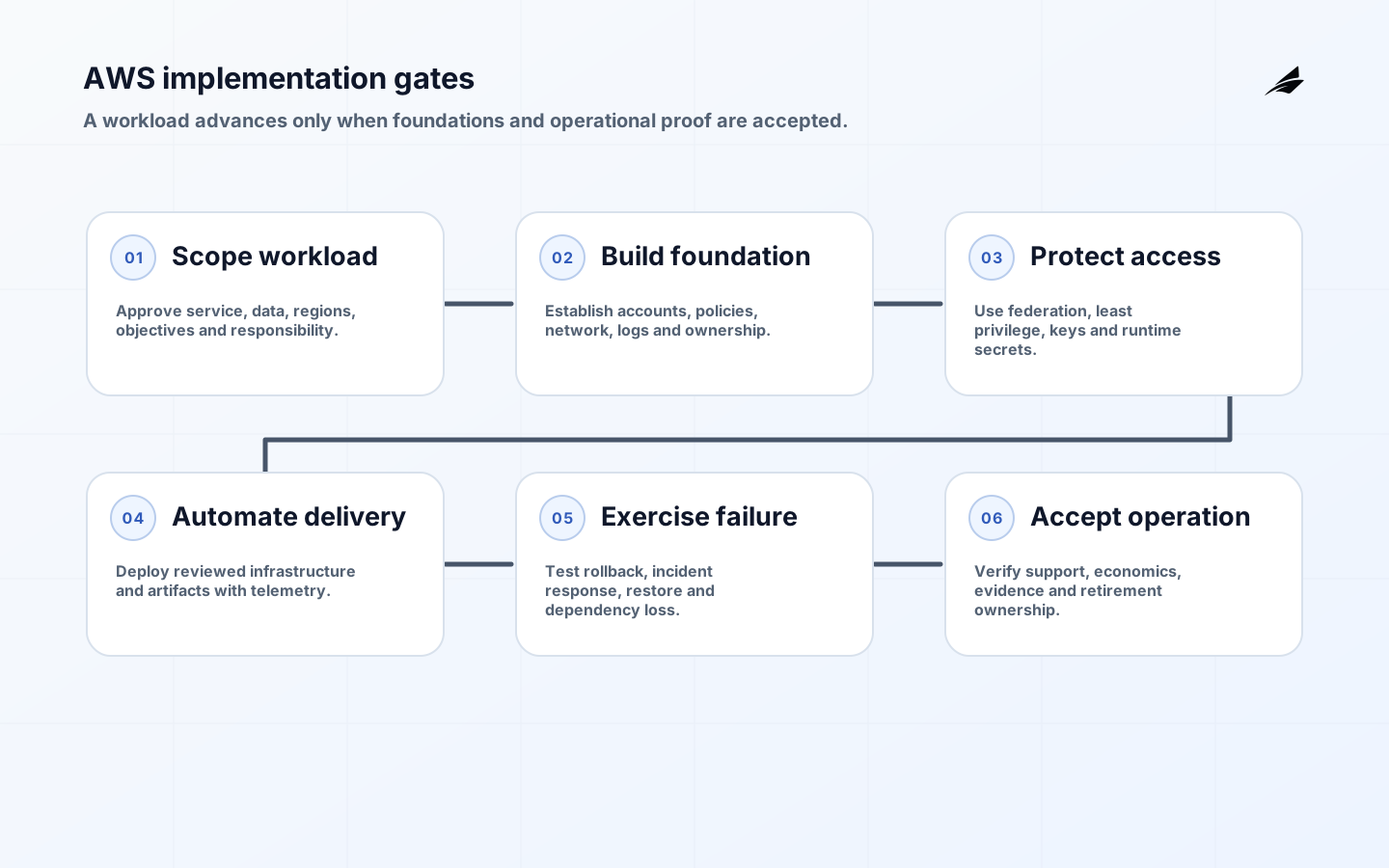
An Amazon Web Services implementation is ready when a workload can be changed, observed, secured, recovered and paid for by accountable teams. Creating an account and deploying resources proves access to AWS, not production readiness. This checklist converts architectural intent into acceptance evidence across organization design, identity, networking, data, delivery, resilience and operations. Apply it per workload and record deliberate exceptions; a control that matters for an internet-facing payment service may not fit an isolated batch process.
Use this checklist with the AWS scope and delivery plan, the AWS FAQ and the application management transition checklist. AWS changes services and recommendations over time, so confirm service-specific limits and documentation during design rather than treating any static list as a substitute for engineering review.
1. Confirm outcomes, workload scope and responsibility
Name the business service, users, data classes, regions, environments, peak demand, recovery objectives and regulatory constraints. Identify upstream and downstream dependencies, including identity providers, DNS, payment systems, SaaS services and on-premises networks. The AWS shared responsibility model changes with the service: AWS operates security of the cloud, while customers retain responsibilities in the cloud such as data, identities, configuration and applications. Managed services reduce some operational tasks but do not transfer business accountability.
- Approve a workload owner, technical owner, security owner, data owner and incident authority.
- Record supported regions, data residency, service quotas and any prohibited services.
- Define availability, latency, recovery point, recovery time and maintenance expectations.
- List third parties and clarify which team owns every configuration and response action.
- Create an architecture decision record for material trade-offs and accepted risks.
2. Establish the account and landing-zone boundary

Separate production, non-production, security, log archive and shared services according to risk and operating model. Use AWS Organizations and centrally governed policies where appropriate, but test policies against real deployment paths. Protect the management account, restrict routine activity in it and define break-glass access. Enable an approved region strategy and prevent accidental resource creation outside it. A landing zone should supply repeatable identity, network, logging and policy foundations without forcing every workload into an architecture that does not fit.
The AWS Security Reference Architecture provides a vendor-authored pattern for organizing security services across accounts. Adapt it to ownership and threat model. Verify that account creation automatically attaches baseline logging, security contacts, budget alerts, backup policies and inventory. Test a newly created account from request through removal; incomplete account vending creates unmanaged exceptions faster than central teams can discover them.
| Foundation | Implementation decision | Acceptance evidence |
|---|---|---|
| Accounts | Environment and workload isolation model | New account inherits policy, contacts, logs and budget |
| Identity | Federation, roles, elevation and emergency access | Join, privileged task and revocation are demonstrated |
| Network | Ingress, egress, DNS and private connectivity | Approved flows pass; prohibited paths fail and log |
| Logging | Organization trail, service logs and archive | Events arrive intact and are searchable within target |
| Ownership | Tags, inventory and service catalog | Every production resource resolves to an owner |
3. Implement identity, keys and secrets
Federate workforce access through the organization’s identity provider and use short-lived role sessions. Avoid shared users and long-lived access keys. Design roles around tasks, separate deployment from administration and require controlled elevation for powerful actions. Service identities should have narrowly scoped policies and should not rely on embedded credentials. Analyze resource policies as well as identity policies because S3 buckets, KMS keys, queues and roles can create cross-account access independently.
Choose key ownership and rotation based on data and operational requirements. Restrict who can change key policy or schedule deletion, and monitor those actions. Store application secrets in a managed secret service, retrieve them at runtime and test rotation without downtime. An encrypted resource is not protected if a broad role can decrypt it or logs disclose the value. Test employee departure, compromised deployment credentials, emergency access and restoration after an accidental policy change.
4. Build network and data protections
Document traffic flows before creating subnets and security groups. Minimize public exposure, use load balancers or API boundaries where suitable, and control outbound traffic based on threat and support needs. Plan address space to avoid conflicts with connected networks. Central inspection can improve consistency but also creates latency and failure dependencies; define bypass and recovery behavior. Enable flow and DNS evidence where it will support investigations, with retention and access appropriate to sensitivity.
Classify each data store by authority, sensitivity, durability and recovery need. Enforce encryption in transit and at rest, but also validate access paths, lifecycle policy, replication and deletion. Block unintended public access at multiple levels. Design object and database versioning to match recovery scenarios, not as a universal checkbox. When a managed database provides automated backup, perform a restore into an isolated environment, validate application consistency and measure elapsed time. Recovery objectives concern usable service, not completion of a storage copy.
5. Automate delivery and observability
Represent infrastructure in version-controlled code and deploy through reviewed pipelines. Pin or constrain dependencies, scan templates and artifacts, separate build and deployment identities, and retain provenance. Promote the same tested artifact between environments while supplying environment-specific configuration securely. Use small, reversible changes and test rollback. Manual console work should be exceptional, attributable and reconciled back to code; otherwise the declared architecture and actual account drift apart.
Define service-level indicators before alerts. Capture request success, latency, saturation, queue age, dependency failure and business completion where relevant. Logs require structured fields, synchronized time, correlation identifiers and controls against secrets. Trace a representative request across boundaries and verify a responder can reach the evidence. Tune alarms through exercises; an alarm that has never fired in a test is an assumption. Dashboards should show missing telemetry and stale data, not silently present partial coverage as normal.
6. Prove reliability and recovery
The AWS Reliability Pillar emphasizes foundations, architecture, change and failure management. Identify single points of failure across application, data, network, quotas and people. Multi-Availability Zone deployment can mitigate an Availability Zone failure, but it does not automatically protect against bad data, flawed deployment or exhausted quota. Multi-Region architecture adds cost and consistency complexity; use it only when the approved service objective justifies that burden.
Create playbooks for dependency outage, credential compromise, data corruption, region impairment and failed deployment. Exercise them with realistic authority and communications. Verify backups are isolated from routine administrative compromise and that restore credentials are available. Record actual recovery point and time, data reconciliation, customer impact and follow-up work. Reliability evidence should feed design: repeated manual recovery steps are candidates for automation, while brittle automation may require a simpler fallback.
7. Make cost and capacity observable
Assign required cost-allocation tags or account boundaries and test billing exports before scale. Build budgets and anomaly alerts with named responders. Model steady, peak, storage, data transfer, observability, support and disaster-recovery costs. The AWS Cost Optimization Pillar treats financial management, expenditure awareness, resource efficiency, demand management and ongoing optimization as operational disciplines. A one-time rightsizing exercise is not cost governance.
Measure utilization and business demand before purchasing commitments. Shut down safe non-production resources, expire abandoned snapshots and logs according to policy, and choose storage tiers from retrieval behavior. Performance tests should reveal both latency and unit cost. Capacity planning must include service quotas and scaling speed; an autoscaling policy cannot create resources beyond quota or recover a dependency that scales more slowly. Review cost changes alongside releases so teams can connect architecture to spend.
| Operational test | Pass condition | Owner |
|---|---|---|
| Identity revocation | Departed user and active sessions lose access within target | Identity owner |
| Deployment rollback | Known-bad release is detected and previous service restored | Workload team |
| Backup restore | Usable, reconciled data returns inside approved objectives | Data and service owners |
| Telemetry loss | Missing logs or metrics trigger a visible alert | Operations owner |
| Cost anomaly | Unexpected spend reaches an empowered responder | FinOps or service owner |
| Account exit | Workload, evidence and keys can be exported or retired | Platform owner |
8. Complete operational acceptance
Use the six pillars of the AWS Well-Architected Framework as a review lens, not a certification badge. Record risks, owners and target dates. Confirm support contacts, incident severity, change windows, vendor escalation, vulnerability handling, on-call access and evidence retention. The AWS Cloud Adoption Framework also highlights business, people, governance, platform, security and operations perspectives; acceptance needs representatives beyond the cloud engineering team.
A production gate should require demonstrated journeys: deploy, observe, rotate a secret, revoke access, handle an alert, restore data and attribute cost. Approve only known residual risks. Schedule the next architecture and recovery review because workload assumptions change after launch. Document decommissioning from the beginning, including data disposition, retained evidence, DNS, certificates, reserved capacity and dependencies. Creation is easy in cloud environments; controlled retirement is part of implementation quality.
Key takeaways
- Scope each workload with owners, data classes, service objectives and explicit shared responsibility.
- Automate account foundations, identity, logging, policy and cost attribution.
- Prefer short-lived access, infrastructure as code and observable, reversible changes.
- Test recovery, identity revocation, telemetry failure and cost response before production.
- Review architecture continuously as demand, services and risks change.
AWS implementation FAQ
Does every workload need multiple AWS accounts?
Not necessarily, but accounts provide strong policy, billing and blast-radius boundaries. Choose separation from risk, ownership and scale. Even a small estate should usually isolate production from experimentation and protect centralized security evidence.
Do managed AWS services remove operational responsibility?
They transfer defined infrastructure tasks to AWS. The customer still configures access, data, resilience, monitoring and application behavior. Read the service’s responsibility and recovery details, then test the customer-controlled parts.
Conclusion
A strong AWS implementation leaves behind more than deployed resources. It creates a governed workload with reliable identity, repeatable change, useful telemetry, tested recovery and visible economics. Production acceptance should rest on those demonstrations, not on the absence of errors during a launch window.