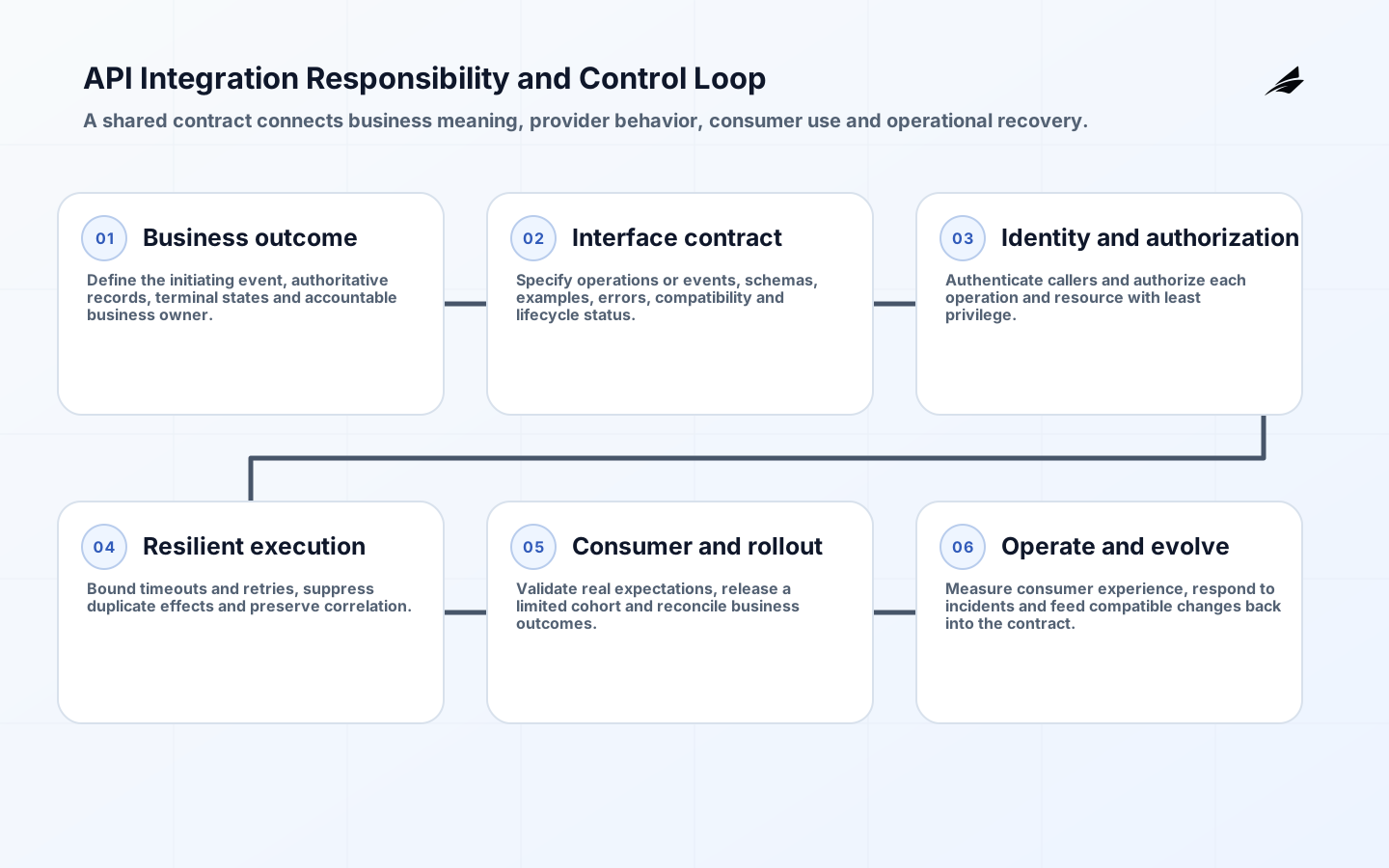
API integration services connect business capabilities across applications, partners and data platforms through governed interfaces. The work may involve synchronous HTTP APIs, webhooks, event streams, managed file exchange or adapters for older systems. A useful engagement does more than make two endpoints communicate: it preserves business meaning, establishes ownership and creates an operable path for change and failure.
The questions below help buyers, product owners, architects and risk teams evaluate scope without assuming that every integration needs the same protocol or platform. For a build-ready sequence, use the API integration services implementation checklist.
What should API integration services include?
Scope should cover the business transaction, participating systems, source of truth, data classification, interface contract, identity model, failure behavior, testing, deployment, monitoring, support and retirement. Deliverables should be evidence, not only diagrams: approved contracts, mappings, threat decisions, test results, operational dashboards, runbooks, consumer communication and ownership records.
| Workstream | Questions to settle | Expected evidence |
|---|---|---|
| Business flow | What event starts the flow and what outcome completes it? | Sequence with exceptions, compensations and accountable owner. |
| Contract | What requests, events, schemas and errors are stable? | Versioned OpenAPI or AsyncAPI document plus examples. |
| Security | Who or what may perform each operation? | Threat model, authorization rules, credential flow and negative tests. |
| Reliability | What happens on timeout, duplication or dependency failure? | Retry, idempotency, queueing, reconciliation and recovery tests. |
| Operations | Who detects, communicates and restores failures? | Correlated telemetry, alerts, runbook, escalation and service objectives. |
How do we choose between APIs, events, webhooks and files?
Choose from interaction needs. A synchronous API suits a caller that needs an immediate result. An event suits notification of a completed fact to multiple consumers. A webhook is a producer-initiated HTTP callback and therefore needs delivery, verification and replay design. Managed file exchange can be appropriate for large scheduled batches or legacy boundaries. The business semantics matter more than fashion.
A single process can use several patterns. An order API may accept a request synchronously, publish an order-accepted event, receive a carrier webhook and exchange a daily settlement file. Document which record is authoritative at each step and whether a response means accepted, completed or merely queued.
What belongs in an API contract?
For HTTP interfaces, define resources, operations, parameters, schemas, authentication, authorization expectations, status codes, error representations, limits, pagination, concurrency, idempotency and lifecycle status. OpenAPI provides a machine-readable description, but a valid document does not guarantee coherent domain semantics. Include examples and consumer-oriented explanations for rules that schemas cannot express.
For event-driven interfaces, define channels, operations, message payloads, headers, correlation, ordering, delivery expectation, replay policy and schema compatibility. AsyncAPI can hold the machine-readable contract. Events should name completed business facts in the past tense where appropriate and avoid leaking the producer's internal database structure.
Who owns an integration?
Assign a business owner for the outcome, a provider owner for the interface, a consumer owner for each dependency, a data owner for sensitive fields and an operational owner for incidents. The provider should own contract quality and change communication; consumers own correct use and migration. Shared ownership without named decisions often becomes no ownership during an outage.
How should API authentication and authorization be designed?
Authentication establishes the identity of a user, workload or client; authorization determines whether that identity may perform a specific operation on a specific resource. Do not treat a valid token as permission for every object. Apply least privilege, verify audience and issuer, constrain scopes, protect secrets and test object-level and function-level denial paths.
For OAuth deployments, use the current IETF best current practice, RFC 9700, rather than copying an old flow from a tutorial. The appropriate grant, client authentication and token controls depend on whether the caller is a browser-based user, native app, confidential service or external partner. Network placement alone is not an authorization control.
What should a good API error contain?
An error should be stable enough for a consumer to act without parsing prose. Use correct protocol status semantics, a machine-readable problem type or code, a safe human explanation, a correlation identifier and field-level details where useful. RFC 9457 defines a common problem-details format for HTTP APIs. Do not expose stack traces, secrets or sensitive record contents.
How should retries and idempotency work?
Retry only failures that are plausibly transient, with bounded attempts, backoff and jitter. Respect server guidance such as Retry-After where applicable. A retry budget prevents one failure from becoming a traffic amplification event. Timeouts should reflect the complete call chain, not an arbitrary library default.
HTTP defines some methods as idempotent at the semantic level, but a business operation may still need an idempotency key or deduplication identifier. A payment or order request must not produce a second business effect merely because a client did not receive the first response. Store enough outcome state to return a consistent result for a repeated request.
How should API versioning and breaking change be handled?
Prefer compatible evolution: add optional fields, tolerate unknown fields where the contract permits, and avoid changing meaning. A version label does not remove migration work. Define what counts as breaking, how consumers are inventoried, how notice is delivered, how parallel versions are observed and what evidence allows retirement.
| Change | Usually compatible when | Needs explicit migration when |
|---|---|---|
| Add response field | Consumers ignore permitted unknown fields | Consumers use strict deserialization that rejects it. |
| Add optional request field | Omission preserves current behavior | The field becomes operationally required. |
| Change enum | Consumers tolerate documented extension | Consumers switch exhaustively on known values. |
| Change validation | Existing valid requests remain valid | Previously accepted business cases are rejected. |
| Change event meaning | Semantic interpretation remains unchanged | The same field or event name represents a different fact. |
What testing is required?
Use contract tests to check provider and consumer expectations, component tests for mappings and rules, integration tests across real protocol boundaries, negative security tests, failure injection for timeouts and dependency errors, performance tests at representative concurrency, and end-to-end business reconciliation. Production-like test identities and realistic but protected data shapes matter more than a large collection of happy-path samples.
Test the ambiguous outcome: the provider completes work but the response is lost. Test duplicates, reordered events, expired credentials, partial batches, malformed payloads, clock differences and a consumer unavailable longer than the retry window. Verify that logs and support tools reveal enough context without exposing sensitive payloads.
What should API observability show?
Correlate the business transaction across gateway, service, queue and dependency. Capture request or message identity, contract version, consumer, outcome class, latency, retry count and relevant business state without placing secrets or unnecessary personal data in telemetry. OpenTelemetry describes traces, metrics and logs that can provide complementary views.
Service objectives should reflect what consumers experience: successful valid requests, processing latency, event age, delivery completion or reconciliation timeliness. Infrastructure utilization helps diagnosis but does not prove the integration completed the business outcome.
What drives API integration cost and duration?
Primary drivers are domain ambiguity, number and stability of systems, access to test environments, data quality, identity and network constraints, nonfunctional requirements, migration obligations, compliance evidence and operating model. Estimate discovery, contract design, provider change, consumer change, data work, platform controls, testing, rollout and support transition separately. A count of endpoints is not a reliable estimate.
Example: connecting order capture to fulfillment
Suppose an order application must send approved orders to a fulfillment system. The contract distinguishes request acceptance from allocation completion. The caller sends an idempotency key; the provider returns a durable order reference; allocation results arrive as versioned events; and a reconciliation job compares accepted orders with terminal outcomes. Least-privilege workload identity permits only the required operations.
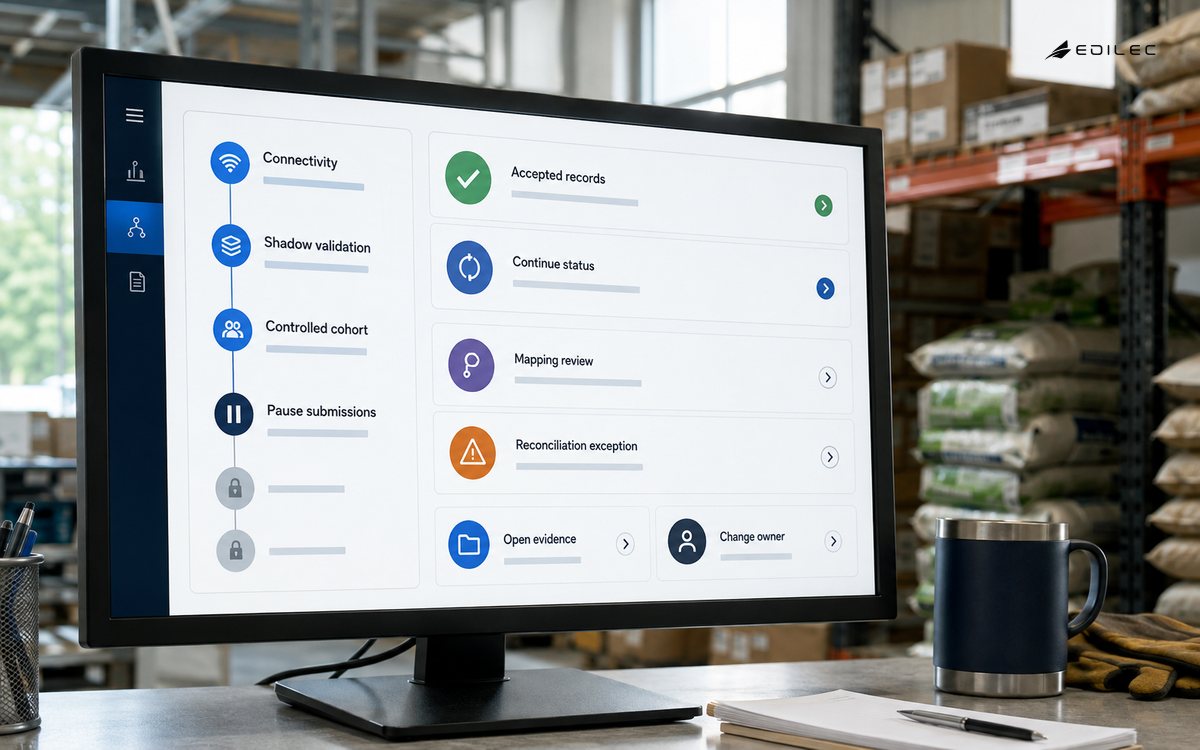
The rollout starts with a non-writing connectivity test, then shadow validation of mapped orders, then a small controlled cohort. Dashboards show valid request success, end-to-end allocation age, duplicates suppressed and reconciliation exceptions. Rollback stops new submissions while preserving already accepted orders and continuing status processing.
What are the most common integration risks?
| Risk | Practical control | Warning sign |
|---|---|---|
| Semantic mismatch | Joint field mapping with examples and authoritative ownership | Teams agree on names but not on business meaning. |
| Broken authorization | Resource-level checks and negative tests for every role and tenant | A valid token can enumerate unrelated objects. |
| Duplicate effects | Idempotency and durable deduplication at the business boundary | Retry count rises with corresponding duplicate records. |
| Dependency cascade | Timeout budgets, isolation, bounded retries and degradation | One slow provider exhausts caller threads or queues. |
| Unmanaged change | Consumer inventory, compatibility tests and deprecation evidence | Unknown consumers appear after a release. |
| Invisible partial failure | End-to-end correlation and reconciliation | Transport success rises while business corrections increase. |
How should an API integration be rolled out?
- Confirm owners, contract, data classification and measurable outcome.
- Prove authentication, authorization and connectivity without business writes.
- Validate mappings and outcomes using representative controlled cases.
- Run shadow, replay or dual-read comparison where it does not create side effects.
- Enable a limited consumer, tenant or transaction cohort with explicit stop conditions.
- Expand only while service objectives, reconciliation and support readiness remain healthy.
- Retire old paths after consumers, records, credentials, jobs and monitoring are accounted for.
Key takeaways
- Scope API integration around a complete business transaction and its failure paths.
- Use machine-readable contracts, but govern meaning, ownership and compatibility outside the schema too.
- Design authorization at operation and resource level; authentication alone is insufficient.
- Make retries bounded and business effects idempotent, observable and reconcilable.
- Release through controlled cohorts and retire old interfaces only with consumer evidence.
Additional questions
Do we need an API gateway?
A gateway can centralize routing, authentication enforcement, rate controls and telemetry, but it does not own domain authorization, idempotency or data quality. Adopt one when its responsibilities and operational ownership are clear, not as a substitute for interface design.
Should we replace an integration platform before adding APIs?
Not automatically. Characterize current flows, contracts and risks first. A stable adapter can protect a legacy system while new boundaries are introduced incrementally. A platform replacement and business integration migration together can unnecessarily enlarge the failure surface.
Conclusion
Effective API integration services turn distributed behavior into an explicit contract with owners, controls and recovery. Teams that settle semantics, authorization, failure handling and operations before scaling can add consumers without making every change a coordinated emergency.