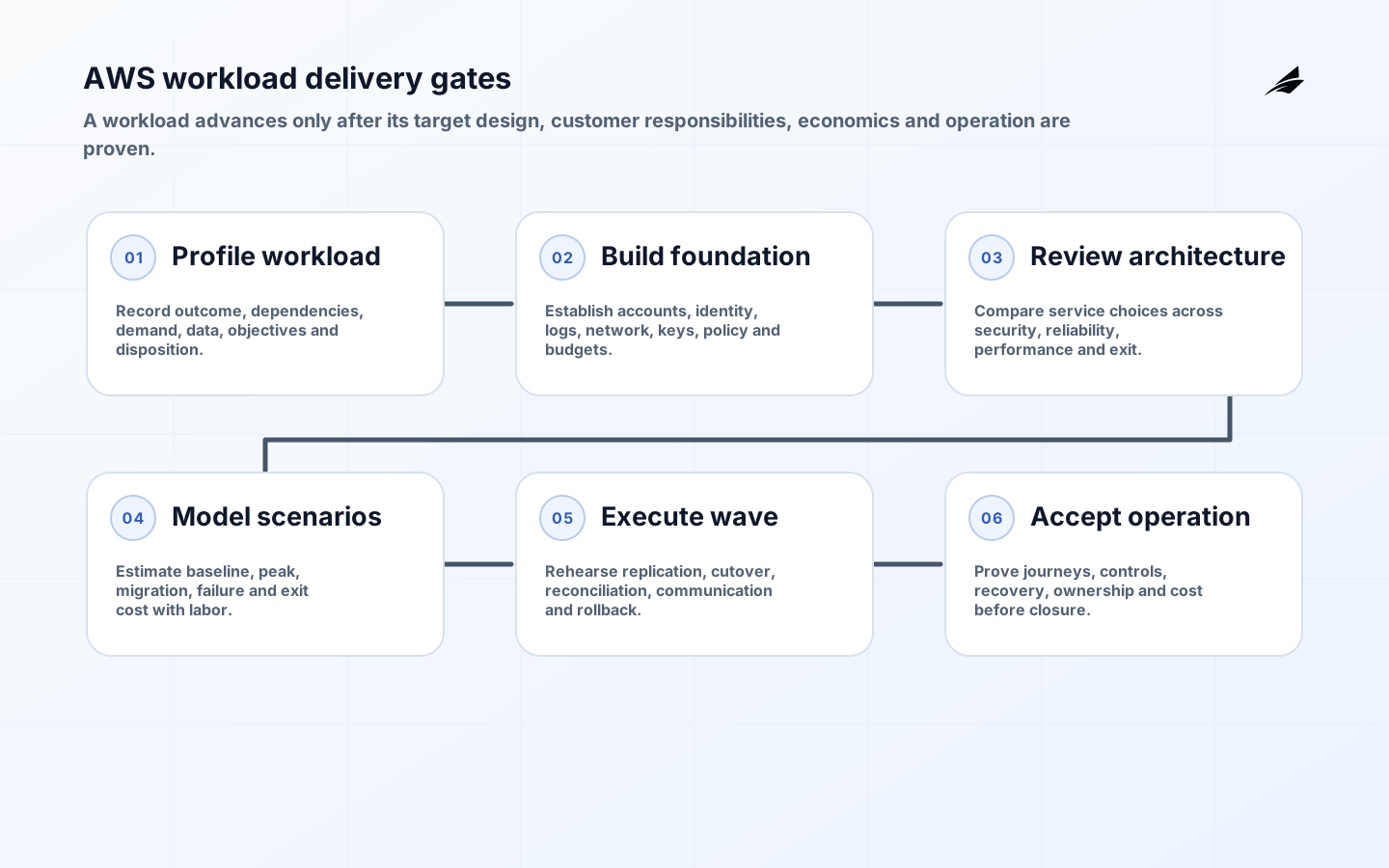
Amazon Web Services offers hundreds of capabilities, but an AWS plan should begin with workloads and organizational constraints rather than a service catalog. The central questions are which outcome needs to improve, which data and dependencies are in scope, who owns cloud controls, how demand becomes cost, and how the service will be operated and recovered. A credible plan makes those decisions visible before a migration deadline turns them into production incidents.
This guide supports business sponsors, architects, platform engineers and finance partners preparing a first AWS workload, modernization or estate migration. Pair it with the AWS implementation checklist, the AWS FAQ and the enterprise application management plan. AWS changes services and prices frequently, so verify design and estimates against current regional documentation before approval.
Scope outcomes, workloads and constraints
For each workload, document owner, users, critical journeys, data classification, dependencies, current cost, availability, recovery objectives, performance profile, change frequency, licensing and retirement horizon. Then state the target outcome: faster environment creation, resilient public access, data-center exit, lower recovery risk or a new managed capability. “Move to AWS” is not an outcome and cannot determine architecture or prove value.
Build a dependency map from observed traffic, scheduled jobs, identity, DNS, certificates, data exchanges, vendor links and operational procedures. Include outbound dependencies and people-operated steps. Classify each workload as retain, retire, rehost, relocate, replatform, repurchase, refactor or another explicitly defined disposition; AWS migration strategy guidance can inform the vocabulary, but the business case and risk decide the route.
| Scope artifact | Minimum evidence | Decision enabled | Owner |
|---|---|---|---|
| Workload inventory | Runtime, data, dependencies, criticality and lifecycle | Disposition and sequence | Application owner |
| Demand profile | Baseline, peak, seasonality and growth | Capacity and pricing model | Product and finance |
| Control obligations | Data, identity, logging, region and retention rules | Landing-zone controls | Security and privacy |
| Service objectives | Availability, latency, RPO and RTO | Architecture and test plan | Service owner |
| Exit constraints | Licenses, portability, export and contract terms | Reversibility and negotiation | Procurement and architecture |
Establish the account and identity foundation
Use multiple AWS accounts to create governance, billing and blast-radius boundaries. Define organization units around policy needs, not an org chart that changes every quarter. Separate production, non-production, security logging and shared services where justified. AWS Organizations best practices recommend managing accounts within one organization, validating email addresses, using organizational units and applying controls at scale. Keep the management account free of ordinary workloads and tightly protect its access.
Federate workforce access from the approved identity provider, require phishing-resistant authentication where policy supports it, and use short-lived roles instead of long-lived access keys. Define break-glass access, test it, monitor it and store recovery material separately. Centralize audit logs with protection against alteration, set configuration and security baselines through code, and establish network, DNS, certificate, key and secret ownership. A landing zone is an operated product with versioned changes, not a one-time diagram.
Choose services through explicit tradeoffs
Compare at least two viable architectures against operational excellence, security, reliability, performance, cost and sustainability. The AWS Well-Architected Framework provides questions across those pillars. Use it to surface decisions, not as a guarantee. A managed database may reduce patching and failover work but constrain extensions or versions. Serverless execution can match variable demand but requires careful timeout, concurrency, observability and downstream-capacity design.
Design failure behavior first. Identify availability zones and regional dependencies, queue boundaries, retry budgets, idempotency, backup scope and restoration order. Set RPO and RTO from business impact and test them through service-level exercises. Multi-region architecture is not automatically more reliable; it adds data-consistency, deployment, failover, cost and operational complexity. Adopt it only when requirements and tests justify that burden.
Translate shared responsibility into named controls
AWS secures the underlying cloud infrastructure while customers remain responsible for responsibilities that vary with the selected service, configuration, data and applications. Review the official shared responsibility model for each architecture, then create a control matrix naming the provider, platform team, workload team and vendor contribution. “AWS handles security” is never an acceptable control statement.
For every inherited or shared control, state how evidence is obtained and how customer configuration is tested. Include identity, encryption, network exposure, operating-system or runtime maintenance, vulnerability response, data classification, backup, logging, incident notification and supplier access. Establish an exception path with expiry and risk owner. Keep regulated evidence linked to immutable infrastructure and pipeline versions so a later team can reproduce what was deployed.
Model AWS cost with demand and uncertainty
Build estimates from architecture quantities: instance or function duration, requests, storage by class, provisioned throughput, backups, logs, data transfer by route, security services, support plan, third-party marketplace products and engineering labor. Use the AWS Pricing Calculator for current scenario estimates, record region and date, and keep the exported assumptions. Pricing is only one part of total cost; migration, dual running, refactoring, training, assurance and operations often dominate early phases.
| Scenario | Assumption to vary | Cost often missed | Management response |
|---|---|---|---|
| Baseline | Observed demand plus planned growth | Logs, backups and support | Budget and owner tags |
| Peak | Burst duration and concurrency | Downstream scaling and transfer | Load test and service quotas |
| Migration | Wave duration and duplicate operation | Replication, egress and specialist labor | Time-boxed transition budget |
| Failure | Restore, failover and incident volume | Warm capacity and forensic retention | Exercise against RTO/RPO |
| Exit | Data volume and replacement lead time | Egress, conversion and contract overlap | Test export and portability |
Allocate costs with account, workload, environment and owner metadata. Set budgets and anomaly alerts before migration, but avoid treating a budget as a hard reliability control. Review unit measures such as cost per order, tenant or processing job alongside total spend. Commitments and discounted pricing can reduce stable usage cost, but buy them only after measuring demand and accounting for architecture change. The cost-optimization pillar emphasizes financial ownership, expenditure awareness, cost-effective resources, demand management and continual review.
Include service quotas and forecast error in financial governance. A quota increase may be necessary for peak reliability while also enabling an expensive runaway process. Pair technical limits with anomaly response, clear owners and tested throttling. Review forecast versus actual after each wave and update later business cases with observed storage, transfer, support and labor instead of carrying early assumptions forward.
Treat quota approvals as architecture decisions: record the workload, demand evidence, failure impact, cost exposure, alarm and rollback. Recheck them when a wave closes or traffic changes.
Deliver through migration waves
- Build and test the organization, identity, logging, networking, security and cost foundation.
- Move a low-criticality representative workload to prove the complete delivery and support path.
- Reconcile data, behavior, performance, cost and control evidence against the baseline.
- Group later workloads by shared dependencies and business windows, not arbitrary application counts.
- Rehearse cutover, rollback, restore and communication with production-like data volumes.
- Decommission source resources only after acceptance, retention, audit and financial closure are confirmed.

Each wave needs an entry and exit gate. Entry requires dependency evidence, target design, tested automation, data reconciliation rules, cutover ownership and rollback criteria. Exit requires accepted user journeys, control evidence, achieved service objectives, operations handover, cost visibility and source-system disposition. Keep a migration control room focused on decisions and evidence rather than status theater. Pause the wave when shared assumptions fail; repeating a bad template scales risk.
Prove operations before declaring success
Define service-level indicators, alerts with actionable owners, incident severity, escalation, change controls, patch responsibilities, backup validation and recovery exercises. Instrument user outcomes and dependencies, not only infrastructure utilization. Give responders access to correlated logs, deployment history and runbooks. Test provider API throttling, expired certificates, identity-provider outage, lost connectivity, corrupt data and unavailable operators. A dashboard that has never triggered an exercised response is not operational proof.
Use the AWS Cloud Adoption Framework to review business, people, governance, platform, security and operations perspectives. Assign a product owner and roadmap for the cloud platform, measure onboarding time and control exceptions, and reserve capacity for upgrades. Review architecture and cost at regular intervals because workload behavior and AWS capabilities change. The business case should include improved delivery or resilience evidence, not only data-center cost removal.
Key takeaways
- Tie Amazon Web Services decisions to workload outcomes, dependencies and service objectives.
- Treat accounts, identity, logs, networking, security and cost controls as an operated foundation.
- Turn shared responsibility into a control matrix with named owners and evidence.
- Estimate demand, transition, failure and exit scenarios, including labor and dual running.
- Use gated waves and prove recovery, support and cost visibility before decommissioning sources.
Frequently asked questions
Is AWS cheaper than on-premises infrastructure?
It depends on demand, architecture, labor, licenses, existing assets, utilization and operating model. AWS can turn capacity into measured consumption and provide managed capabilities, but poor sizing, idle resources, excess transfer or complex designs can cost more. Compare whole-life scenarios with the same service objectives.
Do small teams need a landing zone?
They need an appropriately sized foundation. Even one workload benefits from managed identity, account boundaries, logs, backups, budgets and recoverable configuration. Avoid enterprise-scale ceremony, but do not postpone controls that become disruptive to retrofit after production data and multiple teams arrive.
Should every workload use managed AWS services?
No. Managed services can reduce undifferentiated operations, but evaluate capability fit, portability, skills, cost behavior, quotas, regional availability and failure modes. Choose the service that meets the workload’s requirements with an acceptable operational and exit burden.
Conclusion
An AWS delivery plan is credible when the organization can explain why each workload is moving, what foundation protects it, how demand translates into cost, which responsibilities remain with the customer, and how operators will recover it. Evidence-based waves turn cloud adoption from a large transfer event into a controlled improvement of services and capabilities.