An enterprise client portal is an external operating surface, not merely a branded dashboard. It exposes documents, requests, approvals and account data to people who belong to customer organizations with changing roles. Client portal development for enterprise teams must therefore solve delegated administration, tenant isolation, source-system consistency and support before visual polish. This guide follows a representative B2B journey: a client administrator invites a colleague, submits a service request, uploads evidence and tracks fulfilment across enterprise systems.
Define the service boundary before selecting technology
Start with a coherent set of high-volume client journeys backed by authoritative enterprise systems. Observe real cases, including exceptions, reversals and incomplete inputs. Record who initiates the work, which system owns each fact, who may approve an outcome, what makes an action irreversible and how staff recover when an integration fails. This boundary prevents enterprise client portal development from becoming a vague transformation program. It also exposes policy disagreements before software silently turns them into inconsistent behavior.
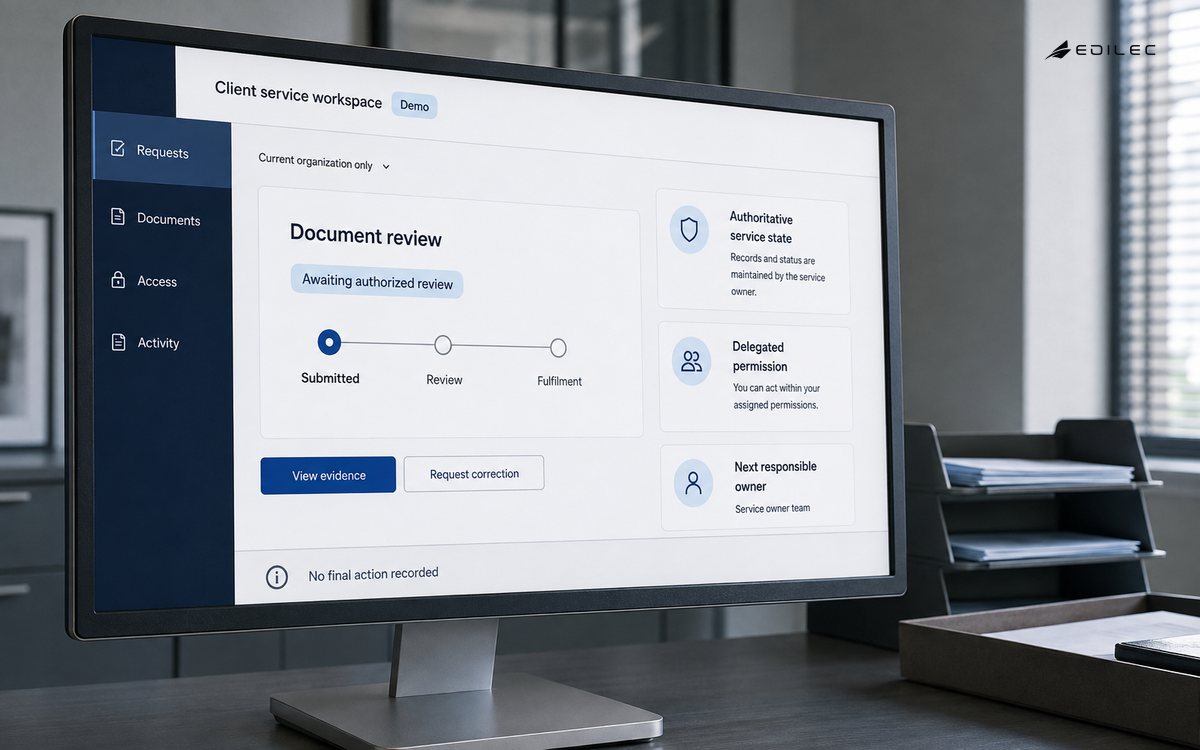
Acceptance criteria should describe the whole client journey. The invited user must verify identity, join the correct organization and receive only the permissions granted by its administrator. Uploaded documents need type, size, malware and retention controls. A submitted request should display the authoritative reference, current state and last update, even when fulfilment is asynchronous. The portal must explain errors without revealing another tenant or internal topology, and support staff need a safe impersonation alternative that preserves who actually performed each action.
Architecture and ownership
The architecture must preserve authority across federated identity and organization membership, tenant-aware authorization and consent, API orchestration over systems of record, notifications, evidence, observability and support tooling. Each component needs an owner, a versioned contract and observable failure behavior. Avoid direct point-to-point writes from an interface or model into a critical record. A narrow orchestration layer can validate identity, current state, policy and idempotency before an action proceeds, while an audit event records the evidence and rule version used.
| Architecture area | Required design decision | Evidence before release |
|---|---|---|
| federated identity and organization membership | For this design choice, name the accountable owner, supporting evidence, exception route, and next measurable check. | Approved data-flow and owner |
| tenant-aware authorization and consent | Within this design choice, name the accountable owner, supporting evidence, exception route, and next measurable check. | Authorization and negative tests |
| API orchestration over systems of record | When implementing this design choice, name the accountable owner, supporting evidence, exception route, and next measurable check. | Versioned interface plus retry behavior |
| notifications, evidence, observability and support tooling | Before releasing this design choice, name the accountable owner, supporting evidence, exception route, and next measurable check. | Dashboard, alert and recovery runbook |
A six-stage delivery path
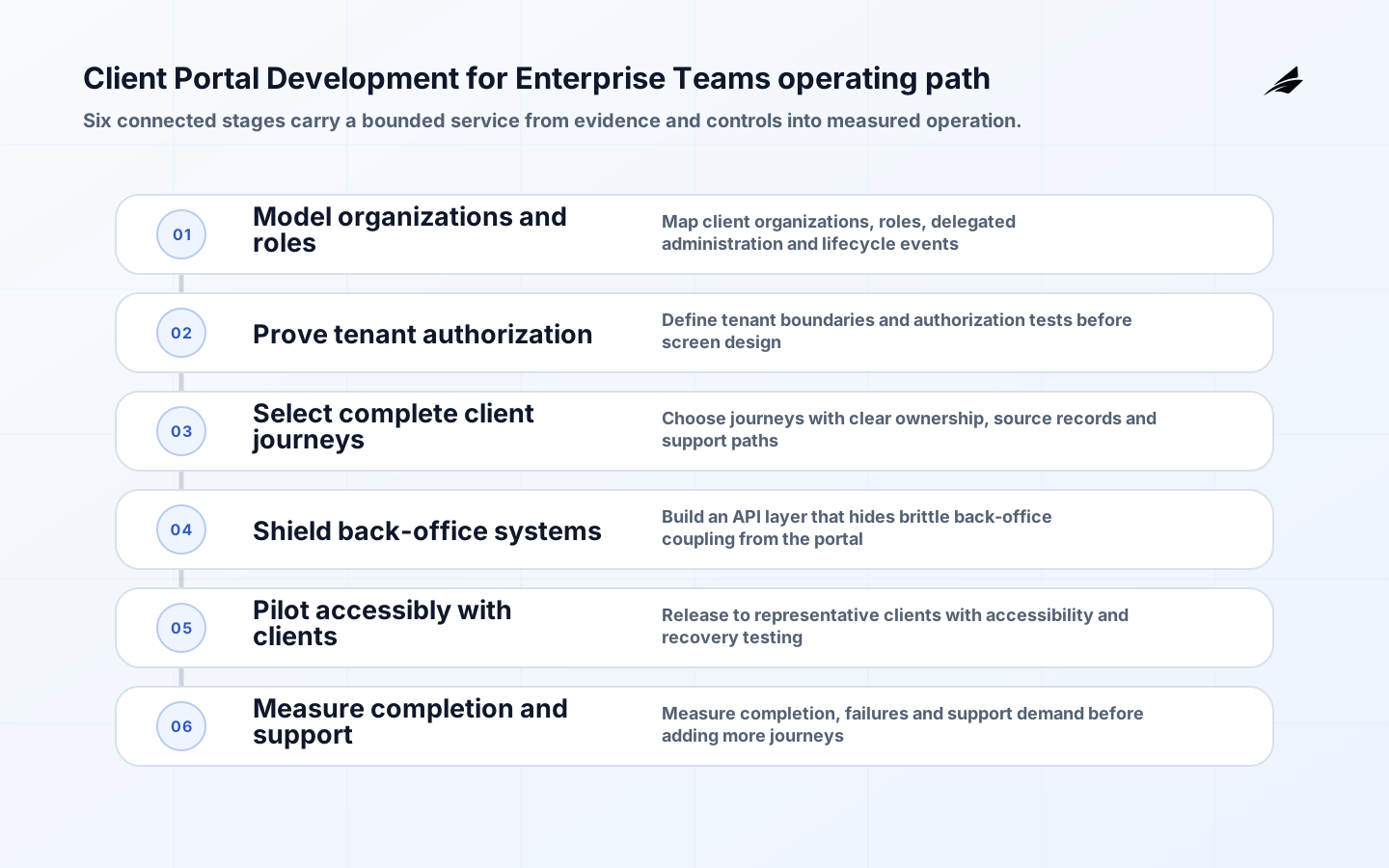
Build the first portal slice around one high-volume request and one representative enterprise client. Start with identity federation and organization membership, then prove object-level authorization for list, search, detail, export and attachment endpoints. Add an API facade over the source system so portal releases do not depend on its internal schema. Test notifications and status changes through delayed and failed integrations. Invite users with different roles and assistive technologies before adding more journeys. Their failures will reveal architecture problems earlier than broad launch.
- Map client organizations, roles, delegated administration and lifecycle events.
- Define tenant boundaries and authorization tests before screen design.
- Choose journeys with clear ownership, source records and support paths.
- Build an API layer that hides brittle back-office coupling from the portal.
- Release to representative clients with accessibility and recovery testing.
- Measure completion, failures and support demand before adding more journeys.
Controls and failure modes
Authorization must be enforced at the service layer on every object, not inferred from hidden navigation. Sessions should rotate after privilege changes and terminate promptly when an organization administrator removes access. File downloads need tenant checks and short-lived references. Audit records should distinguish client action, support intervention and background processing. For delegated administration, show administrators the consequences of each role and require reauthentication for sensitive grants. Rate limits, anomaly detection and clear incident ownership protect the portal without making normal client work unnecessarily difficult.
| Failure mode | Design response | Operating signal |
|---|---|---|
| Cross-tenant exposure | Test object-level authorization on every read, search, export and attachment. | Denied and anomalous access events |
| Orphaned access | Integrate joiner, mover and leaver events with client-admin review. | Stale privileged memberships |
| Inconsistent source state | Show authoritative timestamps and reconcile asynchronous updates. | Conflicting or delayed records |
| Inaccessible critical workflow | Test keyboard, focus, labels, errors and reauthentication across responsive layouts. | WCAG defects and abandonment |
Measure outcomes, not activity
A dashboard should connect technical behavior to the intended operating result. Track successful self-service completion by journey; support contacts caused by portal ambiguity or failure; authorization denials and suspicious cross-tenant requests; latency and availability for the client-visible workflow. Segment results by workflow type and material risk instead of hiding poor tails inside a global average. Review a sample of accepted, corrected, escalated and failed cases. When a metric moves, retain enough trace evidence to identify whether the cause was source data, policy, interface behavior, model output, reviewer workload or downstream execution.
Measure completion by journey, not page views. Track successful invitations, request submissions, attachment failures, abandoned reauthentication, source-system delays and support contacts. Segment by client organization, role, browser and assistive technology to expose localized defects. Review denied requests to separate attacks from confusing authorization design. Availability should be tied to the client-visible workflow, including dependencies, while status freshness indicates whether the portal is merely reachable or actually trustworthy. Use these signals to prioritize fixes before adding a larger catalogue.
Cost, timeline and commercial model
Portal cost follows the number and quality of back-office integrations, tenant and role complexity, document handling, accessibility obligations and support maturity. A polished shell over unreliable APIs is not a finished portal. Timeline should be expressed as evidence-bearing stages: discovery, thin-slice build, controlled pilot and measured expansion. Procurement should require source access, documentation, data export, incident support and transition assistance. A lower quote is not cheaper if it omits evaluation, operating ownership or the path away from the chosen provider.
Rehearse the operating model before expansion
A useful rehearsal for client portal development for enterprise teams follows one representative case from intake through final evidence. The team should interrupt the exercise after each transition and ask which record is authoritative, whether the acting identity has permission, whether the rule is current, and whether retrying would create a duplicate outcome. Run the same case with a missing field, delayed dependency and unavailable reviewer. This reveals assumptions that unit tests and polished demonstrations often miss, especially where federated identity and organization membership meets tenant-aware authorization and consent.
Next, simulate the two most consequential failure modes: cross-tenant exposure and orphaned access. Operators should identify the alert, inspect the trace without broad production access, contain further actions, communicate with affected users and restore a known state. Record elapsed time and every manual workaround. If the team cannot determine what happened from the retained evidence, the workflow is not ready for a wider cohort, even if its normal path appears efficient.
The portal release packet should include the organization and role model, authorization test matrix, identity lifecycle, API contracts, document controls, accessibility results, dependency map and support procedures. Add screenshots or recordings of keyboard focus and error recovery for critical journeys, plus evidence that exports and search cannot cross tenant boundaries. Client-facing release notes should explain changed behavior without exposing security details. Internal runbooks must state how to revoke access, correct stuck workflow state and notify affected organizations.
Before expansion, ask a client administrator to invite, change and remove users while a support operator observes only through approved tools. Introduce a delayed source update, expired session and document rejection. Confirm that the client sees an accurate state and a useful next step, while support can trace the event without assuming the client’s identity. Then attempt direct object references from another tenant. This rehearsal tests the trust boundary more effectively than reviewing page layouts or counting passed unit tests.
Practical takeaways
- Anchor client portal development for enterprise teams to one named outcome and accountable owner.
- Treat a coherent set of high-volume client journeys backed by authoritative enterprise systems as the first deliverable, not an assumption.
- Keep permissions, policy and irreversible actions in deterministic services with review evidence.
- Pilot with representative exceptions and retain a tested manual route.
- Measure successful self-service completion by journey alongside quality, risk and human workload.
- Expand only when the current release is supportable, observable and recoverable.
Frequently asked questions
- What should the first engagement deliver? It should deliver a process map, data and authority model, risk register, thin-slice backlog, evaluation plan, cost range and explicit decision on what will remain manual.
- How long should a pilot run? Long enough to include ordinary cases, realistic exceptions and at least one controlled recovery exercise. Calendar duration matters less than representative evidence and a pre-agreed exit decision.
- Can a team buy a platform before discovery? A short technical trial can inform discovery, but procurement should follow the service boundary and control requirements. Otherwise the available product features begin defining the business process.
- Who owns the released service? A business owner is accountable for policy and outcomes; a technical owner is accountable for reliability and change; security, privacy and domain specialists approve relevant controls. A vendor can support these roles but should not replace them.
- How is success demonstrated? Compare the agreed baseline with completed outcomes, corrections, exceptions, failures, cost and user impact. Pair aggregate metrics with case review so a favorable average cannot conceal harmful edge cases.
Conclusion
A valuable enterprise portal reduces coordination while making authority and status clearer to clients. Achieving that result requires tenant-aware services, disciplined identity lifecycle, resilient integration and accessible end-to-end journeys. Start with one request that matters, prove every object boundary and measure support demand as carefully as digital completion. When the portal can explain delays, survive dependency failures and revoke access cleanly, it becomes a dependable service channel rather than another interface clients must verify by email.