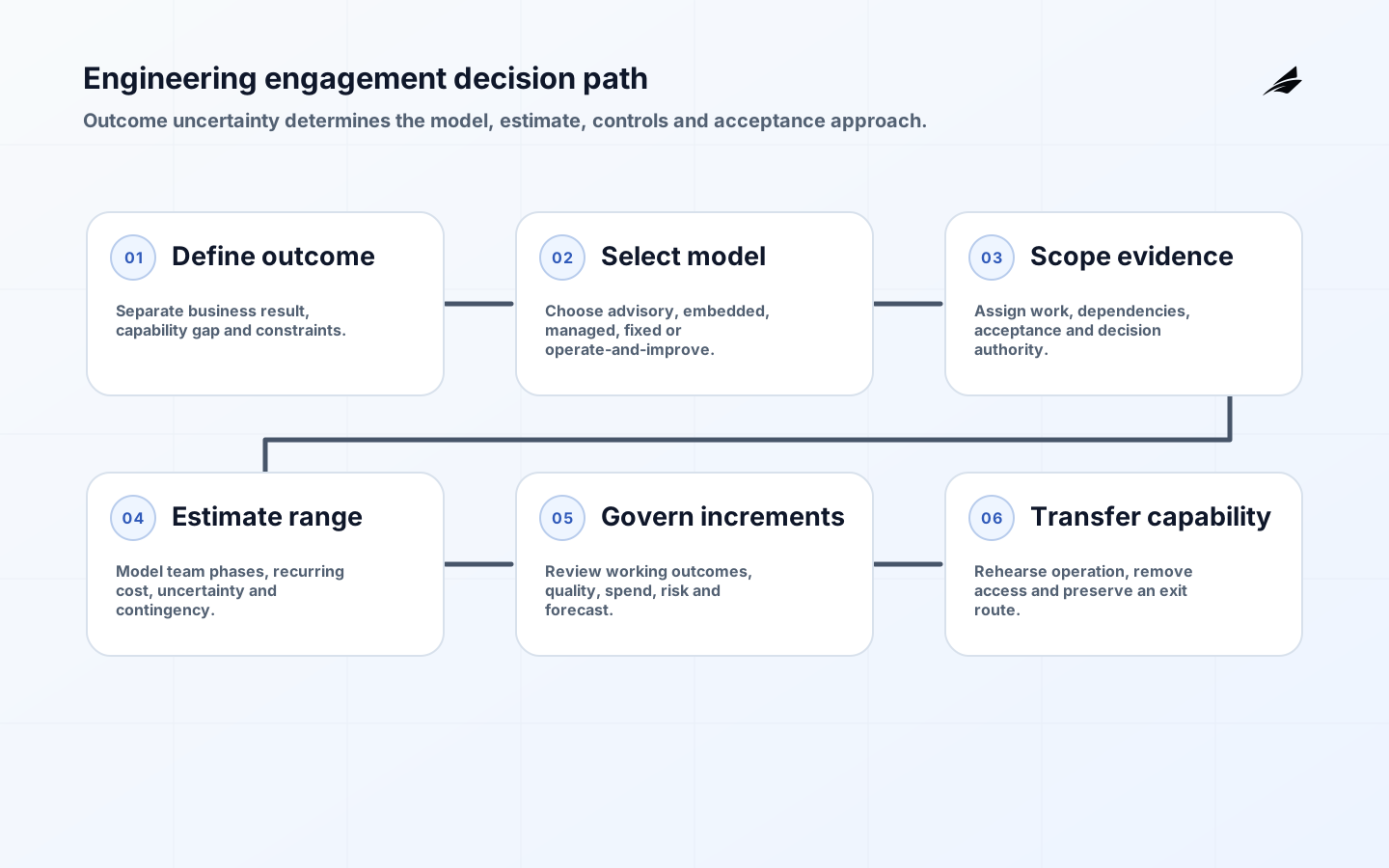
Engineering services and solutions can mean advisory work, embedded specialists, a managed product team, platform modernization or end-to-end delivery. Buyers get into trouble when they purchase a team label without defining the outcome, authority and evidence expected from it. A strong engagement plan connects business decisions to engineering capability, estimates cost from explicit assumptions, assigns risks to parties able to control them, and creates usable increments before a large commitment becomes irreversible.
Use this plan with the engineering services implementation checklist, the engineering services FAQ and the software build scope guide. The client must retain accountable product, security and operational owners. Outsourcing execution does not transfer the duty to define acceptable outcomes or residual risk.
Define the outcome and capability gap
State the current operational problem, affected users, baseline and target change. Separate a capacity gap from a capability gap: adding developers will not fix absent product decisions, unsafe release governance or unclear data ownership. Inventory constraints such as deadlines, legacy systems, procurement, regulated data, internal skills and required technologies. Define what the supplier may decide independently, what needs client approval and what remains out of scope. The result should be a short outcome brief, not a solution-shaped request.
Choose the engagement model deliberately. Advisory work suits a decision or roadmap; staff augmentation adds named skills under client management; a managed team owns delivery of a bounded product area; a fixed deliverable fits stable requirements and testable acceptance. Hybrid models are common, but each workstream needs one owner. Avoid assigning the supplier responsibility for an outcome while withholding access, decision authority or stakeholder time needed to achieve it.
| Model | Best fit | Principal buyer responsibility |
|---|---|---|
| Advisory | Architecture, assessment or roadmap decision | Provide evidence and own the decision |
| Embedded specialists | Temporary skill or capacity gap | Manage priorities and integration |
| Managed product team | Evolving outcome with sustained backlog | Own product direction and acceptance |
| Fixed deliverable | Stable boundary and verification criteria | Control changes and dependencies |
| Operate and improve | Established service needing reliability work | Define SLOs, access and escalation |
Build a scope around work and evidence
Decompose the outcome into discovery, product slices, platform work, migration, assurance, release and transition. For each, specify inputs, dependencies, deliverable, acceptance evidence and owner. Define quality attributes using a recognized model such as ISO/IEC 25010 where useful. Include secure development, accessibility, performance, observability, data migration, documentation and support in scope rather than treating them as final hardening. List exclusions and assumptions beside the relevant item so they remain visible.
Create a responsibility matrix for product decisions, architecture, data, environments, identity, security review, third-party contracts, testing, release, incidents and cost. Name people, not only departments. Establish decision times because delayed access and approvals consume delivery capacity. Give the supplier a route to escalate blocked work and define what happens to schedule and cost when a client dependency misses its date. This makes accountability operational instead of ceremonial.
Estimate cost with ranges and assumptions
Labor is usually the dominant software cost, but team rate multiplied by months is not the whole estimate. Include discovery, product management, design, engineering, quality, security, cloud environments, licenses, data work, supplier coordination, client participation, release, warranty, training and transition. NASA's cost-estimating guidance emphasizes a documented basis, methodologies, risk and uncertainty. Use analogous work, bottom-up work packages or parametric models according to available evidence, then reconcile the results.
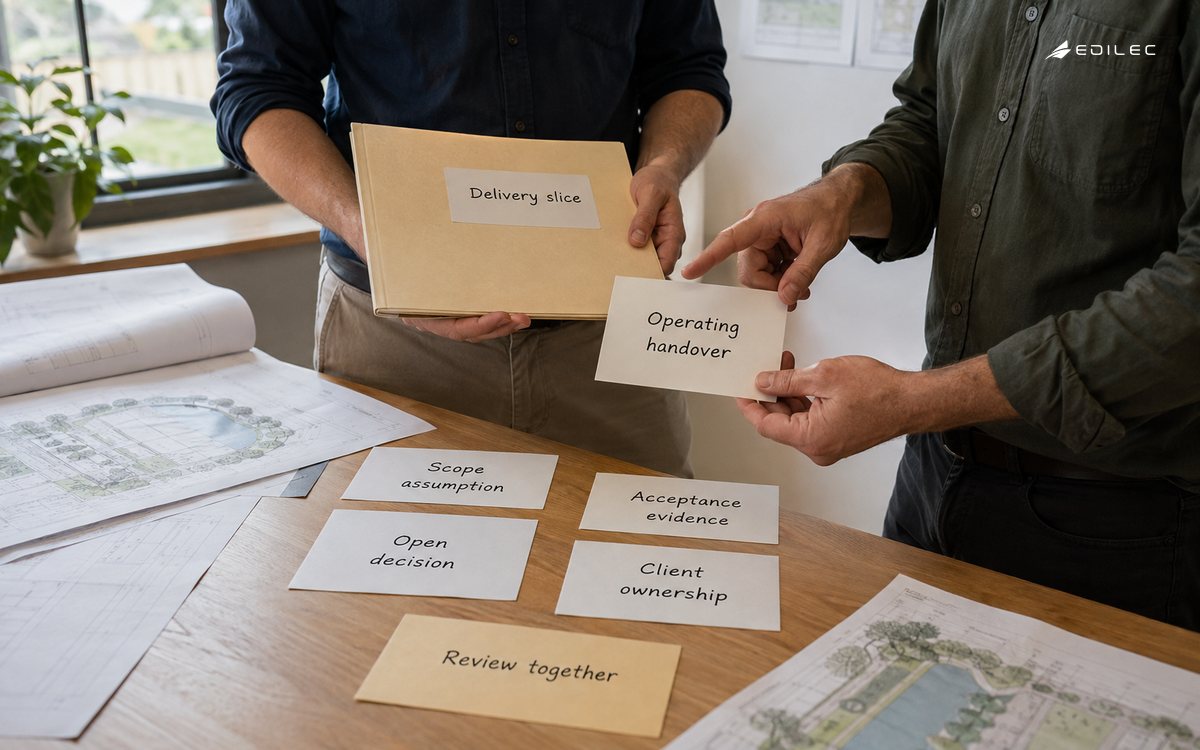
Present a range with confidence, assumptions and excluded exposure. Show the expected team shape by phase, not a constant peak team. Separate one-time delivery from recurring hosting, support, licenses and maintenance. Include contingency for identified uncertainty rather than hiding it in rates. Re-estimate after discovery and major evidence changes. A precise total built on unknown integration and migration conditions is less useful than a range with decision points and an explicit reserve.
| Cost area | Estimate driver | Control |
|---|---|---|
| Delivery labor | Team mix, duration and throughput evidence | Phase-based capacity plan |
| Integration and data | Interfaces, quality, volume and cutover | Early profiling and contract tests |
| Assurance | Risk, quality targets and review depth | Risk-based verification plan |
| Operations | Usage, SLO, support and licenses | Unit forecast and owner |
| Uncertainty | Unknowns and correlated schedule risks | Range, contingency and re-estimation gate |
Assign risks and commercial protections
Maintain a live risk register with cause, consequence, probability, impact, owner, mitigation, trigger and contingency. Common risks include unavailable stakeholders, weak source data, undocumented integrations, procurement delay, security approval, supplier dependency, skill concentration and unrealistic cutover. Assign each risk to the party best able to control it. A contract that pushes every unknown to a supplier often produces a large premium, defensive change control or hidden quality reduction.
Use commercial terms that support evidence: milestone payments tied to accepted outcomes, transparent rates and team changes, source and artifact ownership, dependency and vulnerability duties, audit rights, subcontractor visibility, data handling, termination assistance and access removal. Avoid acceptance based solely on elapsed sprints or document delivery. Define a fair change process and distinguish a corrected defect from a changed requirement. Protect the ability to exit without making the relationship adversarial.
Deliver in controlled increments
Start with a short inception that validates users, architecture risks, access, data and an end-to-end walking skeleton. Then deliver vertical slices into a production-shaped environment. The GAO Agile Assessment Guide emphasizes incremental development and continuous evaluation; use reviews to inspect working behavior, quality, cost and forecast. Keep one prioritized backlog with acceptance examples. Do not allow a separate hidden list of essential security, migration or operational work.
Track outcome progress alongside delivery health. Useful indicators include completed user journeys, adoption, escaped defects, change lead time, change failure, recovery, SLO attainment, blocked time and forecast range. DORA metrics diagnose a delivery system and should not be weaponized against individuals. Review evidence at defined governance points, make decisions promptly and document accepted tradeoffs. Stop, narrow or redirect work when evidence invalidates the original case.
Accept capability and plan the exit
Acceptance should cover business behavior, quality, security, data reconciliation, recovery, operations and ownership. Require reproducible builds, source, infrastructure definitions, test results, artifact history, decision records, runbooks, licenses and known limitations. Have the client team lead deployments, support diagnosis, access changes and restore exercises before final sign-off. A repository transfer without operational capability is not a handover.
Plan exit at contract start. Define notice, knowledge transfer, replacement cooperation, export formats, data return or deletion, credential revocation and continuing vulnerability obligations. Reduce dependency throughout delivery through pairing, shared decisions and client-owned accounts. Decide which supplier support remains after launch and price it explicitly. The best engagement leaves the client with a stronger product and stronger ability to govern its evolution.
A ten-step engagement setup procedure
Complete a short engagement charter before the supplier mobilizes. It should be usable by delivery, commercial, security and product leaders and should make unresolved decisions visible. The following sequence creates a baseline that can change through evidence without losing accountability.
- Document the business baseline, target outcome, users, constraints and explicit reasons specialist engineering help is needed.
- Separate capacity, capability and decision gaps, then name the client leaders responsible for closing each non-supplier gap.
- Select the engagement model and define supplier autonomy, client approvals, escalation rights and required stakeholder availability.
- Decompose work into discovery, vertical product slices, platform, migration, assurance, release, warranty and capability-transfer packages.
- Attach inputs, dependencies, acceptance examples, quality thresholds and named approvers to every material work package.
- Build a phase-based estimate with labor mix, client effort, environments, licenses, recurring operation, contingency and excluded exposure.
- Negotiate data, security, intellectual property, subcontractor, vulnerability, change, termination and exit terms before sensitive access begins.
- Establish one backlog, decision log, risk register, evidence repository and review cadence shared across commercial and delivery governance.
- Deliver a production-shaped walking skeleton, update uncertainty and approve the next investment only after reviewing actual evidence.
- Have the client lead release, incident, restore and change rehearsals, then remove excess supplier access and confirm export completeness.
Key takeaways
- Buy a defined outcome and capability, not an ambiguous team label.
- Match the engagement model to uncertainty, client management capacity and acceptance clarity.
- Estimate a range from documented assumptions, recurring cost and risk exposure.
- Use incremental working evidence to govern scope, cost and quality.
- Build client operating capability and exit readiness from the beginning.
Frequently asked questions
When is fixed price appropriate?
When the boundary, dependencies and acceptance tests are stable enough for both parties to price risk. For uncertain products, fund discovery or increments and use decision gates rather than forcing unknowns into a brittle total.
How should proposals be compared?
Normalize assumptions, team composition, client effort, recurring cost, excluded work, evidence, risk and exit terms. The lowest headline rate may create the highest total cost when essential responsibilities are omitted.
How often should the estimate change?
Update it when material evidence changes: after discovery, integration proof, data profiling, architecture decisions and major scope changes. Keep the baseline and reasons visible so learning is not mistaken for uncontrolled spending.
Govern team continuity explicitly. Require notice and approval for key-person changes, a maintained skills matrix, documented onboarding and overlap for critical roles. Monitor concentration in architecture, deployment, security and domain knowledge. Replacing a named expert with nominally equivalent capacity can still increase schedule and quality risk, so assess the actual transition evidence rather than relying on job titles. The client should retain enough context to challenge design and priority decisions throughout the engagement.
Define dispute resolution before delivery pressure arrives. Technical leads should resolve routine interpretation, product owners should decide value and priority, and commercial leaders should handle contractual impact. Set escalation times and preserve the evidence behind each decision. Fast, accountable resolution protects delivery better than allowing disagreement to accumulate until a milestone or invoice forces a broad renegotiation.
Conclusion
An engineering services and solutions engagement is governable when outcome, authority, evidence, cost assumptions and risk ownership are explicit. Select the right model, deliver production-shaped increments, review measurable results and transfer real operating capability. That creates room for discovery without surrendering commercial control or long-term ownership.