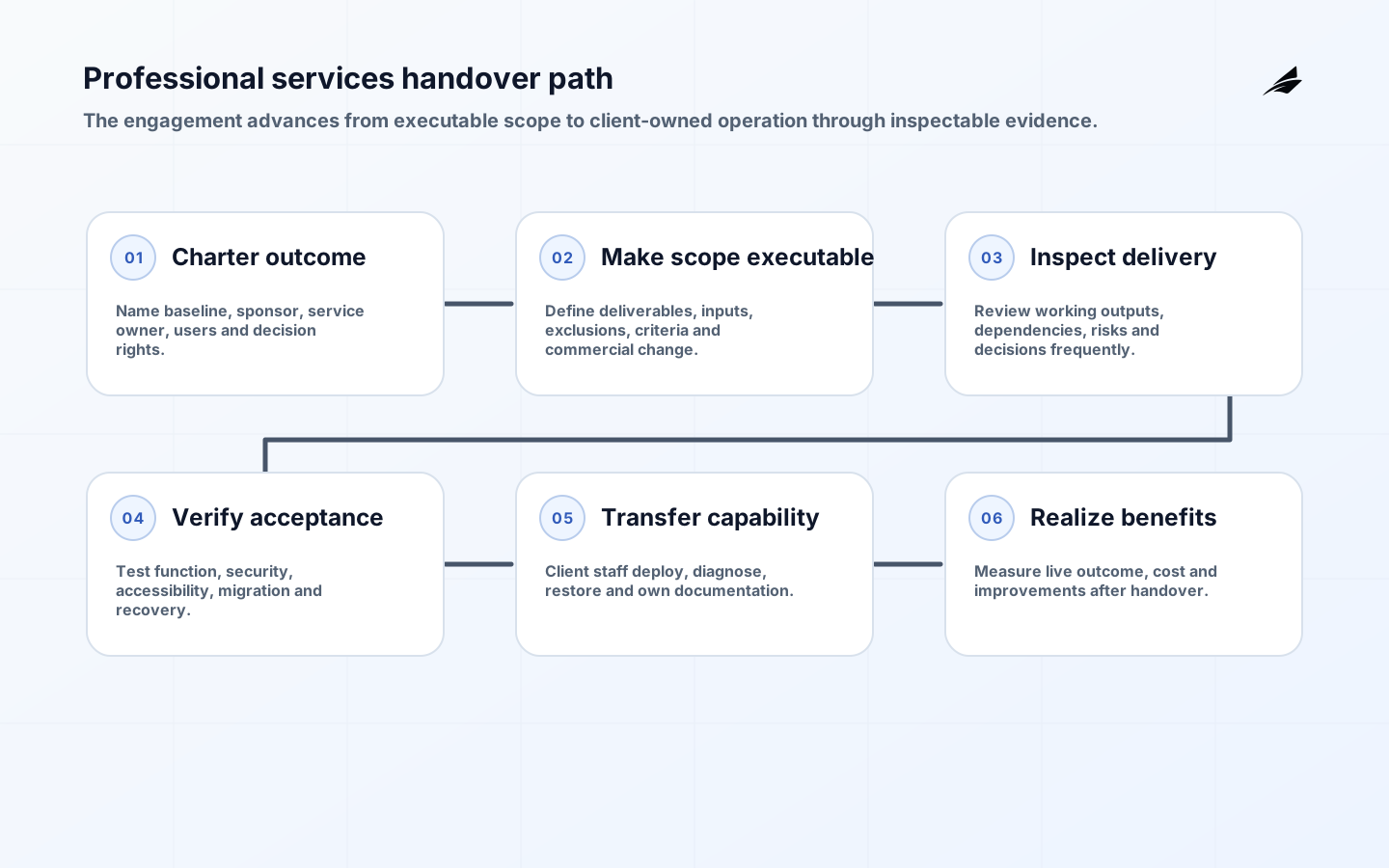
A professional services implementation succeeds when the client can use, operate and improve the delivered capability after the engagement. Completing workshops or submitting documents is not enough. The implementation needs a shared outcome, explicit decision rights, controlled scope, inspectable work, acceptance evidence and a handover that transfers real capability rather than an archive of files.
Use this professional services implementation checklist with the professional services scope and delivery plan, the professional services FAQ, the technology services company guide and the application management services guide. Adapt the controls to the consequence, delivery method and contract; a two-week assessment and a regulated production implementation should not carry identical ceremony.
1. Mobilize around an outcome and accountable roles
Write a one-page engagement charter before detailed planning. State the problem, baseline, target outcome, in-scope users and systems, non-negotiable constraints, sponsor, service owner, delivery lead and final approver. Identify who can decide priorities, architecture, security exceptions, data use and acceptance. Record escalation routes and the maximum decision time the schedule assumes.
Map supplier and client responsibilities at deliverable level. Professional services often stall because the supplier is waiting for access, data or a subject-matter expert that no client owner was assigned to provide. Include onboarding, confidentiality, acceptable use, background requirements, environments, tools and offboarding. ISO 21502 applies across predictive, iterative, adaptive and hybrid delivery, so choose the method that fits the work rather than treating one method as governance.
| Mobilization item | Named owner | Evidence ready |
|---|---|---|
| Outcome and baseline | Sponsor and service owner | Metric definition, source and current value |
| Decision rights | Governance chair | Decision matrix and escalation time |
| Client dependencies | Client delivery lead | Access, data, people and due dates |
| Supplier team | Supplier engagement lead | Roles, allocation, substitutes and onboarding |
| Acceptance authority | Business approver | Criteria, evidence format and review window |
2. Turn the statement of work into an executable contract
Translate broad promises into deliverables with boundaries. For each deliverable, define purpose, inputs, activities, output format, quality criteria, reviewer, acceptance method, due window, assumptions and exclusions. Distinguish a recommendation from implementation, configuration from custom development, and deployment from operated adoption. If a term such as production-ready is used, define security, accessibility, performance, recovery, support and documentation evidence.

Connect fees to the commercial model. Fixed price needs stable boundaries and a change process; time and materials needs budget controls, transparent staffing and prioritization; an outcome-based component needs attributable measures and protection against gaming. State travel, taxes, licenses, third-party costs and cancellation terms. Define intellectual-property ownership, pre-existing materials, open-source obligations, data return, confidentiality and post-termination access with legal counsel.
3. Build an evidence-backed delivery plan
Decompose deliverables into outcomes that can be reviewed frequently. Maintain a single backlog with priority, owner, acceptance notes, dependency and target release. Add a decision log and risk register, but keep them connected to work: a data-access risk should have a dated treatment and a backlog item, not live as a red cell for weeks. Baseline schedule and cost at a useful level, then forecast from remaining work and known constraints.
Governance should enable timely decisions. The GOV.UK agile governance principles emphasize decisions at the right level, involving the right people, seeing work directly, adding value, and trusting while verifying. Review working outputs, tests and user evidence rather than relying on percentage-complete slides. Record approvals and rejected options so later teams understand why the design changed.
| Review cadence | Purpose | Decision or artifact |
|---|---|---|
| Working session | Resolve delivery detail with practitioners | Updated backlog, design or test evidence |
| Weekly delivery review | Forecast scope, dependency, spend and risk | Priority and escalation decisions |
| Milestone assurance | Assess agreed quality and controls | Accept, conditionally accept or remediate |
| Steering review | Protect outcome and commercial boundaries | Change, funding, stop or escalation |
| Benefits review | Compare live outcome with baseline | Improve, scale, sustain or retire |
4. Verify quality, security and accessibility during delivery
Create a trace from requirement to evidence. Functional tests should cover ordinary and exception paths. Integration tests should use realistic contracts and failure behavior. Migration needs reconciliation, duplicate and rollback tests. Performance needs representative load and an agreed percentile, not a single average. Recovery evidence should show restore steps and ownership. User acceptance should involve people who perform the work, including users with access needs.
For software work, contract secure practices and evidence into delivery. The NIST Secure Software Development Framework provides a common vocabulary for preparing the organization, protecting software, producing well-secured software and responding to vulnerabilities. For web interfaces, use WCAG 2.2 as the current W3C recommendation where applicable. Automated scanning helps, but manual testing and user research remain necessary for many security and accessibility outcomes.
5. Control change without freezing learning
Log a change when it alters outcome, deliverable, acceptance, dependency, architecture, risk, schedule or cost. Describe the reason, options, impact, decision owner and funding source. Small backlog refinement inside agreed tolerances need not become a contract amendment; material changes should. Define those tolerances at mobilization so teams do not negotiate governance during a deadline.
Keep the original outcome visible. A client-requested feature may be attractive but displace migration, training or resilience work needed for adoption. Show the opportunity cost and effect on acceptance. If discovery invalidates the premise, use a stop or rescope decision rather than consuming the budget to produce the originally imagined output. Preserve paid-for learning in a concise decision record.
6. Prove acceptance and transfer operational ownership
Acceptance is a decision against criteria, not the date a file is emailed. Assemble an evidence index with test results, unresolved defects, risk acceptances, licenses, configurations, source and artifact locations, runbooks, monitoring, recovery, data disposition and training. Give reviewers the contracted period and record acceptance, conditional acceptance with due dates, or rejection with the unmet criterion. Avoid deemed acceptance where stakeholders have not had realistic access to evidence.
Transfer capability through participation. Client staff should configure, deploy, diagnose, restore and explain key decisions while the supplier is still available. Run a failure exercise and a normal operating cycle. Remove supplier accounts and secrets, confirm data return or deletion, assign warranty and support routes, and schedule post-launch checks. ISO 21505 addresses governance for projects and portfolios; the sponsor remains accountable for the transition even when delivery expertise is external.
7. Measure benefits after the engagement
Measure the end-to-end service, not only the supplied component. The GOV.UK guidance on measuring service success recommends combining performance metrics with methods such as usability testing and using multiple data sources. Compare live results with the baseline and segment where aggregate improvement could hide a worse experience for one group.
Track adoption, completion, quality, cycle time, support load, cost and control outcomes that fit the service. Separate implementation effects from unrelated changes and state uncertainty. Assign a benefits owner and review dates after users have had time to adapt. The supplier may support measurement, but the client owns the business process and should retain the ability to reproduce each metric.
8. Verify client readiness before the supplier leaves
Run a readiness review against people, process, technology, data and suppliers. Confirm named primary and backup owners, support schedules, change authority, training completion and access. Walk through a normal task, a complex exception, a failed integration, a security concern and a restore. The client team should lead while the supplier observes. Record gaps as owned work with due dates and decide whether each blocks launch, blocks handover, or can remain as accepted residual risk.
Review commercial and administrative closure separately from technical acceptance. Reconcile invoices and approved changes, transfer licensed accounts and repositories, inventory client and supplier information, and execute contractual return or deletion. Confirm warranty start, defect classification, response routes and rates for future work. Schedule a post-implementation review after a representative operating period. The review should compare outcome and cost with baseline, identify unanticipated work, verify that controls remain effective and decide which improvement becomes normal product ownership rather than an engagement extension.
Do not postpone adoption ownership until this review. Before launch, managers should know which old procedure ends, how performance expectations change, where users get help and how feedback reaches the product owner. Track training attendance only as an input; observe whether people can complete the changed task. Where dual running is required, set an end date and reconciliation owner so temporary work does not become a permanent hidden operating cost.
Key takeaways
- Name the business outcome, baseline, service owner and decision rights before detailed delivery.
- Give every deliverable explicit inputs, boundaries, acceptance criteria and evidence.
- Inspect working outputs frequently and connect risks and decisions to the backlog.
- Test security, accessibility, recovery, migration and exceptions before the acceptance window.
- Make client operation and benefits measurement part of delivery, not an optional closing activity.
Frequently asked questions
Who should accept a professional services deliverable?
The person with authority over the affected business outcome should accept, informed by technical, security, legal or operational reviewers. A project manager can coordinate evidence but should not approve a control or business result outside their mandate. Name the approver and delegates in the statement of work.
Can a deliverable be accepted with open defects?
Yes, when the contract allows conditional acceptance and the residual effect is understood. Record severity, workaround, owner, deadline, warranty impact and whether payment or deployment is held. Do not use a generic punch list to hide a failed critical criterion such as data integrity or recovery.
How much documentation is enough?
Enough for the intended operators to perform, diagnose, recover, change and retire the capability. Test documentation through a task, not page count. Prefer versioned, maintained sources close to the system, with concise decision records and runbooks, over a large static handover pack.
Conclusion
A professional services implementation is complete when evidence supports acceptance and the client can own the result. Clear outcomes, executable scope, frequent inspection, proportionate assurance and practiced handover reduce commercial disputes and operational surprises. They also make external expertise more valuable because it leaves behind a working capability, not dependence.