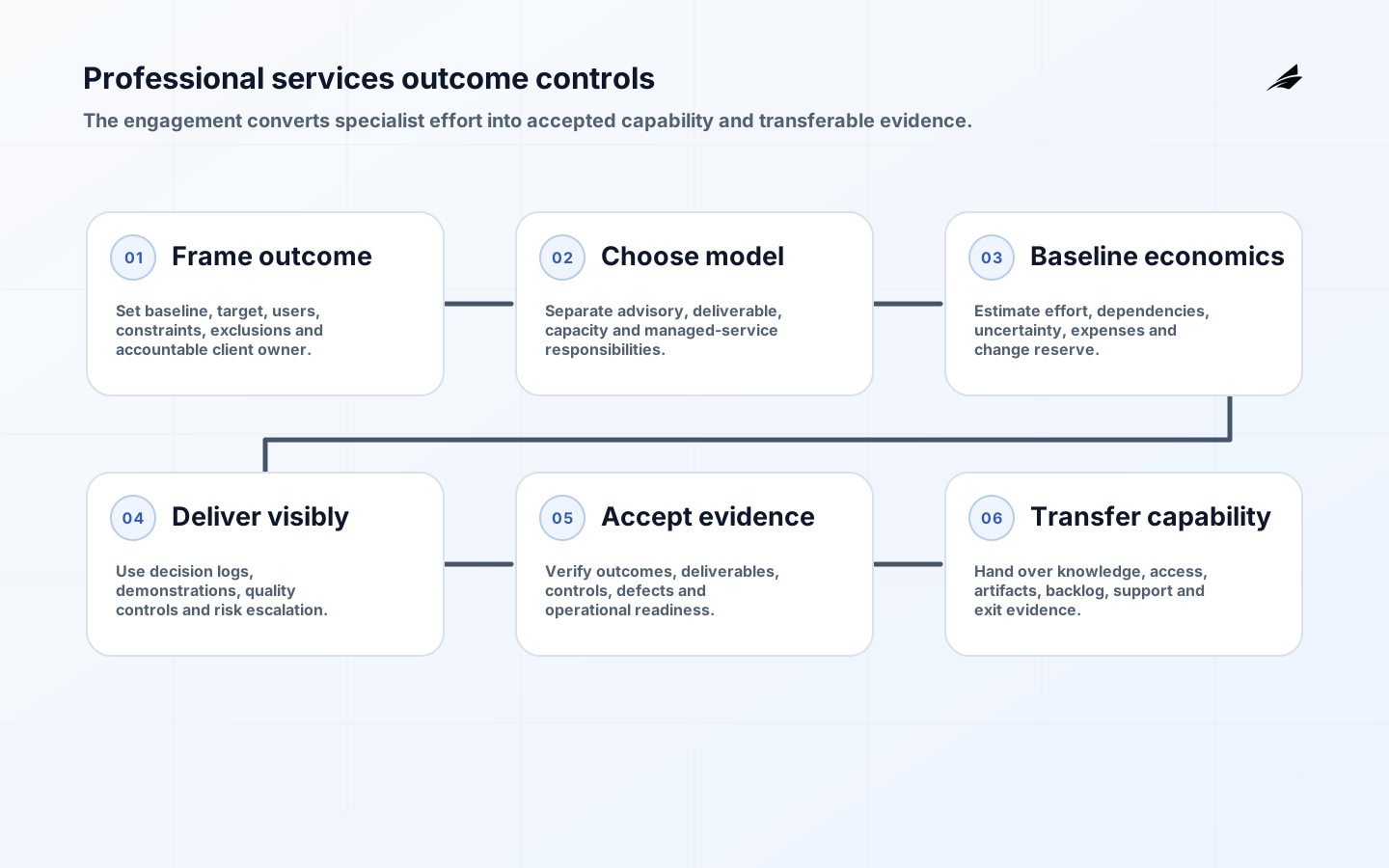
Professional services are external or internal specialist capabilities engaged to change an outcome, solve a defined problem or transfer expertise. They include advisory work, design, implementation, assurance, training and temporary delivery leadership. The commercial label matters less than the operating design: who owns the result, what evidence will be produced, how decisions are made and what capability remains when the engagement ends.
This guide connects the professional services implementation checklist, professional services FAQ, technology services company guide and application management services plan. Use it before requesting proposals, then convert the decisions into a statement of work and client-owned governance plan.
Start with the outcome, not the consultant category
Write an outcome brief in operational language: the affected users, current baseline, target condition, decision deadline, constraints and named client owner. “Provide cloud strategy consulting” is a purchasing category. “Enable three product teams to release through an approved platform with measured lead time, recovery and cost ownership” is a result that can guide discovery and acceptance. Keep benefits distinct from deliverables; a report may be complete even when the promised capability does not exist.
ISO 20700 emphasizes effective and transparent management consultancy delivery. Its broad principle is useful beyond management consulting: align expectations through contracting, delivery and closure. Before market engagement, decide what must remain a client decision, which skills are genuinely scarce, whether knowledge transfer is an outcome and which parts can be standardized. Do not outsource accountability for policy, risk acceptance, employee decisions or service ownership.
| Engagement model | Best fit | Main control |
|---|---|---|
| Advisory | Independent analysis, options or specialist judgment | Decision remains explicitly with the client |
| Defined deliverable | A bounded design, assessment, migration or training package | Acceptance criteria describe usable evidence |
| Capacity augmentation | Temporary skills working in a client-led backlog | Client directs priorities and reviews quality |
| Outcome-based delivery | Supplier controls methods to achieve measurable results | Dependencies and outcome attribution are explicit |
| Managed service | Continuing operation against service objectives | Responsibilities, transition and exit are continuously maintained |
Define scope, interfaces and exclusions
Map scope as a service boundary rather than a deliverables list. Include business process, information, systems, users, locations, environments, suppliers, approvals, migration, operations and decommissioning. Name client-provided inputs and their due dates. State exclusions with consequences: if data cleansing is excluded, who performs it and what happens to schedule and quality if it is late? This makes assumptions testable before they become change requests.
For a software engagement, require secure development responsibilities from the start. NIST’s SSDF provides a common vocabulary for preparing the organization, protecting software, producing well-secured releases and responding to vulnerabilities. Define repository ownership, identity, secrets, third-party components, testing, defect severity, release approval, vulnerability disclosure and evidence retention. Client access to source, pipelines and work tracking should be normal, not a transition surprise.
Build a cost range from drivers and uncertainty
A credible estimate shows people by role and period, expected utilization, discovery, delivery, quality review, client effort, tools, travel, tax, expenses, transition and contingency. Separate price from total client cost. A low proposal can consume scarce internal experts, require new licenses or defer operational work. Model a base case, plausible delay and stressed case. Document which assumptions change the range, such as data quality, access approval, stakeholder availability or number of interfaces.
Choose commercial mechanics that match control. Time and materials suits uncertain work when the client can prioritize and inspect progress. Fixed price suits stable, testable deliverables. Capped time protects an exploration envelope. Milestones can tie payment to accepted evidence. Outcome fees require a measurable baseline, credible attribution and safeguards against gaming or harmful shortcuts. Keep change control lightweight but real: changed scope, assumption, impact, decision owner and revised baseline.
| Risk | Early evidence | Treatment and measure |
|---|---|---|
| Unclear outcome | Stakeholders describe different success conditions | Agree baseline and acceptance map; track disputed criteria |
| Client dependency delay | Access, data or decisions miss promised dates | Dependency owner and escalation; track blocked days |
| Senior-to-junior substitution | Proposed experts vanish after award | Named roles and replacement approval; track allocation |
| Deliverable without adoption | Artifacts arrive but users cannot operate them | Vertical demonstrations and transfer tasks; measure independent use |
| Security or quality debt | Controls are deferred behind schedule pressure | Release gates and defect policy; track open critical findings |
| Lock-in at closure | Build, data or knowledge cannot transfer | Exit plan from day one; rehearse export and handover |
Use a controlled professional services delivery procedure
Begin with a short inception that validates the brief instead of silently rewriting it. Confirm the baseline, stakeholder map, delivery method, environments, decision rights, dependencies, acceptance and reporting. Demonstrate one thin but complete slice early. In a process-redesign engagement, that could mean one real case moving through the proposed workflow with controls, data and user feedback. In software, it means a usable path running through integration, security, telemetry and support rather than disconnected component progress.
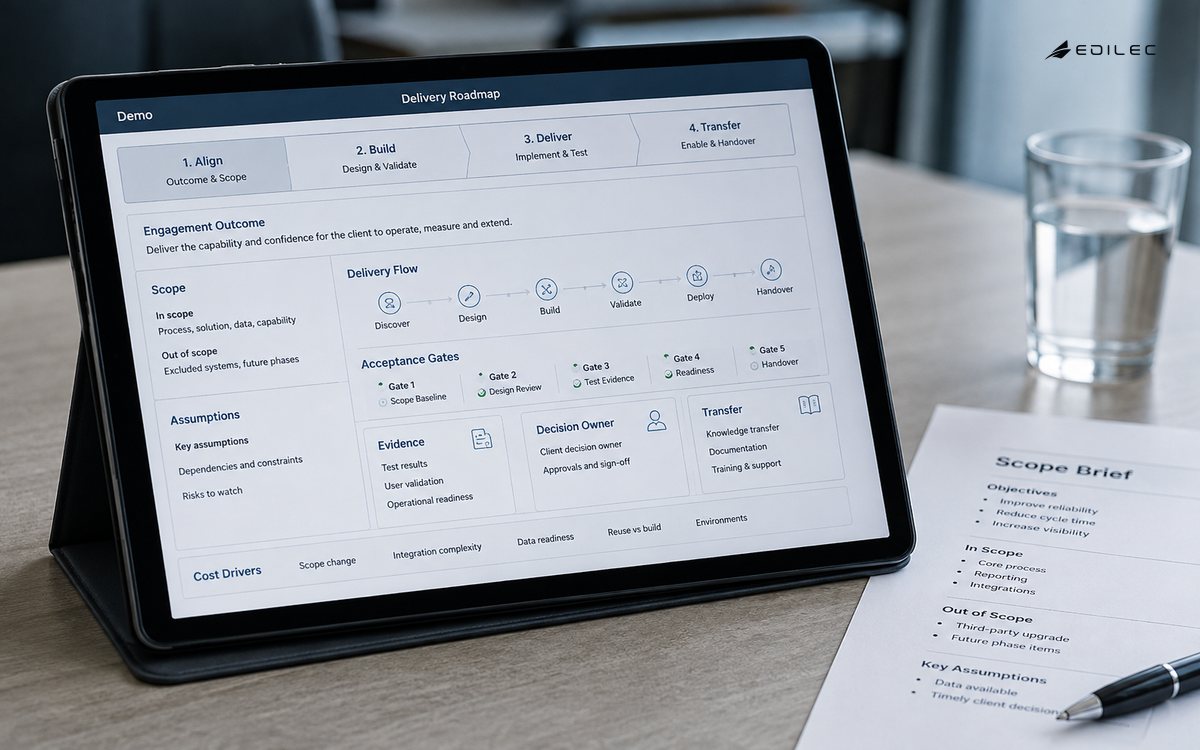
- Approve the outcome brief, baseline, target, scope boundary, exclusions and client owner.
- Select the engagement and pricing model according to uncertainty and control, not procurement habit.
- Contract named people, client dependencies, security, quality, evidence, knowledge transfer and exit.
- Run visible increments with demonstrations, decision logs, risk review and accepted work products.
- Measure outcomes and operational readiness alongside effort, schedule and budget.
- Close only after artifacts, access, knowledge, residual risks and follow-on ownership are accepted.
The GAO Agile Assessment Guide reinforces incremental delivery and continuous evaluation of functionality, quality and customer satisfaction. Apply that logic without turning every engagement into a software sprint. Advisory work can deliver testable decision packets; training can demonstrate independent performance; migration can prove reconciled records and recovery. The unit of progress should be evidence a client can inspect, use and accept.
Keep governance close to decisions
Create a responsibility matrix that names the client sponsor, service owner, product or process owner, supplier lead, commercial manager, security and quality reviewers. Establish thresholds for design approval, risk acceptance, spend, staffing change and scope change. A weekly status meeting is not governance if nobody can decide. Keep a decision log with context, options, owner, date and consequences, plus an assumptions register whose entries have owners and review dates.
Report a small balanced set of measures: accepted outcome progress, time to decision, blocked work, defect escape, user adoption, knowledge-transfer completion, forecast at completion and unresolved high risks. Avoid counting slides, meetings, tickets or hours as value. For longer services, monitor team continuity, service objectives, incidents, vulnerability age, backlog health and unit cost. Review measures for gaming; speed achieved by dropping review is not improvement.
Design transition and closure at the beginning
Closure should leave the client able to operate, improve or competitively re-source the result. Define required repositories, models, source files, credentials, data exports, configuration, runbooks, licenses, decisions, training and support backlog. Pair supplier specialists with client counterparts throughout delivery. Ask client staff to perform key activities under observation; attendance at knowledge-transfer sessions does not prove capability.
At the closure review, reconcile deliverables and commercial obligations, verify access removal, accept or assign residual risks, document unfinished work and capture benefits still to be measured. For a managed service or long implementation, rehearse exit before it is needed. A sample export, build from client-owned source or recovery by the receiving team exposes gaps while there is time to correct them.
Benefits usually mature after contractual closure, so assign a client owner and review dates for each expected result. Preserve the baseline, calculation method and factors outside the supplier workspace. At 30, 90 and 180 days, compare adoption, service quality, risk, cost and user outcomes with the approved case. Distinguish benefits attributable to the engagement from unrelated demand or policy changes. Where results lag, decide whether the cause is incomplete delivery, weak adoption, an invalid assumption or a changed environment, and fund or stop follow-on work accordingly.
Key takeaways
- Describe the operational outcome and baseline before choosing a professional services category.
- Match advisory, deliverable, capacity, outcome and managed-service models to the control the client can exercise.
- Estimate total cost from drivers, dependencies and scenarios, including the client team and transition.
- Accept inspectable evidence in small increments and keep security, quality and operations inside the delivery path.
- Build knowledge transfer and exit into the engagement from day one so value survives the supplier relationship.
Frequently asked questions
Should every engagement begin with a detailed request for proposal?
No. A short market conversation or paid discovery can clarify high uncertainty before competitive scope is fixed, subject to applicable procurement rules and fairness. The buyer should still publish a clear outcome, constraints and evaluation method and avoid giving one bidder an unrecorded advantage.
Is fixed price safer than time and materials?
Only when scope and acceptance are stable. Under uncertainty, fixed price can hide contingency, encourage narrow interpretation or produce constant change requests. Time and materials needs active prioritization, transparent evidence and an envelope. Risk follows the operating model, not the label.
Who should accept professional services deliverables?
The client role accountable for the resulting capability should accept them with relevant technical, security, legal or operational reviewers. Procurement can confirm commercial completion but usually cannot judge whether a design, model or service is fit for use.
What should happen when an assumption fails?
Record the new evidence, assess outcome, cost, schedule and risk impact, and have the authorized owner choose a response. Options include changing method, narrowing scope, adding client capacity, using contingency, pausing or stopping. Quietly absorbing the impact makes later forecasts unreliable.
Conclusion
Professional services are most valuable when specialist judgment becomes client-owned capability. Define the outcome and boundary, expose cost and assumptions, deliver inspectable evidence, keep decisions accountable and prove transition. The goal is not a busy engagement or a polished final deck; it is a result the organization can operate and improve after the external team leaves.