A technology services company can provide product discovery, software engineering, cloud, integration, security, data, support or a managed operating capability. Those labels do not define an engagement. Buyers need to know which business outcome changes, which systems and decisions are in scope, who owns architecture and operation, what evidence marks completion, and how the customer can continue or exit. A proposal built around roles and monthly hours may be commercially valid, but it still needs a delivery system that converts effort into usable, secure and supportable outcomes.
This guide supports early planning and procurement. The technology services implementation checklist and technology services FAQ provide more detailed acceptance questions. The right model may be a fixed discovery, outcome-based build, dedicated team, staff augmentation or managed service. Choose from the uncertainty and ownership involved rather than from a fashionable label. Whatever the model, customer accountability for business decisions, data, risk and supplier oversight remains.
Define scope around an outcome and service boundary
Begin with a one-page brief: users, current workflow, measurable problem, desired behavior, constraints, systems, data classes, deadline drivers and accountable owner. Map the smallest end-to-end slice including identity, integrations, exceptions, support and recovery. Separate required outcomes from proposed features. Record assumptions and exclusions, especially migration, content, licensing, accessibility, security testing, training, post-launch support and third-party fees. A vendor cannot estimate responsibly when the customer expects unstated work to be included or when no one can decide among conflicting requirements.
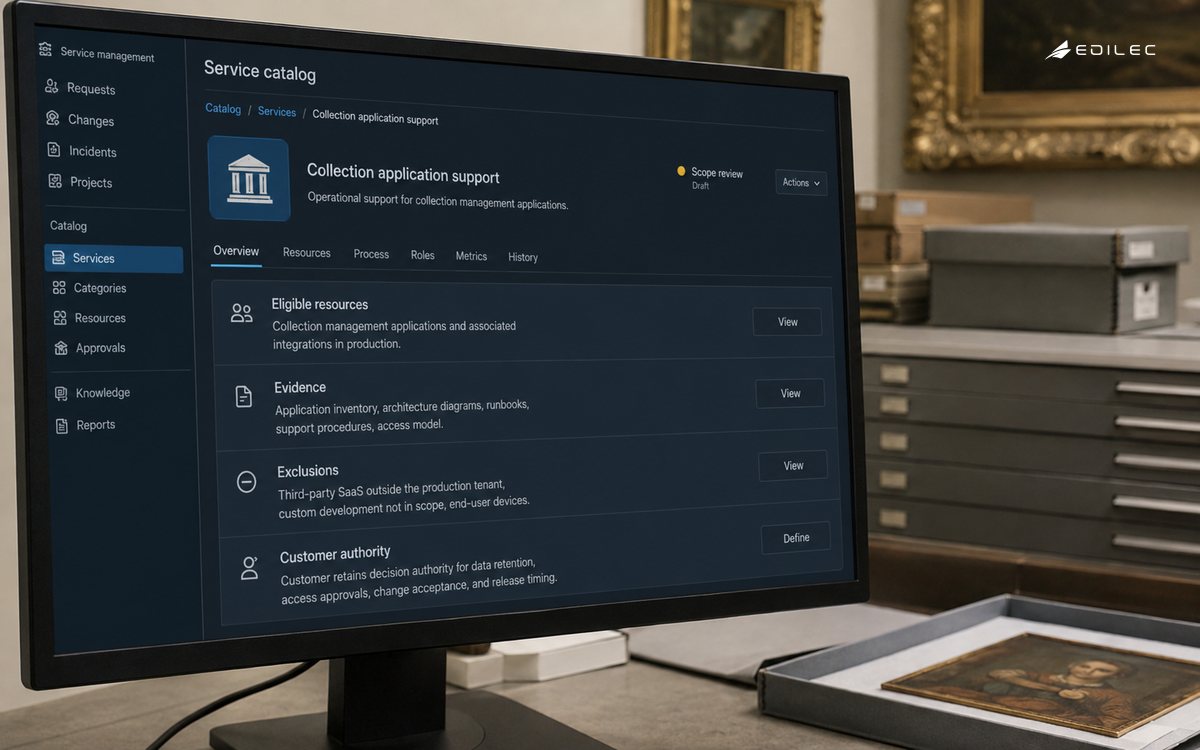
For managed operation, define a service catalog rather than a project backlog. Each item should name eligible resources, request path, hours, target, dependencies, evidence and exclusions. Distinguish incidents, service requests, standard changes, projects and customer-retained tasks. Name decision authority: who approves a production release, accepts residual risk, isolates an account, changes a recovery objective or communicates with customers. A RACI table is a start, but interfaces also need tools, data, timing and escalation. Acceptance must prove that the operating parties can use those interfaces.
| Engagement model | Best fit | Primary control |
|---|---|---|
| Discovery | High uncertainty about problem or feasibility | Time-boxed evidence and explicit next decision |
| Outcome-based build | Coherent scope with testable acceptance | Change mechanism and complete production definition |
| Dedicated team | Evolving roadmap with strong customer ownership | Backlog authority, team continuity and delivery measures |
| Managed service | Recurring operation with defined boundaries | Service catalog, targets, evidence and exit plan |
Estimate total cost, not only delivery rates
Build a range from scope size, uncertainty, integration complexity, quality requirements, team composition and operating horizon. Separate discovery, implementation, migration, licenses, cloud, security assurance, training, support and contingency. Include customer effort for subject-matter decisions, data preparation, review and adoption. A low hourly rate can produce a high total cost when handoffs, rework and weak ownership extend the schedule. Conversely, a more expensive specialist may reduce risk on a bounded critical component. Compare scenarios using the same acceptance and lifecycle assumptions.
Tie commercial terms to observable progress without encouraging superficial output. Milestones can release payment when a vertical slice works with tests, telemetry and documentation. Time-and-materials work should still use budget ranges, decision gates and transparent forecasts. Retainage may be appropriate for migration or handover evidence. Avoid incentives based on lines of code, ticket count or utilization. For a managed service, identify included capacity, consumption pass-through, after-hours work, indexation and termination assistance. Model cost over build, stabilization and a realistic operating period.
Perform evidence-based provider diligence
Ask the proposed delivery leads to explain a comparable architecture, difficult trade-off, production failure and recovery. Review anonymized work products: decision records, code review standards, test strategy, threat model, runbook, service report and handover checklist. Verify who will actually perform the work, where, under which employment or subcontracting arrangement, and how replacements are handled. References are most useful when asked about forecast accuracy, transparency under pressure, defect response, continuity and exit, not only whether the relationship was pleasant.
Assess secure development and supply-chain practice. NIST SSDF describes preparing the organization, protecting software, producing well-secured releases and responding to vulnerabilities. CISA's Secure by Design work emphasizes customer security outcomes. Ask how repositories, identities, secrets, dependencies, builds and artifacts are protected; how vulnerabilities are reported and remediated; and what software inventory is delivered. SLSA provides a framework for artifact provenance. Require controls proportionate to the system rather than accepting a certification as proof that this engagement will be secure.
Design a delivery system with reviewable evidence
Keep source, backlog, decisions and production access in customer-visible systems from the start. Use short vertical slices that include interface, domain logic, data, integration, security and operation. Demonstrate working behavior with acceptance evidence, not slides. Protect the main branch, require review for consequential changes, automate tests and create traceable release artifacts. Define environments, test data, migration rehearsal and rollback. DORA metrics can reveal delivery-system performance when considered together, but they should guide improvement rather than become individual targets that teams can game.
Hold architecture decisions in concise records with context, options, decision and consequences. Review security, privacy and accessibility during delivery instead of at the end. Use OWASP ASVS to select verifiable application controls appropriate to the product. Establish a risk register with owner, response and review date. When an assumption fails, update scope and forecast openly. A healthy partnership makes uncertainty visible early; it does not preserve an obsolete promise by hiding quality work or shifting unfinished operation into an ambiguous support phase.
| Delivery gate | Required evidence | Buyer decision |
|---|---|---|
| Discovery | Workflow, baseline, risks and feasible options | Fund, reshape or stop |
| Architecture | Trust boundaries, data, interfaces and recovery | Accept design and ownership |
| Production slice | Working path, tests, telemetry and support | Release to a bounded cohort |
| Migration | Reconciliation, rollback and business sign-off | Cut over or hold |
| Handover | Receiving team operates a representative change | Accept service and close transition |
Put operational risks into the contract and plan
Address intellectual property, open-source obligations, confidentiality, data processing, security controls, incident notification, audit evidence, insurance, subcontractors, personnel continuity and applicable law with qualified counsel. Contract language should match the delivery architecture. If customer data enters a provider tool or model, that use needs approval and lifecycle rules. Define severity and remedy for security and availability failures. A liability clause allocates consequence; it does not create prevention, detection or recovery, so pair it with technical controls and rehearsed response.
Design exit before dependency grows. The customer should control domains, cloud tenants, repositories and essential service accounts where practical. Require exportable source, infrastructure definitions, schemas, documentation, tickets, telemetry configuration, licenses and credentials. Set transition assistance, deletion evidence and access return. Rehearse handover by asking another team to deploy and diagnose a representative change. Knowledge transfer is complete when the receiver can operate the system, not when the provider conducts a presentation. Preserve enough internal capability to make informed supplier and risk decisions.
Measure outcomes, quality and independence
Use a small scorecard covering user outcome, reliability, security, quality, delivery flow, support and cost. Examples include task completion, change failure, restoration time, escaped defects, vulnerability age, support queue age and forecast variance. Define sources and review cadence. Avoid rewarding raw velocity or closed tickets. Inspect trends and causes with the team. A slower period may reflect necessary migration hardening; rapid output may conceal growing rework. Acceptance should include the quality attributes that make the capability safe to use and affordable to own.
Schedule governance at useful levels: weekly delivery decisions, monthly commercial and risk review, and quarterly service or roadmap review. Keep one decision log and one risk view. Escalate when authority, access or customer input blocks progress. At completion, compare the original baseline, actual cost, adoption, operating load and unresolved risk. Record lessons for the next engagement. The provider should leave the organization with a dependable capability and clearer operational knowledge, not a permanent need to rediscover how the system works.
When several providers contribute, appoint one integration owner and publish interface responsibilities. Customers should not arbitrate every defect between cloud, software and support suppliers. Define evidence and escalation for shared incidents before launch, then rehearse one cross-supplier failure.
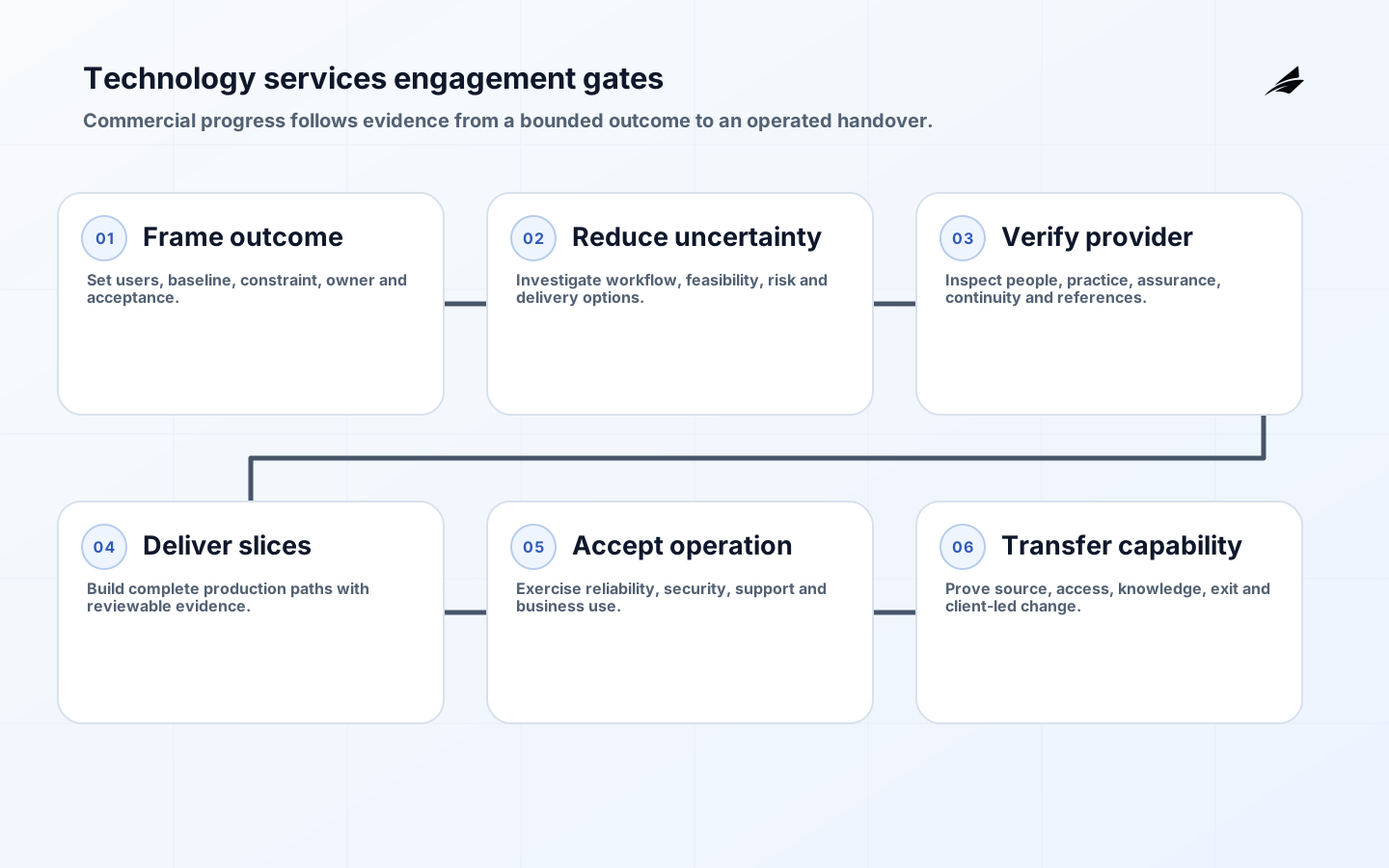
A six-step engagement plan
- Frame the outcome, users, baseline, constraints and accountable owner.
- Run a bounded discovery and select the appropriate commercial model.
- Complete provider diligence using real delivery and assurance evidence.
- Contract for ownership, controls, visibility, change and exit.
- Deliver vertical production slices with reviewable acceptance.
- Prove operation and handover before closing or expanding the engagement.
Key takeaways
- Define an outcome and service boundary before comparing rates.
- Estimate customer effort and lifecycle cost alongside provider fees.
- Inspect actual delivery, security and operating evidence.
- Keep customer visibility and control of critical assets from day one.
- Accept the engagement only when the receiving team can operate it.
Frequently asked questions
Fixed price or dedicated team?
Fixed price fits a coherent outcome with stable acceptance and manageable uncertainty. A dedicated team fits an evolving roadmap when the customer can own priority and decisions. Discovery can reduce uncertainty before either model. Do not use fixed price to pretend unresolved requirements are known.
Does provider location determine quality?
No. Time zones, language, law and data location matter, but quality depends on people, practices, continuity, communication and evidence. Evaluate the actual team and operating model. A nearby provider with opaque subcontracting may create more risk than a distributed team with clear ownership.
When should handover start?
At the beginning. Use customer-controlled systems, shared decisions, maintainable documentation and paired operation throughout delivery. Final transition then verifies capability rather than attempting to transfer months of hidden context in a few meetings.
Conclusion
A technology services company is most valuable when its work becomes a capability the customer can explain, operate and improve. Scope the outcome, select a model that matches uncertainty, inspect evidence, protect ownership and verify the full production path. Commercial clarity and engineering quality reinforce each other when both are tied to observable acceptance and a credible exit.