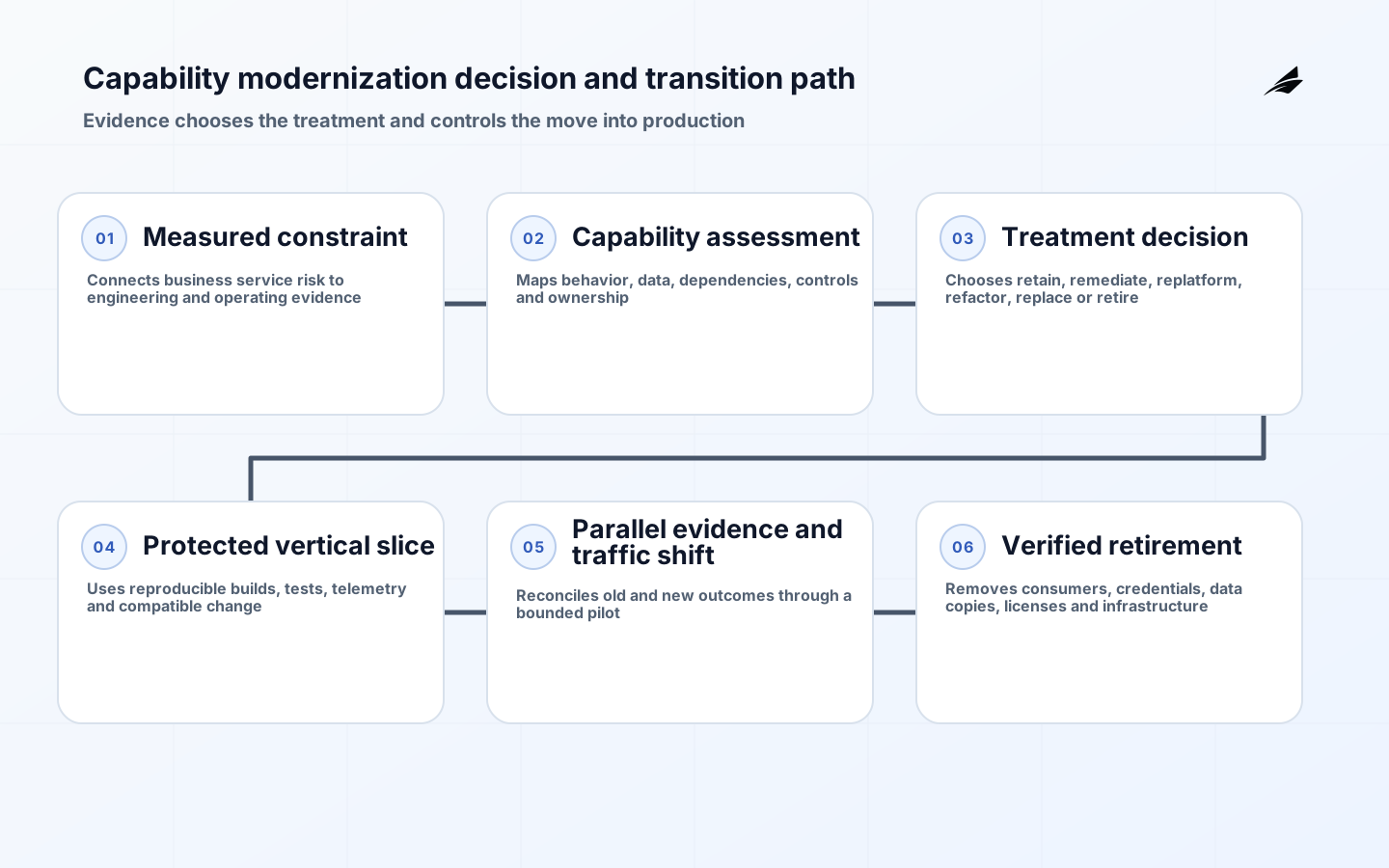
Software modernization services improve a system's ability to change, operate safely and support business outcomes. Modernization can include remediation, upgrade, rehosting, replatforming, refactoring, capability extraction or replacement. None is inherently modern. A containerized application with the same brittle releases and unknown data may preserve the original problem at a new address. The work should begin with a measured constraint, a business service and a safe transition path. That produces a scope that can be estimated and verified without assuming a full rewrite.
Diagnose the constraint before choosing the treatment
Identify the service outcome at risk: slow change, recurring incidents, unsupported components, capacity limits, security exposure, poor accessibility, high operating effort or inability to enter a market. Baseline change lead time, deployment failure, recovery, incident burden, performance and cost where relevant. Trace representative user and operational journeys across applications, jobs, data, infrastructure, identities and providers. The visible legacy application may not be the limiting dependency; a manual reconciliation or proprietary interface may dominate risk.
Create an evidence-backed system profile. Inventory runtime and framework versions, dependencies, source and build availability, data stores, interfaces, batch schedules, privileged paths, test coverage, deployment process, telemetry, recovery and support ownership. Sample code and production behavior rather than rating maintainability by age. Record business rules that exist only in code or operator practice. Assess data quality and archival obligations. Modernization discovery is complete enough when the team can state the constraint, dependencies, major unknowns and a representative slice to prove.
| Constraint | Possible treatment | Proof needed |
|---|---|---|
| Unsupported runtime | Upgrade or replatform | Compatible build, regression and rollback |
| Fragile releases | Pipeline, test and architecture remediation | Smaller change, repeatable deploy and recovery |
| Scaling bottleneck | Profile and isolate the limiting path | Load evidence and correctness under stress |
| Security exposure | Targeted remediation or replacement | Threat model and verification results |
| Tightly coupled capability | Extract behind a stable contract | Parallel comparison and failure isolation |
| Unusable interface | Incremental experience replacement | Task, accessibility and support evidence |
Select a strategy per capability
Use retain, retire, remediate, rehost, replatform, refactor, repurchase or replace as decision prompts, not a scoring ritual. Different parts of one system may need different treatment. Retire unused functions before migrating them. Remediate build and observability when they block every other option. Rehost only when infrastructure is the actual constraint or it creates a deliberate bridge. Refactor where a capability changes often or causes disproportionate failure. Replace commodity functions when migration and integration risks are lower than continued ownership.

Evaluate options against business continuity, data integrity, security, accessibility, performance, skills, time, whole-life cost and exit. Avoid architecture fashion. Microservices introduce network, ownership and operational complexity; a well-structured modular application may be the better target. Cloud placement does not eliminate capacity, identity or recovery design. Create a decision record with assumptions and disconfirming evidence. Run a spike against the hardest technical unknown and a vertical slice against the real business path before scaling the chosen strategy.
Create a protected path for change
Stabilize source control, reproducible builds, dependency inventory, artifact provenance, secrets and deployment identities. NIST SSDF groups secure development around organizational preparation, software protection, well-secured production and vulnerability response. Tailor those outcomes to the modernization. Add characterization tests around critical legacy behavior, contract tests at interfaces and a limited set of end-to-end journeys. Introduce telemetry before major structural change so baseline and regression are visible. Do not postpone vulnerability response because the system is scheduled for replacement; schedules slip.
Use backward-compatible database and interface changes. Expand schemas and consumers before contracting old fields, keep dual-read or dual-write periods short and reconciled, and version external contracts. Feature flags and traffic routing can support gradual exposure, but every flag needs ownership and removal criteria. Rollback must account for data created under the new path; redeploying old code may not be safe after an incompatible write. Define roll-forward, compensation and restore choices for each release, then rehearse them.
| Risk | Leading indicator | Treatment |
|---|---|---|
| Hidden rule loss | Parallel outputs disagree on edge cases | Characterization examples and owner review |
| Data corruption | Migration totals or checksums diverge | Rehearsal, immutable source and reconciliation |
| Release coupling | Many components must change together | Stable contracts and incremental compatibility |
| Observability gap | Teams cannot compare old and new behavior | Correlated telemetry before cutover |
| Cost duplication | Parallel estates remain without exit date | Wave-level retirement criteria and ownership |
| Skill dependency | Only contractors can operate target | Pairing, runbooks and reverse-shadow recovery |
Estimate transition and retirement, not only build
Cost depends on estate condition, business criticality, data volume, interface count, assurance, coexistence, licensing, target operations and knowledge concentration. Estimate by modernization slice: discovery, remediation, target build, data transition, integration, testing, dual run, support and retirement. Include internal experts and operations. Keep ranges while source, data and behavior remain uncertain. Reforecast after the first slice. A replacement quote that omits archives, reports, historical access or partner certification is not a complete estimate.
Model recurring target cost and temporary overlap. Include environments, telemetry, network, backup, support, managed services and specialist skills. Track unit cost relevant to the service. Contract with a provider around deliverables, evidence, source and artifact ownership, security, production responsibility, staffing continuity and exit. Knowledge transfer should be continuous and demonstrated through independent deployment, diagnosis and recovery. Avoid tying payment only to migrated component count; it can reward moving low-value complexity without reducing the original constraint.
Modernize through controlled vertical slices
- Frame the business service, measured constraint and risk tolerance.
- Discover dependencies, behavior, data, controls and operating ownership.
- Stabilize build, tests, telemetry and vulnerability response needed for safe change.
- Prove one end-to-end slice with realistic data, failure and rollback.
- Pilot traffic or users while comparing old and new outcomes.
- Expand only when service, security, cost and operational thresholds hold.
- Retire code, data copies, credentials and infrastructure after consumers are verified.
A useful slice crosses interface, logic, data, deployment, telemetry and support for one journey. It can use a facade or strangler pattern to route a bounded capability while the remaining system continues. Validate business results, latency, authorization, audit, recovery and operational effort. Compare outputs during shadow or parallel processing. Define stop conditions for unexplained differences, backlog growth or error. The slice should reduce one constraint and teach the team how to repeat the transition; otherwise it is a technology demonstration.
Govern retirement as actively as creation. Inventory consumers of old APIs, reports, data extracts, identities and jobs. Monitor use, communicate deadlines and provide migration support. Preserve records according to retention and legal requirements, then sanitize data and revoke access. Confirm backups and disaster recovery no longer depend on retired components. Remove temporary bridges, flags and duplicate telemetry. Financial savings appear only when licenses and infrastructure end, but risk reduction also requires the attack surface and unsupported operational paths to disappear.
Prove the target can be operated
Before each wave, run a production-readiness review with service map, objectives, dashboards, alerts, capacity, access, known errors, incident communication, backup restoration and rollback. Exercise a dependency failure and recover data to a reconciled business state. Track the original constraint alongside guardrails: change lead time, failed deployment, incident impact, recovery, security findings, user completion and unit cost. Targets should come from baseline and business need. A successful migration that leaves change slower or support dependent on specialists has not delivered the intended modernization.
Modernization also needs a policy for the hybrid period. Define which team owns incidents that cross old and new components, which telemetry view establishes the customer journey and how emergency changes are synchronized. Keep compatibility contracts under automated test and publish deprecation dates. Limit new feature work on the old path unless it is required for safety or continuity; otherwise coexistence grows faster than retirement. Review the hybrid architecture after every wave and remove temporary routes as soon as evidence permits. Temporary infrastructure without an owner quickly becomes the next legacy estate.
Keep customer and internal communications synchronized with each traffic shift. Support teams need the affected cohort, expected behavior, known limitations and rollback signal before release. When a wave changes an API or report, notify consumers through a versioned deprecation plan and monitor remaining use. Communication is part of technical risk control because silent behavioral change creates shadow workarounds and delayed incident discovery.
Key takeaways
- Define modernization by a measured business or engineering constraint.
- Choose treatment per capability; do not make one estate-wide technology assumption.
- Stabilize builds, tests, telemetry and security before high-risk structural change.
- Use compatible changes, reconciled coexistence and realistic rollback.
- Budget retirement and prove the target team can operate independently.
Frequently asked questions
When is a full rewrite justified?
When the existing architecture fundamentally blocks required behavior, incremental transition is less safe or more costly, and the organization can preserve business rules, migrate data and run a controlled coexistence. The burden of proof is high because rewrites remove accumulated operational evidence.
Does modernization require moving to cloud?
No. Placement follows security, resilience, latency, data, skills, economics and regulatory needs. Cloud services can enable useful change, but moving an unchanged application may not reduce coupling, release risk or operating effort.
What should be modernized first?
Choose a valuable, bounded path that exercises representative dependencies and can be released reversibly. Avoid both the easiest irrelevant component and the most critical unbounded core. The first slice should reduce risk and test the transition method.
How is modernization success measured?
Measure the original constraint plus service guardrails. Examples include safer and faster change, lower incident burden, supported components, successful recovery, better user completion and sustainable unit cost. Count migrated applications only as progress, not outcome.
Conclusion
Modernization is controlled change to a living service. Diagnose the constraint, understand the behavior and choose treatment at capability level. Protect the delivery path, prove a vertical slice, reconcile data and outcomes, and expand through reversible waves. The job ends only when old dependencies are retired and the target team can operate the service. This evidence-led approach makes modernization less theatrical and far more likely to improve the system the business actually relies on.