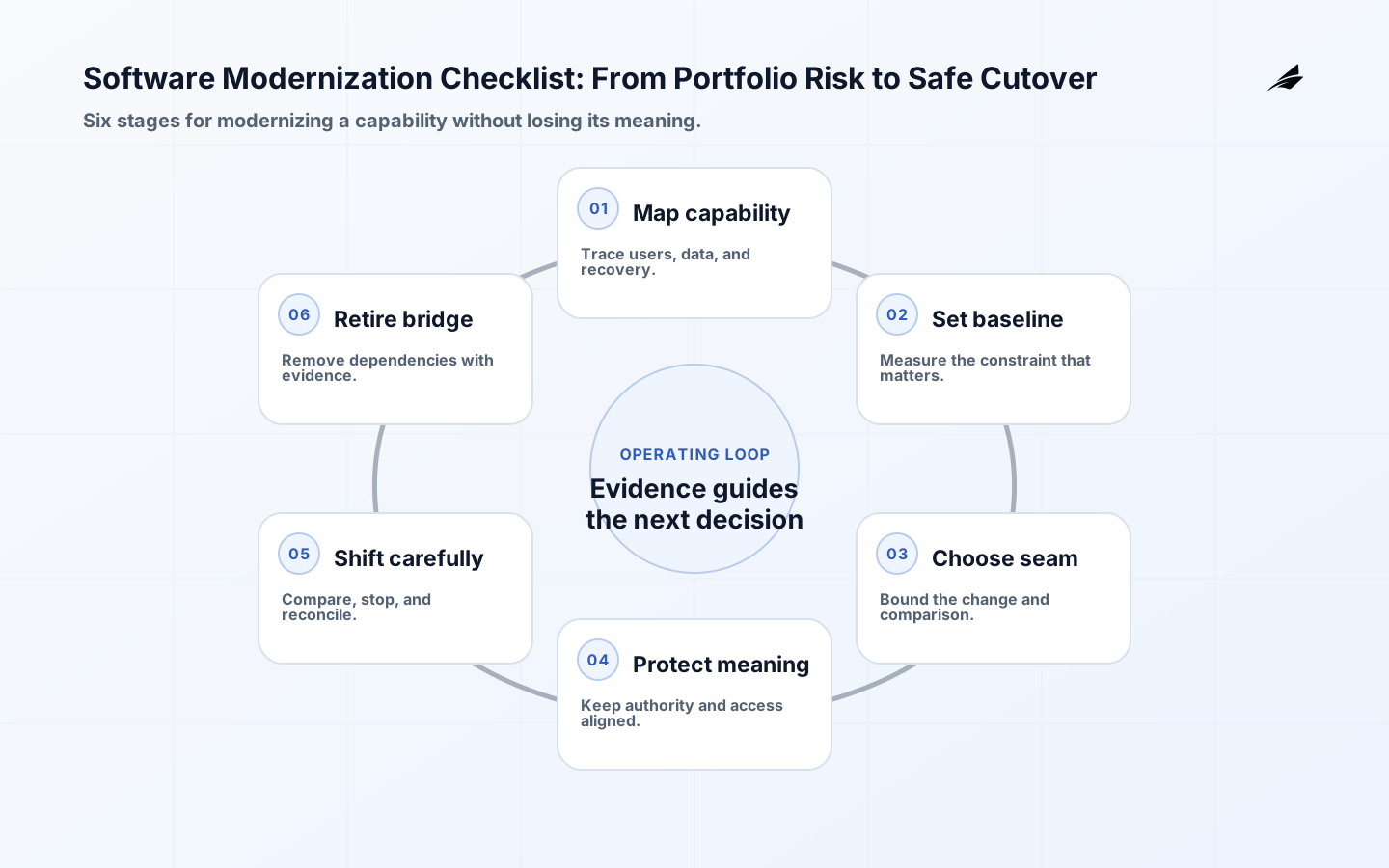
Software modernization is not a race to replace old technology. It is a controlled change to a business capability that people already depend on. The checklist should therefore start with behavior and authority, not a target platform. Map the current journey, identify the pain that matters, choose a seam where a new path can be compared, protect the records and permissions that give the capability meaning, and define how the team will stop or repair the change. A modern runtime is useful only when the organization can operate and evolve the capability more safely than before.
Start with the capability, not the application inventory
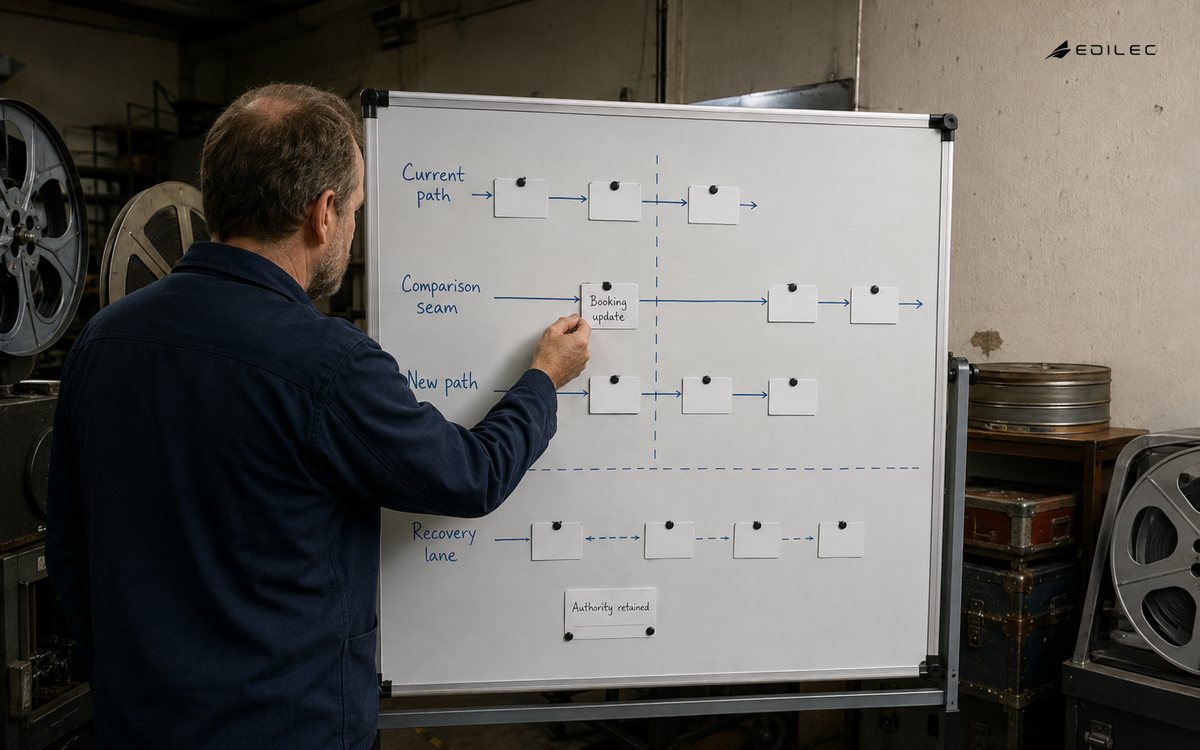
Choose a workflow with a recognizable user, decision, authoritative record, and measurable constraint. Map the screens, batch jobs, integrations, permissions, data stores, exports, manual workarounds, and recovery steps that make the current behavior real. Include the hidden dependencies: a report used by finance, a file sent to a partner, a nightly reconciliation, or a support tool that corrects a state. The Microsoft modernization planning guidance recommends phasing work and matching the approach to business goals, risk, and resources; the capability map is how a team makes that match concrete.
| Portfolio fact | Question | Evidence to collect |
|---|---|---|
| Capability | What outcome does the system support? | Journey, users, and business owner. |
| Authority | Which record or policy decides correctness? | Source, identifiers, and reconciliation rule. |
| Constraint | What is failing or limiting change today? | Baseline time, defects, cost, risk, or lead time. |
| Dependency | Which systems and people must remain compatible? | Contracts, jobs, exports, and permissions. |
| Recovery | How does the team correct a partial or failed result? | Runbook, owner, and current evidence. |
Set a baseline before choosing a modernization target
Modernization needs a comparison that is meaningful to the capability. Use completion time, error and reconciliation rate, recovery effort, deployment frequency, security findings, infrastructure cost, or the time required to make the next safe change. Do not choose a metric because it is easy to collect. A service may become faster while its support load increases, or its infrastructure becomes cheaper while data corrections become harder. Record the baseline window, population, and known exceptions so a later team can interpret the result.
The portfolio record should show technology age, support status, dependency risk, data sensitivity, change frequency, and operational history, but those facts are inputs rather than the conclusion. A system that is old and stable may not be the best first target. A small service with an unsupported runtime or unclear recovery may offer a safer high-value seam. Link modernization to technical debt for custom software when the constraint is accumulated change cost rather than a single platform replacement.
Choose the least disruptive strategy that meets the outcome
Replatforming changes the hosting or managed-service boundary with limited application change. Refactoring improves internal structure, performance, security, or maintainability while preserving the capability. Rearchitecting changes the shape of the system, perhaps by separating services, using asynchronous boundaries, or changing the data model. The official modernization strategy guidance describes these as options on a continuum, not a maturity ladder.
| Approach | Use when | Main proof needed |
|---|---|---|
| Replatform | The code works but operating burden or support limits are the issue. | Compatibility, performance, backup, and operational comparison. |
| Refactor | Internal coupling or quality blocks safe change. | Behavior parity, test coverage, and incremental deployability. |
| Rearchitect | The current boundary prevents a required scale, isolation, or capability. | New invariants, data authority, failure behavior, and cutover. |
| Retire or replace | The capability is redundant or no longer justified. | User transition, data disposition, and dependency removal. |
Choose a seam that can be compared and reversed
A good modernization seam has a clear input and output, stable identifiers, measurable behavior, and a real owner. It may be a reporting read path, a document generation service, an authentication adapter, or one bounded business function. Avoid a seam that depends on changing five databases at once or that has no way to compare old and new results. The AWS Strangler Fig pattern is useful because it frames incremental migration around routing a portion of behavior to a new implementation while the old remains available.
Preserve meaning at the seam. Keep identifiers stable, define which side is authoritative, and make transformations explicit. If both systems write the same record during a transition, specify conflict resolution and reconciliation rather than trusting timing. If an adapter is temporary, give it an owner and an exit condition. A bridge with no retirement plan becomes the next layer of legacy.
Protect data, permissions, and secure delivery
Modernization often changes how data moves and who can administer it. Carry forward access decisions, audit evidence, retention expectations, and secrets management. Validate untrusted input at the new boundary, restrict service identities to the required actions, and test denied as well as allowed paths. NIST’s Secure Software Development Framework is outcome-based: use it to connect secure practices to the risks and evidence of the capability rather than treating security as a final scan.
Data migration needs more than row counts. Compare identifiers, states, relationships, timestamps, and business totals. Test partial failure, duplicate execution, interruption, and restart. Make the correction path explicit and protect the authoritative record from an ambiguous dual-write. The plain-language database schema guide is a useful companion when a modernization changes the model that holds the capability’s meaning. If the new path publishes asynchronous updates, review the event-driven systems security review before treating the broker as a neutral transport.
Roll out with comparison before cutover
Run the new path against representative cases before it becomes the only path. Shadow reads, dual calculations, canary traffic, or a parallel environment can reveal differences without committing every user to them. Compare not just success counts but decisions, timestamps, permissions, downstream messages, support behavior, and recovery effort. Set a stop threshold before rollout: a material reconciliation mismatch, unexpected access outcome, or unbounded error rate should halt exposure while the team investigates.
The Microsoft planning guidance distinguishes in-place and parallel deployment and recommends matching the strategy to risk, reversibility, downtime tolerance, and data synchronization. Use a parallel path for complex or mission-critical changes when the duplicate operating cost buys a safer cutover. Keep the rollback action tested and time-bounded; a theoretical restore that requires reconstructing state from logs is not a practical stop condition.
Operate the modernized capability as a new responsibility
Do not declare success at deployment. Transfer the runbook, dashboards, on-call route, support explanation, access roles, backup checks, and cost ownership. Review errors, latency, completion, reconciliation, security events, and the effort required for the next change. If an operator cannot explain which path handled a case or how to repair an uncertain result, the modernization is not operationally complete.
Keep the old and new paths distinguishable in telemetry and business records during the transition. Add release or configuration annotations to dashboards, retain a correlation identifier, and record which authority produced the final decision. Review a sample of ordinary and exceptional cases with someone who did not build the change. This rehearsal catches hidden dependency on private knowledge before the bridge is removed.
Govern scope, exceptions, and bridge retirement
Modernization programs attract adjacent improvements. Keep a backlog for useful ideas, but require a decision when a request changes the capability, risk, timeline, or evidence plan. The Cloud Adoption Framework overview emphasizes strategy, planning, readiness, adoption, governance, security, and management as a lifecycle. Use that lifecycle to keep ownership after the project label disappears.
Before cutting over, list every bridge component, credential, queue, dashboard, compatibility field, and manual workaround that should be retired. Define the evidence for retirement and the person who confirms it. If a bridge remains because the organization is afraid to remove it, record that risk openly and give it a review date. A successful modernization reduces opaque dependencies; it should not simply add a new path beside the old one forever.
Review whether the capability actually improved
Compare the new path with the baseline using the measures chosen at the start. Did the team reduce recovery time, support demand, change lead time, exposure, cost, or defect rate? Which benefit reached users, and which was only an infrastructure improvement? What new operating burden appeared? Invite product, engineering, support, security, and finance to review the same evidence so the next portfolio decision is not driven by one dashboard.
Modernization should leave the organization with clearer boundaries, stronger evidence, and a capability that can change safely. If the result is only a different deployment target with the same hidden coupling, say so and choose a smaller follow-up. Honest evidence makes the next investment better.
Key takeaways
- Map one business capability, its authority, dependencies, permissions, and recovery before choosing a target platform.
- Use a baseline that reflects user outcome and operating effort, not only infrastructure age.
- Match replatform, refactor, rearchitect, replace, or retire to the constraint and risk.
- Choose a seam with stable identifiers, comparable behavior, and a real stop or correction route.
- Keep ownership, evidence, and bridge retirement after cutover so the modernization remains changeable.
Frequently asked questions
What is the first step in software modernization?
Map one capability and its real workflow: users, decisions, authoritative records, integrations, permissions, constraints, and recovery. Then establish a baseline. The first target should be a bounded outcome that the team can observe and support.
Should a team replatform, refactor, or rearchitect first?
Match the strategy to the business need, risk, skills, time, and reversibility. Replatforming may reduce operating burden; refactoring may make safe change possible; rearchitecting is justified when the current boundary blocks a required capability. Avoid choosing by fashion.
How can modernization avoid a big-bang cutover?
Run a bounded path beside the current one, preserve identifiers and authority, compare outcomes, shift traffic progressively, and keep a tested stop or reconciliation route. Retire the bridge only after evidence and ownership are clear.
Conclusion: modernize the capability, then prove the change
Software modernization earns its cost when a real capability becomes easier to secure, operate, recover, and change. Use the checklist to preserve business meaning through the seam, compare old and new outcomes, and keep retirement visible. The strongest modernization plan is ambitious about the outcome and disciplined about the path.