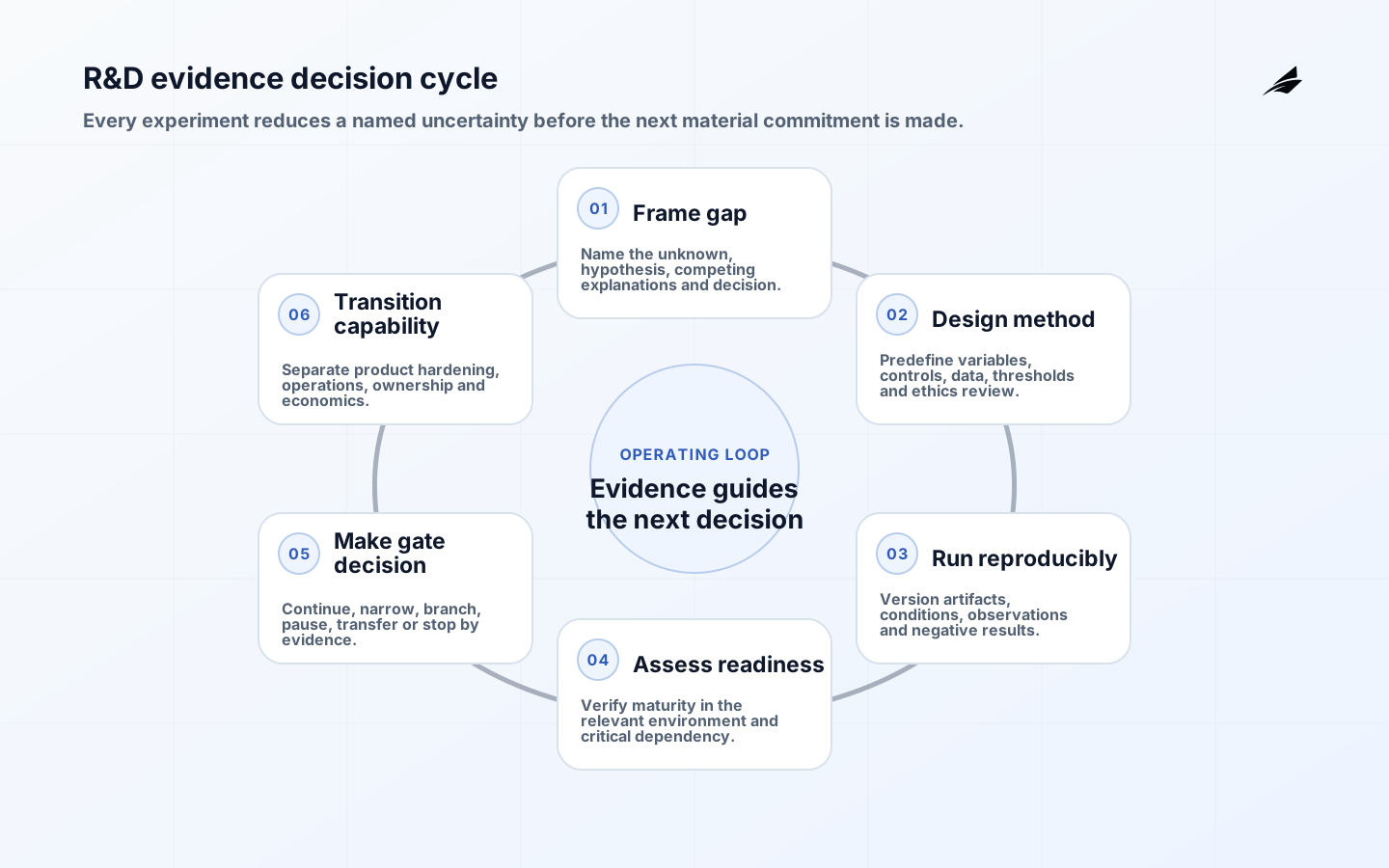
Research and development should reduce an important uncertainty, not provide an indefinite label for difficult product work. The OECD describes R&D as novel, creative, uncertain, systematic and transferable or reproducible. A practical plan therefore states the knowledge gap, hypothesis, experimental method, evidence threshold and decision that the result will inform. It also distinguishes exploratory work from routine engineering, product hardening and commercialization so leaders can fund each with suitable expectations.
Use this plan with the R&D implementation checklist, the R&D FAQ, the startup software planning guide and the finance software delivery guide. Name a research lead, sponsor, domain reviewer, security or ethics owner where relevant, and the person authorized to continue, redirect or stop investment.
Frame the knowledge gap and decision
Write what is unknown, why existing evidence is insufficient, who needs the answer and by when. State a falsifiable hypothesis and competing explanations. Define the intended environment and constraints: data, scale, latency, safety, privacy, hardware, suppliers and skills. Separate technical feasibility from desirability, operational viability and commercial value. A prototype can answer whether a method works under specified conditions; it rarely proves production reliability or market demand. Record exclusions and the consequence of learning that the hypothesis is false.
| Work type | Primary output | Completion evidence |
|---|---|---|
| Basic research | New general knowledge | Peer or expert scrutiny and reproducible method |
| Applied research | Knowledge for a practical objective | Evidence under relevant assumptions |
| Experimental development | New or improved capability | Prototype and measured technical result |
| Product engineering | Operable customer capability | Quality, security and service acceptance |
| Commercialization | Repeatable value delivery | Adoption, economics and supported operations |
Design reproducible experiments
Define variables, controls, datasets, equipment, environments, baselines and analysis before observing results. Use representative conditions and protect against leakage between training, tuning and evaluation. Version code, data, configuration, prompts, dependencies and hardware details sufficiently for an independent person to repeat the work. Predefine success, failure and inconclusive outcomes. For human studies or sensitive data, obtain the required ethics, consent and privacy review. Negative and null results belong in the record because they prevent repeated dead ends and reveal boundary conditions.

Assess maturity with evidence
Technology readiness levels can create a common vocabulary, but GAO’s guidance emphasizes credible evidence of how maturity was demonstrated. Define the relevant environment, interfaces, scale and integration conditions for each claim. Avoid averaging unrelated components into one reassuring score. Track the least mature critical dependency and its maturation plan. An algorithm demonstrated on curated data, a laboratory prototype, an integrated pilot and an operable product carry different evidence. Use independent review at major commitment points and record dissent or uncertainty.
Estimate cost as a range
Build a work breakdown covering people, data acquisition, specialist facilities, compute, prototypes, testing, security, intellectual property, suppliers, documentation and transition. Estimate by phase because team shape changes as uncertainty narrows. Use analogous projects, bottom-up tasks or parametric drivers where evidence supports them. Conduct sensitivity and risk analysis around the variables that dominate cost and schedule. Show minimum, expected and high cases with confidence and assumptions. Reserve funding for planned learning, not unbounded iteration, and re-estimate at every evidence gate.
| Cost area | Key driver | Control |
|---|---|---|
| Specialist labor | Scarcity, mix and iteration count | Phase-based capacity and peer review |
| Data and materials | Rights, quality, collection and preparation | Early sample and provenance check |
| Compute or equipment | Experiment volume, scale and utilization | Budgets, quotas and unit tracking |
| Integration | Interface novelty and test environment | Early thin integration proof |
| Assurance | Consequence and required evidence | Risk-based review plan |
| Transition | Hardening, support and knowledge transfer | Separate product estimate and gate |
Manage research and delivery risks
Maintain technical, schedule, cost, safety, security, privacy, legal, supply and adoption risks with causes, consequences, owners, triggers and contingencies. Distinguish uncertainty to investigate from risk to mitigate. Common failure modes include confirmation bias, benchmark overfitting, unavailable data, irreproducible environments, dependence on one expert, supplier changes and premature product commitments. Apply secure development practices to research software that touches real data or systems. Restrict credentials and external actions even when code is called experimental.
Deliver through evidence gates
Use short learning cycles with a review at each material commitment. A gate should ask whether evidence is trustworthy, what uncertainty remains, whether the next experiment is the cheapest discriminating test and whether the opportunity still matters. Possible decisions are continue, narrow, branch, pause, transfer or stop. Incremental working evidence reduces the risk of funding a long program that produces outdated or unusable technology. Keep one decision log linking hypotheses, experiments, results, cost and sponsor choices.
Transition to product only with a separate plan for architecture, reliability, security, accessibility, data governance, operations, support and economics. Inventory prototype shortcuts, research licenses, manual steps, sensitive datasets and unsupported dependencies. Decide what can be reused and what must be rebuilt. Have the receiving team reproduce the result, operate the integrated slice and estimate hardening. Preserve research artifacts according to policy and close environments, credentials and supplier spend that are no longer needed.
Run a reproducible R&D gate review
Prepare the gate package before the review meeting. It should state the original knowledge gap, hypothesis, competing explanations, method, preregistered thresholds, deviations, raw-data location, analysis version, result and the decision the work can inform. Include negative and inconclusive runs. For a new scheduling algorithm, for example, preserve the baseline implementation, representative workload generator, random seeds, hardware profile, dependencies and statistical analysis. Report queue delay, throughput, failure and compute cost across relevant load ranges rather than one best-case average. A reviewer should be able to rerun the experiment without relying on the researcher’s undocumented workstation state.
Separate scientific or technical evidence from product readiness. A method can outperform a baseline under controlled conditions while lacking secure inputs, predictable latency, failure handling, explainability, licensing clearance or an economical operating path. Score each critical dependency in the environment where it was actually demonstrated and state what remains inferred. Use readiness levels as communication aids, not arithmetic proof that the whole system is mature. The gate owner should challenge the weakest dependency and alternative explanation. When the experiment changed after results were observed, label the new analysis exploratory and require an independent confirmatory run before material commitment.
Connect funding to the next uncertainty. A continuation request should name the evidence sought, method, acceptance threshold, duration, people, equipment, data, review and maximum cost. Show ranges for uncertain drivers and define an early stop when the result cannot affect the intended decision. Branch competing approaches only when their learning value justifies parallel expense. A pause can be rational when a component, dataset or regulatory condition is unavailable. Preserve enough context to resume without repeating work. A stop decision should release scarce resources and document why further effort is unlikely to change the investment case.
If the gate approves transition, create a distinct product-hardening plan. Transfer code and data through reviewed repositories, resolve licenses and intellectual property, define supported inputs and limitations, threat-model the service, establish tests and observability, estimate capacity and assign long-term ownership. Product teams should reproduce the core result before inheriting it. Run a pilot against real operating constraints with rollback and customer feedback. Do not ask researchers to become permanent on-call owners by accident, and do not rewrite history when engineering changes reduce benchmark performance. Preserve the research claim, the production objective and the measured tradeoff as separate records.
A useful gate record also states what the evidence does not show. Note excluded populations, unavailable conditions, measurement sensitivity, dependence on expert judgment and how long the result is expected to remain relevant. Assign triggers for re-evaluation, such as a supplier component change, new operating range or contradictory field result. This makes uncertainty actionable instead of hiding it in an appendix. Decision-makers can then accept a bounded claim, request the next experiment or decline the investment without pretending that a research result is permanent universal proof. Archive superseded claims without erasing them, and link later contradictory evidence to the original decision. That history helps teams improve methods instead of repeating a confident but fragile result. Review access and retention so sensitive research data is protected without making the decision trail unusable.
- Package hypothesis, method, deviations, data, analysis and negative results before review.
- Require an independent person to reproduce the material result.
- Assess the weakest dependency in its demonstrated environment.
- Fund the next named uncertainty with a threshold, cap and early-stop rule.
- Treat exploratory analysis as a new hypothesis needing confirmation.
- Create a separate hardening, ownership and economics decision for product transition.
Key takeaways
- Fund an explicit knowledge gap and decision, not vague innovation activity.
- Predefine methods and thresholds, then preserve reproducible artifacts and negative results.
- Base readiness claims on demonstrated conditions and critical dependencies.
- Estimate ranges with uncertainty, re-estimating after material learning.
- Treat transition to an operable product as a new evidence-backed commitment.
Frequently asked questions
Is a failed experiment wasted spend?
Not when it tests an important uncertainty with a sound method and changes a decision. It is waste when no decision, reusable evidence or documented learning follows.
Can R&D use agile delivery?
Yes. Organize increments around learning outcomes and reviewed evidence rather than pretending uncertain research has a predictable feature backlog.
When should intellectual property be reviewed?
At the start, before disclosure or publication, when third-party material enters, and before product transfer. Contract terms should address background and newly created rights.
When should research stop?
Stop or redirect when the decision is answered, evidence invalidates the opportunity, the next useful test costs more than its decision value, or risk exceeds tolerance.
Conclusion
Disciplined R&D turns uncertainty into attributable evidence. By defining the question, designing reproducible experiments, assessing readiness, exposing cost and risk, and governing each commitment through a decision gate, teams can pursue genuine novelty without confusing exploration with finished product delivery.