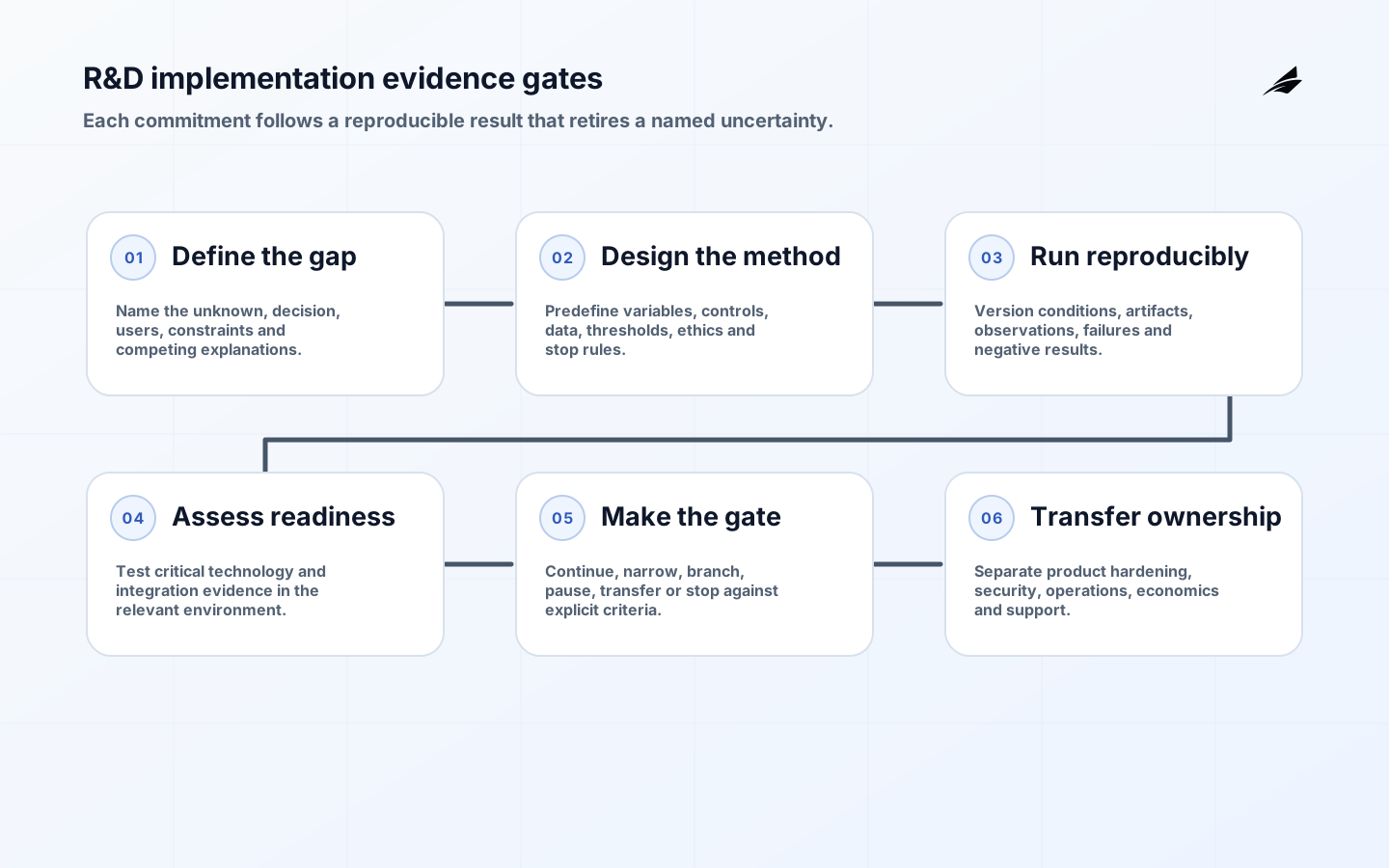
A research and development implementation checklist should protect learning, not merely organize tasks. R&D begins with a material uncertainty: the team cannot yet explain, predict or build something with adequate confidence. The work is successful when a reproducible result changes a real decision, including a decision to stop. A prototype that looks convincing but lacks controlled evidence, provenance or a transition path may be useful exploration, yet it is not enough to justify production investment.
Use this checklist with the R&D scope and cost guide and the research and development FAQ. The sequence below separates research evidence from product delivery while keeping them connected. It works for software, AI, materials, process, data and systems research; the method, ethics review and applicable regulation still need to be tailored to the field.
Confirm that the work is genuinely R&D
The OECD Frascati Manual describes research and experimental development through novelty, creativity, uncertainty, systematic work and results that are transferable or reproducible. Those tests are a useful boundary. Routine configuration, a known migration, ordinary quality improvement or implementation of a published technique may be valuable engineering, but should not be relabeled as research. Conversely, writing code does not make an activity routine if the code is an instrument for testing a genuinely uncertain technical proposition.
| Boundary question | Evidence to record | Decision implication |
|---|---|---|
| What is not known? | A precise gap, hypothesis and plausible competing explanations | If the answer is already established, use normal delivery |
| Why does it matter? | The product, policy or investment decision the result will change | Do not fund curiosity without a declared decision context |
| What is novel here? | Difference from internal capability and accessible prior work | Search and review before building |
| How will it be tested? | Variables, controls, observations and acceptance thresholds | Reject demonstrations that cannot distinguish explanations |
| Can another team use the result? | Versioned method, artifacts, data lineage and limitations | Treat undocumented insight as fragile evidence |
Establish ownership, ethics and decision rights
Name a research lead accountable for method, a sponsor accountable for the decision and a future delivery owner who can challenge whether the evidence is usable. These are different responsibilities. Add domain, security, privacy, safety, legal or ethics review according to the consequence of the work. The sponsor should approve the question, budget envelope and gate criteria without pressuring researchers to produce a favorable answer. Negative and inconclusive findings belong in the record.
Create a short decision charter before the first experiment. It should state the knowledge gap, intended users, excluded claims, expected evidence, data rights, publication or confidentiality constraints, maximum exposure, review cadence and stop conditions. For work involving people, sensitive data, safety-critical behavior or environmental release, obtain the necessary approval before collection or testing. A retrospective signature cannot repair an experiment conducted without valid authority.
Design the method before observing the result
Write the hypothesis and analysis plan while the team is still capable of being surprised. Define independent and dependent variables, control or comparison conditions, sampling logic, measurement error and thresholds. Record which decisions are exploratory and which are confirmatory. For computational work, pin code, dependencies, model versions, prompts, random seeds, hardware assumptions and data snapshots where feasible. For physical trials, preserve calibration, material batch, environment and operator details.
Reproducibility is proportionate rather than theatrical. A second qualified person should be able to follow the method and obtain a result consistent within declared tolerances. When full replication is costly, use staged checks: independent review of the protocol, rerun critical analyses from raw observations, repeat a representative subset and challenge sensitivity to assumptions. Preserve failed runs and deviations; deleting them can hide selection effects and makes cost or schedule estimates falsely optimistic.
| Gate | Minimum evidence | Possible decision |
|---|---|---|
| Question gate | Gap, prior-work review, hypothesis and decision owner | Approve, reframe or route to delivery |
| Method gate | Protocol, controls, data plan, approvals and thresholds | Run, revise or stop |
| Result gate | Versioned observations, analysis, deviations and independent check | Replicate, branch or reject |
| Readiness gate | Critical technology tested in a relevant context with integration risks | Mature further or begin transfer |
| Investment gate | Expected value, uncertainty, cost range and alternatives | Continue, narrow, pause or stop |
| Transfer gate | Product requirements, ownership, controls, support and residual risks | Accept into delivery or retain as research |
Run the research and development implementation procedure
Start with a two-week framing period rather than an open-ended discovery phase. Review accessible prior art and internal attempts, interview the decision owner, list assumptions and rank uncertainties by decision impact. Choose the smallest experiment that can discriminate between meaningful alternatives. Estimate resources as a range and reserve capacity for replication, because the first run often reveals method flaws rather than a final answer.

- Register the knowledge gap, hypothesis, owner, affected stakeholders and decision deadline.
- Approve the protocol, evidence standard, risk controls, data rights and explicit stop conditions.
- Execute in versioned increments; log conditions, deviations, failures and observations as they occur.
- Review results independently and test sensitivity before presenting a readiness claim.
- At each gate choose continue, narrow, branch, pause, transfer or stop, and record the reason.
- When transferring, create a separate delivery backlog for hardening, integration, assurance, support and economics.
Example: a team investigating whether retrieval can reduce support-answer errors should not begin by building a polished assistant. It can select representative questions, freeze an approved knowledge snapshot, define supported-answer and citation measures, compare a baseline with retrieval variants, blind the review and record abstentions. If retrieval improves common answers but fails on access-controlled documents, the result supports a bounded next experiment; it does not support unrestricted deployment.
Assess readiness without confusing it with value
A technology readiness level is evidence about maturity in a defined environment, not a universal score for commercial value, safety or integration ease. Follow the GAO emphasis on critical technologies and the environment in which readiness was demonstrated. Name the component, its required function, the relevant context and the evidence. A high-performing laboratory component can remain a serious program risk if manufacturing, data availability, interoperability, maintainability or user operation is unproven.
Transfer is a negotiated change of accountability. The delivery owner should accept a package containing the problem statement, method, result, limitations, reproducible artifacts, security and privacy findings, open risks, dependency licenses, operational assumptions and recommended acceptance tests. Product engineering then owns reliability, usability, secure development, monitoring, support and decommissioning. Keeping that work visible prevents an experimental prototype from quietly becoming a production service.
Control cost, risk and learning flow
Track money and time by hypothesis or uncertainty, not only by team. Useful measures include time to first discriminating evidence, replication success, proportion of experiments that changed a decision, unresolved critical assumptions, cost to retire a major uncertainty and elapsed time from readiness decision to accepted transfer. Counts of patents, prototypes, papers or experiments may describe activity but do not prove that the portfolio is learning efficiently.
Review the portfolio for correlated risk. Ten projects may depend on the same dataset, supplier, fabrication process or regulatory interpretation. Maintain a dependency map and run pre-mortems at major gates. Stop work when the question has been answered, the decision no longer matters, the method cannot produce adequate evidence within the envelope, risk exceeds authority or a better alternative dominates. A well-supported stop is an R&D outcome, not a delivery failure.
Schedule a quarterly evidence audit for active work. Sample whether protocols were approved before execution, raw observations remain traceable, analysis can be rerun, deviations are explained and gate decisions match the record. Review access to sensitive data and experimental systems, remove stale credentials and confirm retention. This audit is not a scientific popularity contest; it tests whether the organization could defend, reproduce and responsibly act on the knowledge it is funding. Feed recurring gaps into training, tooling and portfolio policy.
Key takeaways
- Define R&D through a genuine, decision-relevant uncertainty rather than the presence of new technology.
- Predefine methods, thresholds, approvals and stop rules before results create pressure to move the goalposts.
- Preserve provenance, deviations and negative findings so another qualified team can assess the evidence.
- State readiness for a specific critical technology in a specific environment; do not treat a level as proof of product value.
- Transfer research into a separately owned hardening and operations plan, with residual risks made explicit.
Frequently asked questions
Can R&D use agile delivery methods?
Yes. Short increments, demonstrations and retrospectives help, but the backlog should be organized around uncertainties and evidence. A sprint that produces features without testing the hypothesis can create motion without learning. Keep protocol changes and exploratory work visible so iteration does not erase comparability.
How should an R&D budget be approved?
Approve a bounded envelope for the next evidence gate, plus a transparent reserve for replication or an alternative path. Use ranges and scenarios instead of false precision. Release later funding only when the result, remaining uncertainty and decision value justify it.
When should intellectual property be reviewed?
Review ownership, licenses, publication rights, confidentiality and relevant prior art during framing, then again before external disclosure or transfer. The appropriate specialist should assess jurisdiction-specific rights. An IP question discovered at product launch can invalidate an otherwise successful technical transfer.
What should happen after an inconclusive experiment?
Determine whether the result reflects insufficient power, noisy measurement, protocol deviation or a genuinely small effect. Record the finding, then decide whether a revised experiment can change the decision at reasonable cost. Repeating the same weak method is not persistence; it is unpriced uncertainty.
Conclusion
Research and development works when disciplined curiosity produces evidence that can survive challenge. Frame a real gap, authorize a proportionate method, preserve reproducibility, judge readiness in context and make explicit continuation decisions. The final responsibility is not to make every experiment succeed. It is to ensure that each experiment changes what the organization can responsibly know, decide or build.