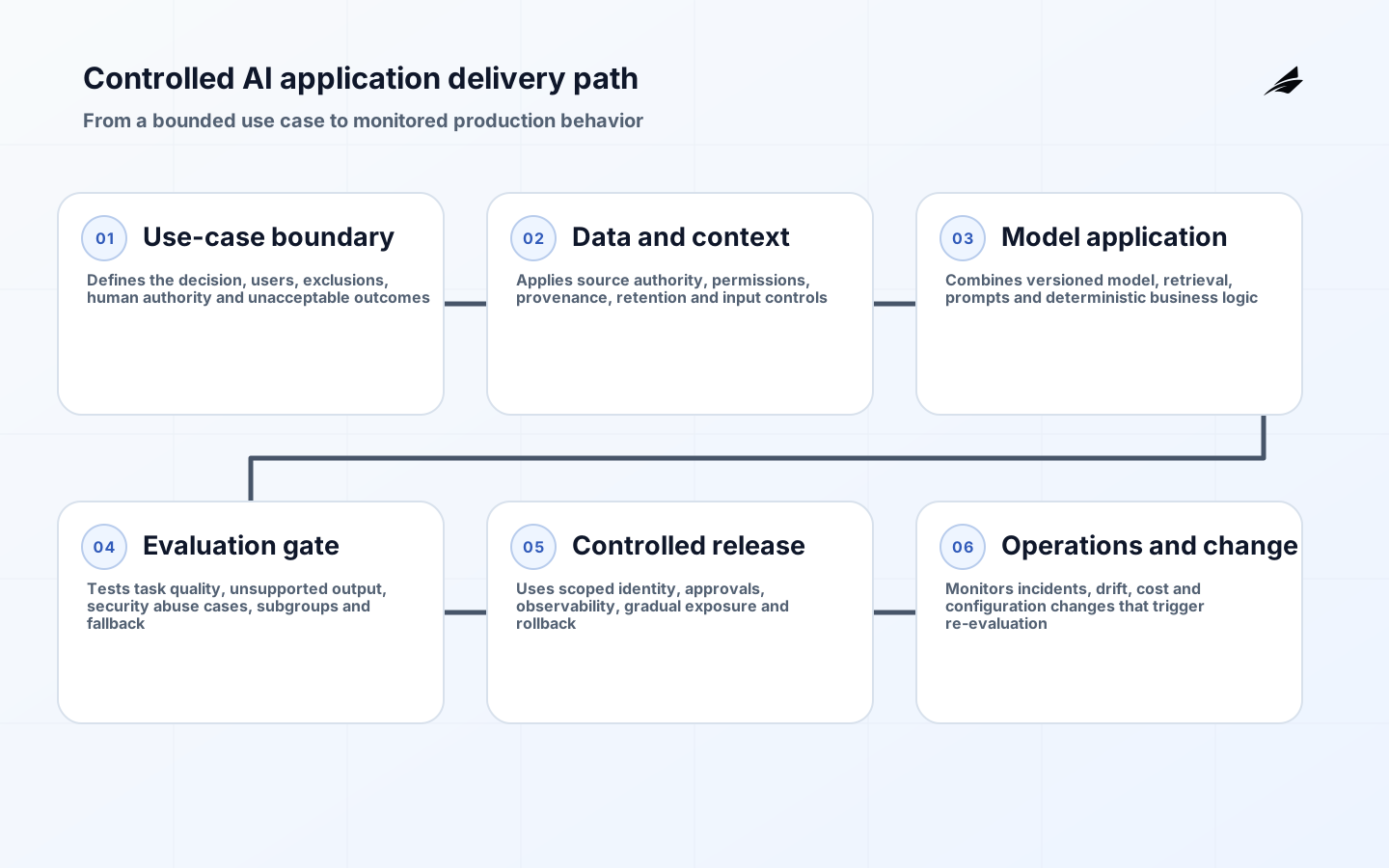
Enterprise teams often struggle to balance the rapid pace of AI innovation with the need for robust, secure, and cost-effective development. Unlike consumer-focused AI projects, enterprise applications require careful consideration of regulatory compliance, data privacy, and integration with existing systems. This article provides a risk-driven approach to defining scope, estimating costs, managing risks, and planning delivery—without the common pitfalls of over-engineering or underestimating security requirements. The goal is to deliver practical, actionable guidance that aligns with real-world constraints and priorities.
Why Enterprise AI Development Demands Risk Awareness
The most significant difference between enterprise AI projects and other initiatives is the complexity of risk exposure. Enterprise environments involve multiple stakeholders, regulatory obligations, and legacy systems that can introduce unexpected vulnerabilities. For example, a single misconfigured data pipeline might expose sensitive customer information or conflict with applicable privacy obligations, leading to material legal, customer, and operational consequences. Risk-aware development starts with identifying these vulnerabilities early, rather than addressing them after deployment. This proactive stance ensures that scope, cost, and delivery plans are built around real threats, not assumptions.
Defining Scope with Risk in Mind
Scope definition is often the first point of failure in AI projects. Many teams start with broad goals like 'improve customer experience' without understanding the specific risks involved. A risk-driven approach requires breaking down scope into discrete, manageable components, each with a clear risk profile. For instance, an AI chatbot for customer support might have high risk if it handles financial data, requiring encryption and access controls. By mapping each component to potential risks, teams can avoid scope creep and ensure that resources are allocated where they matter most.

- Identify critical data flows and their sensitivity levels
- Assess integration points with legacy systems
- Determine regulatory requirements for the domain
- Prioritize components based on risk exposure
Cost Estimation Beyond Simple Labor Hours
Cost estimation for enterprise AI projects is frequently misaligned with actual needs. Traditional approaches focus on labor hours, but enterprise AI development requires additional costs for security, compliance, and specialized expertise. For example, security, evaluation, data preparation, integration, and operational controls can materially change the cost. A risk-driven approach includes these hidden costs upfront, ensuring that the budget reflects real-world requirements. This prevents the common scenario where teams discover critical security gaps after the project is underway, leading to costly rework.
| Cost area | Evidence-based drivers | Planning response |
|---|---|---|
| Data and knowledge | Source quality, permissions, preparation, retrieval and retention | Profile representative inputs and include remediation work |
| Model and evaluation | Provider terms, model choice, test-set design, review and red-team effort | Price the complete evaluation loop, not only inference |
| Integration and controls | Identity, APIs, approvals, logging, security testing and fallback paths | Estimate each controlled interface and exception path |
| Operation | Monitoring, incident response, model or prompt changes, support and re-evaluation | Separate recurring run cost from initial delivery cost |
Risk Assessment for Delivery Planning
Delivery planning must account for the timeline and resources required to address identified risks. For example, if a project involves handling financial data, the team must allocate time for compliance reviews and security testing before deployment. This ensures that the delivery schedule reflects realistic constraints rather than optimistic timelines. A risk-aware delivery plan includes buffer periods for critical risk areas, preventing delays due to last-minute security issues or regulatory non-compliance.
Security as a Core Development Practice
Security should not be an afterthought but a fundamental part of the development process. The NIST AI Risk Management Framework emphasizes that security practices must be integrated from the start. For instance, using secure coding standards for AI models can prevent injection attacks or data leaks. This approach reduces the likelihood of vulnerabilities being discovered post-deployment, which is critical for enterprise environments where data breaches can have severe consequences.
AI development teams must prioritize security practices that address the unique risks of generative AI. The OWASP Top 10 for LLM Applications highlights vulnerabilities such as prompt injection attacks and data leakage. These risks are often overlooked in traditional development processes but can lead to significant breaches if not addressed early. Teams should implement strict input validation, model monitoring, and access controls to mitigate these threats.
Real-World Risk Scenarios in Enterprise AI
Enterprise AI risk changes with context. A clinical support use may involve sensitive health information, safety consequences, and sector-specific oversight; a fraud workflow may involve protected financial records and adverse customer outcomes. The delivery team should not infer legal requirements from the technology label. Accountable legal, privacy, security, and business owners must identify applicable obligations, while engineering turns those obligations and use-case risks into testable access, evaluation, logging, review, and incident-response controls.
| Context | Risk question | Required evidence |
|---|---|---|
| Customer support | Can generated content expose records or make unauthorized commitments? | Permission tests, grounded-answer evaluation and escalation records |
| Decision support | Could users over-rely on an incomplete or biased recommendation? | Use-case limits, subgroup evaluation, uncertainty display and human authority |
| Document processing | Can hostile or malformed content influence tools or downstream records? | Input isolation, schema validation, tool authorization and exception review |
| Operational automation | Can an error create an external side effect? | Idempotency, approval policy, bounded credentials and rollback evidence |
Avoiding Common Pitfalls in Risk-Driven Development
One of the most common pitfalls in enterprise AI development is underestimating the time required for security and compliance. Teams often focus on the AI model itself and neglect the supporting infrastructure, leading to delays and rework. Another pitfall is scope creep, where teams add features without assessing the associated risks. A risk-driven approach helps avoid these issues by requiring explicit risk assessment for every change.
Risk assessment requirements for AI application development
Enterprise teams must define specific risk assessment requirements for AI applications before initiating development. This includes identifying critical business processes affected by AI, establishing baseline risk tolerance levels, and determining which AI capabilities require formal risk assessments. The assessment must cover both the AI system's operational risks and the potential impact on existing business processes. Teams should document these requirements in a risk assessment matrix that specifies risk categories, likelihood, impact, and mitigation strategies for each AI component.
- Identify critical business processes impacted by AI functionality
- Establish baseline risk tolerance levels for AI applications
- Determine which AI capabilities require formal risk assessments
- Document risk categories, likelihood, impact, and mitigation strategies
AI Risk Assessment Requirements
Enterprise teams must define specific risk assessment criteria aligned with the AI Risk Management Framework. This includes identifying critical assets, data sensitivity levels, and potential failure points in the AI application lifecycle. The assessment must explicitly address generative AI-specific risks such as hallucination rates and output drift, which are not covered in traditional risk models.
- Identify data sources with high sensitivity (e.g., PII, financial records) using the AI Risk Management Framework's data classification standards
- Quantify hallucination rates through controlled testing against known datasets
- Establish thresholds for acceptable output drift in production environments
Risk Assessment Requirements for AI Applications
Enterprise teams must define specific risk assessment requirements before initiating AI application development. This includes identifying critical business processes impacted by AI, quantifying potential financial and operational impacts of failure, and establishing clear thresholds for acceptable risk levels. The assessment should explicitly address data privacy implications, model bias risks, and system reliability constraints unique to the enterprise environment.
- Identify all data sources and their associated privacy compliance requirements
- Quantify potential financial impact of model failure scenarios
- Define minimum acceptable performance metrics for production systems
- Establish clear failure tolerance levels for critical business functions
Key takeaways
Enterprise teams should start by identifying critical data flows and their associated risks before defining scope. Cost estimates must include security and compliance overhead. Delivery plans should incorporate buffer periods for high-risk areas. Finally, security practices should be integrated from the beginning, not treated as an afterthought.
Frequently asked questions
How do I determine the right level of risk for my AI project?
Start by identifying the most sensitive data flows and the regulatory requirements for your industry. For example, sector and jurisdictional obligations differ, so qualified legal and risk owners must identify the applicable requirements. Use the NIST AI Risk Management Framework to categorize risks into low, medium, and high priority based on impact and likelihood.
What are the most common cost overruns in enterprise AI projects?
Cost overruns often occur due to underestimating security and compliance requirements. For instance, security and privacy controls can add design, assurance, infrastructure, and operating work that must be estimated explicitly. Another common issue is scope creep, where teams add features without assessing the associated risks. A risk-driven approach helps identify these costs early and adjust the budget accordingly.
How can I ensure my AI project meets regulatory requirements without delaying delivery?
Integrate regulatory compliance checks into your development process from the start. For example, map applicable privacy requirements to testable technical and procedural controls, then have accountable specialists review the evidence. Allocate buffer time for compliance reviews and conduct regular audits to ensure ongoing adherence. This approach helps avoid last-minute delays and ensures the project meets regulatory standards without compromising delivery timelines.
What should I do if I discover a high-risk vulnerability after deployment?
Immediate action is required: isolate the affected system, assess the impact, and implement a fix. For critical vulnerabilities, such as data breaches, contact your regulatory body and inform affected stakeholders. Post-deployment, conduct a thorough review to understand how the vulnerability occurred and update your risk management plan to prevent recurrence.
Conclusion
Enterprise AI development requires a risk-aware approach that prioritizes security, compliance, and realistic cost estimation. By focusing on the specific risks of their domain, teams can define scope, manage costs, and plan delivery without over-engineering or underestimating critical needs. This article provides practical steps to build a robust, risk-driven AI development process that aligns with enterprise realities.