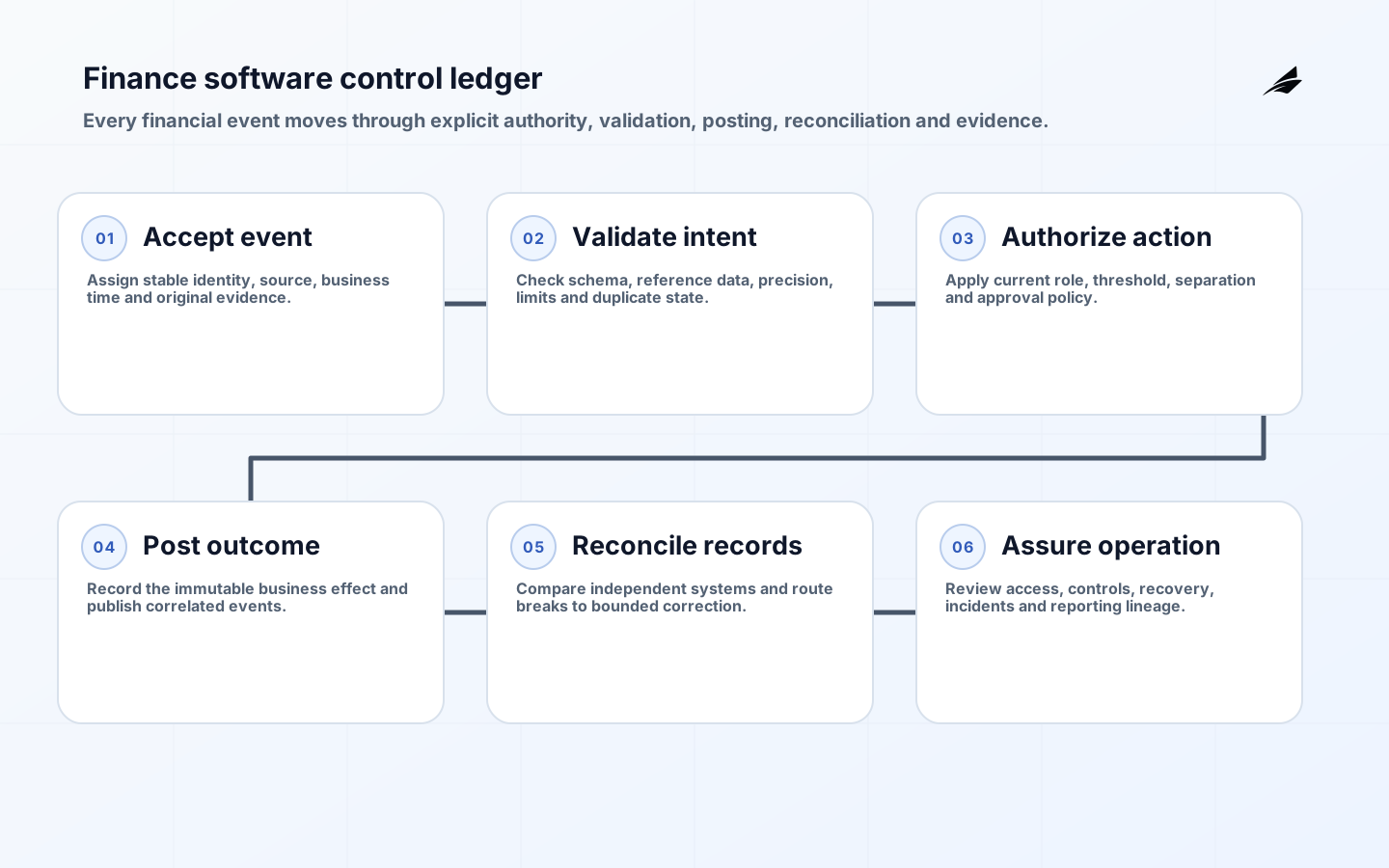
Custom software development for finance must preserve trustworthy records while changing the workflows around them. The relevant product may support lending, treasury, reconciliation, reporting, payments, approvals or internal operations, but the engineering questions repeat: which system is authoritative, who may change a record, how duties are separated, what evidence is retained and how an incomplete transaction is recovered. A professional scope begins with financial events and control objectives rather than a generic list of dashboards.
This guide supports buyers defining a delivery engagement and complements the finance software implementation checklist and finance software FAQ. Regulatory and contractual duties differ by entity, jurisdiction, product and data. The technical plan should make those obligations traceable to controls, but qualified legal, compliance and risk owners must interpret which requirements apply.
Scope the system around financial events and authority
Model the event lifecycle from source through validation, approval, posting, settlement, reconciliation, correction and reporting. Define identifiers, currencies, precision, business dates, time zones and immutable references. Avoid changing a posted record in place when the business requires an adjustment trail; use reversal or correcting entries with links to the original. State which system owns account, customer, transaction and reporting truth, and how downstream copies are refreshed.
Map actors and authority separately from screens. A requester, approver, operator, administrator, auditor and service identity need distinct permissions and evidence. Enforce authorization on the server for every action, including bulk imports, exports, jobs and support tools. Define monetary and risk thresholds, dual control, delegation, temporary access and emergency authority. A workflow is incomplete until expired approval, rejected input, duplicate request and unavailable approver have designed outcomes.
| Control objective | Software behavior | Evidence |
|---|---|---|
| Completeness | Every accepted event reaches a terminal or exception state | Counts and reconciliation status |
| Accuracy | Rules, precision and reference data are versioned | Validation and calculation record |
| Authorization | Every action checks current identity and policy | Decision and actor audit event |
| Segregation | Conflicting duties cannot complete one transaction | Role and approval trail |
| Recoverability | Interrupted processing can resume or compensate | Replay and restore test |
Design deterministic boundaries and idempotent processing
Separate calculation and posting rules from interface code, and version rules whose historical meaning must be reproduced. Use decimal arithmetic and explicit rounding policy for monetary values. Make commands idempotent so client retries or message redelivery cannot create duplicate effects. Persist enough state to distinguish not-started, processing, completed, rejected and outcome-unknown conditions. Generate stable correlation identifiers across API, queue, ledger and external provider records.
Choose synchronous or asynchronous processing from the business promise. A user may receive an accepted reference while settlement continues, but the interface must not represent acceptance as final completion. Use transactional outbox or another proven consistency pattern when database state and published events must remain aligned. Reconciliation is a core subsystem, not a report added later: compare independent records, classify breaks, preserve investigations and limit correction actions.
Specify integration and data contracts
For banking, payment, market, identity, ERP and reporting interfaces, document schema, semantic meaning, authentication, encryption, delivery guarantees, rate limits, calendars, duplicate handling and support ownership. Validate inbound files and messages before they reach authoritative state. Preserve original payload hashes or protected originals where evidence requires it. Version contracts and test backward compatibility; an apparently minor field change can alter a calculation or break downstream reporting.
Classify customer, account, transaction and authentication data. Collect only what the process needs, define retention and deletion or archival rules, and keep sensitive fields out of routine telemetry. Tokenize or isolate payment data to reduce scope where appropriate, confirming actual PCI DSS responsibilities with the relevant parties. Encrypt transport and stored sensitive data, manage keys separately and test rotation. Data lineage should connect reported values to source records and transformations.
Build security and software integrity into delivery
Use NIST SSDF to organize protected repositories, reviewed changes, dependency governance, build integrity, verification and vulnerability response. Apply OWASP ASVS as a control catalogue for authentication, sessions, authorization, validation, cryptography and logging. Threat-model account takeover, insider misuse, injection, replay, enumeration, export abuse and supply-chain compromise. Security tests should include negative authorization and transaction-limit cases, not only scanner output.
A zero-trust approach does not trust a request because it originates on an internal network. Authenticate users and workloads, authorize the requested resource and action, minimize privileges and monitor material activity. Separate production administration from business approval. Use individual, time-bound access for exceptional support, with reason and retrospective review. Maintain a tested response plan that connects technical containment to fraud, legal, communications and business continuity decisions.
Make audit evidence useful without leaking sensitive data
Record identity, action, target, decision, prior and resulting state, rule version, timestamp and correlation reference for consequential events. Protect audit records from alteration, restrict access and define retention. Logs should explain the transaction without copying complete sensitive payloads. Keep operational telemetry, security evidence and financial books related but distinct. Test whether an investigator can reconstruct a sampled transaction and whether support can answer status without privileged database access.
Define user-centered indicators for successful submission, approval, posting, reconciliation and reporting freshness. Observe queue age, rejected records, duplicate attempts, external dependency delay and reconciliation breaks. Alert when timely action is required and assign an owner. Test that dashboards continue during partial failure and that monitoring itself does not expose account or personal data. Financial correctness may require sampled invariant checks in addition to availability and latency.
Test resilience through business recovery scenarios
Set recovery time and recovery point objectives for each business capability, then design backups, replication and runbooks to meet them. Rehearse restoration and verify balances, pending work, external messages and access after recovery. A database restore can reintroduce commands that external systems already processed, so recovery requires reconciliation and idempotency. Include dependency outage, delayed file, corrupted reference data, key unavailability and unavailable approver in exercises.
Use controlled releases with backward-compatible database changes, migration rehearsal, bounded exposure and explicit rollback or forward-repair rules. Separate deployment from feature activation where risk warrants it. A rollback must account for transactions accepted by the new version and cannot assume old code understands new state. Define release windows from business cycles and settlement calendars, but keep an emergency process for critical vulnerabilities.
| Cost driver | Uncertainty | Evidence to obtain |
|---|---|---|
| Control complexity | Approval and duty rules vary | Approved authority matrix |
| Legacy integration | Semantics may be undocumented | Interface traces and sandbox tests |
| Migration | Historical records and open items differ | Profile and reconciliation rehearsal |
| Assurance | Obligations change by product and entity | Control applicability review |
| Resilience | Recovery targets shape architecture | Business impact and exercise scope |
Deliver through evidence-based gates
- Map financial events, authoritative records, actors and control objectives.
- Prove calculations, permissions and exception states in a thin workflow.
- Integrate one real dependency with idempotency and reconciliation.
- Add audit evidence, secure delivery, telemetry and recovery controls.
- Migrate and pilot a bounded account, product or business unit.
- Complete assurance and operational acceptance before wider rollout.

Key takeaways
- Model authoritative events and corrections before interfaces.
- Enforce authorization, limits and separation of duties in code.
- Treat idempotency, reconciliation and audit evidence as core features.
- Test recovery across internal state and external side effects.
- Estimate from controls, integrations, migration and resilience evidence.
Frequently asked questions
Does every finance application need a double-entry ledger?
No. Use the accounting model required by the business record and reporting obligations. However, consequential value changes need clear authority, immutable history and balanced or reconciled outcomes. Consult finance and accounting owners before inventing ledger semantics.
Can financial software run in public cloud?
Often yes, when architecture, configuration, contracts and operating controls meet the applicable risk and regulatory requirements. Cloud use does not transfer the organization’s accountability for data, access, resilience, suppliers or incident decisions.
Where can AI be used safely in finance workflows?
Begin with bounded assistance such as document classification or draft explanation, retain deterministic transaction controls and human authority for consequential decisions, and evaluate errors across relevant cases. Data use, explainability and regulatory implications require specific review.
Procurement and handover should preserve customer control of source, build and cloud accounts, keys, interface specifications and operational records. Define intellectual-property and third-party license treatment, security notification, subcontractors, assurance evidence and exit support. Test the handover by asking the receiving team to deploy a controlled rule change, investigate a sampled transaction and restore a bounded dataset. A folder of documents is not evidence that the finance organization can resume operation safely.
Avoid performance tests that measure only read-heavy demonstrations. Use realistic transaction mixes, approval contention, reporting queries, file arrivals and reconciliation workloads. Verify behavior at boundaries such as end of day, month close, leap day, daylight-saving change and provider cut-off. Preserve deterministic test clocks where business-time rules are involved, and include capacity headroom in production acceptance.
Define the evidence package required for internal audit or an external assessor before building reports. Map each control to the generating system, owner, retention, access and sample test. Automate collection where it preserves meaning, but retain human review for judgment. Evidence should be reproducible from authoritative records; screenshots assembled after the fact are fragile and can conceal that a control did not operate consistently.
Keep reference data such as currencies, calendars, limits and account classifications under controlled ownership. Record effective dates and version changes, validate downstream compatibility and provide a safe correction process. A small reference-data error can affect many otherwise valid transactions, so monitor its use and reconcile after change.
Conclusion
Finance software is credible when every material value change can be authorized, reconstructed, reconciled and recovered. Scope the engagement around financial events and control evidence, then deliver one production slice through realistic dependencies and failure. That discipline creates software that supports faster operations without weakening the trust on which financial processes depend.