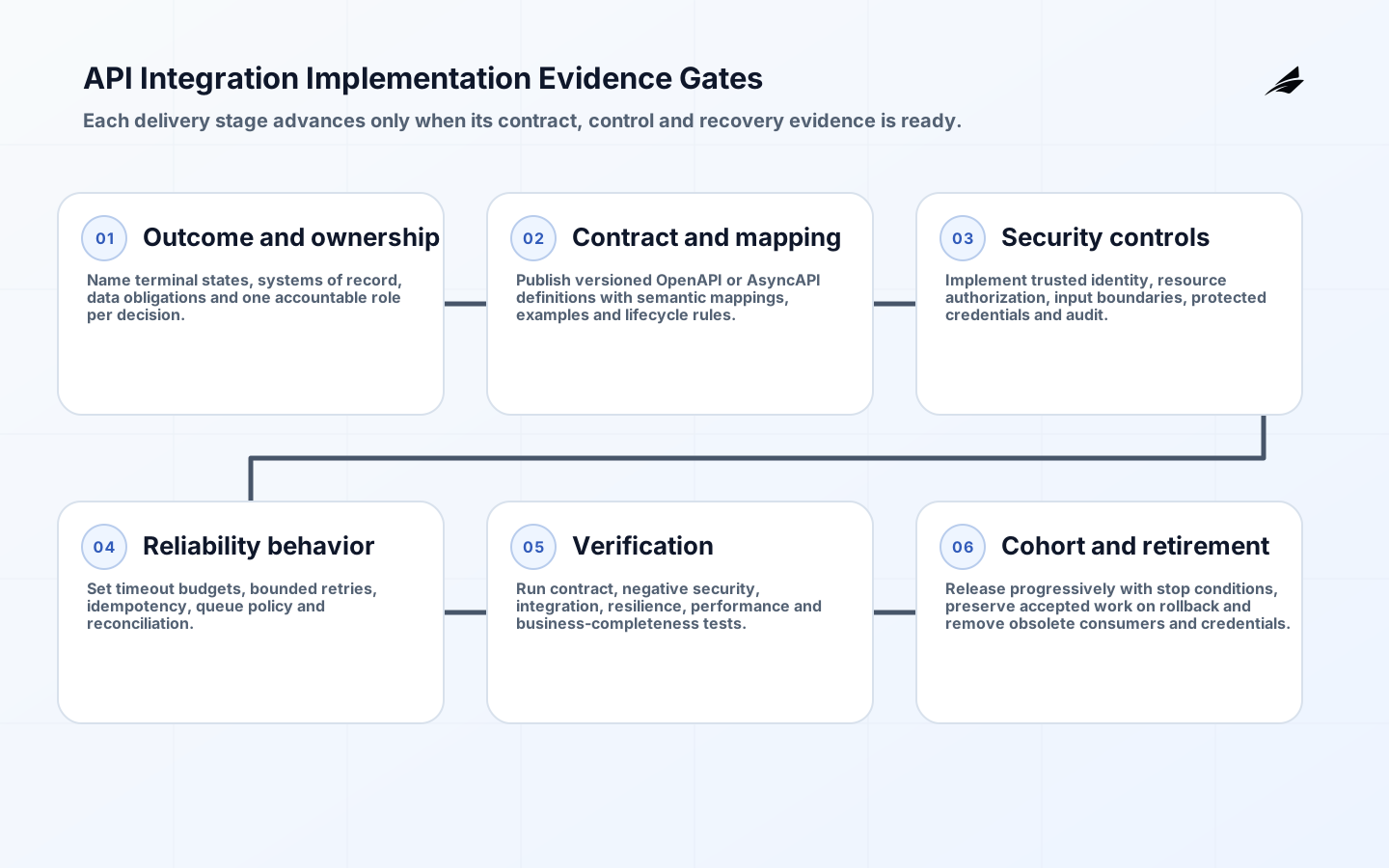
An API integration is complete only when a business transaction can cross system boundaries safely, be understood by both sides, recover from expected failure and remain supportable as contracts change. This checklist organizes implementation around evidence gates. It applies to HTTP APIs, webhooks and event-driven interfaces, with protocol-specific decisions called out where necessary.
Use the checklist in a working review with business, provider, consumer, security, data and operations owners. Mark an item complete only when its artifact or test result exists. For common evaluation questions, see the API integration services FAQ.
1. Frame the outcome and ownership
- Name the business event that starts the integration and the terminal outcome that proves completion.
- Map happy path, validation failure, dependency failure, cancellation, timeout, duplicate and correction.
- Identify authoritative systems for each record and state transition.
- Assign business, provider, consumer, data, security and operational owners.
- Classify data, retention, residency, audit and deletion obligations.
- Define scope boundaries, assumptions, non-goals and approval authority.

Do not begin with an endpoint inventory alone. Draw the business sequence and note where a system accepts work versus completes it. A synchronous 202 response, for example, can indicate acceptance while the business outcome remains pending. Define a durable identifier that follows the transaction through all systems and support tools.
| Artifact | Acceptance question | Owner |
|---|---|---|
| Outcome map | Can every terminal and recoverable state be named? | Business owner |
| System-of-record matrix | Is authority clear for each field and transition? | Data and application owners |
| Responsibility model | Is one role accountable for each decision and incident action? | Program owner |
| Data classification | Are handling controls tied to fields and logs, not only systems? | Data and security owners |
| Success measures | Can the outcome be measured end to end before and after release? | Business and operations owners |
2. Define the contract before implementation
- Create a versioned OpenAPI document for HTTP interfaces or AsyncAPI document for message-driven interfaces.
- Define operation semantics, schemas, required and optional fields, formats, limits and examples.
- Specify status codes, problem types, retry guidance and correlation identifiers.
- Document pagination, filtering, sorting, concurrency and conditional update behavior.
- State ordering, delivery, replay and schema-compatibility expectations for messages.
- Record what constitutes a breaking change and how consumers will be notified and inventoried.
Validate the contract with concrete examples from both teams. A field named status is not meaningful until its allowed values, transitions and owner are known. Separate transport acknowledgement from business completion. Use RFC 9110 semantics consistently and use RFC 9457 problem details where a standard HTTP error representation fits.
3. Map and protect data
Create a field-level mapping from source to target, including type, unit, time zone, format, default, validation, transformation, sensitivity and ownership. Decide how null, absent, zero and empty values differ. Record reference-data mappings and who can approve a change. Avoid silently truncating precision or substituting a default that changes business meaning.
- Profile representative records and edge cases without moving uncontrolled production data into development.
- Define validation at trust boundaries and safe handling for unknown fields.
- Minimize payloads to the fields required for the transaction.
- Define encryption, masking, tokenization and telemetry redaction as applicable.
- Establish retention and deletion behavior for payloads, queues, retries and dead-letter records.
- Design reconciliation totals or state comparisons that reflect the business outcome.
4. Implement identity and authorization
Model each caller as a user, workload, partner or device with an explicit trust path. Select an authentication method appropriate to that client and environment. For OAuth, use RFC 9700's current security guidance. Validate token issuer, audience, expiry and required claims. Keep credentials out of source code and rotate them through a defined process.
| Control | Implementation check | Negative test |
|---|---|---|
| Client identity | Credential is unique, attributable and lifecycle-managed | Revoked or expired credential is rejected. |
| Operation authorization | Scope or role permits only required functions | Read-only caller cannot create, update or delete. |
| Object authorization | Access is checked against the requested resource | Caller cannot access another account or tenant by changing an identifier. |
| Input boundary | Schema and business validation run before side effects | Unexpected properties, oversized input and malformed encodings fail safely. |
| Outbound trust | Destinations, certificates and callbacks are constrained | Unapproved callback or redirect target is rejected. |
| Audit | Security-relevant actions record actor, target, outcome and time | Sensitive values do not appear in the audit record. |
Apply rate and resource controls to sensitive business flows, not merely an undifferentiated request-per-second limit. Consider payload size, expensive queries, fan-out and downstream quotas. A gateway can enforce common controls, but domain services must still authorize the requested object and action.
5. Design timeout, retry and idempotency
Set timeouts from the caller's end-to-end budget and the dependency's observed behavior. Retry only eligible transient outcomes. Bound attempts and elapsed time, add backoff and jitter, and prevent retries from exceeding downstream capacity. Separate retry queues where one consumer or tenant could block others.
For operations with side effects, define a durable idempotency key or business identifier. The provider should detect repeats and return the original outcome or a stable current outcome. Include the ambiguous case in testing: the provider committed the operation, but the response never reached the caller.
- Specify which methods or message outcomes are retryable and which require human review.
- Define deduplication scope, retention and behavior after the retention window.
- Choose ordering guarantees only where the business requires them.
- Define poison-message handling, quarantine access and replay approval.
- Add circuit breaking or load shedding where dependency failure could cascade.
- Document compensation carefully; reversal is a new business action, not database rollback across systems.
6. Build and test against the contract
Generate or validate code from the contract where useful, while reviewing generated assumptions. Provider tests should prove the published interface; consumer tests should prove the expectations each consumer actually relies on. Run contract checks in continuous integration and prevent undocumented breaking changes from reaching deployment.
| Test layer | Purpose | Representative cases |
|---|---|---|
| Schema and contract | Detect interface drift early | Required fields, enum extension, error shape and examples. |
| Component | Verify mappings, validation and rules | Nulls, boundaries, precision, time zones and reference data. |
| Security | Prove deny paths and abuse controls | Wrong audience, excessive scope, object switching and oversized input. |
| Integration | Exercise real protocol and identity boundaries | TLS, DNS, certificates, gateway policy and queue behavior. |
| Resilience | Verify controlled failure behavior | Timeout, dependency slowdown, duplicate, reordering and queue saturation. |
| Reconciliation | Prove business completeness and correctness | Accepted records versus terminal states and correction workflow. |
Use production-like topology and identities without exposing uncontrolled sensitive data. Capture test evidence with contract and build versions. Performance tests should include representative concurrency, payload distributions and downstream limits, not only a single endpoint at peak throughput.
7. Instrument the transaction
Propagate a correlation context across calls, queues and events while respecting trust boundaries. Record contract version, caller, operation, outcome class, latency, retry count and business state needed for support. Do not log bearer tokens, credentials or full sensitive payloads. OpenTelemetry instrumentation can correlate traces, metrics and logs across services.
- Define consumer-centered service indicators such as valid-request success and end-to-end completion age.
- Create alerts with an owner, threshold rationale, investigation link and expected response.
- Monitor dependency latency, retry amplification, queue age, dead letters and reconciliation exceptions.
- Provide support search by safe transaction identifier.
- Test that telemetry survives partial failure and that sampling does not hide critical errors.
- Set retention and access controls for operational data.
8. Prepare migration and rollout
Inventory current consumers, credentials, jobs, files and manual workarounds. Choose a migration pattern that avoids duplicate effects: limited cohort, traffic splitting, shadow read, replay or carefully controlled dual write. Define stop conditions in terms of user impact, correctness, security, latency, queue health and reconciliation.
Rollback must respect completed business transactions. It may mean stopping new submissions and routing future work to the old path while the new path continues processing accepted work. Test the exact rollback procedure and communications before production exposure.
| Rollout stage | Entry evidence | Exit evidence |
|---|---|---|
| Non-writing connectivity | Approved identity, network path and test endpoint | Authenticated calls and denied unauthorized calls are observable. |
| Representative validation | Approved mappings and controlled cases | Expected outputs and errors reconcile. |
| Shadow comparison | No side effects or isolated destination | Differences are explained and within approved criteria. |
| Limited cohort | Runbook, alerts, support and rollback ready | Service objectives and business reconciliation remain healthy. |
| Expansion | Cohort review and capacity headroom | Each wave meets the same acceptance criteria. |
| Retirement | Consumer inventory and retention plan | Old access, jobs, credentials and monitoring are removed. |
Example: customer creation across CRM and billing
A CRM must create a billing account after a customer is approved. The outcome map states that API acceptance is not billing activation. The CRM sends an approval identifier as an idempotency key. The billing service returns an account reference and later emits activation or rejection. Reconciliation finds approved customers without a terminal billing state.
Tests cover duplicate approval, expired credential, validation rejection, response loss after account creation and an activation event delivered twice. Rollout begins with one controlled business unit. If the queue age or reconciliation exceptions exceed the approved condition, new submissions return to the existing process while accepted records finish.
9. Review residual risks
| Residual risk | Decision required | Evidence to retain |
|---|---|---|
| Unknown consumer | Accept, discover or delay retirement | Gateway logs, repository search and owner sign-off. |
| Manual correction | Define authority and dual control where needed | Correction runbook and audit test. |
| Partner outage beyond retention | Define expiry, replay or alternate process | Outage exercise and communication path. |
| Breaking upstream change | Pin, adapt or renegotiate contract | Compatibility test and dependency owner. |
| Sensitive data in telemetry | Redact, tokenize or restrict | Log test and access review. |
| Capacity contention | Quota, isolate or scale | Load test and saturation response. |
Key takeaways
- Begin with an owned business outcome and authoritative state model, not an endpoint count.
- Make contracts machine-readable and supplement them with semantics, examples and lifecycle rules.
- Prove least-privilege authorization and negative paths at every trust boundary.
- Design ambiguous outcomes, bounded retries, idempotency and reconciliation before production.
- Expand through evidence gates and remove the old path only after consumers and records are accounted for.
Frequently asked questions
Which checklist item should happen first?
Frame the outcome, ownership and authoritative records first. Contract and technical choices depend on what completion means and who can decide exceptions.
When is an integration implementation complete?
When the intended outcomes and failures are controlled in production, support ownership is active, reconciliation is healthy, documentation matches deployed behavior and obsolete paths are retired. A successful connectivity test is only an early gate.
Do contract tests replace end-to-end tests?
No. Contract tests catch interface drift efficiently, while integration, resilience, security and reconciliation tests examine behavior that a schema cannot prove. Use a focused set at each layer.
Is dual writing the safest migration?
Not automatically. It can create divergent state and duplicate side effects. Prefer shadow reads or controlled cohorts when they meet the need. If dual write is necessary, define authority, ordering, reconciliation and correction before use.
Conclusion
A disciplined API integration implementation makes correctness and recovery visible before traffic grows. Evidence gates keep business meaning, security, resilience and operations together, allowing teams to release a narrow transaction confidently and extend it without losing control of the boundary.