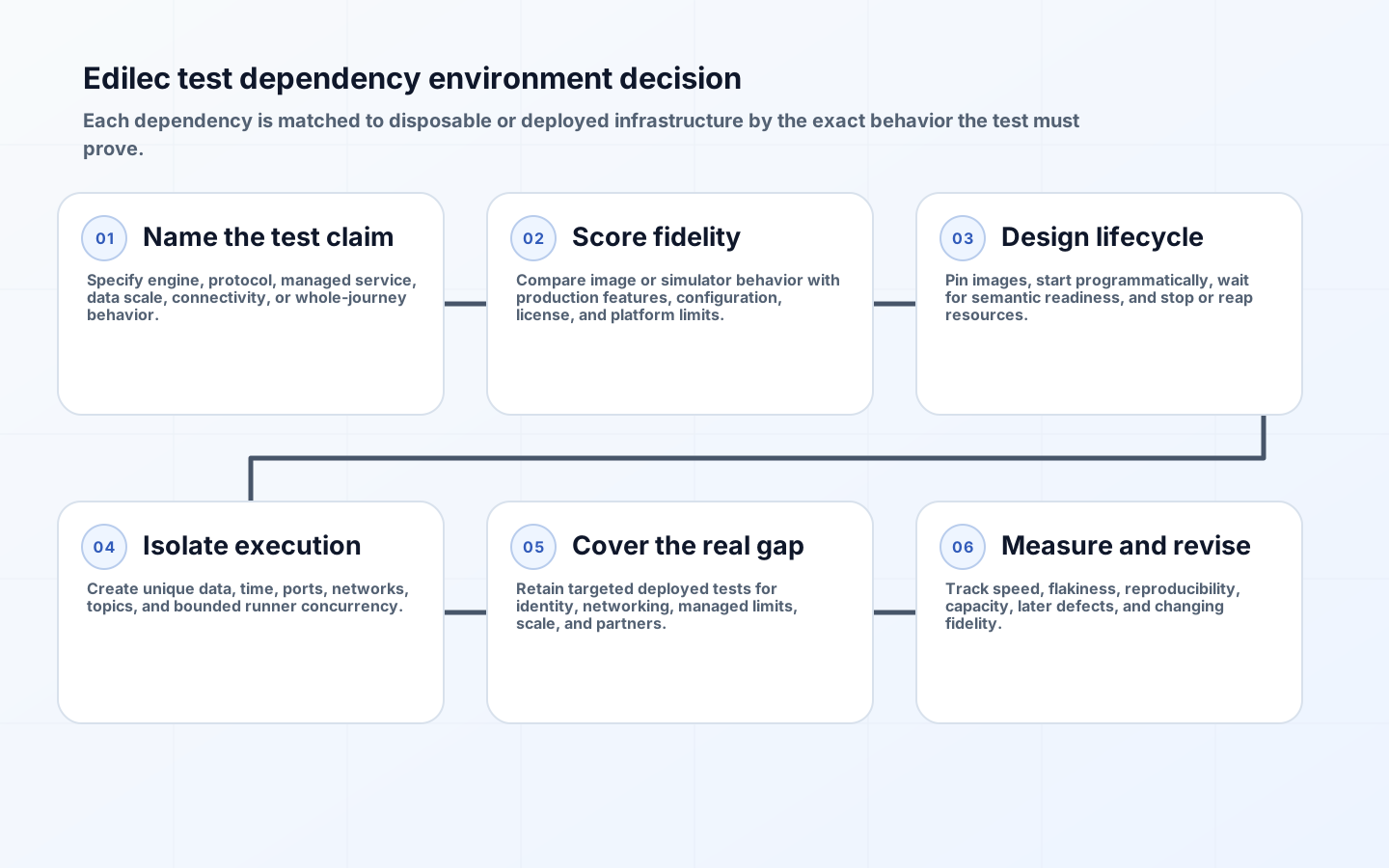
The Testcontainers vs shared test environment decision should be made dependency by dependency, not as a program-wide slogan. Disposable containers give a test a known service version, isolated state, programmable lifecycle, and local reproducibility. Shared environments can provide managed-cloud behavior, large curated data, hardware, enterprise identity, partner connectivity, and whole-system topology that a local container cannot faithfully reproduce.
A strong strategy moves deterministic component integration tests toward disposable infrastructure while retaining a smaller set of shared or ephemeral deployed environments for properties containers do not represent. The payoff is less queueing and cross-test interference without pretending that a database container proves production networking, managed-service limits, upgrade behavior, or organization-wide workflows.
Inventory dependencies and test claims
List every database, broker, cache, search engine, object store, identity provider, external API, browser, hardware device, and internal service used by tests. For each, name the behavior being claimed: SQL semantics, migration validity, retry behavior, IAM integration, regional failover, query plan at scale, or complete user journey. A container is suitable only if it preserves the property the test is supposed to prove.
Testcontainers provides libraries across several languages and modules for common technologies. Its official guides demonstrate provisioning dependencies such as PostgreSQL, Kafka, browsers, and service simulators. Treat modules as lifecycle tooling, not proof of equivalence. Pin the same major and configuration family used in production where practical, and document every deliberate substitute.
Score each dependency for disposable execution
| Criterion | Prefer Testcontainers | Prefer shared or deployed environment | Question to verify |
|---|---|---|---|
| Fidelity | Official image preserves needed protocol and engine behavior | Managed control plane or proprietary feature is central | What exact property differs? |
| Isolation | Tests need clean state and parallelism | Scenario requires shared cross-system state | Can ownership and cleanup be made deterministic? |
| Startup | Service becomes ready within feedback budget | Provisioning is slow or quota constrained | Can lifecycle be suite-scoped safely? |
| Data | Small generated fixtures prove behavior | Production-shaped volume or history is essential | Can synthetic scale reproduce the plan? |
| Connectivity | Dependency is reachable in test network | Partner, hardware, or enterprise identity is required | Can a contract or simulator cover earlier stages? |
| Rights and cost | Image and runtime are permitted and affordable | License or CI capacity forbids broad use | Who owns license and capacity evidence? |
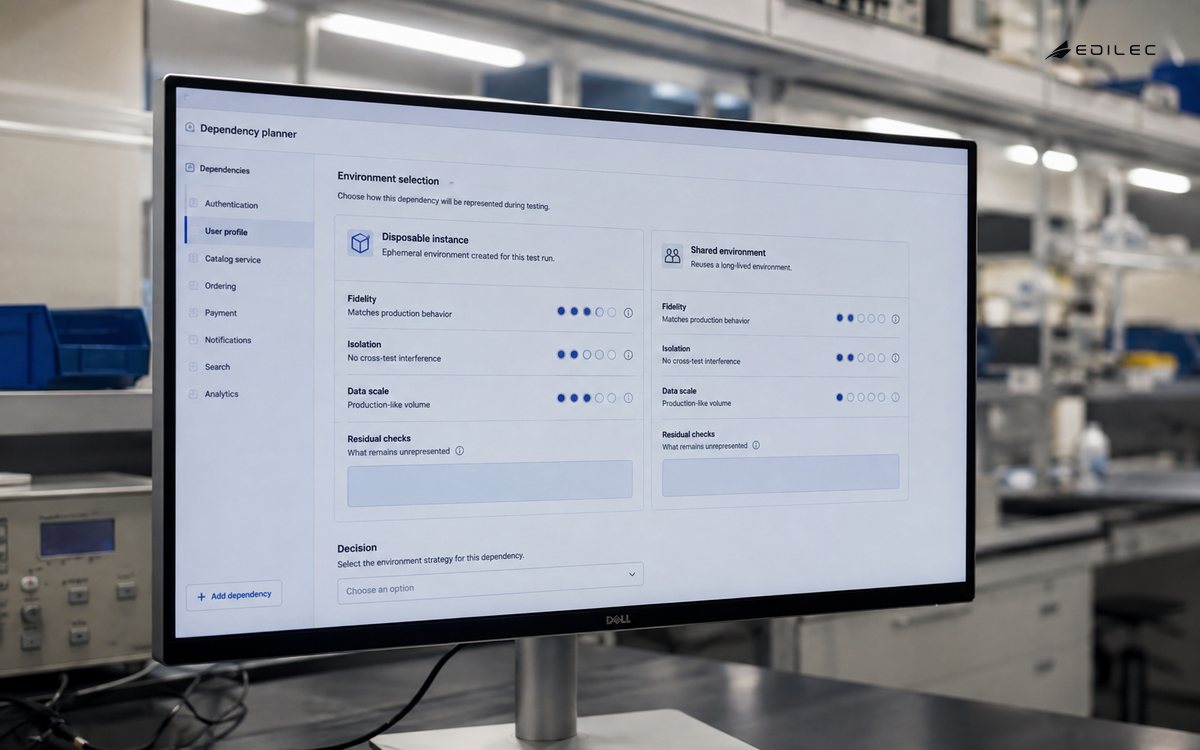
Classify outcome as container by default, container plus scheduled environment test, or environment only. Most relational correctness, schema migration, queue consumption, cache serialization, and protocol error tests fit the first two. Cloud IAM, managed autoscaling, region behavior, huge data plans, and partner certification often require a real environment. Revisit the score when services, licenses, or CI runtimes change.
Design deterministic lifecycle and readiness
Pin image versions or digests through an approved registry, configure the service in code, expose random host ports, use an isolated network, and wait for semantic readiness rather than sleeping. Testcontainers for Java documents startup and wait strategies for ports, logs, health checks, and HTTP responses. Container running is not the same as database accepting migrations or broker leader ready.
Choose lifecycle scope deliberately. Per-test containers maximize isolation but may be expensive. Per-class or per-suite containers reduce startup while requiring unique databases, schemas, topics, buckets, or tenant IDs and reliable cleanup. Java’s manual lifecycle guidance describes explicit start and stop plus a singleton pattern. Avoid accidental lifecycle mismatch between test-framework extensions and application context caching.
undefinedControl data, time, and parallel execution
Create the minimum fixture through public setup APIs, migrations, or owned seed helpers. Avoid a giant anonymous database dump: it slows startup, leaks sensitive data, and makes failures hard to explain. Generate edge cases explicitly. Freeze or inject time when expiration matters, use stable random seeds, and isolate identifiers. A disposable service does not make a test hermetic if it calls the internet, shares a clock-sensitive account, or races on global topic names.
Run tests in parallel only after resource identity is isolated. Give each test or worker a unique database, schema, queue, consumer group, bucket prefix, and application tenant. Limit concurrent heavy containers per agent and measure memory, disk, image-pull, and network pressure. Cache approved images on runners where policy permits, but verify digest and cleanup. Failed tests should retain service logs, configuration, mapped ports, and seed identity as CI artifacts.
Retain a smaller shared-environment purpose
| Layer | Infrastructure | Primary claim | Run cadence |
|---|---|---|---|
| Component integration | Disposable real dependency | Code works with protocol and engine semantics | Every change |
| Contract | Provider implementation plus published consumer expectations | Version compatibility | Consumer and provider builds |
| Service composition | Ephemeral deployed slice | Networking, identity, configuration, and service wiring | Pull request or main branch |
| Managed-service qualification | Real cloud service | Provider-specific limits and behavior | Scheduled and before upgrades |
| End-to-end journey | Controlled shared environment | Critical workflow across deployed system | Selective pre-release and continuous probes |
| Production verification | Progressive exposure and telemetry | Deployment and real operating behavior | Every release |
Define entry criteria and ownership for residual shared environments. Version deployments, reset or provision tenant-scoped data, reserve test accounts, expose health and dependency status, and prevent teams from treating one mutable stage as release truth. Queueing for a scarce environment is a signal to move lower-level claims earlier or create ephemeral slices, not to add more unowned stages.
Testcontainers for .NET describes throwaway Docker containers, random port binding, wait strategies, and Docker-API-compatible runtime requirements in its current documentation. Runtime support differs across languages and CI platforms. Validate rootless, remote, or alternative runtimes with the chosen library; do not assume every Docker-compatible implementation supports every feature.
Migrate incrementally and measure the result
Select a high-pain dependency whose shared test failures are frequent and whose container fidelity is strong. Reproduce one representative test locally, add readiness and diagnostics, parallelize carefully, then compare failure detection against the shared environment for several weeks. Move tests in coherent groups and delete their shared fixtures only after coverage is demonstrated. Keep the residual environment test that proves a distinct property.
Measure median and tail feedback time, queue wait, startup share, flaky reruns, failure reproducibility, runner resource minutes, image-pull failures, escaped resource cleanup, and defects found only later. Java documentation still marks reusable containers experimental and not suited to CI, so do not base CI economics on that feature without rechecking current support. Optimize suite scope and runner capacity first.
Supply-chain controls apply to test images too. Pull through an approved registry, scan images according to policy, pin versions, retain license evidence, and update on a managed cadence. A years-old database image may make tests stable while concealing production incompatibility and known vulnerabilities. Run compatibility jobs against the next supported production version before upgrades, then change the default only after failures are understood.
Fault injection is a strong reason to own the dependency lifecycle. Add a network proxy or container controls to test latency, disconnects, reset connections, unavailable leaders, and recovery. Assert bounded retries, transaction outcome, and diagnostics. Do not make every test chaotic; keep focused fault scenarios deterministic and separate from ordinary correctness so failures remain interpretable.
Developer experience matters. The same test should run from the IDE and CI with automatic ports and no secret local setup. Provide a supported runtime check, clear error when the container engine is unavailable, and a documented alternative for restricted workstations. Keep production credentials entirely out of the path. A test suite that is theoretically reproducible but requires tribal setup will drift back to the shared environment.
Retain a small qualification suite for container-image differences. Validate collation, extensions, time zone, authentication mode, filesystem behavior, architecture, and startup configuration against production. Where an official local emulator differs from the managed service, list unsupported properties and ensure a real-service test covers them. Fidelity is a maintained claim, not a one-time decision.
Key takeaways
- Choose infrastructure based on the property each test claims, not tool preference.
- Use containers for reproducible engine and protocol behavior; keep real environments for managed, scaled, connected, and whole-system properties.
- Pin images, wait for semantic readiness, isolate state, and capture dependency diagnostics.
- Control parallelism across database, queue, cache, network, and runner resources.
- Migrate one dependency at a time and retain only shared tests that prove a distinct risk.
Frequently asked questions
Are Testcontainers tests unit tests?
Usually they are integration tests because they exercise an external process through a real protocol. They can still be fast, isolated, and run on every change. Classification should reflect the tested boundary, not execution time.
Do containers eliminate mocks and fakes?
No. A fake clock, deterministic payment simulator, or fault-injection proxy may express a test more precisely. Use a real container when implementation semantics matter, a contract or simulator for controlled external behavior, and production qualification where neither reproduces the risk.
Should an entire application stack run in containers for every test?
Generally no. Start the smallest dependency set that proves the claim. Large stacks increase startup, diagnosis, and hidden coupling. Reserve composed stacks for a smaller number of wiring or journey tests.
Conclusion
Disposable dependencies improve integration feedback when they reproduce the behavior under test and remain operationally cheap. Shared environments remain valuable for a narrower set of real-platform and system claims. An evidence-based portfolio uses each where it pays, which gives developers reproducibility without sacrificing confidence in the production properties containers cannot simulate.