API integration services connect applications so that a business event in one system can trigger a reliable, authorized outcome in another. The visible endpoint is only a small part of the work. A production integration also needs clear data ownership, contract semantics, identity, failure handling, observability, support and a controlled way to change either side. Teams that define those responsibilities before implementation are better placed to estimate effort and avoid a connection that works in a demonstration but fails under ordinary operational pressure.
Start with the business transaction, not the endpoint
Describe the outcome as a complete transaction: for example, when an approved order enters the commerce system, create the corresponding fulfillment request, preserve the originating identifier and return a status that service staff can see. Identify the system of record for every important field and state. If both systems may edit a customer address or order status, define which authority wins, when synchronization occurs and how conflicts reach a person. This prevents an apparently technical interface from silently creating a second, inconsistent business process.
Discovery should include every participant: API producer, consumer, identity provider, network path, queues, scheduled jobs, data stores and operational teams. Capture expected and peak demand, payload sizes, latency needs, data classifications, maintenance windows, retention and recovery expectations. Include downstream consumers that receive copied data. An integration boundary can change the security and compliance exposure of information even when the source application itself is unchanged.
| Scope question | Decision to record | Useful evidence |
|---|---|---|
| What starts the flow? | User action, event, schedule or external callback | Journey map and sample events |
| Who owns each record? | Authoritative source by field and lifecycle state | Data dictionary and stewardship decision |
| What does success mean? | Accepted, completed, eventually reconciled or rejected | State model and acceptance examples |
| How much demand is expected? | Normal, peak, burst and batch volume | Traffic history and forecast assumptions |
| What must be protected? | Classification, permitted use, retention and residency | Control register and data-flow map |
| Who runs it? | Release, incident, supplier and business owners | Support model and escalation path |
Choose the integration pattern around timing and failure
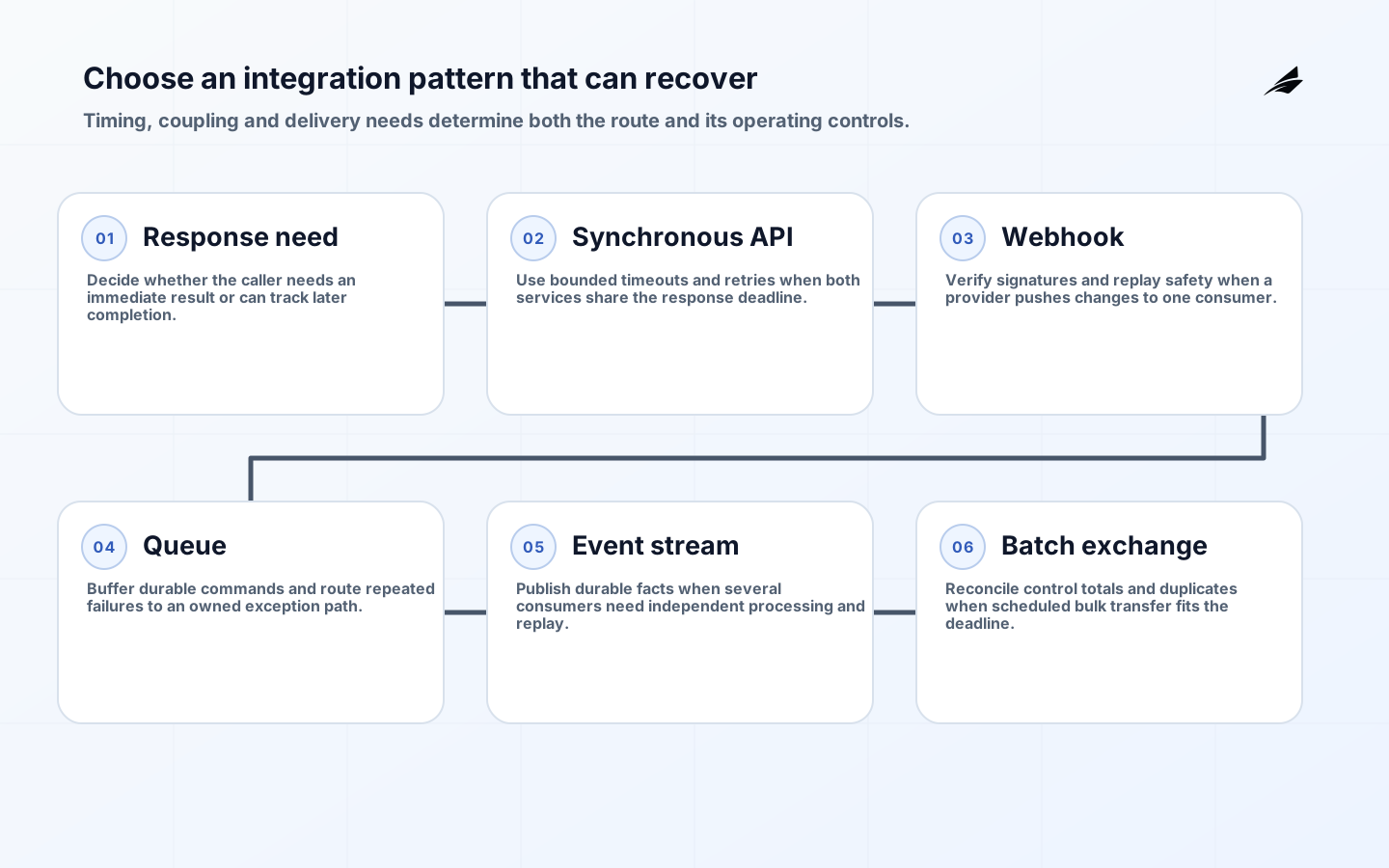
A synchronous request is appropriate when the caller needs an immediate answer and both services can meet the same availability and latency expectation. Messaging or event delivery is usually a better fit when work may take time, bursts need buffering or the receiving service can be temporarily unavailable. Batch transfer remains reasonable for high-volume reconciliation or systems without suitable real-time interfaces. The decision is not a contest between modern and old technology; it should reflect the business deadline, consistency need and operating capabilities.

| Pattern | Good fit | Design obligation |
|---|---|---|
| Synchronous API | Immediate validation or retrieval | Timeout budget, bounded retries and clear error semantics |
| Webhook | Provider pushes a change to a known consumer | Signature verification, replay protection and redelivery |
| Queue or command | Work can complete asynchronously | Idempotent consumer, dead-letter handling and status visibility |
| Event stream | Multiple consumers react to durable facts | Schema evolution, ordering assumptions and replay policy |
| Batch or managed file | Scheduled bulk exchange or constrained legacy system | Encryption, control totals, duplicate detection and reconciliation |
Make the API contract an operated product
Use an explicit contract that defines operations, schemas, required fields, error responses, authentication and examples. The OpenAPI Specification provides a machine-readable description for HTTP APIs, while RFC 9110 supplies the underlying method and response semantics. A contract can drive documentation, validation and test fixtures, but it does not decide business meaning. Define units, time zones, identifiers, nullable fields, enumeration behavior and whether omission means unknown, unchanged or deleted.
Plan compatibility before the first release. Producers should normally add optional fields without changing existing meaning and should tolerate older consumers during a stated transition. Consumers should ignore fields they do not understand unless the contract says otherwise. Breaking changes need a version policy, consumer inventory, migration window and retirement evidence. Versioning a URL does not by itself protect a consumer from a changed interpretation or undocumented validation rule.
Design security for every trust boundary
Authenticate the calling workload and authorize the specific operation and object, not merely access to the gateway. Use short-lived credentials where the platform supports them, store secrets in an appropriate secrets service and rotate them without coordinated downtime. RFC 9700 is the current OAuth 2.0 security best-current-practice reference; it includes stronger guidance on redirect matching, PKCE, token replay and deprecated flows. Select an authorization pattern only after identifying whether the actor is a user, a service or both.
OWASP's API security guidance highlights broken object- and function-level authorization, unrestricted resource consumption, inadequate inventory and risks from trusting third-party responses. Apply request and response validation, object-level permission checks, rate and size limits, egress controls and careful handling of remote content. Log security-relevant decisions without recording tokens or unnecessary sensitive payloads. NIST's SSDF adds the organizational practices needed to protect build systems, review dependencies and respond to discovered vulnerabilities.
Estimate API integration cost from uncertainty and operation
There is no credible universal price per endpoint. A read-only connection to a mature, documented API is materially different from a bidirectional workflow with poor source data, a vendor sandbox and strict recovery needs. Estimate discovery, contract design, implementation, environments, security, data mapping, testing, release and ongoing support separately. Express early estimates as ranges tied to assumptions, then narrow them after a proof using representative data and the real authentication path.
| Cost driver | Why it changes effort | How to reduce uncertainty |
|---|---|---|
| Contract maturity | Ambiguous behavior creates investigation and rework | Run sample calls and document edge cases |
| Data transformation | Different identifiers and meanings require mapping | Profile representative records and agree ownership |
| Workflow criticality | Financial or safety impact raises control and test depth | Classify transactions and define recovery |
| Partner constraints | Limited sandboxes, quotas or release windows slow feedback | Confirm access and calendar during discovery |
| Failure model | Retries, compensation and reconciliation add durable state | Model timeout and partial-success scenarios |
| Operations | Monitoring, on-call and certificate rotation continue after launch | Price the support model and platform consumption |
Test the contract, the journey and the failure path
Combine schema and contract tests with business examples, authorization tests, performance checks and end-to-end reconciliation. Test expired credentials, duplicate delivery, delayed messages, malformed payloads, partial outages, quota responses and changed field ordering. Avoid making every pre-production test depend on an unstable partner environment: use contract-based simulators for repeatability, then reserve a smaller suite for real-system verification. Production-like tests must use governed data rather than unreviewed copies of live records.
Observability should connect the business identifier to technical evidence across the flow. W3C Trace Context standardizes trace propagation, but trace identifiers are only useful when both sides preserve them and dashboards expose meaningful stages. Monitor acceptance, completion, rejection, lag, retry age, dead-letter volume and reconciliation differences alongside latency and error rate. Alerts need owners and actionable thresholds; a chart that nobody is accountable for is not an operating control.
Example: connecting orders to fulfillment
Consider an online order service that must send approved orders to a warehouse platform. The order service remains authoritative for customer intent and payment approval; the warehouse owns picking and shipment states. Instead of holding the checkout request open, the order service records approval and publishes a durable order-ready event with a stable order identifier. The warehouse consumer validates the schema, deduplicates by that identifier, creates work and returns status events. Service staff see a pending state while asynchronous work continues.
If the warehouse times out after accepting an order, the consumer checks status before retrying. Events that repeatedly fail move to a controlled exception queue with the payload reference, reason and owner. A daily reconciliation compares approved orders with warehouse acknowledgements and shipment states. This design does not promise that failures disappear; it makes uncertain outcomes visible and recoverable without asking staff to infer truth from two screens.
Manage integration risks explicitly
| Risk | Control | Early warning |
|---|---|---|
| Duplicate side effects | Idempotency key and status lookup before retry | Repeated business identifiers |
| Silent data drift | Schema checks and field-level reconciliation | Growing correction queue |
| Authorization gap | Object and function checks with negative tests | Unexpected cross-account access |
| Cascading outage | Timeout budgets, circuit breaking and buffering | Retry volume and dependency saturation |
| Breaking provider change | Consumer inventory, contract tests and version notice | Sandbox or schema difference |
| Unknown ownership | Named service owner and incident runbook | Alerts without acknowledgement |
A practical API integration delivery plan
- Frame the business transaction, owner, service expectation, data authority and non-goals.
- Discover real contracts, access paths, representative data, dependency limits and support constraints.
- Design the state model, integration pattern, security controls, version policy and reconciliation method.
- Prove one end-to-end path, including authentication, duplicate handling, observability and a forced failure.
- Release to a limited workload or consumer cohort, compare outcomes and keep a tested rollback or pause path.
- Expand gradually, hand over runbooks and dashboards, then remove temporary adapters, credentials and duplicate jobs.
A release gate should use evidence, not a calendar alone. Confirm that expected transactions complete, differences reconcile, access is least-privileged, alerts reach the correct team and recovery has been exercised. During progressive rollout, cap traffic or eligible transaction types and define a pause threshold. Rollback may mean stopping new messages and draining safely rather than reversing transactions already accepted by the destination.
Key takeaways
- Scope an integration as a business transaction with explicit data and state ownership.
- Select synchronous, event, queue or batch patterns according to timing and failure needs.
- Treat contracts, authorization, idempotency, observability and reconciliation as core scope.
- Estimate from data complexity, partner constraints, control depth and ongoing operation, not endpoint count.
- Roll out progressively with measurable gates, owned exceptions and a tested pause or rollback path.
Frequently asked questions
How long does an API integration take?
Duration depends on contract maturity, access, data mapping, workflow criticality and testing constraints. A short discovery and representative proof provide better evidence than a generic timeline. Include partner approval and release windows in the plan.
Do we need an API gateway?
A gateway can centralize routing, authentication enforcement, quotas and telemetry, but it does not replace object authorization, business validation or service ownership. Use one when those shared controls justify the additional platform and operating responsibility.
Should we use REST APIs or events?
Use request-response when the caller needs an immediate result. Use events when consumers react independently to a durable fact or work can continue asynchronously. Many reliable workflows use both, with clear authority and correlation between them.
Build connections that remain trustworthy
A successful API integration is not merely connected; it remains understandable when traffic rises, credentials rotate, either system changes or a request ends in uncertainty. Define the transaction and ownership first, prove the difficult paths early, and make operational evidence part of delivery. That is the foundation for an integration that can evolve without turning every change into a coordinated emergency.