An enterprise SaaS integration is ready only when the business outcome, contract, access model, failure behavior and operating owner are ready together. This checklist is organized as delivery gates so a team can expose missing decisions before they become production incidents. It works for direct APIs, an integration platform, event-driven middleware or a mixed estate.
Use each item as an evidence request, not a box to tick from memory. Tailor the depth to transaction criticality and data sensitivity. A low-risk notification and a financial posting should not carry the same controls, yet both need a named owner and a defined response when delivery fails.
Gate 1: Frame the workflow and ownership
Describe the user or system trigger, the business outcome and the record that proves completion. Map every handoff, including manual review and correction. Identify systems of record by field rather than calling an entire application authoritative. Record legal, retention, residency and contractual constraints with the relevant owner.
- Business outcome and measurable service expectation are approved.
- Producer, consumer, system-of-record and support owners are named.
- In-scope records, operations, cohorts and environments are listed.
- Manual exceptions and current workarounds are observed with real users.
- Out-of-scope workflows and dependencies are explicit.
- Decision, security and production-approval authority is documented.
Exit this gate when owners agree on a scenario narrative and can trace at least one representative record from trigger to final state. A process diagram that omits rejected, duplicated or delayed work is not sufficient.
Gate 2: Inventory provider and enterprise capabilities
Review official API documentation, service limits, authentication methods, event delivery, sandbox behavior, support terms, change notices and data export. Confirm that the purchased SaaS edition exposes the required capability; public documentation does not guarantee tenant entitlement. Inventory enterprise network paths, identity services, secret stores, queues and monitoring.
| Capability | Evidence to collect | Decision |
|---|---|---|
| API and events | Version, operations, schemas, limits, change policy | Supported contract and fallback |
| Identity | OAuth or workload options, SCIM support, tenant model | Authentication and provisioning pattern |
| Environments | Sandbox parity, test accounts, reset process | Test limitations and compensating checks |
| Operations | Status page, support path, correlation data | Incident and escalation route |
| Exit | Export formats, deletion behavior, retention | Migration and termination plan |
- Required licenses and tenant settings are confirmed.
- Rate, payload, pagination and concurrency limits are recorded.
- Provider deprecation and maintenance channels have an owner.
- Sandbox differences from production are listed.
- Data export, deletion and account termination have been tested or planned.
Gate 3: Define API, event and data contracts
Describe HTTP APIs with a machine-readable specification such as OpenAPI and put the reviewed version under change control. Define event type, producer, subject, schema, ordering, duplication and delivery expectation. CloudEvents can provide a common event envelope, but business semantics still require explicit definitions.
Map identifiers, enumerations, currencies, timestamps, units, locale, nullability and deletion state. Preserve provider identifiers and define a canonical identifier only where the organization can govern it. For each transformation, state whether invalid input is rejected, defaulted or quarantined. Avoid defaults that create plausible but false records.
- Operations, request and response schemas, examples and status codes are versioned.
- RFC 9457-style problem types or an equivalent stable error contract are defined.
- Schema compatibility rules and deprecation periods are agreed.
- Field-level source authority and transformation rules are approved.
- Time zone, precision, encoding, attachment and size behavior is tested.
- Personal and sensitive fields are minimized and classified.
Gate 4: Design identity, authorization and secrets
Create separate flows for interactive users, background workloads and provisioning. Apply current OAuth guidance from RFC 9700 where OAuth is used, including exact redirect handling, suitable authorization-code protections and constrained tokens. OpenID Connect addresses authentication; it does not replace business authorization. SCIM can standardize provisioning while leaving role and lifecycle policy to the enterprise.
| Control | Implementation question | Evidence |
|---|---|---|
| Least privilege | Which operation and resource does each identity need? | Scope and role matrix with negative tests |
| Credential lifecycle | Who issues, rotates and revokes credentials? | Automated rotation record and emergency procedure |
| Tenant isolation | How is destination tenant bound and verified? | Configuration validation and cross-tenant test |
| Data protection | What is encrypted, redacted and retained? | Data-flow review and logging test |
| Audit | Can a decision be linked to actor and contract version? | Tamper-protected event with correlation ID |
- Threat model covers token theft, replay, confused deputy and tenant mix-up.
- Secrets are stored outside code and deployment manifests.
- Production access uses approved identities, not shared personal accounts.
- Authorization is enforced by the resource service, not UI visibility.
- Logs exclude credentials and unnecessary sensitive payloads.
- Revocation and incident credential rotation are rehearsed.
Gate 5: Specify failure, retry and consistency behavior
For every operation, decide whether repetition is safe and how an unknown result is resolved. Writes should carry a stable operation or idempotency key when the provider supports it. A timeout after submission requires status inquiry or reconciliation before replay. Bound retries so one outage does not create an uncontrolled backlog.
- Retryable and terminal failures are classified by stable error type.
- Backoff, jitter, attempt limits and priority rules are configured.
- Rate-limit headers and provider quotas are honored.
- Duplicate events and repeated writes do not duplicate business effects.
- Dead-letter or quarantine records include safe diagnostic context and an owner.
- Reconciliation compares business state, not only message counts.
Gate 6: Build for supportability
Instrument the integration around business stages: accepted, validated, authorized, sent, acknowledged, completed and reconciled. Use correlation identifiers across services while respecting data minimization. Metrics should reveal latency, error types, backlog age, reconciliation differences and provider-limit pressure. Logs should answer what happened without exposing secrets.
Create dashboards and alerts with actionable thresholds. An alert needs an owner, response step and severity based on business impact. Add runbooks for token failure, provider outage, schema rejection, queue growth and incorrect destination. Verify that support staff can locate a record from a business identifier and understand its current state.
Gate 7: Produce production-relevant test evidence
Run contract tests for provider and consumer, transformation tests with edge records, negative authorization tests and end-to-end business tests. Exercise duplicate delivery, reordered events, expired tokens, revoked users, partial batches, throttling, timeouts and provider downtime. Verify recovery after the failure, not just the alert.
| Test layer | Representative question | Pass evidence |
|---|---|---|
| Contract | Does implementation match the reviewed API or event schema? | Automated conformance result |
| Data | Do boundary and malformed values produce safe outcomes? | Mapping and quarantine results |
| Security | Are forbidden tenant and operation combinations denied? | Negative authorization report |
| Resilience | Can the system recover without duplicate effects? | Fault exercise and reconciliation |
| Operations | Can support diagnose and resolve an exception? | Runbook exercise with timestamps |
- Test data is representative, approved and protected.
- Performance tests model expected bursts within provider terms.
- Monitoring and alert delivery are tested in the target environment.
- Backup, replay and disaster-recovery assumptions are exercised.
- Known limitations and residual risks have named acceptors.
Gate 8: Plan rollout, rollback and reconciliation
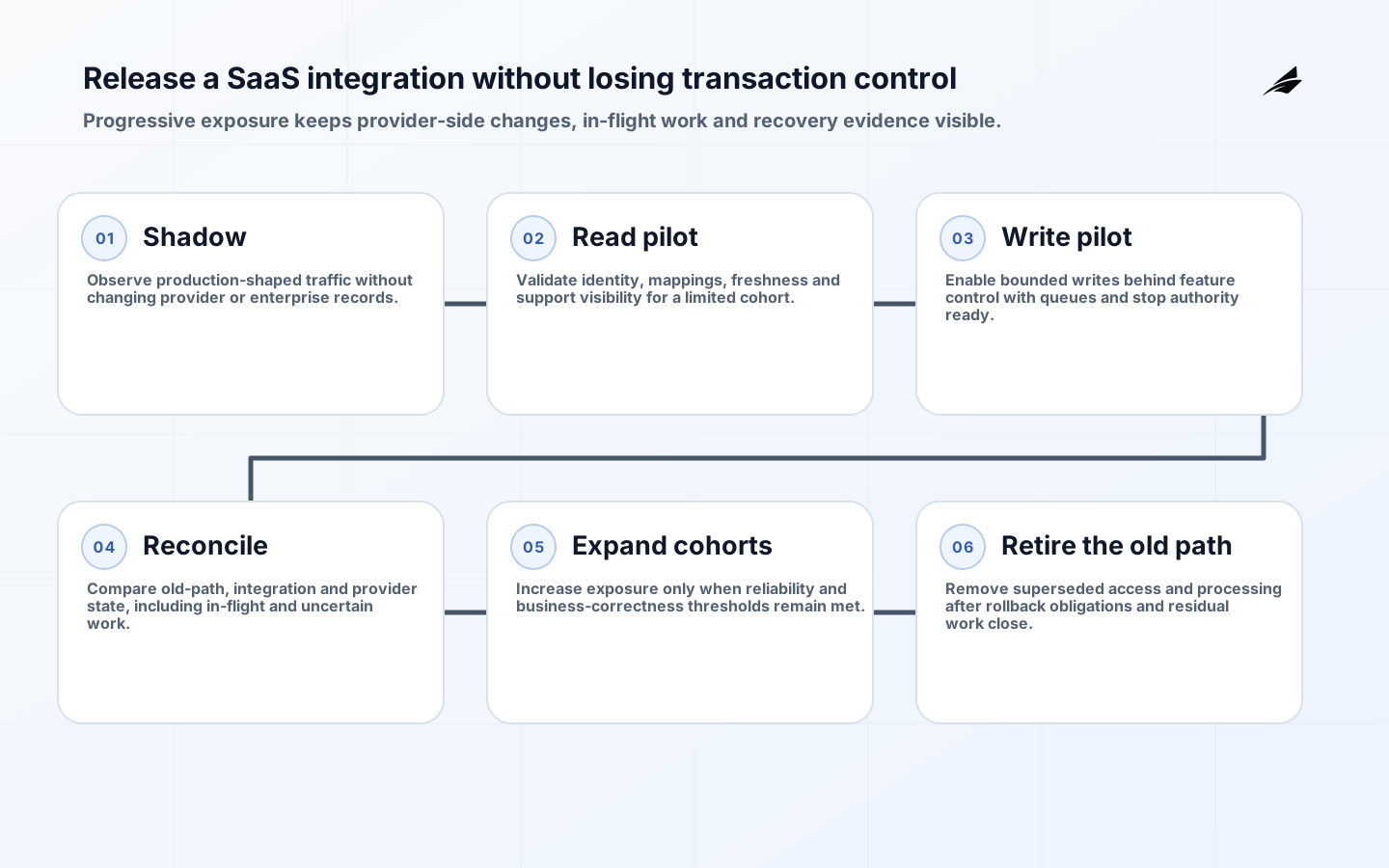
Release by a bounded cohort, operation or data domain. Begin with read-only or shadow comparison when feasible, then enable writes behind controls. Define go, hold and rollback thresholds before the launch window. Rollback must address queued and in-flight work, credentials, state written to the provider and user communication.

- Pilot cohort and support coverage are confirmed.
- Old and new paths have an explicit coexistence rule.
- Feature controls can stop writes without hiding queued work.
- Reconciliation reports compare both paths and final business state.
- Rollback ownership, decision threshold and communication are rehearsed.
- Retirement waits for backlog clearance, evidence retention and access removal.
Gate 9: Transfer into supported operation
Hand over source, configuration, contracts, dashboards, runbooks, access procedures and known risks. Put provider notices, certificate and secret rotation, access reviews and restore tests on a calendar. Define how consumer requests and breaking changes are assessed. A connection without funded maintenance becomes a latent dependency.
Review service outcomes regularly: completed business transactions, latency, exception age, reconciliation differences, security events, support effort and change failure. Use findings to change the contract, workflow or controls. Do not optimize transport throughput while operators are manually repairing outcomes.
Keep one implementation evidence register
Maintain a concise register linking each gate to its owner, artifact, review date, decision and open risk. This is more useful than a large document set with unclear status. Keep the register with the delivery repository and update it through rollout. For high-impact workflows, require independent security or assurance review proportionate to risk.
| Gate | Minimum release artifact | Accountable role |
|---|---|---|
| Workflow | Approved scenario and ownership map | Business owner |
| Contracts | Versioned API, event and mapping definitions | Technical owner |
| Security | Threat model, access matrix and test evidence | Security owner |
| Reliability | Failure policy and reconciliation design | Service owner |
| Release | Go/hold/rollback record and support readiness | Production approver |
Run a preflight release review
Before the production window, walk one normal, one denied, one duplicated and one uncertain transaction through the target environment. Confirm the deployed contract and mapping versions, destination tenant, active credentials, feature controls, alert delivery, support roster and reconciliation query. Record actual evidence links in the release decision; do not rely on a statement that testing passed somewhere else.
The reviewer should be able to answer three questions quickly: how writes can be stopped, how in-flight work remains visible and who can authorize resumption. Confirm the provider status and planned maintenance, but do not treat a green status page as a guarantee. If an assumption changed after the last rehearsal, hold the release until its effect is understood.
- Deployment artifact and contract versions match the approved evidence.
- Production tenant, endpoint and scopes are independently verified.
- Queues, alerts, dashboards and correlation searches are visible to support.
- Stop, rollback, reconciliation and resumption authority is present.
- The first post-release review time and owner are scheduled.
Key takeaways
- Treat every checklist item as evidence with a named owner.
- Define contracts, data authority and error semantics before implementation.
- Test authorization, unknown outcomes and recovery, not only happy-path connectivity.
- Roll out by bounded cohorts with reconciliation and controllable writes.
- Fund provider-change management, access review and support after launch.
Frequently asked questions
Is this checklist too much for a small integration?
Tailor depth, not responsibility. A small low-impact connection may use a short record, but it still needs an owner, contract, credential lifecycle, failure behavior and support path.
Can a prebuilt connector skip these gates?
No. A connector may implement protocol and mapping primitives. The enterprise remains responsible for business meaning, permissions, exceptions, monitoring, reconciliation and provider-change impact.
When is an integration done?
Delivery is complete when the bounded workflow meets acceptance criteria, residual risks are accepted, operators can support it and recurring ownership is funded. Ongoing provider and enterprise changes remain operational work.
Who approves production release?
Approval should combine business outcome ownership, technical readiness, security risk and operational readiness. The exact forum can be lightweight, but authority and evidence should be explicit.
Conclusion
This checklist turns integration readiness into a series of observable decisions. Teams that prove authority, contracts, security, failure behavior and support before broad rollout can move faster with fewer surprises. The goal is not paperwork; it is a workflow that remains correct when credentials expire, records are imperfect and providers change.