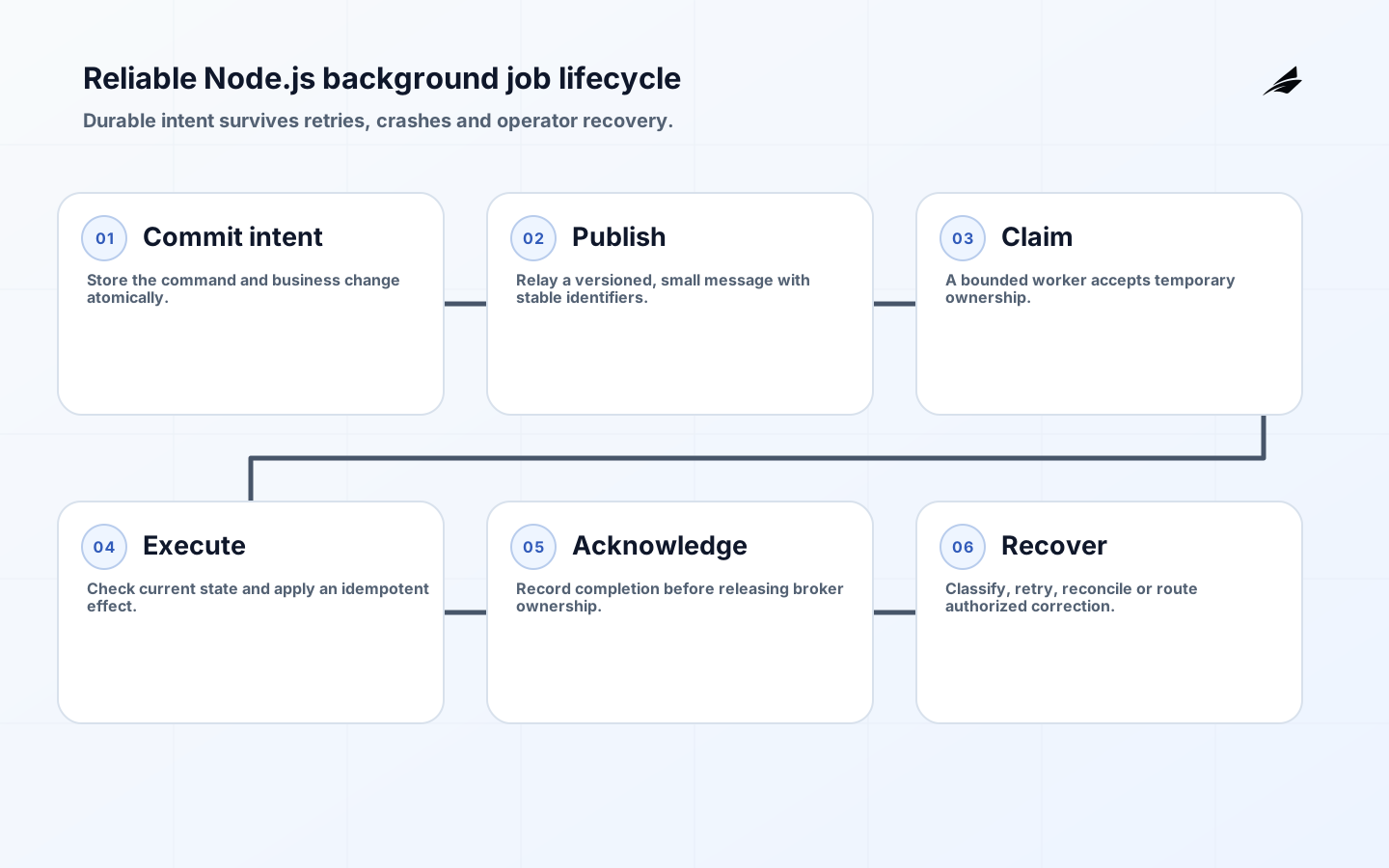
Node.js background jobs for workflow automation move work that should not keep an HTTP request open: generate documents, synchronize records, send notifications, process imports, run approvals or call slow partner APIs. The hard problem is not starting asynchronous code. It is preserving a business commitment when the process crashes, a message is delivered twice, a dependency times out or an operator needs to understand what happened. A reliable design treats each job as a durable state transition with ownership and evidence.
Node worker threads and distributed job queues solve different problems. Worker threads provide parallel execution for CPU-intensive JavaScript inside a process; Node's documentation notes that they do not add much for ordinary asynchronous I/O. A durable queue coordinates work across process and machine failure. Many systems use a queue for ownership and may use a worker-thread pool inside a consumer for bounded CPU work. This guide connects those mechanisms to business workflow reliability and the related API versioning guide.
Define the job as a business command
A job should express an intended outcome with stable identifiers and a versioned payload. Prefer CreateInvoiceDocument with invoice ID and expected version over RunTask containing a large serialized object. The worker can load current authoritative state, check preconditions and record the result. Keep the message small, avoid secrets and decide whether the command may still run after data changes. Include correlation, tenant, actor or authority reference, creation time and idempotency key where those facts are required.
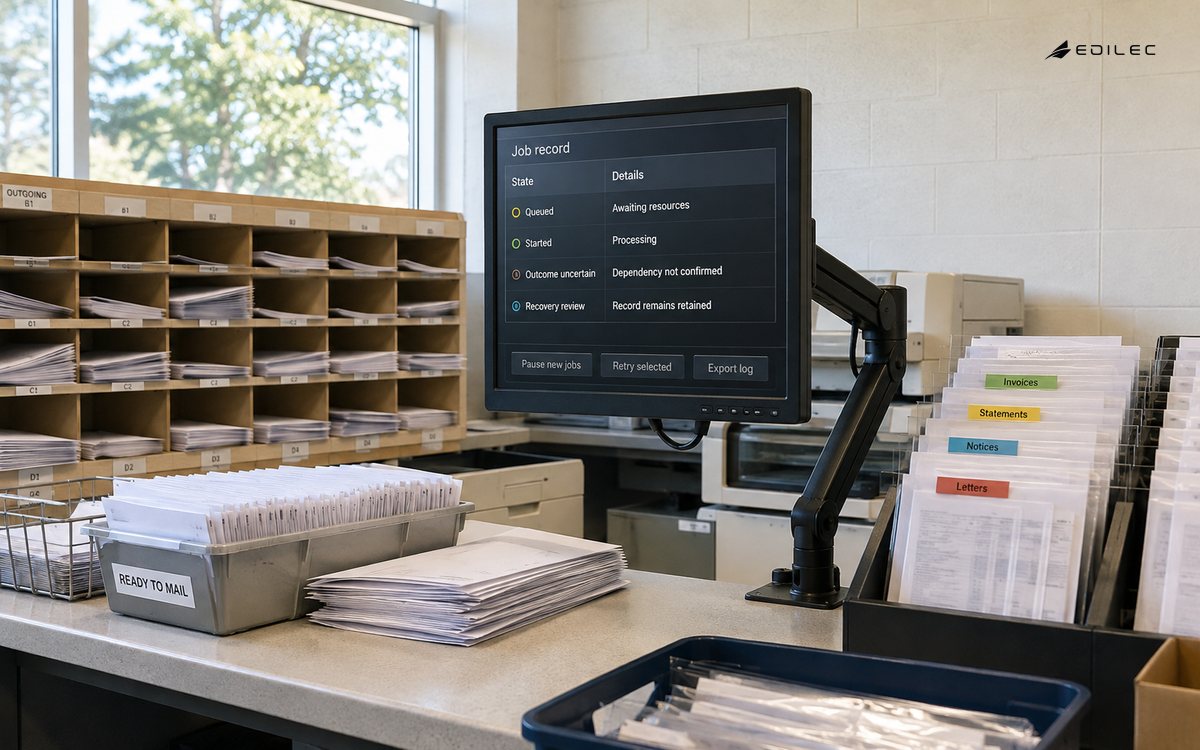
Write completion and failure semantics. Does success mean the file was stored, the partner accepted a request, or a downstream business event was observed? Which failures are transient, permanent or awaiting human correction? Who owns a job older than its service target? Without these definitions, the queue becomes a hidden backlog. Represent job state in a durable operational record when users or staff need to inspect and recover work.
| Job concern | Design choice | Evidence |
|---|---|---|
| Uniqueness | Stable idempotency key and business scope | Prior result or duplicate decision |
| Ownership | Lease or broker acknowledgement | Worker and claim timestamps |
| Retry | Error classification and bounded schedule | Attempt, next time and last error class |
| Completion | Explicit business postcondition | Result reference and completion time |
| Recovery | Operator action with authorization | Replay, cancel or correction audit event |
Keep the database and queue consistent
A common failure occurs when the application commits business data but crashes before publishing the job, or publishes before the database transaction later rolls back. Use a transactional outbox when the database is the source of truth: write the business change and outbox record in one transaction, then a relay publishes the outbox record and marks progress. Consumers still need idempotency because publishing and acknowledgement can repeat. The outbox closes the lost-message gap; it does not create exactly-once execution.
If the queue itself owns the command, return acceptance only after durable publication and expose a job reference. An HTTP API can use 202 Accepted when processing has not completed, with a status resource that reports progress and terminal problems. Do not return success for an in-memory timer that disappears on restart. Define queue durability, retention and backup assumptions explicitly, because broker configuration is part of the service contract.
Make handlers idempotent and concurrency-safe
At-least-once delivery means a worker may see the same message again. Store an idempotency record scoped to the business action, and make the check and durable effect atomic where possible. Unique database constraints can protect creation. Updates can use expected versions. External APIs may support idempotency keys; if they do not, record the outbound attempt and reconcile with the provider before retrying an ambiguous timeout. Never assume that a timeout means the partner did nothing.
Control concurrent jobs for the same entity. Partition by aggregate identifier, use optimistic concurrency or take a narrow lease. Avoid a global lock that removes queue throughput. Define ordering only where the business needs it; strict global ordering is expensive and fragile. A cancellation command should not race silently with execution. Load current state immediately before the consequential effect and stop when preconditions no longer hold.
| Failure | Retry? | Handling |
|---|---|---|
| Network timeout before confirmed response | Maybe | Reconcile remote state or reuse provider idempotency key |
| 429 or temporary 5xx | Usually | Honor delay, add jitter and cap attempts |
| Validation or unsupported version | No | Record permanent failure and correction path |
| Authorization revoked | No automatic bypass | Stop and require authorized re-initiation |
| Process crash after effect | Redelivery expected | Idempotency record returns prior result |
Use bounded retries and backpressure
Classify failures before scheduling retries. Use exponential delay with jitter for transient dependency problems, honor server-provided retry guidance and cap both attempts and total age. Permanent problems should enter a visible failed state immediately. A dead-letter queue is transport storage, not a recovery process; define who reviews it, which context is available and how corrected work is replayed. Avoid infinite retry loops that consume capacity and conceal customer impact.
Set consumer concurrency from measured dependency and database capacity. Broker prefetch and worker pools should bound in-flight work so a slow dependency does not exhaust memory or connections. Apply per-tenant or per-integration limits where one noisy source could starve others. Track queue age, not only queue length, because ten old high-value jobs may be more important than thousands of recent routine notifications. Use admission controls when producers can exceed safe processing capacity.
Make each job traceable without leaking data
Propagate trace context from producer to consumer as OpenTelemetry messaging conventions describe, while keeping job and business identifiers as structured attributes under a privacy policy. Record enqueue, claim, start, dependency calls, completion and acknowledgement. Metrics should include arrival rate, queue age, processing duration, attempts, permanent failures, duplicate suppression and outcomes by job type. Logs should explain decisions without embedding full payloads or credentials.
Build an operator view that supports search, diagnosis and authorized recovery. Show current state, attempt history, error class, relevant entity, next retry and result. Recovery actions need clear semantics: retry now, retry after correction, cancel, supersede or mark externally completed. Require a reason for consequential changes and preserve the prior history. Operators should not edit raw queue messages in production.
Test crash boundaries and release safely
Test handlers against duplicate delivery, concurrent execution, crash before and after each durable write, broker redelivery, database failover, expired authority, dependency timeout and partial external success. Use a controllable clock for retry schedules. Contract-test payload versions and support old versions through a defined migration window. Verify that a new worker can process queued old messages or that the deployment drains them safely.
Roll out by job type or tenant cohort, compare throughput and outcome, and preserve the ability to pause consumers without losing commands. Separate producer and consumer compatibility changes. A schema addition should be tolerant before producers depend on it. Exercise queue restoration and outbox replay. A deployment is accepted only when the team can observe, stop and recover work as well as process the happy path.
Define the worker runbook before volume grows
The runbook should explain how to pause producers or consumers, identify the oldest affected business work, distinguish queue failure from dependency failure, inspect a job safely and restore capacity. Include broker and database ownership, escalation contacts, retry policy, dead-letter retention and the conditions for manual reconciliation. Practice a dependency outage and a faulty worker deployment. Operators should be able to stop harm without deleting messages or changing payloads by hand.
Capacity planning should combine arrival rate, service time, concurrency and dependency limits. Measure drain time after an outage and reserve headroom for bursts. Large backlogs may contain expired work; define whether to cancel, recompute or process it. Priorities must be bounded so low-priority jobs cannot starve forever. Review job types whose backlog repeatedly requires intervention, because the durable fix may be workflow or integration redesign rather than a larger worker fleet.
Document a service objective for each important job family: accepted-to-completed latency, maximum age and successful outcome. Use that objective to size alerts and capacity. Report business work at risk, not only worker CPU. When a breach occurs, preserve the oldest affected identifiers and recovery decisions so the post-incident review can improve both queue configuration and workflow design.
Key takeaways
- Model jobs as versioned business commands with explicit completion.
- Use an outbox or durable publication boundary to avoid lost work.
- Make every handler idempotent and concurrency-aware.
- Bound retries and in-flight work, with an owned recovery process.
- Trace the job lifecycle and test crashes at durable boundaries.
Frequently asked questions
Is a cron task enough for background work?
Cron is suitable for triggering periodic scans or maintenance when missed and overlapping runs are handled. It is not automatically a durable per-command queue. Use leases, checkpoints and idempotency, and expose the work state when individual outcomes matter.
When should Node worker threads be used?
Use them for measured CPU-intensive JavaScript such as parsing or transformation, preferably through a bounded pool. Ordinary database and network jobs benefit from asynchronous I/O and controlled concurrency. A worker thread does not replace durable job ownership.
Should every failed job go to a dead-letter queue?
Not necessarily. Permanent business failures may belong in an application-visible failed state, while malformed transport messages may go to a dead-letter queue. In both cases define ownership, retention, correction and replay. Storage without a process merely postpones the incident.
Conclusion
Reliable Node.js background jobs preserve business intent across distributed failure. Durability, idempotency, bounded retry, backpressure and observability matter more than the queue library's API. Design the state transition first, then choose infrastructure that supports the required ownership and recovery model.
Start with one consequential job and force a crash before and after every durable boundary. If the team can explain the resulting state and recover without duplicating the effect, the architecture is becoming trustworthy.