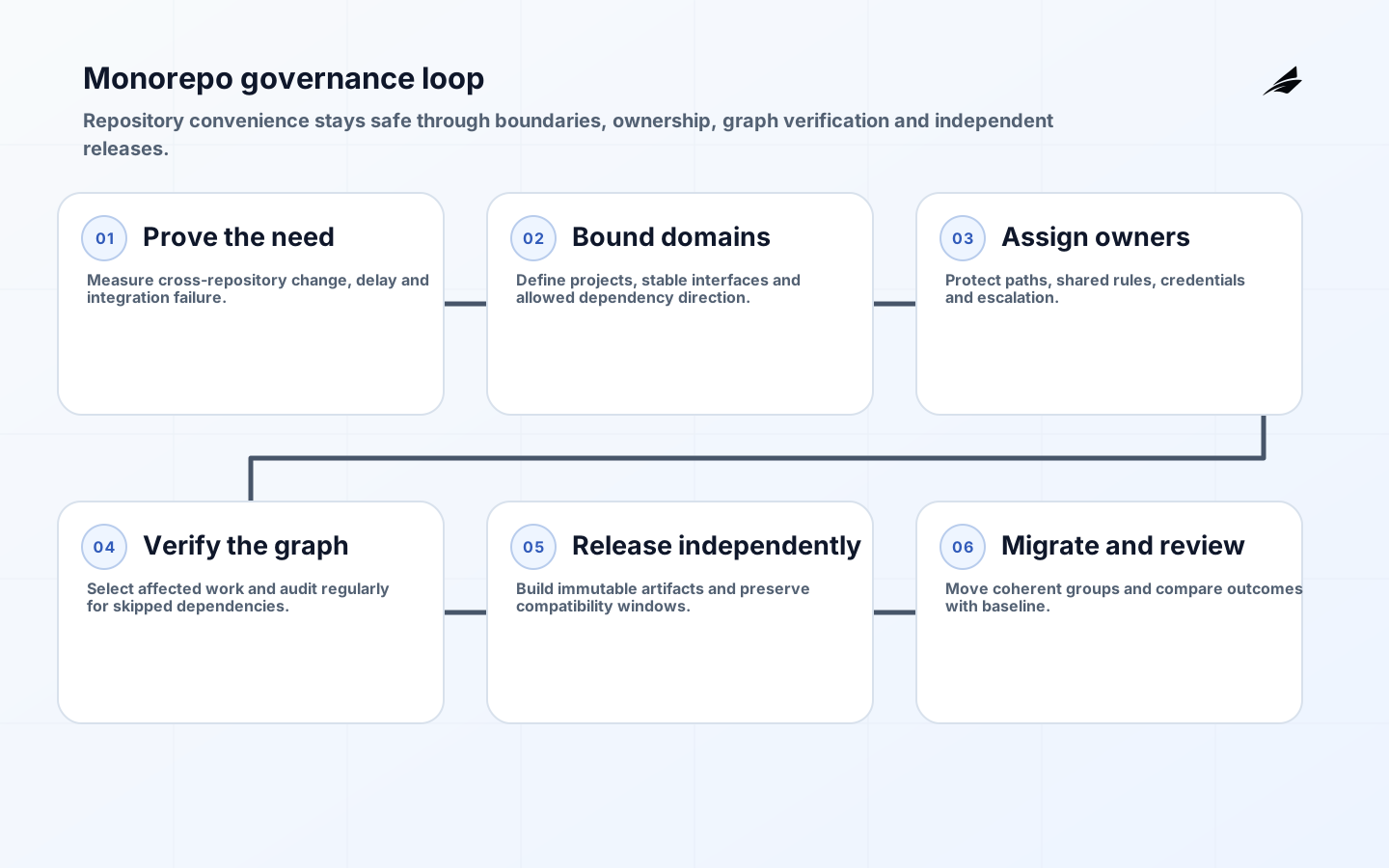
Monorepo planning for product and platform teams is a decision about shared change, not simply where Git repositories live. One repository can make dependencies, standards and cross-project changes visible, but it can also concentrate build cost, permissions and coordination. The right plan defines product boundaries, ownership, allowed dependencies, build graph, test selection, release independence and migration evidence. A monorepo succeeds when teams can make safe changes with less hidden coordination; it fails when every change triggers the whole organization.
This guide helps teams evaluate and design that operating model. It links naturally to API versioning for service businesses, database schema design for approval systems and observability architecture for small teams. Tool choice comes after the dependency and ownership model. The repository should describe how software is composed in production, not create artificial shortcuts that work only inside a developer’s editor.
Decide whether a monorepo solves the actual coordination problem
List the changes that currently span repositories: shared API or schema updates, design-system releases, dependency upgrades, policy changes and coordinated deployments. Measure lead time, failed integration, duplicated tooling and ownership confusion. A monorepo is a strong candidate when products share language ecosystems, tooling and frequent atomic changes. It is less compelling when repositories have strict legal isolation, unrelated lifecycles, extremely different toolchains or no meaningful shared change. Multi-repository automation may solve discovery and standards without consolidation.
Define success before migration: faster verified cross-project change, shorter CI feedback, fewer dependency incidents, clearer ownership or reduced duplicate configuration. Establish current measurements and a target. State constraints such as repository size, regulated code, external contributors, binary assets and regional access. Do not treat one repository as one deployable unit or one team. Products should retain independent release and operational responsibility unless there is a deliberate reason to couple them.
| Signal | Favors monorepo | Favors multiple repositories | Evidence to collect |
|---|---|---|---|
| Cross-project change | Frequent and safely atomic | Rare or contract-based | Change history |
| Toolchain | Mostly shared | Strongly heterogeneous | Build and runtime matrix |
| Access | Common visibility is acceptable | Hard isolation is required | Policy and contributor model |
| Release | Independent releases can use one graph | Repository boundary is contractual | Deployment topology |
Model projects, domains and allowed dependencies
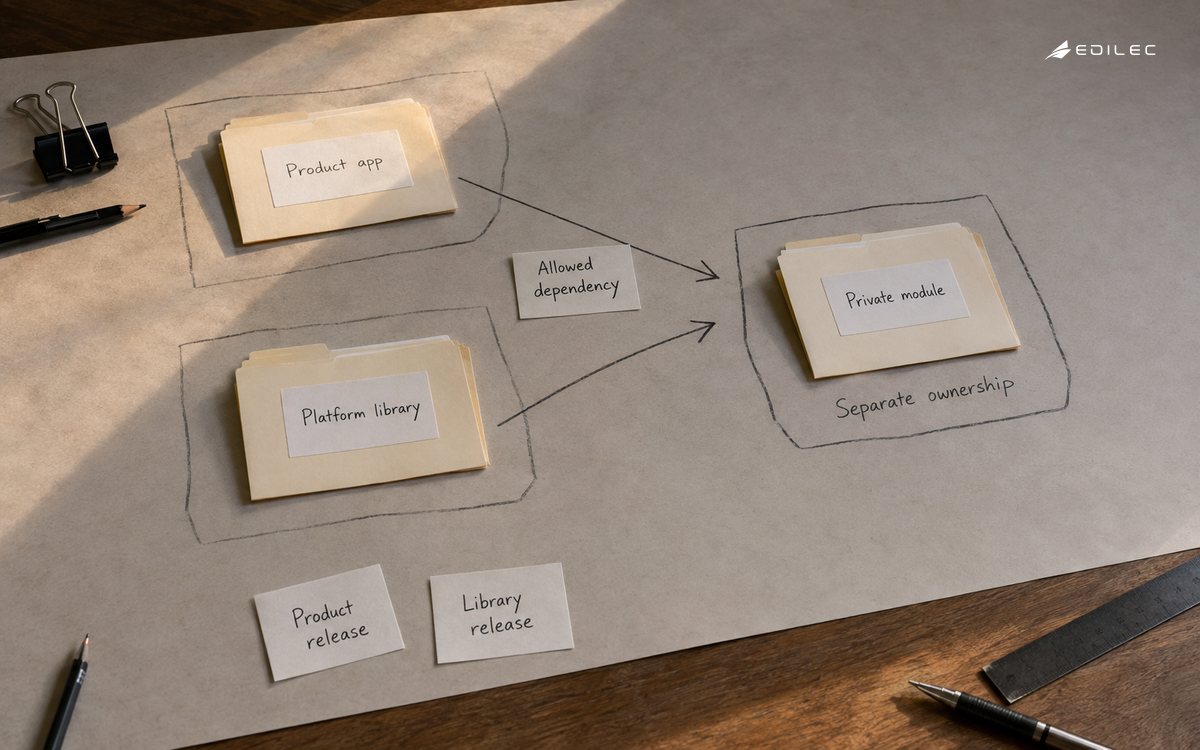
Create explicit project units for deployable applications, publishable packages, internal libraries, tools and infrastructure. Assign each a domain, owner, stability level and release behavior. Define allowed dependency directions, such as product applications depending on stable platform libraries but not on another product’s private internals. Enforce boundaries with build and lint rules. Directory names are not architecture unless tools and reviews prevent bypass. Keep shared libraries cohesive; a broad “common” package becomes a change amplifier and unclear ownership zone.
Represent external behavior through versioned APIs, events and packages even when producer and consumer share a repository. Atomic source changes can ease migrations, but production components may still deploy at different times. Test backward and forward compatibility. For TypeScript, project references can divide programs, enforce logical grouping and support incremental build order. The TypeScript documentation also warns against using paths aliases to simulate sibling package behavior; package-manager workspaces make local resolution resemble installed runtime resolution more closely.
Design ownership, review and access controls
Assign primary and backup owners for each project, critical build rule and shared package. CODEOWNERS can request and require review for paths, but ownership also needs service responsibility, response expectations and documentation. Limit mandatory reviewers to decisions that genuinely require them; a central approval on every change recreates a queue. Establish escalation for abandoned packages. Review ownership when teams reorganize. Measure unowned paths, review delay and changes merged without knowledgeable approval.
Repository visibility and production authorization are separate. Use least privilege for source, secrets, CI configuration, release credentials and protected branches. Do not expose sensitive code merely because most projects can be shared. Split or isolate content that requires legal or customer-specific controls. Protect global build files because a small change can affect many pipelines. Require stronger review and test for high-fan-out packages, dependency policy and CI actions. Audit automation identities and prevent pull-request code from obtaining production secrets.
Build around a trustworthy dependency graph
Select tooling that can identify projects, inputs, outputs and dependencies. The graph should include generated code, configuration and implicit tool dependencies, not only source imports. Nx describes affected calculation using Git history and the project graph; similar approaches are safe only when the graph is complete. Compare affected results against full builds regularly. A false negative that skips a required test is more damaging than extra CI work. Record why a project was selected to make failures diagnosable.
Make tasks deterministic and cacheable where practical. Declare inputs, tool versions, environment and outputs. Do not cache tests that depend on hidden network or time state. Separate fast validation from longer integration and system tests while retaining a full verification cadence. Use remote cache only with access controls, integrity and tenant assumptions understood. Monitor cache hit rate, task duration, queue time and critical path. Distribution cannot repair one large serial task or widespread dependencies.
| Pipeline layer | Runs when | Required property | Fallback check |
|---|---|---|---|
| Format and static analysis | Relevant source or configuration changes | Fast and deterministic | Periodic repository-wide run |
| Unit and package tests | Project or dependency is affected | Declared inputs and isolated tests | Full suite sampling |
| Contract and integration | Interface or consumer changes | Versioned environment and fixtures | Scheduled broad matrix |
| Deploy verification | Release candidate produced | Immutable artifact and provenance | Post-deploy health and rollback |
Preserve independent releases and artifact integrity
Choose release strategy by artifact. Applications can deploy independently from main; packages may use independent or fixed versioning; infrastructure changes may require environment promotion. Build once and promote the same immutable artifact. Generate provenance and dependency records where risk warrants. Keep version and changelog derivation deterministic. A repository-wide version is simple but can create meaningless releases; independent versions require accurate dependency and change detection. Document emergency release and rollback paths per product.
Cross-project changes need compatibility windows. Use expand-and-contract for schemas and APIs, feature flags for behavior, and staged consumer migration. Do not assume atomic merge means atomic production deployment. Test old producer with new consumer and the reverse where deployment order can vary. Make release ownership visible and prevent one broken package from blocking unrelated emergency work. Measure lead time, change failure and restore time by product, not only repository totals.
Keep local development and discovery usable
Provide one documented bootstrap path with pinned tool versions and a bounded default checkout or install experience. Developers should be able to locate project owners, commands, dependencies and examples without learning the entire repository. Support scoped tests and local services while keeping production-like package resolution. Generate project documentation from authoritative configuration where possible. Measure clone or fetch, installation, editor indexing and first-test time on representative hardware. Large binary or generated assets may belong outside normal source history.
Standardize a small set of paved paths for common project types, but allow exceptions with evidence. Templates should include build, test, ownership, observability and release configuration. Keep central configuration modular so one update does not force every project into an incompatible change. Deprecate old paths with migration tooling and dates. Platform teams should treat developer friction and adoption as product signals; mandates without usable support drive teams to bypass the graph and create hidden scripts.
Migrate in reversible, measurable stages
Pilot with a coherent product group and one shared dependency. Preserve history where useful, establish ownership and build rules, then verify local and CI performance before adding more. Avoid a long freeze and one-time merge of every repository. During transition, use explicit source-of-truth and synchronization rules; dual write without reconciliation creates ambiguous history. Migrate secrets and release credentials separately from code. Keep a rollback plan until new builds and releases are demonstrated.
At each stage compare success measures with baseline. Inspect affected-test accuracy, CI critical path, review delay, developer onboarding and release independence. Run a full clean build and recovery exercise. Remove obsolete pipelines and repositories only after artifacts, issues, tags, access and audit needs are preserved. Publish migration status and exceptions. The plan finishes when daily work and releases are owned and stable, not when files appear under one root directory.
Key takeaways
- Adopt a monorepo only for an evidenced coordination problem.
- Model and enforce projects, domains, ownership and dependency direction.
- Treat affected testing as a safety claim that requires graph validation.
- Preserve independent deployment and compatibility despite atomic source changes.
- Migrate coherent groups and verify developer and release outcomes at every stage.
Frequently asked questions
Does a monorepo require one programming language?
No, but heterogeneous toolchains increase build, environment and support complexity. The repository needs tooling that can represent each project and cross-language dependency accurately. Shared ownership and change value should justify the cost.
Should every CI run test every project?
Not necessarily. A trustworthy dependency graph can select affected work, supplemented by periodic full verification and sampling. High-risk or uncertain changes may still require broader testing. Monitor for false negatives.
Can teams still release independently?
Yes. Repository and deployment boundaries are different. Give each deployable an owner, pipeline, artifact and rollback path. Use compatibility techniques because components merged together may reach production at different times.
Conclusion
A monorepo is effective when it makes shared change cheaper without making independent work unsafe. The design depends on explicit projects, enforced boundaries, complete dependency information, proportionate ownership and release autonomy. Without those controls, centralization only moves coordination problems into one very large repository.
Before committing to migration, select one real cross-project change and trace discovery, edit, review, test, build, release and rollback in the proposed model. Then change a high-fan-out library and inspect the affected graph. If both scenarios are understandable and bounded, the plan is credible. If not, strengthen the operating rules before moving more code.