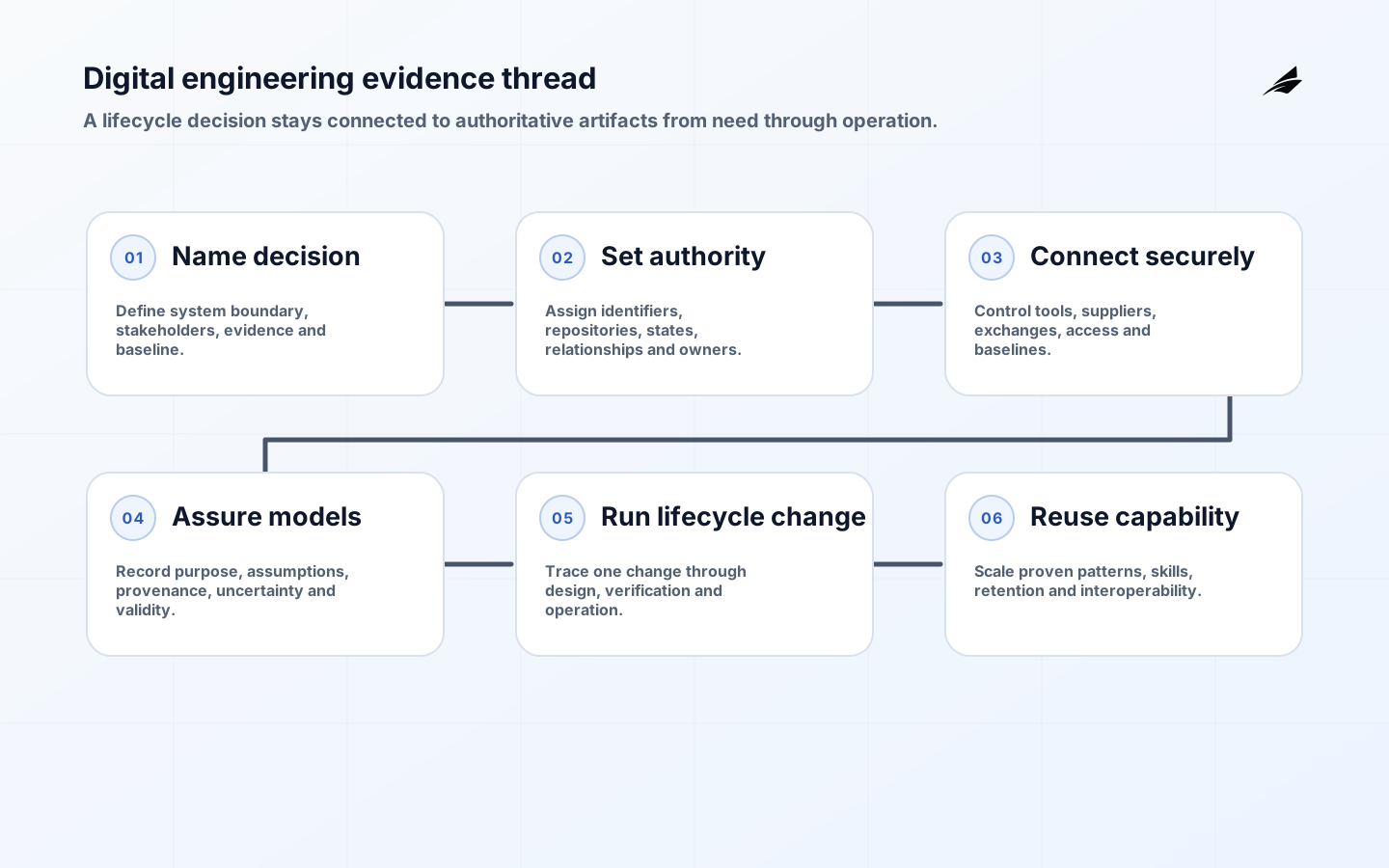
Digital engineering services connect models, data, requirements, analysis, software and configuration evidence so teams can make lifecycle decisions from trusted digital artifacts. The practice is broader than 3D modeling and does not require every artifact to live in one tool. Its value appears when an authorized change can be traced across interfaces, verified against current evidence and carried into manufacturing, deployment, operation or sustainment without manual reinterpretation.
This checklist complements the enterprise digital engineering checklist and digital engineering lifecycle FAQ. Leaders planning scope and cost can use the digital engineering governance plan. Begin with decisions and information exchanges, then select methods and tools.
1. Define lifecycle decisions and the system boundary
Identify the system of interest, lifecycle stage, stakeholders and decisions that need better evidence. Examples include evaluating architecture trades, verifying requirements coverage, predicting maintenance, accepting supplier designs or assessing a field change. Define what evidence currently informs each decision, where it is created, who approves it and how delay or inconsistency causes harm. Set a measurable objective such as reduced impact-analysis time or earlier discovery of interface defects.
Tailor lifecycle processes rather than imposing a universal workflow. ISO/IEC/IEEE 15288:2023 provides a common framework for system lifecycle processes without prescribing one methodology or model. Map the selected processes to program milestones and iteration. Include acquisition, supplier, operation and retirement perspectives; a model useful only to the design team does not create an end-to-end digital engineering capability.
| Decision use case | Required artifact relationship | Acceptance evidence |
|---|---|---|
| Architecture trade | Need, scenario, model, assumption and result | Reproducible comparison |
| Change impact | Baseline item, dependency and affected verification | Reviewed impact trace |
| Supplier acceptance | Requirement, interface, configuration and test | Current approved package |
| Operational diagnosis | Asset state, configuration, telemetry and model | Fault reproduced or bounded |
| Retirement | Asset, hazardous data, records and disposal obligation | Closed lifecycle record |
2. Design the authoritative information model
Define identifiers and relationships for needs, requirements, functions, logical and physical elements, interfaces, analyses, tests, risks, configurations and assets. Specify which repository is authoritative for each information type and which systems hold derived views. 'Single source of truth' should mean governed authority and synchronization, not forced storage in one database. Record provenance, status, owner, version, validity and access classification.
Create a configuration and baseline strategy before connecting tools. Decide what constitutes a releasable model package, how branches and variants work, and how supplier data is accepted. Use machine-readable exchanges where stable standards and tool support exist, but retain validation at every boundary. A technically valid file can still contain stale assumptions or the wrong configuration. Control vocabularies and units, and preserve human-readable decision records for consequential choices.
3. Build a secure collaborative environment
Select modeling, product-lifecycle, requirements, simulation, source-control, data and collaboration tools from the use cases and exchange needs. Prototype integrations before enterprise licensing. Establish identity federation, role-based access, export controls or classification handling, encryption, logging, backup and supplier compartments. Separate production baselines from experimentation. Privileged automation should not silently approve or overwrite authoritative data.
The U.S. DoD describes digital engineering as connecting people, processes, data and capabilities in a digital ecosystem, while Australia's 2024 strategy emphasizes a model-based enterprise connecting people, processes, tools and data. These public-sector strategies illustrate principles, not product requirements for every company. Build the smallest environment that can prove the selected exchanges and scale with measured need.
4. Govern model purpose, validity and trust
Every model needs an intended purpose, scope, assumptions, input pedigree, calibration, verification method, uncertainty, version and approving authority. A model validated for concept comparison may not be valid for safety approval or control. Define acceptable error and operating domain from the decision consequence. Preserve the code, solver, library and environment needed to reproduce important analyses. Independent review should challenge assumptions and sensitivity, not only inspect presentation.
Digital twins add live or periodic linkage to an entity and therefore create data integrity, identity and control concerns. NIST's IR 8356 discusses both conventional and novel cybersecurity and trust considerations. Authenticate assets and data sources, timestamp and quality-check telemetry, restrict command paths and detect divergence between representation and entity. Never treat a visualization as proof that the twin is sufficiently accurate for a decision.
5. Pilot a complete digital thread
Select one change that crosses organizational and tool boundaries. Trace a stakeholder need into requirements, architecture, detailed definition, analysis, verification, configuration and operating information. Include a supplier exchange and a correction after review. Measure manual transcription, broken links, decision lead time and defects found. The pilot should end in an accepted lifecycle decision, not a tool demonstration.

- Approve the decision use case, system boundary and outcome baseline.
- Define authoritative artifact types, identifiers, states and relationships.
- Configure minimum tools, access, exchange and baseline controls.
- Create and assure models with purpose, assumptions and validity evidence.
- Run one real change through design, verification and receiving operations.
- Measure results, close gaps and expand only reusable patterns.
Rehearse unavailable tools, rejected supplier data, conflicting baselines and unauthorized change. Export a durable package and prove it can be interpreted outside the authoring environment. Ask the receiving operation or sustainment team to use the evidence. Their inability to find configuration, limits or maintenance information is a design defect in the digital thread, even if engineering dashboards look complete.
6. Scale capability and lifecycle ownership
Define reusable modeling conventions, interface templates, validation rules, reference architectures and training based on proven pilots. Establish a governance group that includes engineering authorities, information owners, cybersecurity, suppliers and lifecycle recipients. Review standards and tool changes with migration plans. Avoid a central team becoming the only group able to operate the environment; develop model authors, reviewers, integrators and informed decision makers in product teams.
Measure decision quality and lifecycle flow rather than model count. Track impact-analysis time, requirements and interface defects discovered before physical integration, reproducibility, configuration mismatches, supplier acceptance cycles and sustainment use. Also track environment availability, integration failures, data quality, license utilization and support burden. Stop collecting relationships that no decision uses, and preserve those required for assurance or future operation.
| Capability measure | Meaningful result | Unhelpful proxy |
|---|---|---|
| Change impact time | Authorized effects identified sooner | Links created |
| Model reproducibility | Independent rerun within tolerance | Models uploaded |
| Interface quality | Defects found before integration | Interface documents |
| Baseline integrity | Receiving teams use correct configuration | Repository size |
| Lifecycle reuse | Operations resolves a real decision with artifacts | Tool seats purchased |
7. Contract for information access and interoperability
Procurement should specify required digital artifacts, formats, metadata, model purpose, validation, delivery cadence, configuration state, intellectual-property rights and receiving-tool tests. Distinguish editable native content, neutral exchanges, rendered views and evidence packages. State which artifacts the customer may operate, modify or provide to a successor. Require suppliers to identify proprietary extensions and external data rights before they become embedded in an authoritative baseline.
Test an information exchange during supplier selection with representative complexity. Validate identifiers, units, relationships, access markings, variants and error handling. Define how rejected data is corrected and who pays for remediation. A contractual demand for an open format is insufficient if semantics are lost on import. Preserve conformance profiles and tool versions so the exchange remains repeatable after upgrades.
Plan long-term retention and migration from the first baseline. Determine which evidence must remain interpretable for safety, certification, maintenance, records or product-liability periods. Store checksums, schemas, viewers and environment information where needed. Periodically render or migrate a sample and have a receiving engineer use it. Digital continuity is achieved when future teams can understand the approved configuration and decision basis, not simply when files still occupy storage.
Define quality checks for the digital thread itself. Detect orphaned requirements, unresolved interface versions, stale model references, unit mismatches, unapproved baselines and tests linked to superseded configurations. Route findings to artifact owners with due dates and risk context. Automation can find structural defects, while engineering review determines semantic correctness. Track recurring causes and improve authoring templates or integrations instead of accepting a permanent cleanup team.
Include usability in environment acceptance. Engineers should be able to find the current baseline, understand model status, review changes and request access without specialist mediation. Observe representative tasks and measure avoidable handoffs. A rigorous information model that users bypass through exported spreadsheets creates a less trustworthy thread, so workflow friction deserves the same corrective ownership as technical integration defects.
Key takeaways
- Start digital engineering with lifecycle decisions and information exchanges.
- Assign authoritative repositories and governed relationships instead of forcing one tool.
- Treat model purpose, uncertainty, provenance and configuration as acceptance evidence.
- Pilot one complete change through suppliers, verification and operations.
- Scale reusable patterns and measure decision outcomes, not artifact volume.
Frequently asked questions
Is digital engineering the same as MBSE?
No. Model-based systems engineering is an important practice within digital engineering. Digital engineering also includes the broader environment, authoritative data, analysis, software, collaboration and lifecycle integration needed to use digital artifacts for decisions.
Does every program need a digital twin?
No. Use a twin when a linked representation supports a valuable monitoring, prediction, optimization or control decision and can be assured. A static model or governed digital thread may meet the need with less data, security and operating complexity.
Should the organization select a platform first?
Define use cases, information authority and exchanges first, then test tools against them. Early platform choices can be necessary, but a pilot should prove integration, export, supplier access, security and operating cost before broad commitment.
Conclusion
Digital engineering services improve outcomes when trusted artifacts shorten and strengthen lifecycle decisions. Define decision use cases, govern authoritative information, build a secure environment, assure models for purpose, prove a complete digital thread and grow capability from evidence. The result is not simply more models; it is a durable engineering record that teams can use from concept through operation and retirement.