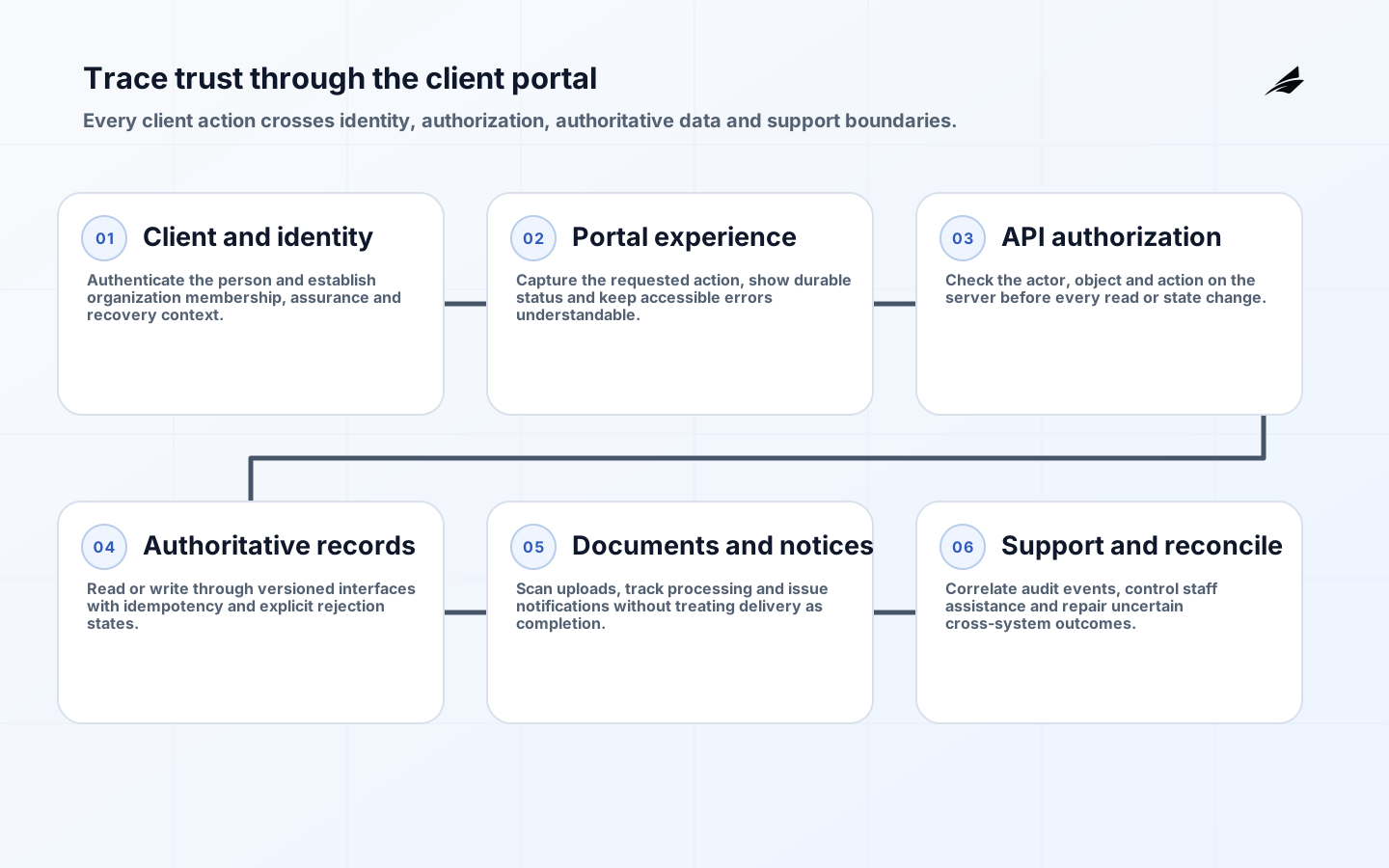
A client portal is a business service, not a collection of authenticated pages. It may let customers view records, exchange documents, submit requests, approve work, pay, message staff or manage users. Every capability crosses boundaries between customer identity, internal systems, policy and support. Start with the customer task and the authoritative record, then decide what the portal may read, change or initiate.
The first design artifact should state the operating outcome: Give clients a clear, secure self-service path while preserving internal controls, accessibility and support. Translate that promise into named records, decisions, controls and measures. Tool selection becomes easier when vendors and implementation teams must demonstrate the difficult exception, the unavailable dependency and the recovery path rather than only the happy path.
Define scope in business and risk terms
Interview clients, account administrators, service teams, compliance owners and support staff about complete tasks rather than desired screens. Observe where users leave the current channel, repeat information or need staff intervention. Choose a first journey with a clear system of record and known client cohort. Record identity, organization membership, accessibility, document and integration assumptions that prototypes must validate.
- Prioritize complete journeys such as submit-and-track, not isolated screens.
- Name the system of record and owner for every displayed or editable field.
- Define organization membership, delegated administration and account recovery.
- Separate inquiry, request, approval and final execution states.
- Set accessibility, responsive behavior and plain-language error requirements.
- Map support escalation and staff-assisted actions, including impersonation controls.
Design the lifecycle, decisions and boundaries
Model each portal journey through submitted, validating, processing, awaiting client, awaiting staff, completed, rejected and cancelled states as appropriate. Authorization must verify organization and object relationships on every server request. Asynchronous integrations should expose truthful status and use idempotency keys for repeat submissions. Reconciliation is essential when a downstream timeout leaves the final business result uncertain.
| Area | Question | Practical design |
|---|---|---|
| Experience | What can the client complete end to end? | Journey map and acceptance criteria |
| Identity | How are people enrolled, authenticated and linked to organizations? | Assurance decision, recovery and lifecycle rules |
| Authorization | Which record and action is permitted in this context? | Server-side policy tests |
| Integration | What if a system of record is slow or rejects a change? | Timeout, idempotency and reconciliation design |
| Operations | How do support and responders understand a failed journey? | Status model, audit event and correlation ID |
Resolve implementation details early
Assign ownership for client-facing content, organization membership, integration contracts, business records and support operations. Production client data must not populate test environments casually; create representative synthetic organizations and documents. Define session and recovery policy, file retention, notification delivery, API versioning, regional obligations, accessibility acceptance and how portal state is restored after a dependency failure.
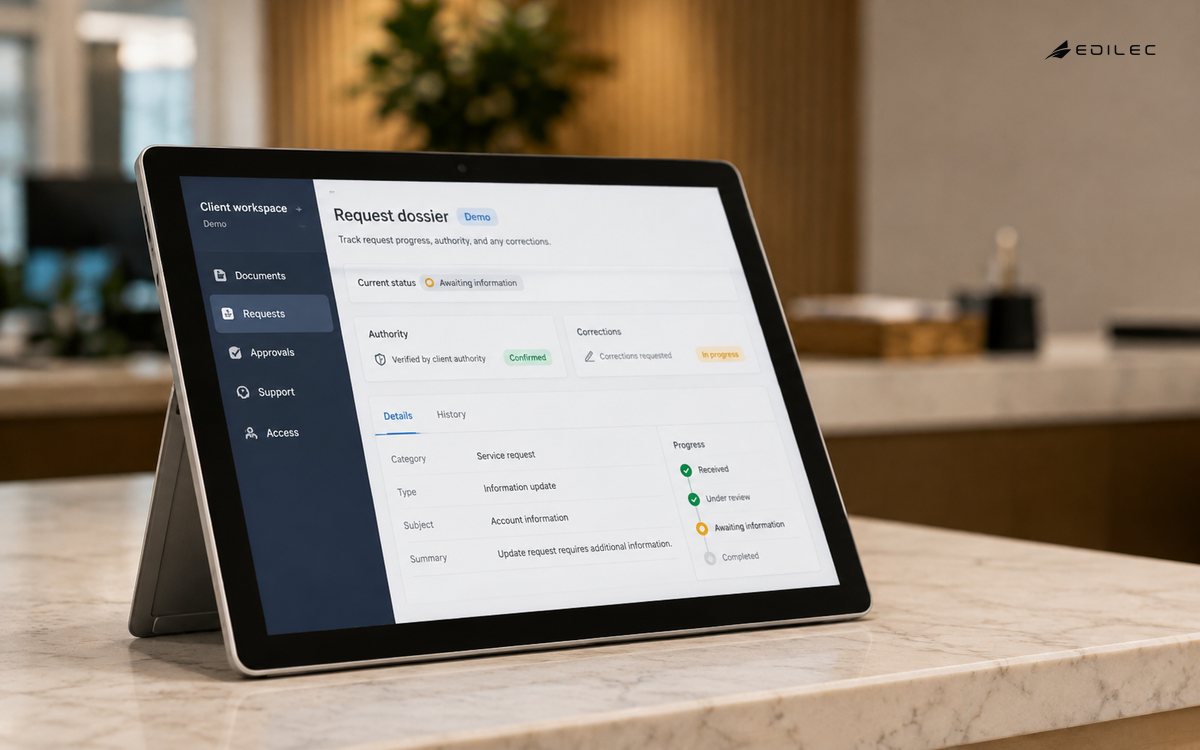
For a document-request journey, a client receives a request tied to the correct organization, uploads an allowed file, sees scanning and review states, replaces a rejected version and receives final confirmation. The file is quarantined before processing; download authorization is checked on every request. Support sees status and correlation data but cannot silently alter the client’s submission.
Build security, privacy and accessibility into acceptance
Threat-model account recovery, invitation abuse, cross-tenant object access, unsafe uploads, session theft and support impersonation. Apply object-level authorization after authentication and restrict staff-assisted actions with reason, duration and review. Collect only journey data the service needs. Test keyboard operation, focus order, error identification, reauthentication and document handling with assistive technologies and representative clients.
Roll out with observable gates
- Baseline the current outcome, delay, failure demand and risk before changing the process.
- Build a thin end-to-end path and test contracts, permissions, telemetry and recovery.
- Run in simulation, shadow or limited-production mode where the control permits it.
- Release to a named cohort with an owner, support coverage, stop conditions and rollback steps.
- Review technical signals and business outcomes together; investigate segment differences.
- Expand only when exceptions are handled reliably and operating documentation matches reality.
- Retire the previous path, credentials, jobs and access after evidence and retention needs are satisfied.
A portal rollout gate should require successful completion of the selected journey, including recovery from downstream rejection and a support handoff. Verify tenant isolation, account recovery, accessibility, notifications, audit events and status reconciliation. Release to a named client cohort with an immediate disable or routing plan. Where submissions create irreversible external actions, define correction rather than promising that interface rollback will undo them.
Risks and measures
| Risk | Response | Evidence to watch |
|---|---|---|
| Account takeover | Risk-based authentication, secure recovery and alerts | Recovery and suspicious login outcomes |
| Cross-client exposure | Object-level authorization and tenant isolation tests | Denied access and test coverage |
| Integration drift | Versioned contracts and reconciliation | Mismatched records |
| Inaccessible flows | WCAG-based design and human testing | Journey defects by assistive technology |
| Low adoption | Research, staged release and support feedback | Completion and assisted-contact rate |
Track journey completion, abandonment by step, downstream rejection, duplicate submissions, time in each status, accessibility defects and assisted-contact rate. Segment by journey, client organization type and supported device only when privacy permits. A higher login count may signal repeated failure rather than adoption. Pair telemetry with support themes and client interviews to explain why a path stalls.
Operate the capability after launch
Name a portal product owner with counterparts for identity, integrations and client support. Review organization administrators, privileged support actions, failed notifications, accessibility regressions and reconciliation queues. Exercise loss of all authenticators, a malicious upload, an unavailable system of record and accidental cross-client request. Update client messaging and staff procedures alongside technical fixes.
Operational details that determine reliability
Organization accounts need a lifecycle beyond individual login. Define who can create an organization, invite members, assign administrators, transfer ownership and remove access when a relationship ends. A person may represent several clients, so authorization should use the active organization and resource relationship on every request. Email domain matching alone is not proof of current authority.
File exchange deserves its own threat model. Validate extension, media type and size; rename server-side; scan in quarantine; store outside executable web paths; and authorize each upload and download. Preserve version, uploader, time and review state. A signed link should be short-lived and scoped, and it should not bypass the portal’s business authorization merely because the URL is hard to guess.
Integrations should expose truthful states. If an internal system accepts work asynchronously, the portal can show submitted, processing, completed or needs attention rather than claiming immediate success. Use idempotency keys for repeat submissions, map internal errors to actionable client language and reconcile portal state against the authoritative system. Give support a correlation identifier that does not reveal sensitive implementation detail.
Account recovery is often the most dangerous journey. Base it on the assurance and impact of the portal, protect against enumeration, notify through established channels and make high-impact recovery observable. Customer-service overrides need strong staff authentication, reason capture, limited duration and review. Test legitimate users who lose every enrolled authenticator; an unusable recovery path invites unsafe exceptions.
Procurement and architecture review should use scenario-based evidence for client portal development, customer portal, web application development. Ask each proposed solution to perform the representative case, reject an unauthorized action, survive an unavailable dependency, expose an understandable status, produce investigation evidence and export the owned data. Record configuration and integration work needed to achieve the demonstration. A feature visible in a product list is not proof that the complete control or journey will operate in the organization’s environment.
Acceptance should connect design claims to repeatable evidence. For experience, retain tests or records that show journey map and acceptance criteria. For the risk of account takeover, assign the response before launch and review recovery and suspicious login outcomes. Add load, recovery, permission and accessibility evidence in proportion to impact. The release decision should identify residual risks, their owners and the conditions that would pause further rollout.
Key takeaways
- Start from a complete business outcome and the evidence needed to trust it.
- Make identity, authority, state, exception handling and ownership explicit.
- Design failure, recovery and reconciliation before expanding volume.
- Roll out to controlled cohorts with measurable gates and practiced rollback.
- Treat configuration, policy, access and retirement as continuing product work.
FAQ
Should we buy a product or build?
Compare portal products and custom development on organization-aware identity, object authorization, journey flexibility, accessibility, integration control, document security and data portability. A packaged shell can accelerate common account functions, while differentiated workflows may require custom application logic. Include branding constraints, API limits, support tooling, upgrade behavior, record export and replacement of the identity relationship.
What belongs in the first release?
Launch one end-to-end client task for an invited cohort, not a menu of unfinished pages. Include enrollment, organization linkage, responsive and accessible interaction, downstream processing, notifications, audit, support visibility and reconciliation. Test an expired invitation, rejected document, duplicate click and unavailable dependency. Staff should be able to explain status without bypassing client authorization.
How should success be measured?
Measure successful task completion, time to outcome, abandonment, repeat submissions, errors, accessibility findings, support contacts and downstream mismatch. Monitor authentication and recovery outcomes separately from page traffic. Define a completion only when the authoritative system confirms the business result; a portal confirmation screen alone can overstate success when processing remains pending.
When can the old process be retired?
Retire an email, spreadsheet or older portal path after targeted clients are enrolled, open cases and documents are migrated, deep links and notifications point correctly, and support can serve the replacement. Remove old accounts, API credentials, upload locations and scheduled imports. Retain records according to policy and monitor the former channel for legitimate clients who were missed.
Conclusion
A trustworthy client portal joins understandable self-service with rigorous identity, tenant isolation and truthful system status. Business teams should deliver complete journeys, test recovery and accessibility with real users, and expand only when support and reconciliation are working. The result should reduce uncertainty for clients without hiding internal failure or granting the portal more authority than the underlying service permits.