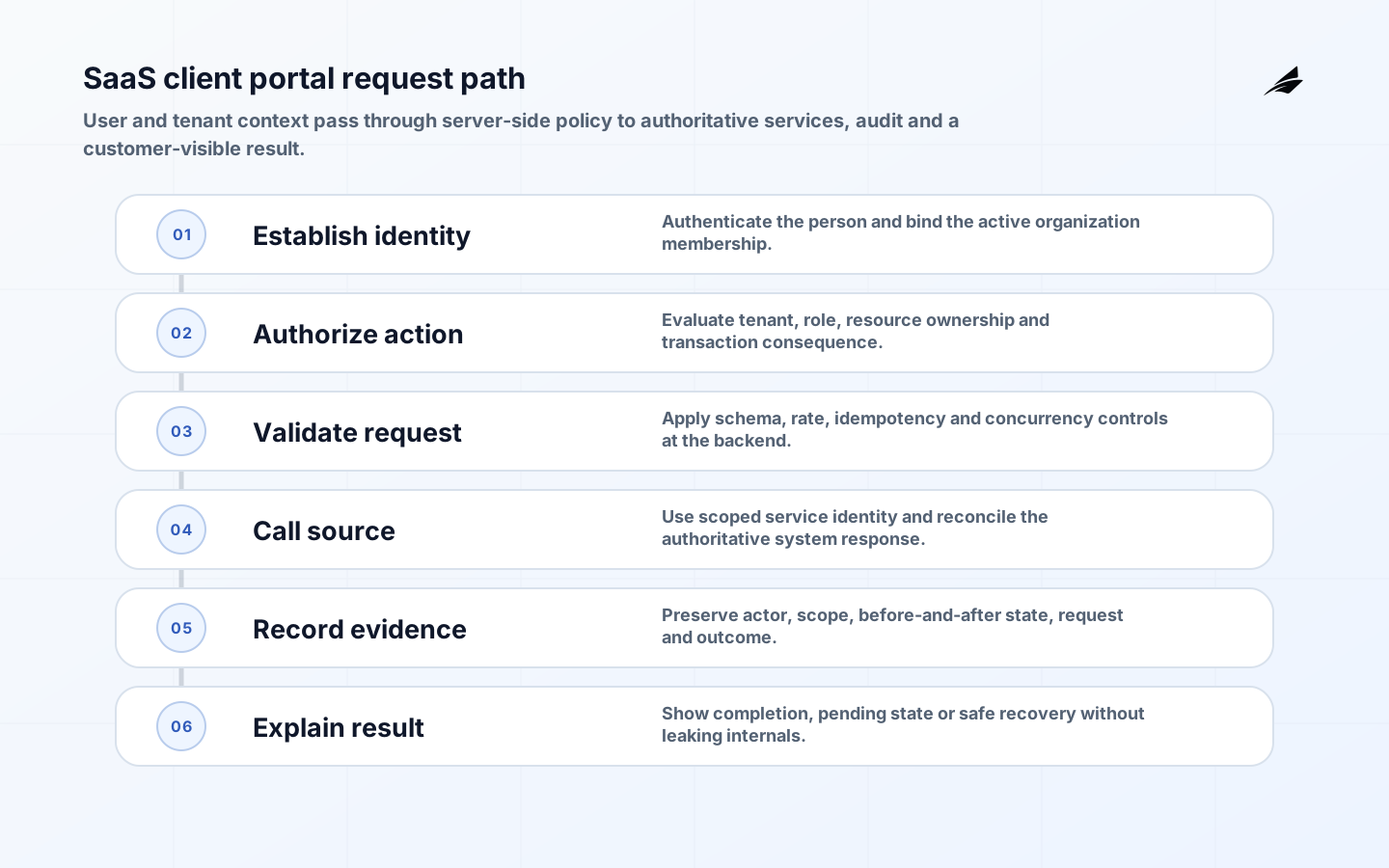
Client portal development for SaaS companies is the work of exposing customer-owned information and actions without exposing the complexity or privilege of internal systems. A portal may support onboarding, account administration, documents, support, billing, reporting, approvals and product configuration. Its value comes from completing those jobs reliably, not from placing a dashboard in front of every database. The architecture must preserve tenant isolation, authoritative data, authorization and audit while giving customers a coherent experience across services that may have been built at different times.
A portal also changes the service boundary. Actions previously handled by trained staff become available to external users at any hour, on varied devices and networks. Error messages, recovery and accessibility therefore become operational controls. This guide covers discovery, identity, data, APIs, user experience, security, rollout and measurement. It is intended for product, engineering and business teams defining a portal, whether they build it as part of the main SaaS application or as a separate web experience.
Start with customer jobs and service boundaries
Interview customers and the internal teams who currently complete the work. Map a small set of journeys such as invite a colleague, download an invoice, approve a request, update a configuration or track a support case. For each, identify the user’s goal, authoritative record, decision rule, completion evidence and recovery path. Baseline contacts, turnaround, errors and abandonment. Avoid beginning with a list of screens; a polished portal that cannot finish a job simply moves support demand into a new channel.
Define what remains internal. High-risk account recovery, contractual changes, destructive operations or unusual financial actions may require staff review. Self-service does not mean unrestricted service. State hours and dependencies for workflows that invoke people or batch systems. Show status and ownership honestly rather than displaying a permanent spinner. Decide whether the portal is the system of engagement, a system of record for selected data, or both. Confusion about that boundary creates conflicting updates and untrustworthy reports.
| Portal job | Authoritative system | Completion evidence |
|---|---|---|
| Invite a user | Identity and tenant membership service | Active membership with assigned role and audit event |
| Change billing contact | Billing or account system | Versioned customer record and confirmation |
| Download a report | Reporting data product | Timestamp, scope and generation status |
| Submit a support request | Case-management system | Case identifier, priority and response expectation |
| Approve a configuration | Product control plane | Authorized change, resulting state and rollback reference |
Design tenant identity and authorization
Model people, organizations, memberships, roles and resource ownership explicitly. One person may belong to several customer organizations and hold different roles in each. Require a tenant context for every resource request and enforce it on the server, not only in page routes or token claims. Prefer permissions that describe actions on resources over broad labels. Document who can invite users, assign privileged roles, transfer ownership and revoke sessions. High-impact role changes should require recent authentication and create a clear notification.
Use an established identity provider and standards-based federation where customers need single sign-on. NIST SP 800-63-4 provides current guidance on identity proofing, authentication and federation; select assurance appropriate to the transaction rather than applying one login experience everywhere. Support phishing-resistant authenticators for administrators and recovery paths that do not become the weakest control. For OAuth, RFC 9700 recommends authorization code flows with PKCE, exact redirect matching and stronger token protections; avoid obsolete implicit and password-grant designs.
Build a portal API boundary
Do not let the browser assemble a customer experience by calling many internal services with broad tokens. Use a portal backend or gateway that validates identity, tenant, permission and request shape, then calls internal systems with narrowly scoped service identities. This boundary can translate internal models, aggregate status and apply rate limits without publishing private APIs. Define contracts using an API description such as OpenAPI and validate them in delivery pipelines. Version behavior intentionally; a field rename or changed default can break customer workflows even if the endpoint remains available.

Design write operations for retries and concurrency. Use idempotency keys for create or payment-like actions, optimistic concurrency for editable records and stable operation identifiers for long-running work. Return errors that tell the user what happened and what they can safely do next without revealing internal details. Reconcile asynchronous results from the authoritative system before declaring success. For exports, apply tenant scope at query time, control generation and storage, use short-lived download authorization and record who requested sensitive data.
Make portal data trustworthy
Every displayed value needs a definition, source and freshness expectation. Label reporting periods, time zones, currencies and status semantics. If a figure is delayed, show its last update; if it is estimated, say so. Avoid copying operational data into a portal database without ownership of synchronization and correction. Cache reads where appropriate, but invalidate or version caches after customer changes. Provide customers a way to report incorrect information and route that feedback to the record owner rather than treating it as a front-end defect.
Audit consequential actions with actor, tenant, permission, target, before-and-after state, request identifier and outcome. Keep audit records separate from general application logs and protect them from routine editing. Customers may need a scoped activity history, but internal security detail and other tenants must remain protected. Establish retention and export rules. Search, analytics and support tooling are additional copies of customer data; include them in access, deletion and incident design.
Treat accessibility and responsive behavior as acceptance criteria
WCAG 2.2 is a current W3C Recommendation for making web content more accessible. Define the applicable conformance target with legal and accessibility specialists, then test representative journeys with keyboard, screen reader, zoom, high contrast and mobile input. Use semantic headings, labels, status announcements and focus management. Do not communicate state only through color. Tables need usable small-screen behavior; complex reports may require summaries and downloadable accessible formats rather than horizontal overflow that hides context.
Design for interruption. Save drafts where appropriate, preserve the user’s place after reauthentication and warn before a session expires without trapping keyboard users. Provide clear loading, empty, partial and failed states. Test with slow networks and large customer datasets. A responsive layout is not simply a desktop grid squeezed into a phone; prioritize the task, let controls wrap, and avoid fixed heights that clip text. Performance budgets should cover initial interaction and the heaviest real workflow, not only a blank account.
| Acceptance area | Scenario | Expected result |
|---|---|---|
| Isolation | Change tenant identifier in URL and API request | Request denied without revealing resource existence |
| Authorization | User loses a privileged role during a session | Subsequent action is denied and session state refreshes |
| Reliability | Retry an operation after timeout | One reconciled result, not duplicate work |
| Accessibility | Complete key journey with keyboard and screen reader | Logical focus, labels, errors and status announcements |
| Recovery | Identity or downstream service is unavailable | Safe fallback, honest status and owned support route |
| Audit | Perform and reverse a sensitive change | Complete actor, scope, state and outcome history |
Verify security beyond login
Use a threat model that covers cross-tenant access, insecure direct object references, invitation abuse, account takeover, session theft, export leakage, file upload, support impersonation and administrative misuse. OWASP ASVS provides a practical basis for specifying and verifying application-security requirements. Apply secure development, dependency and secret controls throughout delivery. Validate authorization at every object and action. Sanitize untrusted content, scan files where appropriate, enforce content type and size, and store uploads outside executable paths.
Protect sessions with secure cookies, appropriate expiry, rotation and revocation. Use CSRF defenses where browser credentials are sent automatically and a restrictive content-security policy to reduce script injection impact. Rate-limit login, invitation, recovery, export and expensive search paths according to tenant and identity context. Monitor unusual role changes, bulk downloads and repeated authorization failures. Prepare incident procedures that can revoke one user, tenant or integration without shutting down every customer.
Release by customer journey
Launch one complete journey to a small customer cohort rather than many unfinished menu items. Migrate identity and roles carefully, reconcile customer records and provide support teams with the same status evidence users see. Use feature controls with tenant scope, preserve an internal route for exceptions and define rollback. Observe task completion, errors, latency, support contacts, authorization failures and qualitative feedback. Segment by journey and customer profile; an aggregate adoption number can hide a workflow that fails for larger tenants or federated users.
Measure self-service as a service outcome. Useful signals include successful completion without assisted rework, time to outcome, repeated attempts, escalation, accessibility defects and data corrections. Do not reward deflection if customers abandon the task or resort to informal contacts. Maintain a joint backlog across product, support, security and platform teams. As internal systems change, rerun contract, isolation and workflow tests. A client portal is a durable product surface, not a one-time web project.
Key takeaways
- Build around complete customer jobs and authoritative completion evidence.
- Model organization membership and enforce tenant scope on every server-side resource action.
- Use modern federation and OAuth patterns instead of custom authentication flows.
- Treat trustworthy data, accessibility, retry safety and recovery as product requirements.
- Measure customer outcomes and assisted rework, not portal visits alone.
Frequently asked questions
Should the portal be a separate application?
It depends on product architecture, release ownership and customer journeys. A separate front end can unify services, but it still needs a controlled backend, shared identity and consistent design. Avoid duplicating business rules in two applications.
When should customer SSO be supported?
Support it when target customers need centralized lifecycle and access policy. Plan tenant domain verification, metadata changes, emergency access, certificate rollover and recovery. SSO does not remove the portal’s responsibility to authorize every action.
What belongs in a portal MVP?
Include one or two complete, high-value journeys with identity, tenant isolation, errors, audit, support and mobile accessibility. A larger collection of read-only cards is less useful than a smaller workflow customers can finish safely.
Conclusion
A trustworthy SaaS client portal gives customers real control without exposing internal privilege or inconsistency. Its quality is visible in tenant isolation, understandable permissions, accurate data, accessible journeys and safe recovery when dependencies fail. By treating the portal as an operated product with explicit service boundaries, teams can expand self-service while reducing—not redistributing—customer effort.