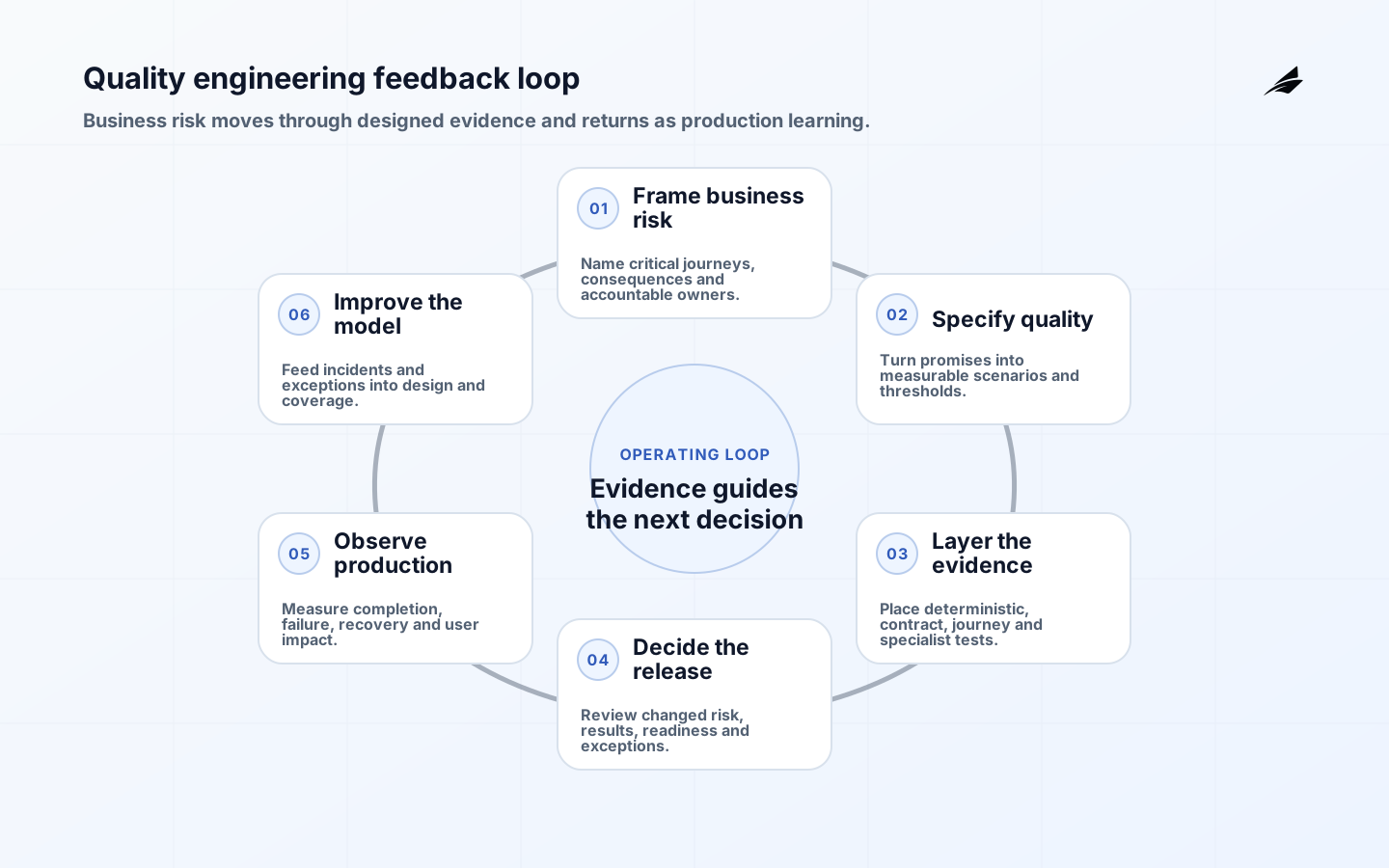
Quality and test engineering is the discipline of turning important product promises into evidence before and after release. It is broader than executing test cases. Teams model risk, improve design for testability, automate repeatable checks, examine security and accessibility, observe production behavior and use failures to improve the delivery system. Business leaders need to understand those choices because quality targets express customer and operational priorities.
This guide complements the quality and test engineering checklist and quality engineering FAQ. Teams coordinating several suppliers can also use the custom systems quality assurance checklist to make handoffs explicit.
Start quality and test engineering with outcomes
A useful strategy starts with consequences. Which failures can harm a person, block revenue, corrupt a record, expose data, breach an obligation or make recovery impossible? For each critical journey, name the user, preconditions, decision, expected state change, dependencies and tolerable failure. That produces a risk model the business can review. A generic demand for “full testing” cannot be estimated or accepted.
Quality attributes need measurable scenarios. “Fast” becomes a percentile response objective under a stated workload. “Available” becomes a service level indicator, observation window and excluded condition. “Accessible” becomes testable conformance and task completion for relevant users. “Secure” becomes threat-informed requirements and verification. The W3C WCAG 2.2 Recommendation is a strong accessibility baseline, but conformance checks should be combined with representative assistive-technology and user testing.
| Business promise | Engineering evidence | Release question |
|---|---|---|
| Orders are not lost | State-transition, idempotency, queue recovery and reconciliation tests | Can every accepted order be traced to a final or owned exception state? |
| Only authorized users approve | Policy, API, UI, negative and audit-event tests | Are permissions enforced below the interface and evidenced? |
| Customers can complete checkout | Journey tests, accessibility review and performance under realistic load | Do priority users finish the task within the target? |
| Changes can be recovered | Backup restore, rollback, forward-fix and incident exercise | Can the team restore service and reconcile data within objectives? |
Build a layered test model
Place most deterministic checks near the code or contract they verify. Unit and component tests give fast diagnostic feedback. Contract tests check assumptions at service boundaries. Integration tests exercise real adapters and infrastructure. A smaller set of end-to-end tests proves priority journeys across deployed components. Exploratory testing investigates uncertainty that scripted checks do not anticipate. Production checks confirm that the released system and its environment behave as expected.
The layers are not a quota. A rules engine deserves dense decision-table and property tests. A thin integration product may need more contract and adapter tests. A workflow with third-party payments needs controlled end-to-end scenarios and reconciliation. Google SRE's testing for reliability treats tests as evidence that changes preserve expected behavior and emphasizes system-scale concerns; that is a better framing than counting cases without considering risk.
Design for fast, trustworthy feedback
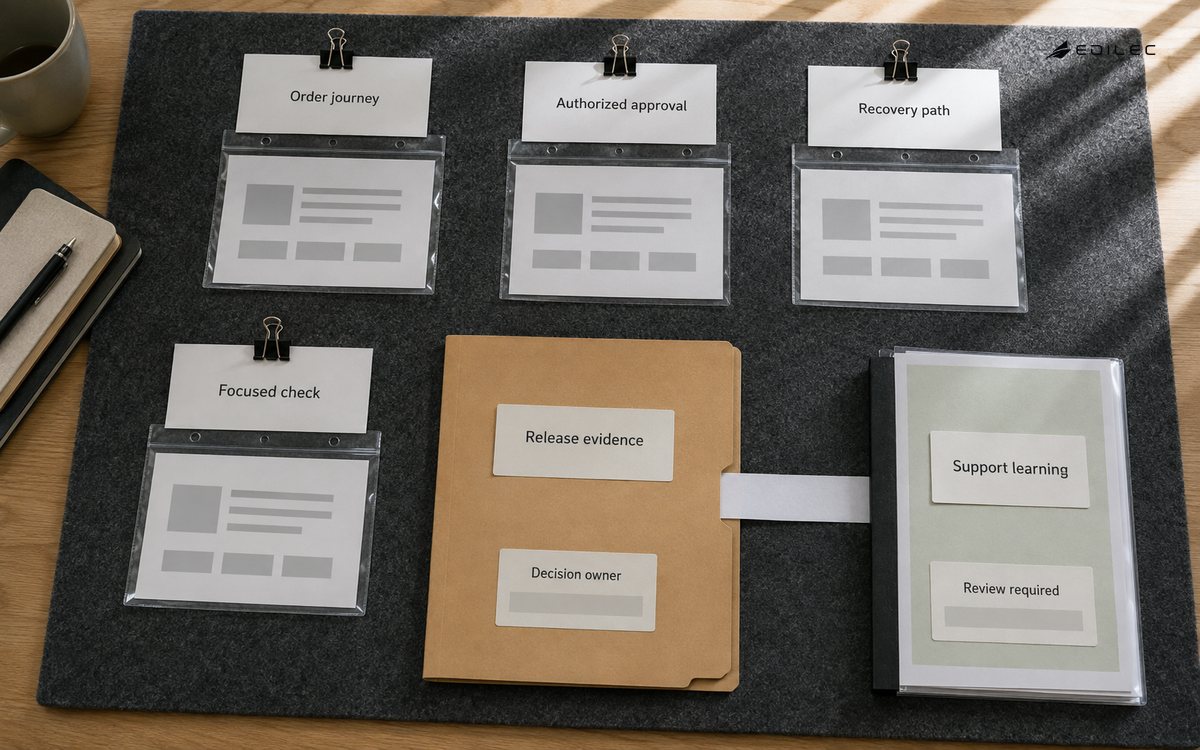
A test is valuable only if the team can trust and act on it. Keep fixtures explicit, control time and randomness, isolate state and avoid arbitrary sleeps. Browser tests should use user-facing locators and condition-based assertions. Playwright's assertion documentation explains auto-retrying web assertions, which repeatedly evaluate an expected condition until success or timeout. This matches asynchronous interfaces better than fixed delays that pass or fail according to machine speed.
Quarantine is not a permanent home for flaky tests. Record the owner, failure signature, customer risk and repair deadline. Track rerun dependence: a pipeline that passes only after rerunning has hidden uncertainty. When failures are environmental, fix environment provisioning and observability. When a test is over-broad, split it. When behavior is genuinely nondeterministic, define a statistical or invariant-based test instead of pretending one expected value is stable.
| Signal | Useful definition | Bad interpretation |
|---|---|---|
| Escaped defect | Customer-impacting defect by origin, severity and detection opportunity | A raw count used to blame the last tester |
| Change failure rate | Production changes requiring remediation under an agreed rule | Every support ticket attributed to deployment |
| Flaky-test rate | Tests with inconsistent outcomes for unchanged code and environment | Failures made invisible by automatic reruns |
| Feedback time | Time from change submission to an actionable quality result | Total pipeline time without identifying the blocking stage |
| Critical-journey coverage | Named high-risk journeys with current automated and exploratory evidence | A single line-coverage percentage |
Integrate security rather than adding a final gate
Security requirements belong in design, code review, dependency controls, automated checks and independent assessment. NIST's Secure Software Development Framework groups practices around preparing the organization, protecting software, producing well-secured software and responding to vulnerabilities. Translate applicable practices into owned delivery controls and evidence. A scanner result is an input; it is not proof that authorization or abuse cases are correct.
Use threat models to select negative tests: cross-tenant access, privilege escalation, replay, injection, unsafe file handling, secret exposure and audit-log tampering. The OWASP Web Security Testing Guide organizes web testing across the lifecycle and publishes versioned scenarios. Reference the exact version in formal plans so identifiers remain stable, and combine tool-driven checks with manual reasoning about business logic.
Make environments and data representative
A pre-release environment should reproduce the behaviors that matter, not every production byte. Match identity flows, network controls, queues, database features, configuration shape and external failure modes. Use infrastructure definitions and configuration tests to detect drift. Virtualize a dependency only when the substitute accurately models the contract and failure behavior needed by the test; keep periodic tests against the real provider sandbox.
Test data needs ownership and lifecycle controls. Prefer generated or masked data with documented properties. Include boundary values, historical formats, locale differences, large accounts, accessibility states and adversarial input. Never copy production personal data merely because it is convenient. Define retention and deletion for screenshots, traces and failure artifacts because they can expose credentials or customer content.
Use risk-based release decisions
A release decision should show the change scope, affected risks, test evidence, unresolved findings, operational readiness and accountable approver. Not every failing test blocks every release. Classify gates: mandatory controls, risk-owner exceptions and informational trends. Exceptions need a reason, compensating control, owner and expiry. This keeps urgency visible without normalizing broken gates.
Progressive delivery can limit exposure, but it requires observable cohorts, health criteria and a tested rollback or disable path. Compare business and technical signals: completion, error, latency, resource saturation, support contacts and data reconciliation. A canary that only watches infrastructure may miss a workflow silently producing wrong invoices. Preserve the release and configuration versions attached to each observation.
Define a quality engineering operating model
Product teams own the quality of what they release. Specialists contribute test design, automation platforms, performance, security, accessibility and exploratory skill; they do not become a downstream approval queue. Establish common interfaces: a risk review, definition of done, testability standards, environment service, incident feedback and quality dashboard. Fund maintenance of test infrastructure as product work.
When introducing AI-assisted development, keep the same accountability. DORA's 2025 AI-assisted software development research characterizes AI as an amplifier of existing organizational strengths and weaknesses. Increase review and automated evidence with generated change volume, and measure delivery stability, maintainability and developer experience rather than celebrating suggestion acceptance.
A practical implementation sequence
- Map five to ten critical journeys and rank failures by customer, financial, security and recovery consequence.
- Create measurable quality scenarios and assign product, engineering and risk owners.
- Inventory existing checks by layer, diagnostic value, runtime and flakiness; remove duplication.
- Automate one thin path from local checks through deployed journey and production observation.
- Add security, accessibility, performance and recovery evidence where the risk model requires it.
- Define release gates, exception rules, artifacts, retention and a monthly quality review.
- Feed incidents, support patterns and escaped defects back into requirements and test design.
Example: redesigning release evidence for an approval service
Consider a service where employees submit expenses and managers approve them. Begin with invariants: a person cannot approve their own claim; an approved claim has a complete audit trail; and a payment instruction is emitted once. Put decision combinations in domain tests, role enforcement in API tests, accounting handoff in contract and integration tests, and one requester-to-approver journey in the browser. Inject a duplicate approval and a queue restart after payment publication. The release report then links changed rules to those results, migration evidence and a tested rollback or feature-disable path.
After release, monitor claim completion, rejected transitions, queue delay, duplicate attempts and manual corrections. Review a sample of approved claims against the ledger. If support sees claims stuck between approval and payment, add the missing state and recovery scenario to the model. This example shows why quality engineering cannot end at a green pipeline: production reconciliation provides evidence about the business promise and improves the next test design.
Key takeaways
- Quality and test engineering begins with business consequences and measurable promises.
- Layer tests according to architecture and risk; do not optimize for one coverage number.
- Fast feedback must also be deterministic, diagnostic and maintained.
- Security, accessibility, performance and recovery belong inside the delivery lifecycle.
- Release evidence and production learning complete the quality loop.
Frequently asked questions
Should every test be automated?
No. Automate checks that are repeatable, valuable and stable enough to repay maintenance. Use exploratory testing, research and review for new risks, ambiguous behavior and human experience. Record what each method covers so manual work is intentional rather than forgotten.
Who owns release quality?
The product and engineering organization owns the outcome, with named risk owners accepting exceptions. Quality specialists own specific capabilities and independent challenge where required. A single test team cannot own decisions made in requirements, architecture, code and operations.
Conclusion
Professional quality and test engineering gives a business a defensible answer to one question: why is this change ready for these users under these conditions? Build that answer from risk, layered evidence, representative environments and observable release behavior. Then use every incident and exception to make the next answer stronger.