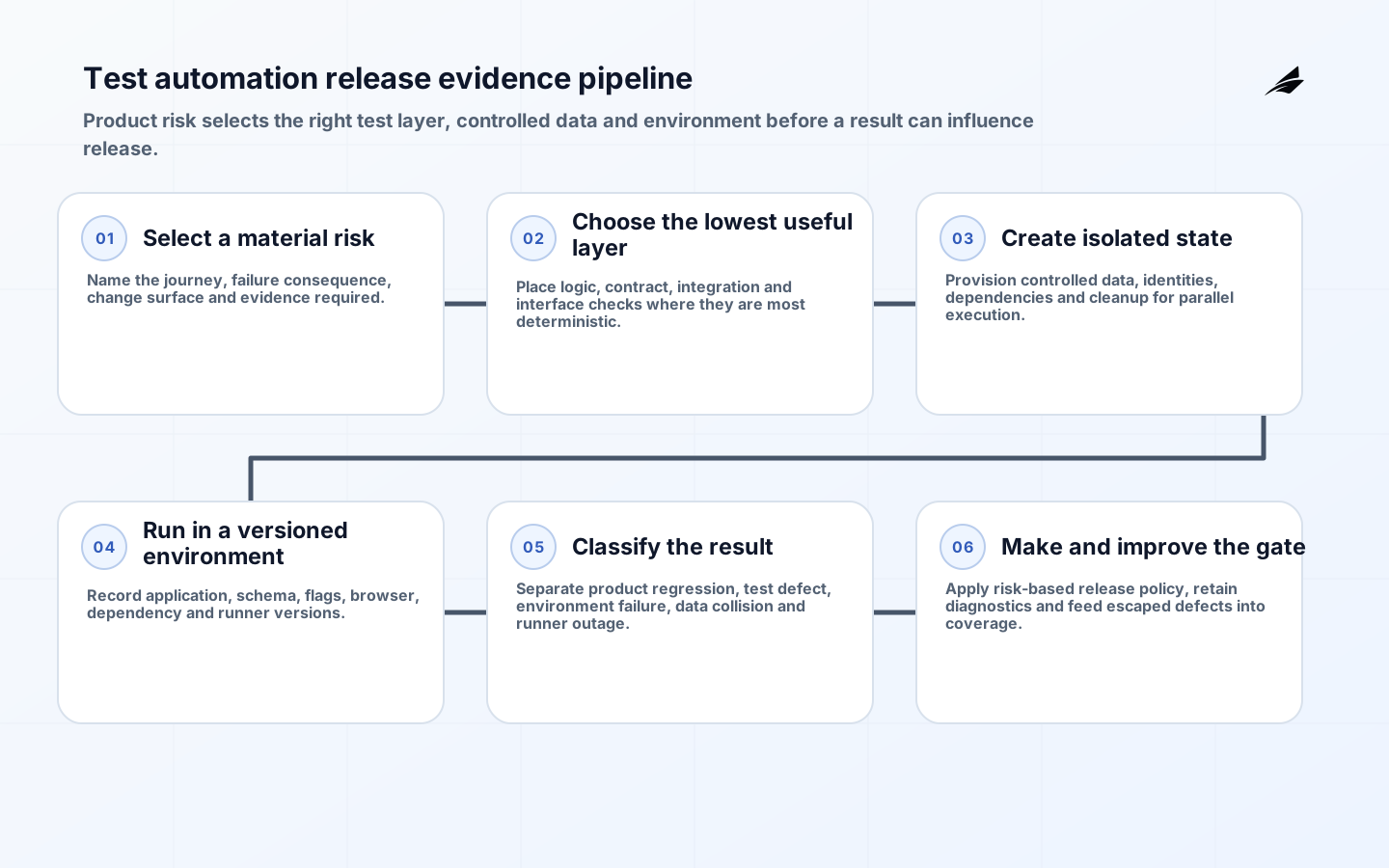
An automation testing services implementation checklist should improve release decisions, not maximize the number of scripts. Automated checks are useful when they detect material regressions quickly, produce evidence a team trusts and remain economical to maintain. A slow or flaky suite can delay delivery while still missing customer failures. Begin with business journeys and consequences, then choose the lowest test layer that provides sufficient confidence.
This guide covers risk, architecture, data, environments, continuous integration, browser and service checks, security, accessibility and suite operations. It complements the automation testing services scope and delivery plan and automation testing services FAQ. The output is a maintained quality system with named owners and measurable release gates.
Build a product risk and coverage model
List journeys that move money, change permissions, store regulated data or affect continuity. For each, identify failure modes, consequence, detection point and evidence needed before release. Include rejected payment, expired session, unavailable dependency and invalid input. Priority follows impact and change frequency, not feature visibility.
Trace each risk to a useful check without turning the suite into a requirements spreadsheet. A checkout may need unit checks for calculations, contract checks for payment messages, integration checks for idempotency and one browser journey. Preserve exploratory testing for novelty and judgment. Record why an area is manual and when that choice will be reviewed.
| Risk area | Early layer | Release evidence |
|---|---|---|
| Business rule | Unit or component | Boundary examples and rule version. |
| Service contract | Schema or consumer contract | Compatible success and error behavior. |
| Transaction | Integration | Commit, retry, rollback and idempotency. |
| Customer journey | Focused browser or mobile | Trace and outcome from a real interface. |
| Security | Static, dependency and dynamic checks | Finding disposition and risk owner. |
| Accessibility | Automated plus human review | Rule result and keyboard scenario. |
Use the smallest reliable test layer
Favor fast deterministic checks near changed code. Unit tests isolate logic, component tests exercise a boundary, contract tests protect interfaces, integration tests verify dependencies and end-to-end tests confirm a few critical journeys. Browser automation observes the product from a user perspective but is more sensitive to environment and timing.
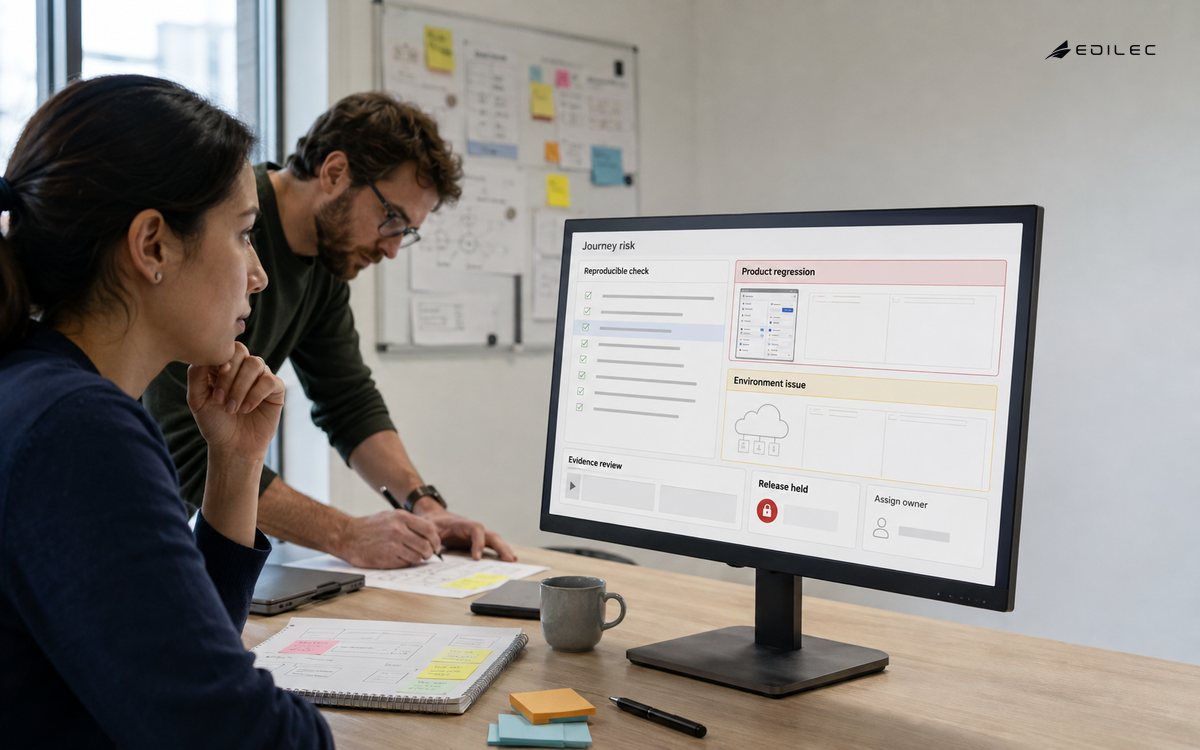
Assign ownership by service and repository. A central quality team can provide frameworks, but product teams maintain behavior checks. Remove redundant scenarios that fail for the same cause. A balanced suite gives rapid local feedback, a bounded pull-request gate and deeper scheduled coverage without making every commit wait for every environment.
Choose frameworks and code standards deliberately
Select tools by application technology, browser or device needs, debugging workflow and team skill. Selenium WebDriver offers broad browser support; Playwright provides integrated waiting and tracing. Tool choice matters less than architecture. Model domain actions rather than every click, prefer stable roles and labels, and keep assertions close to outcomes.
Review test code as production code with linting, type checks, dependency management and peer review. Avoid fixed sleeps; wait for observable state with explicit timeouts. Do not share mutable fixtures or depend on execution order. Retries may gather diagnostics but must not turn intermittent behavior into an unexplained green result.
Control test data and environment state
Choose generated data, synthetic fixtures, masked production-derived records or dedicated seeded accounts deliberately. Personal production data should not enter tests by convenience. Provide deterministic creation and cleanup APIs, unique identifiers and idempotent teardown so scenarios run concurrently without corrupting one another.
Run environment health checks before expensive suites. A failure caused by unavailable identity, stale configuration or exhausted quota is not automatically a product regression. Record application, schema, feature-flag and dependency versions with each run. Use real integrations for risks that mocks cannot represent, while keeping destructive tests isolated.
| Failure class | Identification | Response |
|---|---|---|
| Product regression | Assertion fails on healthy versioned environment. | Block by risk and route to product owner. |
| Test defect | Expectation no longer matches intended behavior. | Repair and review lost coverage. |
| Environment defect | Dependency or capacity prevents execution. | Restore environment and rerun evidence. |
| Flaky behavior | Same state alternates pass and fail. | Quarantine with owner and expiry. |
| Data collision | Parallel tests alter shared records. | Improve isolation and cleanup. |
| Runner failure | Browser or reporting service unavailable. | Use bounded fallback and open incident. |
Integrate tests into a staged pipeline
Run static and unit checks before merge, selected component and contract checks on pull requests, integration checks after deployment to a controlled environment and critical journeys during progressive release. Publish one evidence record showing versions, suites, exclusions, environments, results and authorized risk acceptance.
A gate should stop only conditions that justify stopping a release. Classify infrastructure and product failures separately. Define override authority, required rationale and expiry. Pass percentage is not sufficient: thousands of trivial passes do not outweigh one failed payment or authorization path. Track time to a trustworthy result.
Include security, accessibility and performance
Combine composition analysis, static checks, configuration tests and targeted dynamic work with manual threat-led review. The OWASP testing guide organizes web scenarios while NIST SSDF connects verification to secure development. Do not run intrusive tests against production without authorization and containment. Verify fixes with regression checks.
Automated accessibility rules catch only part of the experience. Add keyboard journeys, focus order, labels, error announcements and selected assistive-technology review. For performance, define representative load, warm-up, data size and environment. Measure distributions and saturation, not one average, and compare against a stable baseline.
Operate suite reliability as a service
Measure flake rate by check, signature and environment. Keep the first failure when retrying for evidence. Quarantine only with an owner, reason and expiry, and keep the missing coverage visible. Capture traces, logs and screenshots on failure rather than retaining every successful run indefinitely.
Plan for browser, device, dependency and application upgrades. Pin versions in controlled runs, validate updates and monitor runner capacity and queue time. The automation platform needs service objectives, support ownership and recovery procedures. If results are consistently late or ambiguous, teams will bypass the suite or batch changes.
Roll out through valuable product slices
Begin with one critical journey that has recurring defects or costly manual verification. Cover its rules, contracts, integration and interface at appropriate layers, then integrate those checks into delivery. The first milestone is not a test count; it is a faster release decision supported by evidence.
Expand by risk family and team. Pair quality engineers with developers and domain experts. Rewrite unstable legacy scripts when they cannot support isolation. Maintain coverage backlog from incidents and upcoming changes. Judge a testing service by gate reliability, detection, repair time and escaped defects rather than automation volume.
Maintain a defect taxonomy that distinguishes requirement ambiguity, implementation regression, integration mismatch, data defect, configuration error and operational failure. Link escaped defects back to the missing or ineffective detection layer rather than demanding another browser test by default. A calculation defect may call for a boundary-focused unit check; a contract mismatch may call for consumer-driven coverage; a production-only configuration failure may require deployment verification. This feedback keeps the suite aligned with actual loss instead of accumulating checks after every incident without considering their best location.
Set retention by diagnostic and compliance value. Failure traces, request identifiers and relevant screenshots may be retained long enough to investigate a release, while successful videos and full payloads can create unnecessary cost and privacy exposure. Redact secrets, tokens and personal fields before publishing artifacts. Restrict access to test evidence because nonproduction results can contain production-like identifiers, internal endpoints and security behavior. Document how evidence is deleted when its purpose expires.
Contracted automation services need acceptance criteria beyond completed scripts. Review code ownership, repository access, framework licensing, documentation, execution environments, data utilities, CI integration and handover. Require a demonstration in which the receiving team diagnoses a failing check, updates a selector safely, creates a scenario and restores a broken runner. The service is not transferred if only the supplier can interpret its reports or renew its device-farm credentials.
Estimate economics using maintenance as well as creation. Include engineering time for framework upgrades, failure triage, data resets, environment support and application-change updates. Compare that recurring cost with manual execution frequency, defect consequence and feedback delay. Some low-frequency, high-judgment scenarios should remain manual; some high-frequency deterministic checks repay investment quickly. Reassess the portfolio quarterly so obsolete coverage is removed and new material risk is funded.
Automation testing implementation takeaways
- Prioritize journeys by consequence, change rate and detection value.
- Place checks at the lowest reliable layer.
- Treat code, data and environments as maintained products.
- Classify product, test, environment and runner failures separately.
- Keep overrides explicit and temporary.
- Measure flakiness, feedback time and escaped defects together.
Frequently asked questions
What percentage of tests should be automated? There is no universal target. Automate repeatable, valuable checks that remain stable enough to maintain, and preserve human exploration for novelty and judgment.
Should flaky tests block releases? An intermittent check cannot provide a trustworthy gate. Investigate it; if temporary quarantine is necessary, keep lost coverage visible and assign an expiry.
Is browser automation enough? No. It complements faster rule, component, contract and integration checks. Browser tests should prove selected complete journeys rather than every business rule.
Conclusion
Automation testing services create value when they turn product risk into timely, reproducible release evidence. A layered strategy, deterministic data, healthy environments, disciplined test code, meaningful gates and active flake management let teams change software with greater confidence and diagnose failures faster.