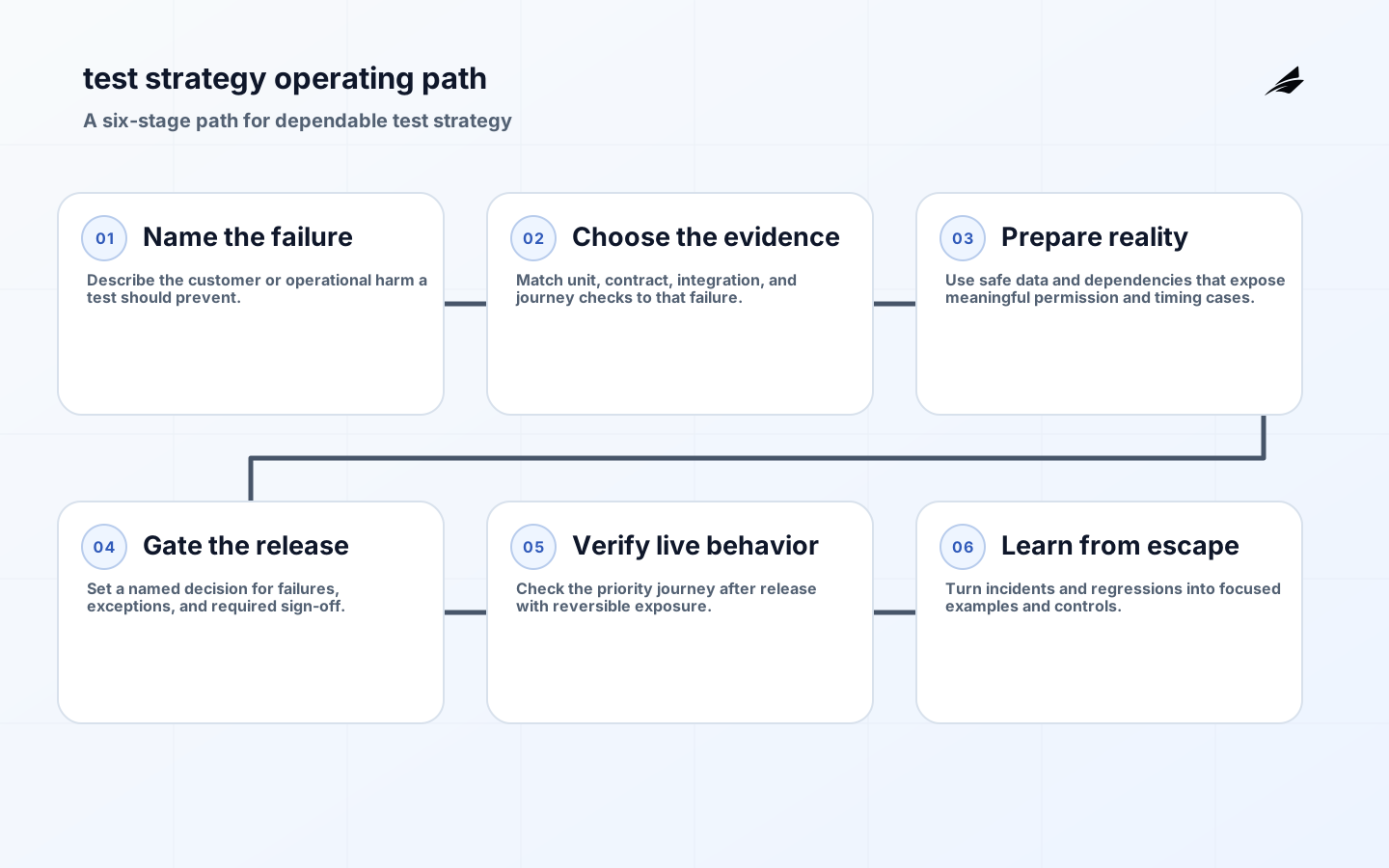
Test strategy matters when a seemingly small technical choice becomes part of an operating promise. Consider a service platform that recalculates customer eligibility overnight, publishes a morning work queue, and must avoid sending a task to the wrong team when a policy rule changes. The hard part is not selecting a library or drawing an architecture box. It is making the result dependable when timing, authority, data quality, and dependencies disagree. Start by stating the outcome in plain language: the team can detect a material behavior change before it harms operations and can decide, with evidence, whether a release is ready, paused, or rolled back. That sentence gives engineers, operators, and product owners a common boundary. It also reveals where a friendly demonstration can conceal an unsafe assumption. This guide treats test strategy as a design and operating discipline: define the decision, make the record and failure behavior explicit, prove the route with representative evidence, and improve it from observed use.
Key takeaways for test strategy
- Write the outcome and the failure boundary before choosing the mechanism for test strategy.
- Make the authoritative record and the actor allowed to change it explicit.
- Test the unhappy case, especially a unit-tested rule behaves correctly in isolation but its production configuration points to an obsolete eligibility table.
- Give every exception an owner, a visible state, and a recovery route.
- Measure critical-path pass rate, escaped defects by failure mode, flaky-test rate, time to diagnose a failed release, test-environment availability, and rollback frequency only when someone has agreed what decision the signal will drive.
Define the decision boundary for test strategy
Begin with one consequential journey rather than a feature inventory. For this topic, identify the user, the trigger, the allowed evaluate a policy rule, integrate with an entitlement service, migrate a schema, render a queue, deploy a release candidate, or recover after a failed check, and the moment at which the promised outcome is complete. Then identify the facts that must be true before the action proceeds. In this example, the working record includes the risk statement, executable example, test data fixture, environment dependency, release candidate, test result, coverage gap, and production incident link. Put names against ownership: an application may read a copy for speed, but the copy must not quietly become the place where a disputed fact is decided. A compact decision record should also state the deadline, approval threshold, and manual fallback. This work is practical discovery, not bureaucracy. It prevents a release from arriving with an impressive normal path and an ownerless exception path.
| Boundary question | Concrete rule | Evidence to retain |
|---|---|---|
| User outcome | the team can detect a material behavior change before it harms operations and can decide, with evidence, whether a release is ready, paused, or rolled back | Named journey, completion condition, and accountable owner. |
| Authoritative record | the risk statement, executable example, test data fixture, environment dependency, release candidate, test result, coverage gap, and production incident link | Identifier, version or effective time, and source owner. |
| Permitted action | evaluate a policy rule, integrate with an entitlement service, migrate a schema, render a queue, deploy a release candidate, or recover after a failed check | Preconditions, authorization decision, and durable result. |
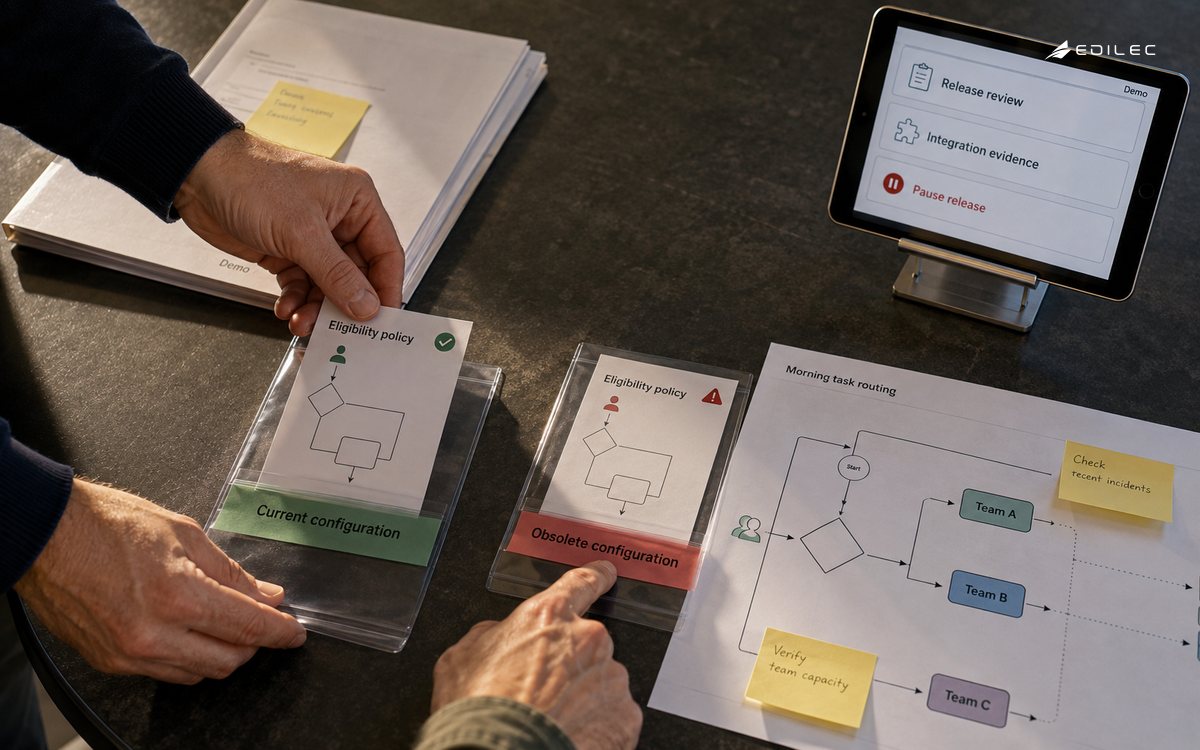
| Exception boundary | a unit-tested rule behaves correctly in isolation but its production configuration points to an obsolete eligibility table | Safe status, next owner, and a recovery or reconciliation route. |
Model the records and authority behind test strategy
A useful model separates a request to do work from the durable business result. The request might be retried, delayed, or rejected; the result needs its own identity, state, and history. Describe which transitions are allowed and which role or system can make each one. For test strategy, make the risk statement, executable example, test data fixture, environment dependency, release candidate, test result, coverage gap, and production incident link inspectable enough that a support person can explain what happened without reading raw logs or asking the original developer. Time matters too. Record when an event occurred, when the system learned it, and when a correction became effective when those are different facts. That distinction keeps late messages and repairs from silently rewriting a decision that another person relied upon.
Implement test strategy with explicit safeguards
Implementation should turn the operating model into checks at the boundary, not into hopes embedded in a user interface. Validate structure and business preconditions close to the action. Authorize the actor against the relevant record and context. Give the operation a stable correlation reference, and decide in advance how a retry, concurrent change, timeout, or dependency outage behaves. The representative failure here is a unit-tested rule behaves correctly in isolation but its production configuration points to an obsolete eligibility table. A robust design never converts that uncertainty into an invented success or an unexplained generic failure. Instead it preserves state, returns a safe next action, and makes later reconciliation possible. Keep configuration, policy versions, and critical assumptions discoverable; a technically correct path is still fragile when only one person knows why it behaves that way.
| Safeguard | Question to answer | Observable check |
|---|---|---|
| Validation | What must be present, current, and internally consistent before the action? | Invalid or stale input produces a safe, useful result. |
| Authorization | Which person, service, or role may perform this action in this context? | Allowed and denied decisions carry an accountable reason. |
| Repeat and concurrency | What happens if work is repeated, reordered, or changed at the same time? | No duplicate or lost business result appears. |
| Recovery | How is the case reconciled when the outcome is uncertain? | An operator can find the state, owner, and next action. |
Verify the behavior that can harm the operation
Verification is stronger when it follows the decision rather than a tool preference. Build examples for the routine path, invalid input, permission denial, stale state, slow dependency, and the scenario that could create an irreversible mistake. For test strategy, exercise evaluate a policy rule, integrate with an entitlement service, migrate a schema, render a queue, deploy a release candidate, or recover after a failed check with the actual roles, data shapes, and boundary conditions that exist in the service. Use automated checks for stable rules, then add a focused integration or journey check where independent components must agree. Release a bounded slice when possible and keep a reversible route: a feature flag, a controlled queue, read-only mode, or a documented manual procedure may be the right safety measure. Record the evidence for the next release instead of treating a green pipeline as the whole proof.
Operate test strategy with signals that lead to action
Operational signals should answer a question that has an owner. For this topic, follow critical-path pass rate, escaped defects by failure mode, flaky-test rate, time to diagnose a failed release, test-environment availability, and rollback frequency. Segment the view by the journey, role, dependency, or state that makes a failure meaningful; an overall average often hides the exact case that matters. Pair metrics with sampled records so a team can see whether a spike comes from a new release, a policy change, bad input, or a third party. Establish a short review rhythm with the people able to change the product and the process. Decide before an incident what warrants a pause, a reduced service mode, a rollback, or a manual queue. That preparation makes recovery calmer and turns each exception into a candidate improvement rather than a recurring support ritual.
Common test strategy mistakes to avoid
- Organizing tests only by tool or code layer instead of by the risk of a wrong decision.
- Using coverage percentage as evidence that important behavior is protected.
- Letting fixtures hide realistic permissions, time boundaries, or dependency failures.
- Treating flaky tests as normal background noise.
- Running production verification without a rollback decision or accountable owner.
Use authoritative guidance in context
NIST Secure Software Development Framework, OWASP Application Security Verification Standard, Playwright Test Documentation, and Google Testing Blog are useful for different parts of this decision. Read the standards for their stated scope, then translate the relevant requirement into a local rule, test, owner, and review cadence. A source is most valuable when it changes a concrete engineering choice rather than when it is merely cited after the fact.
Frequently asked questions about test strategy
What should the first implementation prove? It should prove the team can detect a material behavior change before it harms operations and can decide, with evidence, whether a release is ready, paused, or rolled back. Choose one representative case, one negative case, and one ambiguous case; then make the evidence reviewable by the people who own the business decision. How much automation is appropriate? Automate repeatable checks and state transitions, but stop for human review when the available facts are contradictory, authority is unclear, or a wrong result has consequences beyond the agreed tolerance. What should be reviewed after launch? Review critical-path pass rate, escaped defects by failure mode, flaky-test rate, time to diagnose a failed release, test-environment availability, and rollback frequency. Pair the numbers with sampled cases and support feedback so the team can distinguish a design problem from a temporary incident.
Conclusion: make test strategy dependable
Test strategy is successful when the ordinary path is clear and the difficult path is still understandable. Define the operating promise, protect the record and authority behind it, make uncertainty visible, and practice recovery with realistic cases. The next improvement should come from evidence: a named failure, an accountable owner, and a change small enough to verify. That is how a technical capability becomes a service people can rely on when conditions are less tidy than a demo.