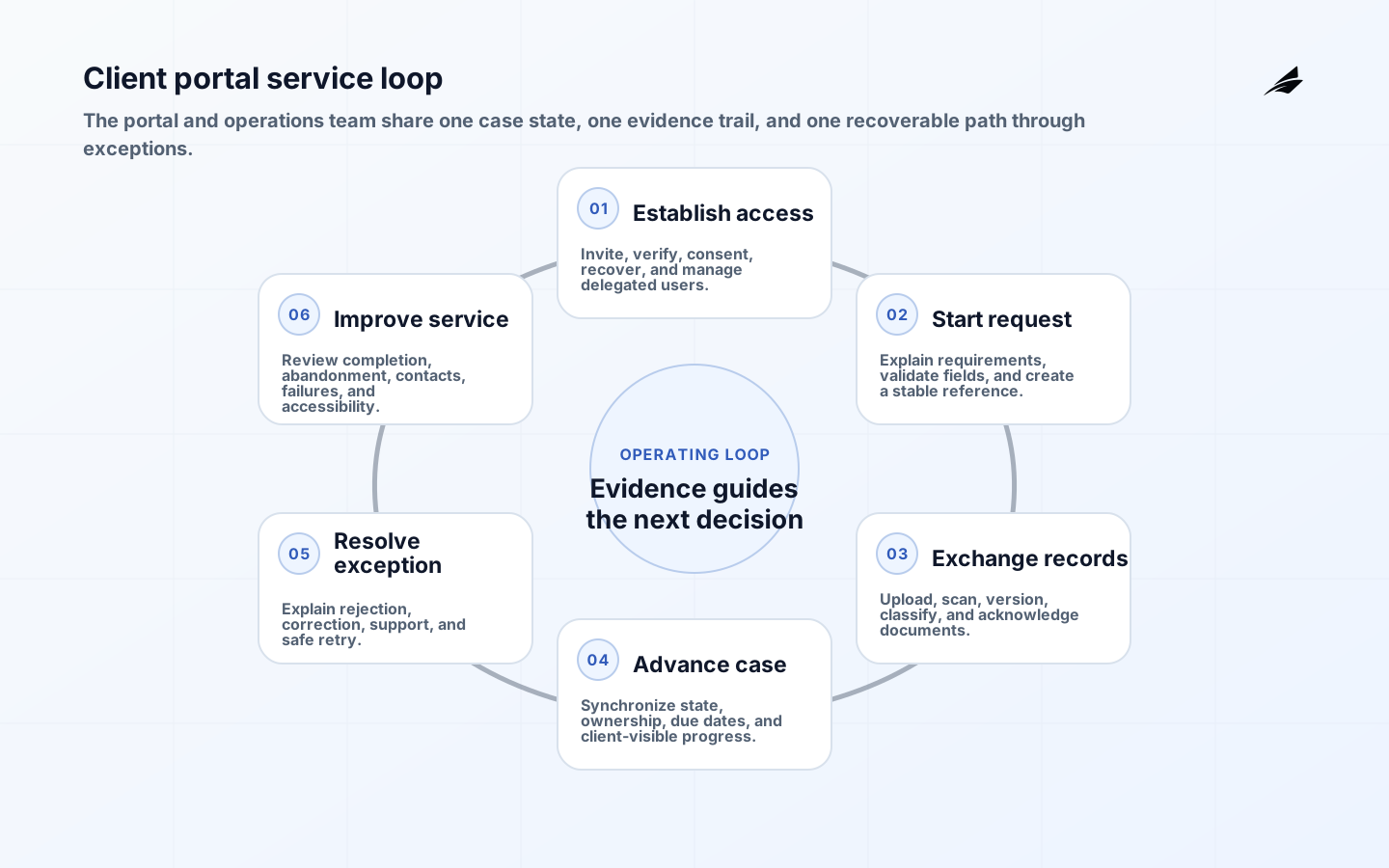
Client portal planning should begin with a service journey, not a home-page layout. A useful portal lets a client complete specific work—submit information, inspect status, respond to a request, download an approved document, or manage an authorized user—without creating a second, contradictory process for the operations team. The plan must define identity, account relationships, case states, document handling, notification rules, accessibility, support, integrations, audit evidence, and the fallback when a dependency or client action fails.
Model the complete client service journey
Walk through a representative client journey from invitation to completion, including an expired invitation, incorrect file, duplicate submission, changed contact, delegated user, rejected request, and status dispute. The portal should expose a stable case reference and an understandable state, while the operational system remains authoritative for work ownership. NIST SP 800-63-4 provides current guidance for identity proofing, authentication, and federation. WCAG 2.2 should influence forms, focus order, validation, status messages, and document interactions from the first prototype rather than as a final audit.
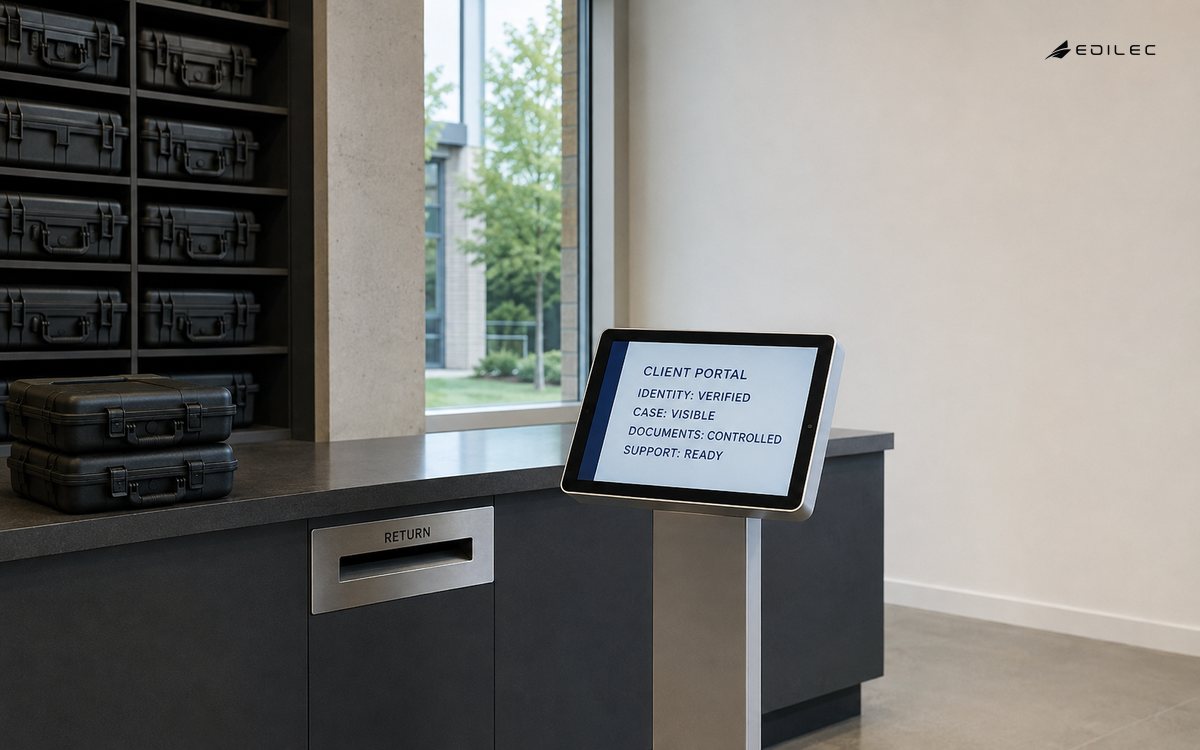
Treat uploads and notifications as security-sensitive workflows. The OWASP File Upload Cheat Sheet recommends extension and type controls, generated filenames, size limits, authorized uploaders, safe storage, and malware or content checks as appropriate. OWASP ASVS helps verify authorization, session, input, and logging controls. Notifications should reveal only enough information to prompt a safe return to the portal; they should not become an alternate record or carry sensitive attachments by default. Test interruption, retry, duplicate submission, inaccessible files, revoked access, and recovery with support staff using the same evidence a client sees.
| Journey step | Portal promise | Operational proof |
|---|---|---|
| Invite and sign in | The intended person can establish and recover access safely. | Invitation, identity, consent, and recovery events are traceable. |
| Submit information | Required fields and files are validated before acceptance. | Client sees receipt, version, time, and next expected action. |
| Track work | Status reflects the authoritative case state in plain language. | Operations can explain each transition and correct a mismatch. |
| Resolve exceptions | The client can understand and repair a rejected or incomplete request. | Support sees the same reference, reason, evidence, and ownership. |
Key takeaways
- Frame client portal planning around a measurable outcome and one bounded end-to-end journey.
- Name the authenticated account relationship and backend record owning the request, document, or entitlement before designing copied data, automation, or interface polish.
- Model explicit states: invited, authenticated, draft, submitted, under review, completed, and needs client action.
- Enforce protected actions at the service boundary and preserve a recovery path.
- Release with representative operations teams and improve using observed exceptions, not opinions alone.
Define the client portal planning boundary
Write the outcome in plain language and make its boundary testable. For this work, that means allow clients to find status, submit accurate information, and complete approved requests while reducing manual follow-up. Treat each client request as a working unit with a trigger, stable identifier, accountable owner, completion condition, and an understood error consequence. A boundary also names what is outside the first release. That protects the team when adjacent requests arrive from other parts of the organization. Review the boundary with clients, account managers, operations reviewers, and identity administrators. Ask what evidence they need, which action they may take, and what happens when information is incomplete. The answer should be specific enough that a release reviewer can identify valid completion without interpreting a broad business aspiration.
| Question | Decision to document | Evidence to collect |
|---|---|---|
| Outcome | allow clients to find status, submit accurate information, and complete approved requests while reducing manual follow-up | Baseline timing, rework, and named business owner |
| Working unit | A client request with stable identity and lifecycle | Recent normal and difficult cases |
| Authority | the authenticated account relationship and backend record owning the request, document, or entitlement | System owner, permitted editors, and policy reference |
| Completion | Durable result, visible confirmation, and recovery condition | Result record, receipt, and reconciliation rule |
| First release | One complete decision loop and its exceptions | Deferred work with owner and review date |
Model state, data, and authority
A state model prevents client portal planning from degrading into a collection of disconnected pages. Use states that explain what happened, what may occur next, who can act, and what is blocking progress: invited, authenticated, draft, submitted, under review, completed, and needs client action. Avoid a generic pending status that hides whether the client request awaits data, a decision, a dependency, or manual repair. For material fields, record the authoritative source, effective time, update expectation, and permitted editors. A display copy can be useful, but it is not automatically allowed to correct the source. Retain the identifier that connects the initiating request, action, downstream call, and recovery activity. This gives operations and engineering a shared route to investigate disagreements without relying on inbox archaeology.
Design controls and recovery
Control design should fit the consequence of the action. In this case, verify identity and relationship before disclosure, then enforce record authorization at every server-side request. Apply permission at the command or API boundary using the current actor, object, relationship, and requested action. Hiding a menu can improve clarity, but it cannot secure a direct request. The OWASP Application Security Verification Standard gives practical checks for authorization, validation, logging, and session handling. Plan a legible response when an action is denied, a dependency times out, or records disagree. A visible exception owned by a real person is safer than a silent retry or undocumented workaround. Significant changes should retain prior state, actor, time, reason, and correlation identifier while avoiding unnecessary personal data in diagnostic records.
| Condition | Expected behavior | Operational evidence |
|---|---|---|
| Information missing | Hold work in a recoverable state and state what is needed. | Validation result and next owner |
| Unauthorized request | Deny at the service boundary without exposing unrelated records. | Actor, action, object scope, review event |
| Dependency failure | Use bounded retry or compensation and expose recovery. | Correlation identifier, attempt history, exception owner |
| Replay or duplicate | Prevent repeated effect and return known outcome. | Request identity, prior result, idempotency decision |
| Manual override | Require authority, reason, and follow-up where appropriate. | Before-and-after state and policy basis |
Build a thin operational slice
Prove the full path before broadening the surface. Begin with one client journey, accessible forms, predictable status, and an internal exception route. Include identity, retrieval of trusted context, allowed transition, usable outcome message, audit event, observable failure, and supportable recovery. Make integration behavior explicit: contract, expected time, duplicate behavior, and the owner who investigates a rejection or delay. The Secure Software Development Framework connects these requirements to secure design, implementation, verification, and release evidence. A thin slice is not a mock-up; it is a production-shaped capability whose behavior remains understandable when conditions are ordinary and when they are inconvenient.
Verify quality with real conditions
Review authentication recovery, uploads, keyboard forms, unauthorized direct links, and clear change confirmation. Include keyboard users, assistive technology users, unreliable networks, and non-default data conditions in the review. WCAG 2.2 is useful for focus visibility, error identification, status messages, target size, and accessible authentication. Define acceptance evidence before implementation: expected outcome, protected boundary, error condition, data condition, and named observer. Pair workflow checks with contract and integration checks, then explore places where a person may misread status or take an irreversible action. Quality is not a release-day ceremony; it is credible assurance for the risks that would make this work unsafe or untrustworthy.
Operate and improve after release
Invite a representative group and retain an assisted route while identity and status definitions settle. Instrument intent and outcome, not merely page loads. A correlation identifier across browser, service, and dependency activity connects a reported issue to its actual path; the OpenTelemetry Specification provides common concepts for traces, metrics, and logs. Review cycle time, failed transitions, queue age, corrections, and recovery time alongside user observation. DORA research also encourages teams to look at delivery performance with organizational outcomes rather than treating deployment frequency as success by itself. Retire old reports, credentials, and manual steps only after the replacement has earned trust in real work.
Define release evidence
For client portal planning, set an expectation for every transition a client can see. A submitted request needs a reference, a status whose meaning is clear outside the organization, and an indication of the next responsible party. A request for more information needs a usable way to respond without exposing internal notes or forcing a second sign-in path. Build a content and operations review around the moments clients are most likely to make an avoidable error: identity recovery, document requirements, deadlines, consent, and rejected submissions. Internal teams should have a controlled correction route that updates the same authoritative request the client sees. During the first cohort, inspect abandonment and assisted-support contacts alongside technical errors. A call or email can indicate unclear language, inaccessible interaction, or a policy that has not been translated into a client-appropriate task. Fix the journey, not just the help text. Use a reviewed sample of portal requests to verify that client-visible language, the internal record, and the actual outcome still agree after each material change.
Frequently asked questions
What belongs in the first client portal planning release?
Start with one repeated client need, such as submitting a request and tracking the result, rather than exposing every internal view.
How should the team decide what to automate?
A portal needs plain language, reliable status, deliberate identity handling, and recovery when a client cannot complete the task.
Conclusion
Client portal planning is successful when it makes consequential work legible, controlled, and easier to improve. Start with the operational outcome, establish data and decision authority, build one complete transition with recovery, and judge the result by what people can safely achieve. That sequence gives clients and internal teams a capability that remains useful when information is missing, dependencies fail, or the original project team is no longer nearby.