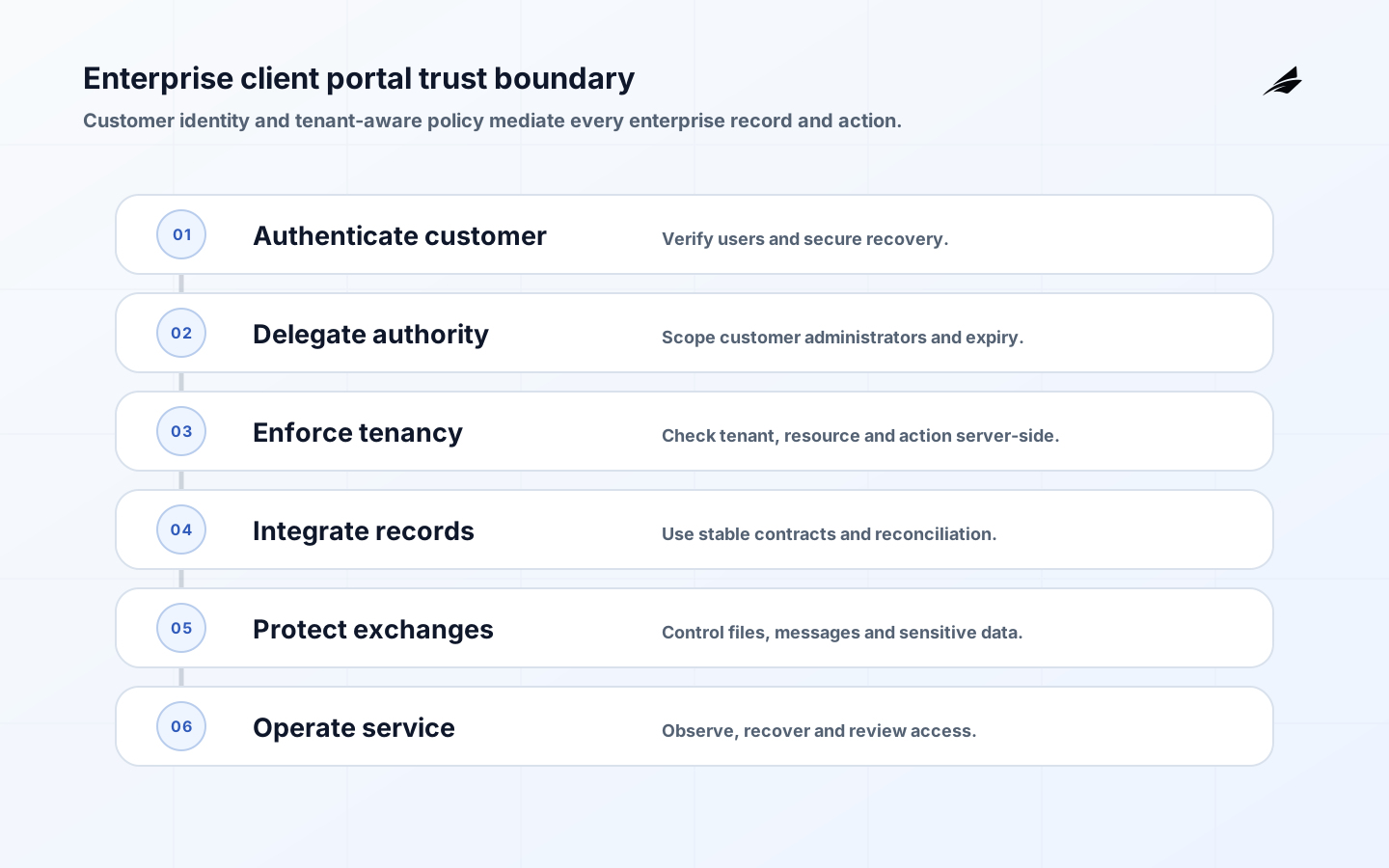
Client portal development for enterprise teams is the work of creating a secure, role-aware digital service where customers, partners and internal operators can complete shared work. A portal may expose orders, cases, invoices, projects, files or approvals, but the interface is only the visible layer. The harder design questions concern identity, tenant separation, authoritative records, document handling, delegated administration, integration failure and support. A portal becomes valuable when it shortens a real customer journey without weakening control over data or action.
This FAQ focuses on architecture and delivery decisions that determine whether an enterprise customer portal remains trustworthy after launch. NIST's current digital identity guidance informs authentication and authenticator management; WCAG 2.2 supports accessible interaction; OWASP ASVS provides testable application-security requirements; the NIST Privacy Framework helps teams reason about data processing; and RFC 9457 supports consistent API error responses. These references do not prescribe one technology stack, but they provide a stronger foundation than starting from a collection of screens.
What should an enterprise client portal include?
Define the portal around customer jobs, not organizational departments. A customer may need to submit a request, attach evidence, obtain an approval, review status and download a final record. That journey can cross sales, finance, delivery and support while remaining one experience. Rank journeys by frequency, consequence and avoidable effort. A portal that exposes every internal field often transfers complexity to the customer; a focused portal translates internal state into the information and actions the customer actually needs.
State what the portal will not do. Exclusions might include emergency support, legally binding changes, payment-card storage or administration of unrelated subsidiaries. Identify the authoritative system for each record and the latency customers can expect. If status is refreshed every fifteen minutes, label it rather than presenting it as live. Define which actions are synchronous, which create queued work and which require internal review. Clear boundaries shape architecture, service levels and customer communication.
| Portal journey | Authoritative record | Important control |
|---|---|---|
| Account and user administration | Enterprise identity or customer master | Delegated authority and periodic review |
| Case or request | Service-management platform | Tenant scope, attachments and response commitment |
| Invoice and payment status | Finance system | Sensitive fields, reconciliation and dispute path |
| Project deliverable | Project or document repository | Version, approval, retention and download audit |
How should customer identity and delegated administration work?
Choose authentication assurance according to the action and data, not one rule for every page. Viewing public project information may need ordinary federated sign-in; changing bank details or granting administrator access may require stronger authentication and step-up verification. NIST SP 800-63B emphasizes phishing resistance, secure authenticator management and recovery. Recovery deserves particular care because weak help-desk overrides can defeat strong sign-in. Keep enrollment, recovery and high-risk changes observable and attributable.
Enterprise portals often need delegated administration: a customer administrator invites colleagues and assigns roles without sending every request to the provider. Model the delegation boundary explicitly. Limit administrators to their organization and approved account scope, prevent privilege escalation and show pending, active and revoked access. Support more than one administrator to avoid lockout, but require review for sensitive roles. Record who granted access, under what authority and when it expires. Offboarding and organization mergers must be supported as normal lifecycle events.
How do tenant isolation and authorization differ?
Tenant isolation prevents one customer from reading or affecting another customer's resources. Authorization decides what a valid user may do inside the correct tenant. Enforce both on the server for every request, background job, export and search path. Never rely on a tenant identifier supplied by the browser without verifying it against the authenticated principal. Include object ownership in queries and policies. Test guessed identifiers, cached pages, file URLs, batch exports, notification links and administrator functions across tenants.
Large customers may contain subsidiaries, regions, projects and external advisers. A simple customer role is rarely enough. Model resource scope and action separately, and avoid roles that accumulate unrelated privilege. Policy decisions should be explainable to support staff without exposing sensitive details. Store a durable authorization decision for consequential actions. If permissions are synchronized from another directory, define delay, conflict handling and emergency revocation. A portal is not isolated merely because each tenant has a different visual workspace.
How should the portal connect to enterprise systems?
Use an integration layer that presents stable, customer-oriented contracts while insulating the portal from internal schema churn. Decide whether reads are live, cached or event-driven according to freshness and resilience. Commands should include idempotency keys and correlation identifiers so retries do not duplicate orders or requests. RFC 9457 problem details can provide consistent machine-readable errors while the interface presents useful customer language. Distinguish rejected input, missing permission, pending processing and unavailable dependency.
Do not create a shadow master record without an explicit reconciliation model. If the portal stores a customer address for workflow convenience while the CRM remains authoritative, define which change wins and how conflicts are surfaced. For long-running work, expose a stable request identifier and state transition history. Events should carry schema version, source and time. Reconciliation should identify records that are missing, stale or contradictory, and operations teams need a queue for resolving them.
| Failure | Customer experience | Operational response |
|---|---|---|
| Dependency timeout | Show current known state and avoid ambiguous success | Trace request, retry safely or reconcile |
| Queued command | Display pending status and expected next update | Monitor age and dead-letter conditions |
| Conflicting records | Explain that review is required | Route to named data owner with both versions |
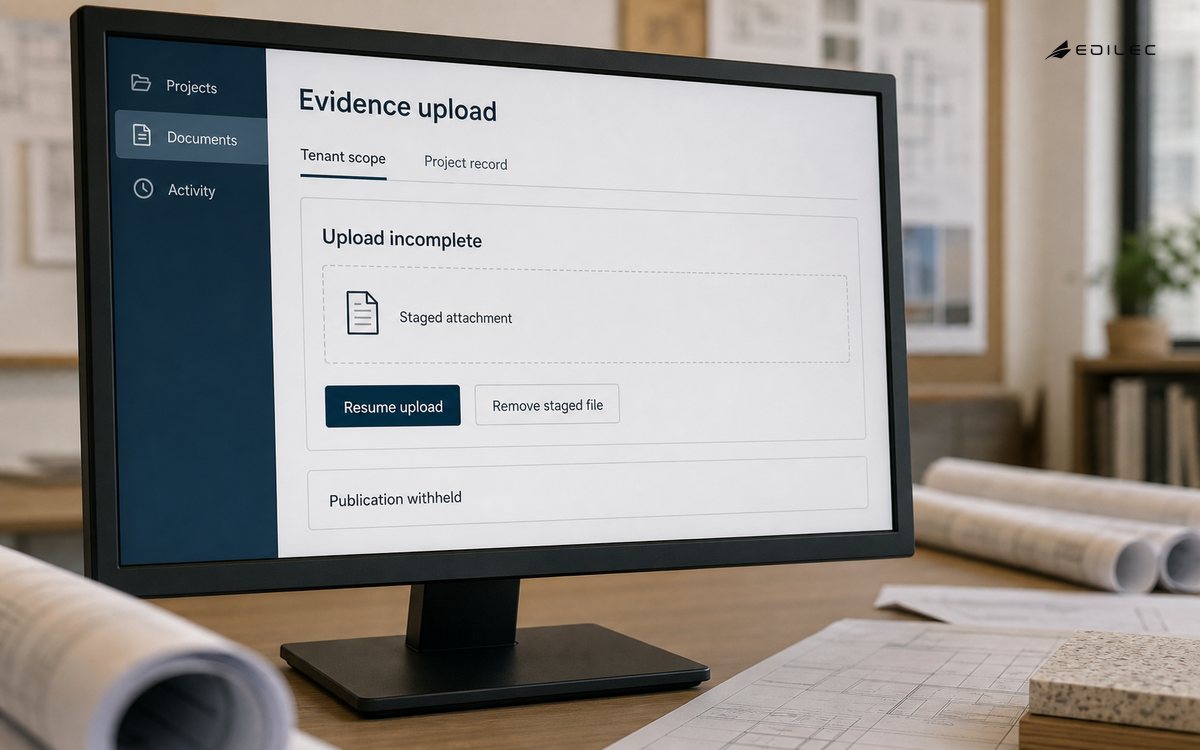
| Partial document upload | Do not publish incomplete evidence | Resume or remove staged content safely |
What controls are needed for documents and messages?
Treat uploads as untrusted. Validate file type and size, scan content, isolate processing and avoid serving active content under the application's trusted origin. Assign each document a tenant, resource, classification, version, retention rule and access policy. A download URL should not become a permanent bearer token. For regulated records, preserve integrity and approval history. Customers should be able to identify the latest approved version and understand whether a document is draft, superseded or final.
Notifications are part of the security boundary. Email and SMS should avoid sensitive details and direct users to authenticated portal state. Protect links from replay where consequence matters. Let customers control ordinary notification preferences while preserving mandatory service or legal notices. Keep a record of template version, recipient, delivery outcome and related event. For collaborative messages, separate internal notes from customer-visible discussion and make that distinction unmistakable in the interface.
How should accessibility and responsive design be tested?
WCAG 2.2 should inform interaction from design through release. Use semantic structure, keyboard access, visible focus, sufficient contrast, clear labels, understandable errors and alternatives to pointer-only gestures. Test zoom, reflow, large text and common assistive technologies. A technically compliant component can still fail when embedded in a complex flow, so test complete journeys such as inviting a user, uploading evidence and correcting a rejected form.
Responsive design must preserve decision context, not simply stack desktop panels. On small screens, place the current task, status and primary action before secondary history. Tables need deliberate alternatives such as prioritized columns, grouped records or detail views; horizontal overflow should be usable and visually indicated. Test long organization names, translations and real documents. Accessibility defects in identity recovery or payment flows can block customers from the service entirely and should be treated as release defects.
How should security and privacy be assured?
Use OWASP ASVS to turn security expectations into verifiable requirements across architecture, authentication, session management, access control, validation, cryptography and logging. Threat-model tenant crossing, compromised customer administrators, malicious files, insecure integrations, bulk export and support impersonation. Protect secrets outside source code, review dependencies and preserve build provenance. NIST SSDF practices make these activities part of delivery rather than a final penetration test.
Apply data minimization to every screen, API and log. The NIST Privacy Framework can help teams map processing purpose, affected individuals, data actions and risk. Define retention and deletion for portal profiles, messages, files and telemetry, including backups. Give customers meaningful information about processing and a correction path. Support access should be time-bound and visible; impersonation should never conceal which employee performed an action.
How should an enterprise portal be launched?
Pilot one customer journey with a small, representative customer group. Migrate only records needed for that journey and reconcile counts and critical fields. Exercise identity recovery, delegated administration, dependency failure, file rejection and support escalation before inviting customers. Publish service status and a support route. Keep the previous channel available until the portal proves reliable, but avoid operating two authoritative update paths indefinitely.
Measure completion rate, time to complete, abandonment, support contacts, integration failure, accessibility defects and customer-reported clarity. Segment by customer type and device without exposing personal data. Adoption alone is not success if customers log in only to discover they must email the same information. Review observations with product, operations, security and account teams, then expand journey by journey with explicit entry criteria.
Key takeaways
An enterprise portal is a shared operating system at the customer boundary. Its quality depends on identity lifecycle, tenant isolation, stable integrations, document controls, accessible journeys and transparent service state. Design each customer action with an authoritative record, bounded permission, failure behavior and support owner.
- Organize scope around complete customer journeys.
- Enforce tenant and resource authorization on every server-side path.
- Treat recovery, delegated administration and document exchange as core architecture.
- Expose freshness, queued work and integration failure honestly.
- Pilot with real customers and reconcile records before expansion.
Frequently asked questions
Should we use a portal product or build custom software?
Use a product when its identity, data model and workflows fit the journeys. Build a custom layer when differentiation or integration demands it, while retaining supported services for commodity capabilities where practical.
Is enterprise single sign-on enough for security?
No. SSO establishes authentication; the portal still needs tenant-aware authorization, session protection, recovery controls, delegated administration, secure integrations and monitoring.
Does an enterprise portal need a native mobile app?
Often a responsive web service is sufficient. Choose native delivery only when device capabilities, offline operation or sustained mobile workflows justify the additional release and support burden.
Conclusion
Client portal development for enterprise teams succeeds when customers can complete important work with confidence and the enterprise can explain every record, permission and state transition. The interface should simplify the journey while the architecture preserves identity, tenancy, privacy, integration integrity and recovery. Build a narrow end-to-end service first, prove it with customer and operational evidence, then extend the portal without weakening those boundaries.