Digital engineering services for SaaS companies should improve the complete path from a customer need to a secure, observable and economically sustainable production capability. The engagement is broader than adding developers and narrower than an open-ended transformation. It needs a defined product boundary, measurable operating outcomes, a prioritized technical backlog and an explicit transfer of knowledge. The useful commercial question is which constraints will be removed and what evidence will show that product teams can deliver more safely after the engagement ends.
This delivery plan is intended for SaaS leaders choosing between modernization, platform work, feature delivery and operating-model change. It pairs with the SaaS digital engineering implementation checklist and digital engineering FAQ. It avoids universal cost estimates because architecture, migration risk, assurance needs, team capability and service criticality determine effort far more than a page count or raw number of engineers.
Frame the engagement around a SaaS value stream
Map one representative change from discovery through design, implementation, verification, release, observation and customer support. Record queue time, approval delay, rework, deployment effort, incident impact and missing ownership. This reveals whether the constraint is product decision-making, architecture, testability, environments, data migration, release governance or operations. Use a small number of outcome measures: time to validate a customer capability, change failure, restoration, product adoption and cost per meaningful unit of service.
Create a service and dependency map for the product journey being improved. Include tenant boundaries, identity, billing, data pipelines, external APIs, asynchronous work, support tools and analytics. Mark authoritative records and critical failure paths. The scope should state which product capabilities, services, environments and teams are included, plus what remains unchanged. Without that boundary, platform initiatives absorb unrelated clean-up while feature teams continue creating the same delivery friction elsewhere.
| Workstream | Typical scope | Acceptance evidence |
|---|---|---|
| Product architecture | Capability boundaries, APIs and data ownership | Decision records and tested contracts |
| Delivery platform | Build, test, environments and deployment | Repeatable traceable release |
| Reliability | SLIs, SLOs, telemetry and response | User-centered service evidence |
| Security | Threats, controls and software supply chain | Verified controls and response ownership |
| Economics | Allocation, unit cost and capacity | Reconciled cost and accountable action |
Modernize architecture only where it changes outcomes
Start with domain boundaries, data ownership and deployment coupling rather than a preferred architecture label. A modular monolith may be the best next state when teams need clearer ownership without distributed-system overhead. Extract a service when independent scaling, fault isolation, security or team autonomy provides measurable value. For every split, account for network failure, consistency, observability, deployment compatibility and operational ownership. Architecture progress should be demonstrated by safer changes and clearer accountability, not by the number of repositories.
Plan modernization as reversible slices. Add characterization tests around critical behavior, introduce explicit interfaces, move reads before writes where useful, and migrate data with reconciliation and rollback criteria. Define compatibility windows for APIs, events and schemas. A dual-run period needs a named comparison method and exit condition; otherwise temporary bridges become permanent. Preserve customer-visible behavior intentionally, and communicate any contract change with enough time for integrators to test.
Build a paved path that removes repeated delivery work
A SaaS engineering platform should provide reusable paths for repository creation, identity, secrets, infrastructure, deployment, telemetry, policy and support metadata. Treat the path as a product: document its users, support model, adoption measures and exceptions. Defaults should be secure and observable, yet teams need a governed way to depart when the product genuinely requires it. A platform that mandates tools without reducing cognitive load merely relocates approval work.
Standardize interfaces before standardizing every implementation. Require service ownership, health endpoints, artifact identity, environment promotion, dependency records and telemetry context. Automate evidence collection so release and assurance reviews use facts produced by the delivery system. Keep source, build configuration and infrastructure definitions under version control. Protect the deployment path from individual credentials and undocumented console changes; emergency actions should be logged, bounded and reviewed.
Connect reliability objectives to product decisions
Define service-level indicators from the customer journey: successful login, usable search, completed checkout, accepted API request or timely data availability. Google’s SRE guidance distinguishes indicators, objectives and agreements; that distinction prevents a technical uptime number from being mistaken for a customer promise. Specify numerator, denominator, measurement point, window and exclusions. Use an error budget or explicit decision rule to adjust release risk when reliability falls below the agreed objective.
Instrument traces, metrics and logs with consistent service, tenant-safe and release context. OpenTelemetry provides vendor-neutral conventions, but instrumentation still requires judgment about useful events and cardinality. Observe dependency latency, queue delay, saturation, correctness and customer-facing failure. Alerts should map to owned action, while trends and diagnostics belong in review dashboards. Include synthetic journeys for externally visible behavior and test that telemetry survives the incidents it is meant to explain.
Make secure delivery part of normal engineering
Use NIST SSDF practices to organize repository protection, development environments, dependency governance, code review, verification, release integrity and vulnerability response. Prioritize threats by data sensitivity, tenant isolation, privileged operations and exposed interfaces. Test authorization and tenancy at the server, including exports, support impersonation, background jobs and administrative APIs. Create a software inventory that connects components and artifacts to deployed services, then define how high-impact vulnerabilities are assessed, mitigated and communicated.
Security controls need operational proof. Review privileged access, rotate secrets safely, preserve audit events, test recovery and rehearse a cross-team incident. If the service uses external processors or AI capabilities, document data sent, retention, contractual boundaries, fallback behavior and monitoring. Assurance work should produce reusable evidence rather than interrupting every release with manual screenshots. Residual risks require an owner and expiry, not a permanent exception hidden in a ticket.
Estimate cost by capability and transition risk
Separate discovery, delivery, platform enablement, migration, assurance, cloud consumption, licenses and post-release support. Team-month pricing is incomplete unless roles, decision cadence, acceptance and customer responsibilities are clear. Use a range for uncertain migration or integration work and fund a short evidence phase to narrow it. Include internal product, security, data and operations time; an external team cannot make authoritative decisions without those participants.
Apply FinOps practices by making consumption visible to engineering and product owners. Allocate shared costs consistently, monitor anomalies and use unit measures such as cost per active tenant, processed order or successful workflow when they reflect the business. Optimization must preserve reliability and delivery speed. Track realized outcomes after performance and labor effects, rather than claiming the theoretical value of recommendations. Capacity commitments require clear authority and workload evidence.
| Risk | Early signal | Delivery control |
|---|---|---|
| Migration expands indefinitely | Unknown dependencies keep appearing | Inventory and slice-specific exit criteria |
| Platform is not adopted | Teams retain custom pipelines | Co-design, migration support and measured friction |
| Reliability is abstract | Infrastructure uptime hides failed journeys | User-centered SLIs and synthetic tests |
| Supplier dependency grows | Only consultants can release | Paired ownership and verified handover |
| Cost rises without value | Spend lacks product allocation | Unit economics and accountable budgets |
Deliver through controlled phases
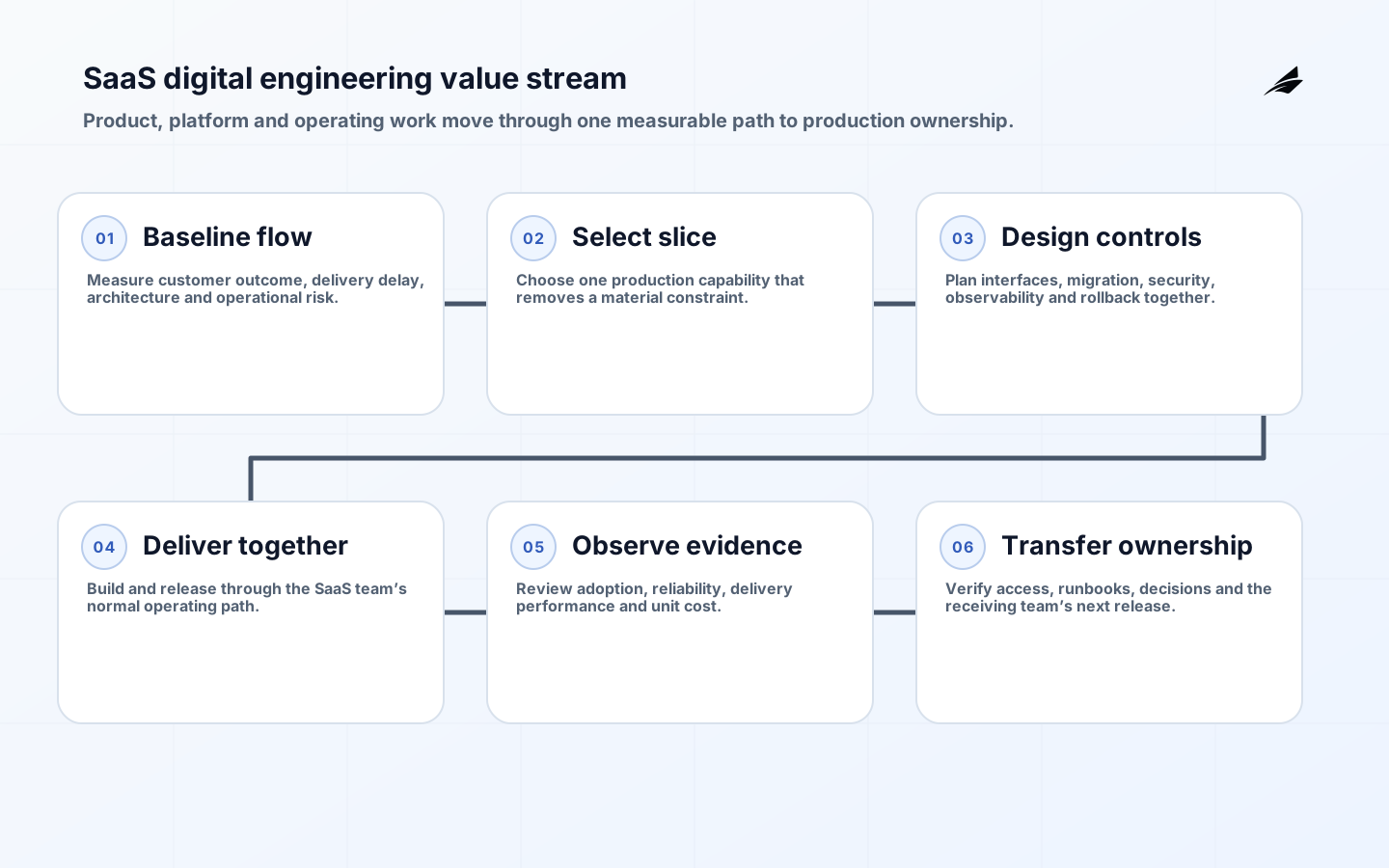
- Baseline one value stream, product outcome, architecture and operating risk.
- Choose a production slice that removes a meaningful constraint.
- Design target interfaces, migration, telemetry, security and rollback together.
- Deliver with the product team through the normal release path.
- Measure customer, delivery, reliability and cost evidence after release.
- Transfer ownership, close gaps and decide the next slice from observed results.

Key takeaways
- Scope digital engineering around a measurable SaaS value stream.
- Modernize architecture when it improves ownership, safety or economics.
- Treat platform capability, reliability and security as product work.
- Estimate migration and internal decision effort explicitly.
- Require paired delivery and operational proof before handover.
Frequently asked questions
Is digital engineering the same as staff augmentation?
No. Staff augmentation adds capacity under the customer’s existing system. A digital engineering engagement should also improve architecture, delivery controls, reliability, security and knowledge transfer against agreed outcomes. Either model can be appropriate, but their responsibilities and acceptance criteria differ.
How long should the first engagement last?
Long enough to baseline, release and observe one meaningful production slice. A fixed calendar alone is a weak boundary. Define entry evidence, the production outcome, observation period and handover test, then use those gates to decide whether a follow-on slice is justified.
Which engineering metrics should leadership review?
Use a balanced set: customer adoption or task success, lead time, deployment frequency where meaningful, failed-deployment recovery, change failure, user-centered reliability, security exposure and unit cost. Trends and distributions are more useful than a single target detached from product context.
Before procurement closes, require a named product owner, architecture owner, security contact and operational receiver. Confirm repository and account ownership, decision turnaround, delivery evidence and acceptance authority. This compact governance design prevents an otherwise capable team from waiting on undefined customer decisions and makes commercial progress correspond to an observable production outcome.
Make architecture decisions durable but revisable. Record the context, alternatives, selected trade-off, consequences and evidence that should trigger reconsideration. Link each material decision to services and backlog work. This helps new team members understand why a boundary exists, prevents repeated debates and gives modernization a measurable reason. Review decisions after production learning instead of treating the original target architecture as an untouchable destination.
Conclusion
Digital engineering services create durable value when they leave a SaaS organization with a better product system, not merely more code. Tie the engagement to a customer journey, improve the constraints that block safe delivery, and prove the result in production. Clear scope, reversible modernization, operational evidence and verified ownership transfer turn outside expertise into internal capability rather than long-term dependence.