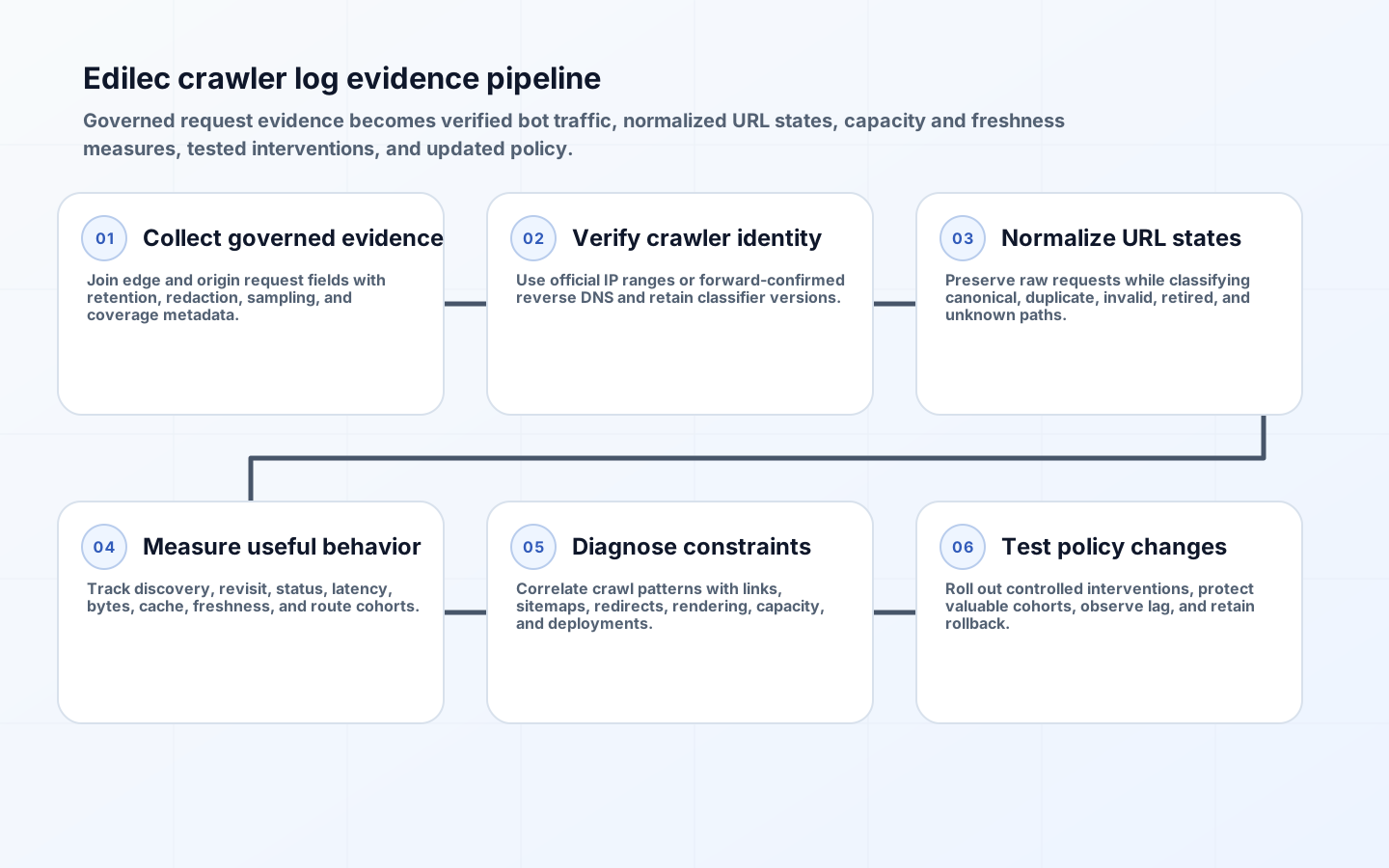
SEO log file analysis reveals what a server actually delivered to crawlers: requested URL, time, client address, response status, bytes, latency, cache outcome, and sometimes upstream behavior. Search Console aggregates Google crawl patterns and provides useful host and response summaries, while edge and origin logs can expose individual templates, parameter spaces, redirects, and failures. Neither source alone proves index status or page quality, so analysis should join request evidence with site inventory and search diagnostics.
The aim is not to maximize crawler requests. It is to support efficient discovery and refresh of valuable URLs while protecting service health and closing useless spaces. “Crawl waste” must be defined operationally: repeated requests to duplicate parameters, redirect chains, retired URLs, empty facets, or unchanged low-value pages may be wasteful; frequent requests to fast-changing inventory or news can be appropriate. Classify purpose before drawing conclusions from counts.
Define the crawler log evidence contract
Document where requests terminate: CDN, web application firewall, load balancer, reverse proxy, origin, rendering service, and API. No single layer may contain the full story. Specify timestamp precision and timezone, request ID, host, method, raw path and query, normalized route, response status, bytes, total and upstream latency, cache status, user agent, client IP or trusted forwarding chain, protocol, region, bot-verification result, and deployment version. Preserve raw evidence under controlled retention.

Treat log data as sensitive operational information. Query strings can contain personal or secret values, and IP addresses require appropriate handling. Redact or tokenize prohibited parameters at collection, restrict access, encrypt storage, establish retention, and document approved analytical uses. Keep enough reversible mapping only where necessary for incident response. Sampling may be suitable for high-volume success traffic, but retain complete error and rare-bot records or record the sampling probability so rates remain interpretable.
| Field | Analytical use | Quality check | Privacy or security control |
|---|---|---|---|
| Timestamp and request ID | Sequence retries and connect edge to origin | Clock synchronization and uniqueness | Bound retention and access |
| Host, path, query | Normalize template and URL state | Preserve raw form before approved normalization | Redact secrets and personal parameters |
| Status and bytes | Measure success, redirects, soft anomalies, and payload | Compare edge and origin outcomes | Avoid logging response bodies |
| Latency and cache | Locate capacity, cache, and rendering pressure | Separate total, upstream, and queue time | Restrict infrastructure details |
| IP and user agent | Verify crawler identity and classify agents | Do not trust user agent alone | Minimize, tokenize, and control access |
| Deployment and route | Correlate regressions with releases and templates | Use governed version and route dictionaries | Prevent internal identifiers from leaking externally |
Verify crawler identity before measuring behavior
User-agent strings are trivial to spoof. Google documents two verification approaches: match source addresses against published crawler IP ranges, or perform reverse DNS lookup and then forward DNS verification for the resulting hostname. Build verification as a cached enrichment pipeline rather than a blocking DNS operation on every request. Store verification method, result, evidence time, and range-data version. Revalidate when addresses or published lists change.
Separate Googlebot Search, image, smartphone, special-case crawlers, user-triggered fetchers, other search engines, commercial bots, monitors, and unknown automation. Apply each provider's official verification method. Do not infer legitimacy from request rate or familiar path. Report unverified agents separately and use rate limiting or security controls according to operational policy. Historical analysis should preserve the classifier version so bot-count changes are not confused with classification changes.
Normalize requests into URL and template classes
Retain the raw requested URL, then derive a normalized representation using the same route and parameter policy as the application. Decode carefully, normalize host and case where appropriate, classify tracking, sort, filter, pagination, language, variant, and unknown parameters, and identify canonical target. Avoid normalization that collapses genuinely distinct resources. A typed parser should mark invalid states rather than silently coerce them into valid categories.
Join each normalized request to publication inventory, sitemap cohort, internal-link graph, canonical policy, last meaningful change, and business class. This reveals whether the bot requested an approved canonical URL, an alternate representation, a redirect source, a retired page, a generated facet, or an unknown attack-like path. Build reports by route and state first; top raw URLs often overrepresent a few anomalies while hiding systemic template issues.
Measure crawler demand, waste, freshness, and discovery
Core measures include verified requests by bot and purpose, unique URLs, first-seen URLs, response distribution, redirect hops, bytes, latency percentiles, cache hit rate, template share, parameter-state share, time since meaningful page change, time from publication to first crawl, and revisit interval. Compare request patterns with sitemap submissions and internal links. A crawl request is evidence of demand, not evidence that the page was indexed or that its content was accepted.
Define useful ratios with denominators. Duplicate-state request share divides requests to noncanonical equivalents by verified requests. Error burden separates 404 for intentionally removed URLs from 5xx and accidental missing pages. Freshness efficiency compares meaningful content changes with revisits. Discovery latency follows a cohort of newly published canonical URLs. Capacity impact includes bot traffic as a share of origin work, not only request count, because rendered pages and cache misses cost more.
| Pattern | Interpretation to test | Corroborating evidence | Likely action |
|---|---|---|---|
| High parameter request share | Internal links or external references expose duplicate space | Link crawl, faceted policy, referrers, canonical targets | Stop generation, normalize URLs, and apply precise crawl controls |
| Repeated redirect chains | Legacy references or mapping layers remain | Hop sequence, sitemaps, links, migration map | Point references directly and collapse redirects |
| New canonical URLs discovered slowly | Weak linking, stale sitemap, capacity, or source issue | Publication events, sitemap fetch, inlinks, host status | Repair discovery path before requesting more crawl |
| High 5xx with latency spike | Origin saturation or dependency failure limits crawl | Queue, cache, deployment, API, and host metrics | Restore service health and capacity |
| Frequent crawl of unchanged archive | Signals imply freshness or URL space is noisy | lastmod history, content hashes, links, cache headers | Correct freshness and reduce duplicate discovery |
| Crawled 200 pages absent from inventory | Generated or legacy URLs remain reachable | Route parser, canonical, internal links, index samples | Close unwanted state and update lifecycle controls |
Diagnose server constraints without blaming crawl volume
Search crawlers adapt to server behavior, and Google documents host availability and response time as factors in crawl capacity. Analyze 5xx, 429, connection failures where visible, DNS or TLS incidents, response-time tails, cache misses, rendering queues, and dependency saturation. A fast edge 200 can hide an origin fallback serving incomplete content, while a cached error can amplify a brief incident. Correlate logs across layers with deployment and infrastructure telemetry.
Do not use robots.txt as emergency load shedding without understanding which valuable routes it blocks. First fix capacity, cacheability, runaway URL generation, and expensive application behavior. Rate controls should distinguish verified search crawlers from spoofed agents and avoid returning misleading success responses. During planned maintenance or severe incidents, serve accurate status and recovery behavior. Measure whether crawler activity and discovery recover after service health returns.
Operationalize dashboards, investigations, and change tests
Create daily template and URL-state summaries, weekly discovery and freshness cohorts, and incident views at finer resolution. Set alerts for verified crawler 5xx, latency shifts, cache deterioration, unknown parameter explosions, redirect growth, sudden loss of important template requests, and bot-verification pipeline failure. Include expected seasonality and deployment markers. Keep example URLs behind access controls, and provide aggregate views for broader stakeholders.
Use logs to test interventions. Before changing robots rules, canonicals, navigation, sitemaps, redirects, or rendering, define the affected cohort and expected request behavior. Roll out narrowly, observe crawler requests, server work, discovery, and indexing diagnostics, and preserve rollback. A fall in unwanted requests can take time; a fall in valuable discovery is an immediate warning. Record decision, configuration version, start time, and evaluation window.
Audit blind spots explicitly. CDN sampling, privacy redaction, regional edges, log rotation, clock skew, lost forwarding headers, and cache-served requests can change apparent crawler behavior. Publish coverage metadata with each report: layers included, properties and hosts, retention window, sampling rate, classifier version, and known outages. Reconcile aggregate request totals between edge and origin where possible. When the difference changes abruptly, fix telemetry before attributing the movement to a search crawler or a technical SEO release.
Key takeaways
- Collect request evidence across edge and origin with a governed field, privacy, retention, and sampling contract.
- Verify crawler identity with official IP data or forward-confirmed reverse DNS rather than user-agent strings.
- Normalize raw requests into typed canonical, duplicate, invalid, retired, and unknown URL states.
- Measure discovery, revisit, response, freshness, and server work by template and business cohort.
- Evaluate crawl-control changes as production experiments with protected valuable URL cohorts.
Frequently asked questions
Do server logs replace Search Console Crawl Stats?
No. Logs provide request-level delivery evidence under the site's retention and topology; Search Console provides Google's aggregated view and host diagnostics. Use both and account for sampling, missing layers, and processing delay.
What counts as crawl waste?
It is crawler and server work spent on URL states that do not support intended discovery or freshness, such as duplicate parameters or avoidable redirect chains. Define it against site policy rather than labeling every repeated request wasteful.
Conclusion
Crawler logs become actionable when identity is verified, URLs are classified against product policy, and request behavior is connected to freshness and server health. The result is not a vanity count of bot visits. It is evidence for closing accidental crawl space, improving discovery, and protecting reliable delivery of pages that matter.