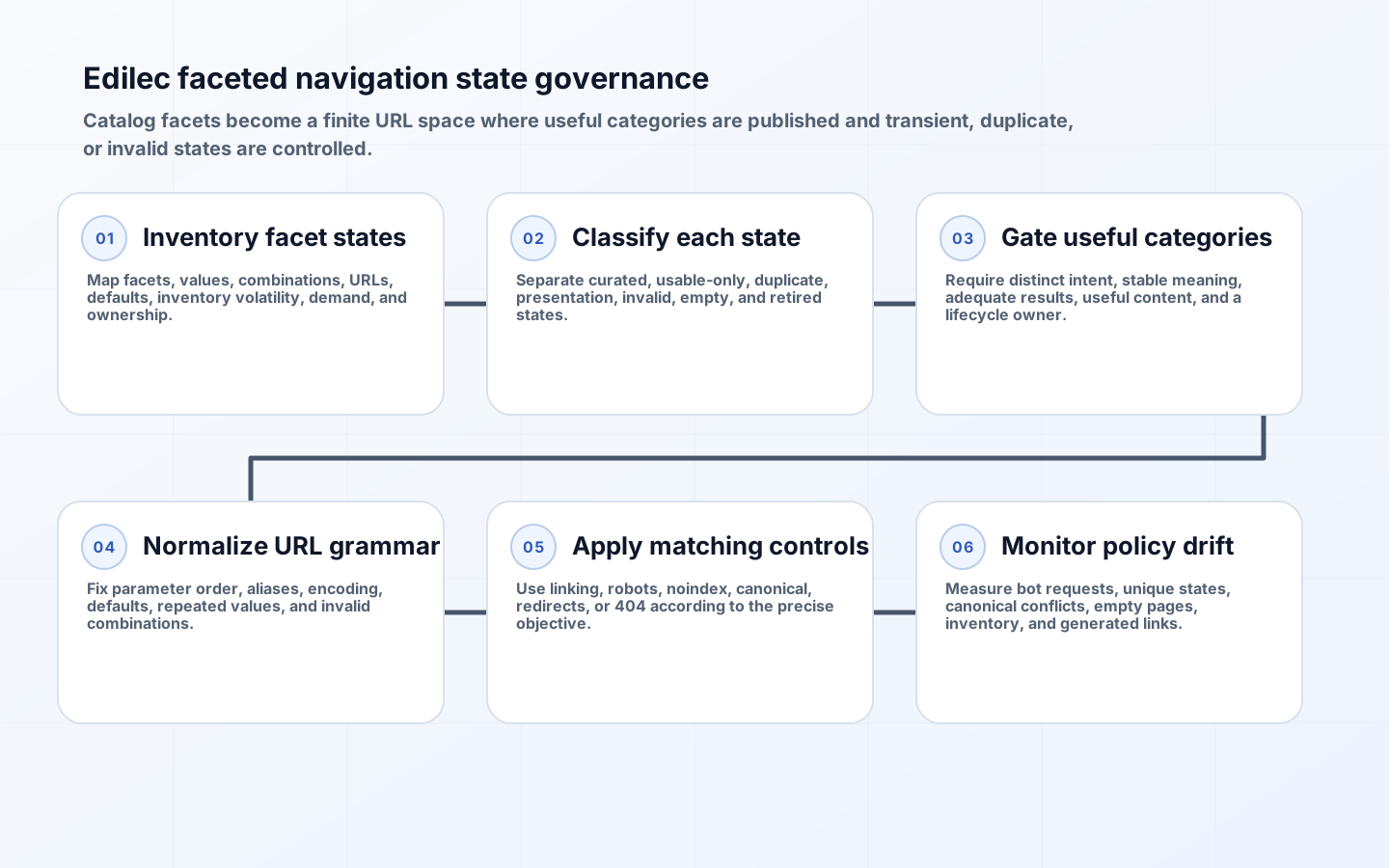
Faceted navigation SEO is a product-governance problem expressed through URLs. Filters help shoppers narrow a catalog by brand, size, color, compatibility, price, location, rating, or availability. If every order and combination creates a crawlable URL, the site can generate an effectively unbounded space of duplicates, empty states, and rapidly changing pages. If every filter is hidden, the site can also lose useful categories that match durable demand.
The solution is not a universal canonical tag or blanket noindex rule. Define which filtered states are navigation only, which deserve stable landing pages, and which are invalid. Then align URL generation, internal links, HTTP status, canonicalization, robots controls, sitemaps, content, and retirement. Google explicitly warns that faceted URLs can cause overcrawling and slower discovery; its current guidance recommends preventing crawl when those URLs are not needed and making allowed spaces finite and consistent.
Inventory the filter state space and business meaning
List every facet, value source, eligible base category, combination rule, URL representation, default state, sort option, pagination behavior, inventory volatility, and user demand. Estimate possible combinations, but also measure which states are actually linked, requested, crawled, indexed, visited from search, and useful to customers. Separate semantic facets such as “waterproof hiking boots” from presentation controls such as grid density or sort order.

Assign an owner for the taxonomy and for crawl policy. Merchandising can propose a valuable combination, but engineering must ensure it is stable and finite, while SEO validates demand and distinct intent. Inventory systems must signal when a combination becomes empty or obsolete. A filter value introduced by an uncontrolled supplier feed should not automatically create public URLs. Establish an approved dictionary and aliases so “navy,” “blue,” and “midnight” do not fragment the same concept without a deliberate reason.
| State class | Example | Crawl and index posture | Canonical and linking | Lifecycle |
|---|---|---|---|---|
| Curated category | Women's waterproof hiking boots | Crawlable and indexable when useful and sufficiently supplied | Self-canonical with persistent internal links and sitemap inclusion | Monitor demand, inventory depth, and content quality |
| Usable filter | Boots filtered to sizes currently in session | Available to users but normally outside index targets | Link or form behavior follows crawl policy; no sitemap | May change with catalog behavior |
| Duplicate representation | Same facets in alternate parameter order | Prevent generation and consolidate | Normalize to one URL form | Redirect legacy forms where safe |
| Presentation state | Price ascending or 48 items per page | Do not create index candidates | Keep outside canonical identity | Expire with session or UI |
| Invalid or empty state | Conflicting size values or no matching inventory | Return 404 when the combination cannot exist or has no results under policy | Do not redirect to generic category | Remove links and sitemap references |
| Retired landing page | Discontinued material category with a clear successor | Redirect only to a genuinely equivalent destination; otherwise 404 or 410 | Update all internal references | Monitor residual requests |
Select index-worthy combinations with explicit gates
A filtered state deserves publication when it represents distinct, durable user intent and can provide a satisfying result. Require a stable taxonomy concept, meaningful inventory, a useful assortment or answer, unique title and heading, sensible explanatory or buying context where appropriate, persistent internal discovery, and an owner. Search volume alone is insufficient: a page that frequently empties, duplicates its parent, or exists only to vary a keyword creates poor experience and maintenance debt.
Set quantitative thresholds as operational gates, not claims about ranking. For example, a category may require a minimum number of eligible products across most weeks, a maximum empty-day ratio, reliable shipping eligibility for its market, and distinct query demand. Choose thresholds by catalog economics. Support exceptions for strategically important narrow ranges, but record the owner and review date. Generate curated URLs from an allowlisted taxonomy, never from arbitrary filter permutations.
Design a finite and deterministic URL grammar
Use one representation for each approved state. Normalize case, Unicode, percent-encoding, separators, facet order, repeated values, defaults, and trailing slashes. Google recommends the standard ampersand separator for query parameters and a consistent logical order when filters appear in paths. Reject duplicate facets and nonsensical combinations. A URL parser should produce a typed state, validate it against category rules, and serialize it back to exactly one canonical form.
Keep sort, view, session, tracking, and experiment parameters out of indexable identity. Strip or ignore them in canonical URL generation and avoid internal navigation that multiplies them. For index-worthy combinations, readable paths can help operations and users, but paths do not cure combinatorial growth. Whether filters use paths or parameters, the allowlist and state machine control the space. Unit-test round trips and property-test permutations so alternate forms cannot proliferate.
Align crawl prevention, indexing, and canonical signals
When a class of filter URLs has no search value, prevent discovery and crawl at the design layer. Do not render ordinary crawlable links to every combination. Depending on interaction requirements, use forms, controlled requests, fragments for non-indexable UI state, or consistently nofollowed links, understanding that externally discovered URLs may still be requested. A precise robots.txt pattern can conserve server resources, but test it against approved categories and future parameter names before release.
Robots.txt prevents crawling; it does not guarantee de-indexing of a URL learned elsewhere. A noindex directive requires crawling to be seen. Canonicalization is a consolidation hint and may reduce duplicate crawl over time, but it is not a reliable circuit breaker for an infinite space. Use self-canonical pages for approved categories, make duplicate representations converge, and remove links to unwanted states. Choose controls according to whether the goal is resource protection, de-indexing, or duplicate consolidation.
| Objective | Primary mechanism | What it does | Important limitation |
|---|---|---|---|
| Avoid creating crawl space | Finite URL generation and non-crawl UI controls | Stops internal multiplication at the source | External malformed URLs still need deterministic handling |
| Conserve crawler and server resources | Targeted robots.txt rules | Prevents compliant bots from fetching matched patterns | Blocked pages cannot expose noindex and URLs may remain known |
| Remove an accessible page from search | Crawlable noindex plus link and sitemap cleanup | Allows directive processing | Consumes crawl and should not become the default for infinite states |
| Consolidate equivalent URLs | Redirects where appropriate plus consistent canonical signals | Moves users or indicates preferred representation | Canonical is a hint; incorrect targets can hide useful pages |
| Publish valuable combinations | Allowlisted routes, self-canonical, links, sitemap, useful content | Creates deliberate category destinations | Requires inventory and lifecycle ownership |
| Handle empty or invalid combinations | Correct 404 response | Closes nonsensical or no-result states | A friendly body must retain the correct status |
Build category pages that remain useful as inventory changes
An approved filtered landing page should state what the collection represents, show accurate count and availability, offer relevant products, and link to sensible parents, siblings, and products. Titles and headings should describe the actual selection rather than mechanically concatenate every facet. Avoid paragraphs that merely repeat filter labels. Useful support may include compatibility guidance, sizing constraints, material differences, or delivery conditions derived from governed catalog data.
Define empty-state behavior before stock disappears. A temporary sellout may retain a useful page with accurate availability, alternatives, and a 200 response if the category remains valid and will be replenished. A combination that cannot exist should return 404. A retired concept may redirect to a close successor only when user intent is equivalent. Do not redirect all empty filters to the unfiltered parent; that conceals the error and teaches crawlers that countless invalid URLs resolve successfully.
Monitor crawl demand, inventory health, and policy drift
Classify server and CDN logs by normalized facet state, bot verification, status, response time, canonical target, and policy class. Track requests to approved categories, blocked patterns, alternate parameter orders, empty states, sorts, tracking variants, and unknown values. Join those signals to Search Console crawl and indexing data, internal link extraction, sitemap membership, inventory depth, organic landings, conversion or task success, and page retirement events.
Alert on explosion in unique facet URLs, increasing crawler share on non-approved classes, new parameter names, high 200 rates for invalid states, approved pages falling empty, or canonical mismatches. Review policies when taxonomy, catalog platform, routing framework, merchandising automation, or analytics parameters change. Deploy new facets with a crawl-disabled default until their state grammar and publication cases are approved. A dashboard cannot compensate for uncontrolled link generation, so include URL-space tests in release gates.
Key takeaways
- Classify filter states as curated, usable-only, duplicate, presentation, invalid, or retired before choosing directives.
- Publish only combinations with distinct intent, stable semantics, useful inventory, persistent discovery, and an owner.
- Use a finite typed URL grammar that normalizes order, encoding, aliases, defaults, and repeated values.
- Match controls to objectives: crawl prevention, de-indexing, consolidation, and publication are different jobs.
- Monitor log demand, index behavior, internal generation, and inventory lifecycle by policy class.
Frequently asked questions
Should every filter URL canonicalize to the main category?
No. Valuable curated combinations may deserve self-canonical pages, while infinite or unwanted states should be prevented at source. Canonicalization is a consolidation hint, not the primary control for unbounded crawl space.
Is noindex the best way to manage faceted URLs?
Usually not for a huge space, because crawlers must fetch pages to see noindex. It can remove accessible finite pages, but URL generation and targeted crawl prevention are more direct resource controls.
Conclusion
Faceted navigation becomes manageable when the product organization owns a finite state model. Preserve the few combinations that answer durable customer needs, keep interaction-only states out of public URL identity, close invalid states correctly, and monitor policy drift. That approach protects crawl capacity without hiding category pages that genuinely deserve discovery.