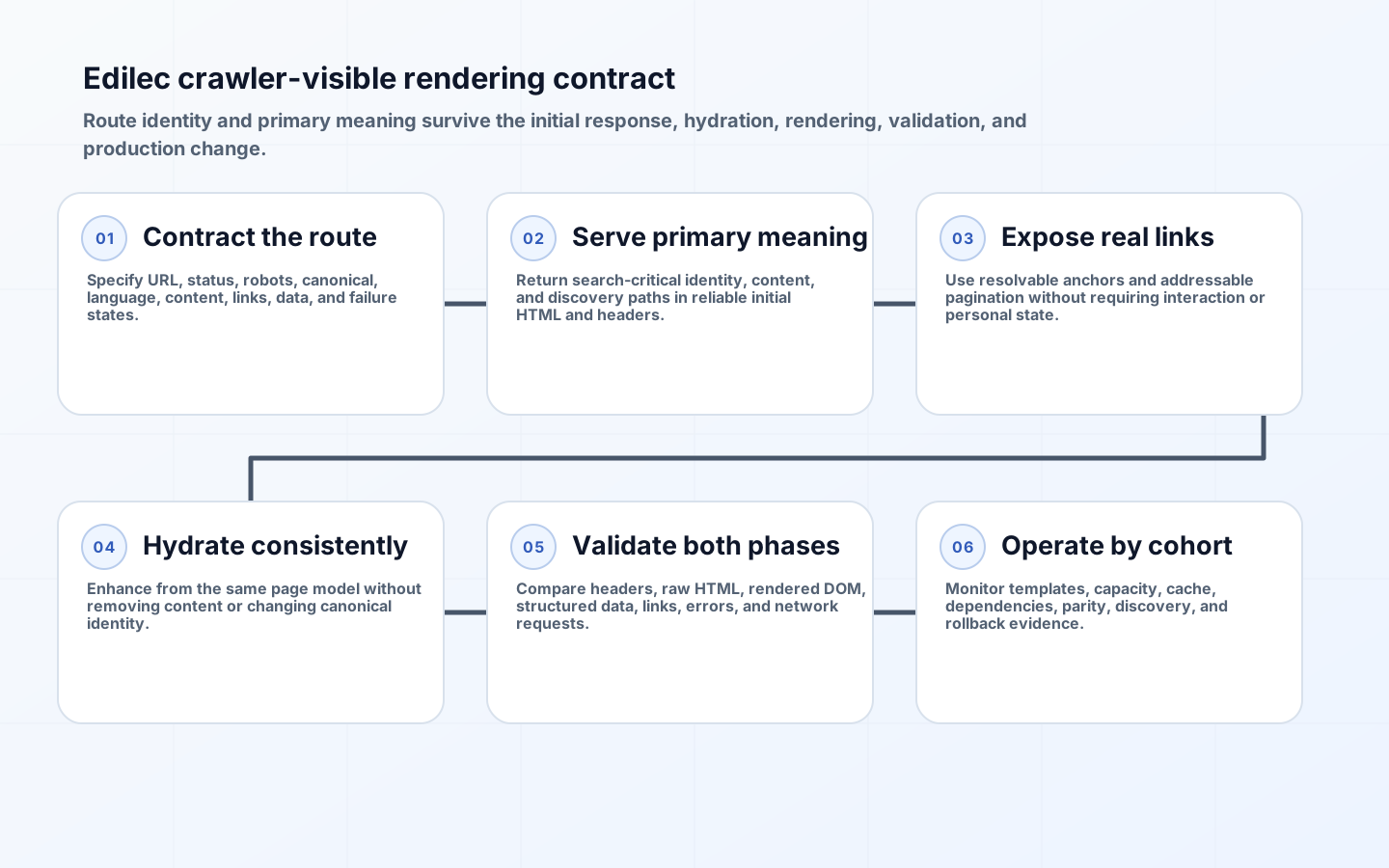
JavaScript SEO architecture is a delivery decision about when each search-critical fact becomes available. Modern crawlers can execute JavaScript, but execution introduces a second processing phase, additional resource requests, failure modes, and delay. Users face similar risks on slow devices and unstable networks. The practical goal is not to eliminate JavaScript; it is to put durable page identity and primary meaning in the earliest reliable response while reserving client code for interaction and enhancement.
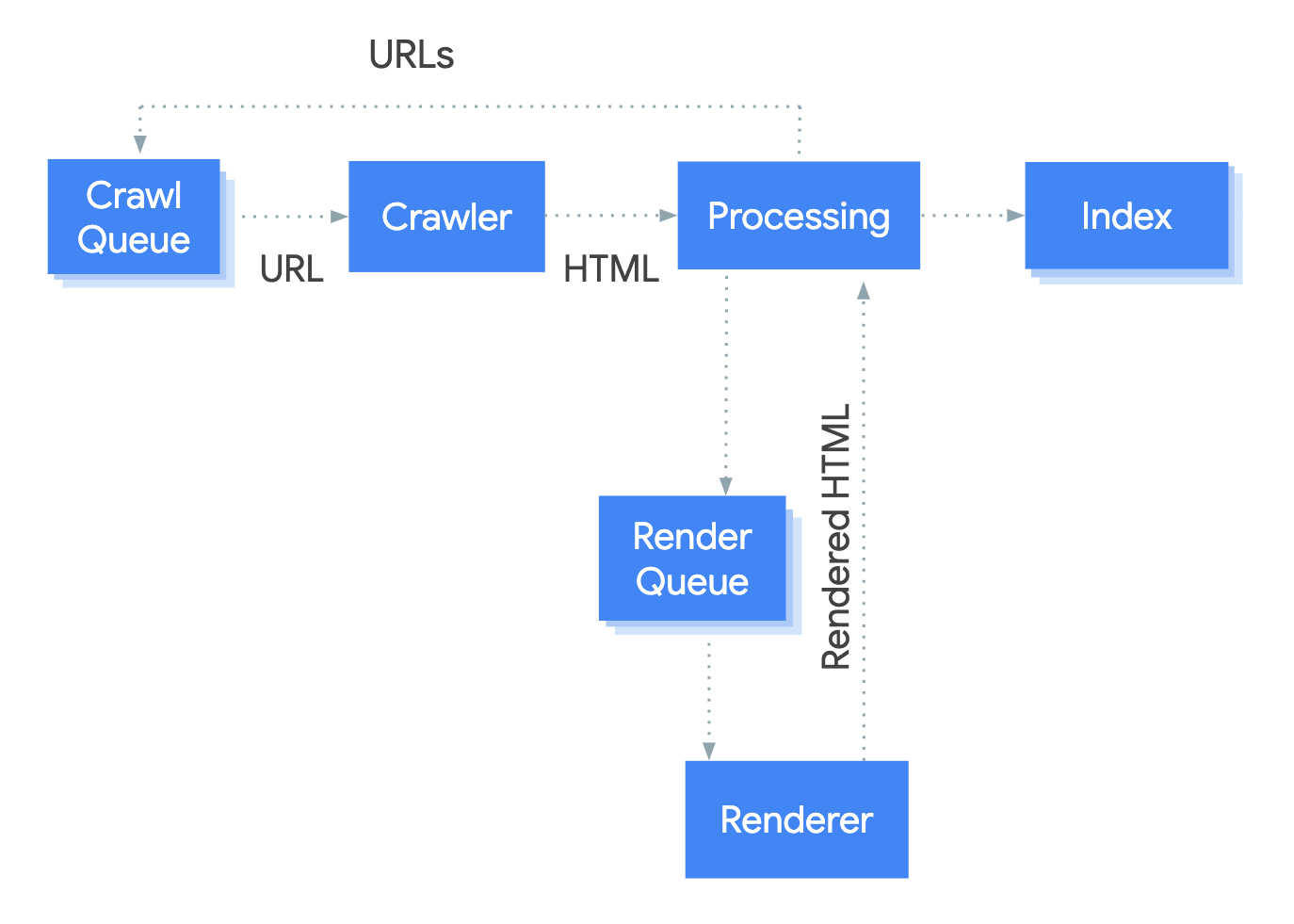
Google documents that it crawls the initial response, queues eligible pages for rendering, executes JavaScript with a headless browser, and then parses rendered HTML again. A page can therefore be technically renderable yet operationally fragile. A blocked bundle, API outage, expired signed request, unsupported browser behavior, or overloaded rendering service can remove content and links. Decide the rendering boundary per content type and test all crawler-visible states as release artifacts.
Define the crawler-visible rendering contract

Create a contract for each route family: product detail, category, article, location, search result, account page, and error state. Identify the canonical URL, expected HTTP status, index policy, language, title, description, primary heading, meaningful body content, navigation and discovery links, structured data, image references, and last-modified semantics. Mark whether each element must exist in the initial HTML, may appear after hydration, or must never be exposed publicly.
Default search-critical identity and meaning to the server response. That includes status codes, robots directives, canonical declarations, unique titles, primary content, and crawlable links needed for discovery. Client rendering can own filters, calculators, personalization, live inventory refresh, comments, and account actions when the initial page remains useful. If price or availability changes quickly and feeds or shopping crawlers depend on it, render a current value in initial HTML and reconcile client updates against the same source contract.
| Element | Initial response expectation | Client enhancement | Release assertion |
|---|---|---|---|
| HTTP status | Correct 200, redirect, 404, 410, or server error from origin or edge | Do not replace transport truth with an in-page message | Request known valid, moved, missing, and failing URLs without a browser |
| Canonical and robots | Stable, absolute, and consistent with intended URL state | Avoid changing to a conflicting value after render | Compare raw and rendered DOM and response headers |
| Primary content | Enough unique content to satisfy the route's purpose | Hydrate interactivity and optional modules | Disable JavaScript and verify meaningful page |
| Discovery links | Real anchor elements with resolvable href values | Prefetch or decorate after load | Extract links from raw and rendered HTML |
| Structured data | Prefer complete data for critical and fast-changing commerce pages | Update only from the same canonical source | Validate syntax, eligibility, and visible-content agreement |
| Personalization | Neutral, accessible default with stable identity | Apply user state without changing canonical topic | Test anonymous, returning, regional, and consent states |
Choose SSR, static generation, streaming, or client rendering by failure cost
Server-side rendering produces route HTML for each request and suits dynamic public content, but it adds origin computation, cache variation, and backend dependencies. Static generation offers predictable, fast HTML for content that can tolerate build or revalidation delay; large inventories need partitioned builds and explicit freshness. Streaming can improve perceived delivery, yet critical head metadata and content should not depend on late fragments whose failure leaves an incomplete document.
Client-side rendering is reasonable for authenticated tools, highly interactive states that should not be indexed, and enhancements layered over a useful shell. It is a weak default for public pages whose entire meaning arrives through API calls. Dynamic rendering, where bots receive a separate pre-rendered version, is described by Google as a workaround rather than a recommended long-term architecture. It creates parity, cache, user-agent detection, and operational burdens. Prefer one rendering path shared by people and crawlers.
Make links and navigation discoverable without interaction
Search discovery depends on URLs exposed in links, sitemaps, redirects, and other references. Use standard anchor elements with href attributes for navigational destinations. A click handler on a div, button, or anchor without a useful href may work for a user but provide no dependable crawl path. Render category, pagination, related-content, language-alternate, and product links from governed URL builders so parameter order and encoding remain stable.
Infinite scroll needs a paginated URL series behind the interaction. Each component page should be addressable, return its portion of content, have a stable canonical policy, and link forward or through a discoverable hierarchy. Avoid requiring scrolling, hovering, search-box submission, or a personalized API result to reveal the only link to an item. Test the link graph from raw HTML and after render; unexplained differences are architecture signals.
Control status, canonical, robots, and metadata at the edge
A single-page application often returns 200 for every route and displays “not found” in the DOM. That is a soft-error risk and wastes rendering. Configure the server, edge worker, or framework route handler to return meaningful status codes before the application boots. Permanent moves should redirect at the HTTP layer. Temporary unavailability should distinguish retryable server failure from an absent resource. Do not redirect every bad URL to a home or category page.
Emit one intended canonical signal and keep it consistent across redirect targets, HTML, sitemaps, internal links, and rendered DOM. JavaScript can inject or update canonical tags, but late conflict makes diagnosis harder because canonicalization may consider both pre-render and post-render signals. Robots directives should be available in initial HTML or headers. Never block a page in robots.txt when the goal is for a crawler to see its noindex directive, because blocked crawling can prevent that directive from being read.
Govern data fetching, hydration, and structured data
Server rendering can still fail search if it fetches data through unstable internal APIs or caches incomplete responses. Set deadlines and explicit fallback behavior for search-critical dependencies. A product route should not emit a valid 200 shell when the catalog lookup timed out. Use request coalescing, cache controls, stale-while-revalidate where business rules permit, and observable degradation. Keep cache keys bounded; uncontrolled cookies, localization headers, and experiment flags can fragment the cache and alter crawler output.
Hydration must preserve server meaning. Detect mismatches where the client replaces text, removes links, changes canonical values, or duplicates components. Generate structured data from the same typed page model used for visible content. Validate that names, prices, availability, variants, dates, and ratings agree. Do not add markup for content unavailable to users. For personalized pages, keep public structured data neutral and prevent user-specific facts from leaking into shared caches.
| Failure | Crawler-visible symptom | Likely cause | Engineering response |
|---|---|---|---|
| Bundle blocked or fails | Empty shell or missing links | Robots rule, CSP, deployment mismatch, runtime exception | Keep essential content in HTML; monitor asset status and JS errors |
| API dependency times out | Skeleton remains or generic content indexes | Client-only fetch or server fallback returns 200 | Render bounded fallback, correct status, and retry policy |
| Hydration mismatch | Raw and rendered titles, links, or content differ | Non-deterministic data, locale, clock, or component defect | Make rendering deterministic and diff DOM contracts in CI |
| Soft 404 | Missing page appears as valid route | SPA catch-all returns 200 | Resolve route server-side and return 404 or 410 |
| Canonical drift | Duplicate URLs remain selected unpredictably | Client tag conflicts with server, sitemap, or links | Use one canonical URL function across outputs |
| Render capacity loss | Pages work locally but fail at scale | Origin, API, or rendering workload saturation | Load-test anonymous routes, cache safely, and expose saturation metrics |
Test raw responses, rendered states, and production cohorts
Build route fixtures that cover valid pages, no-results states, removed items, redirects, pagination, variants, localization, experiments, consent modes, and backend failures. For each fixture, capture headers, raw HTML, rendered DOM, console errors, network failures, extracted links, robots state, canonical, structured data, and visible text. Fail releases when required elements are absent or contradictory. Browser tests alone are insufficient because they can hide the initial response contract.
In production, combine Search Console inspection and indexing signals with origin logs, synthetic anonymous fetches, render latency, cache hit rate, dependency failures, JavaScript errors, and template-level coverage. Deploy rendering changes by route cohort and compare discovery, response codes, rendered parity, and user performance. Keep a server-rendered rollback path for framework or hydration releases. Diagnose by template and state rather than treating every indexing change as a crawler mystery.
Key takeaways
- Put page identity, status, index policy, primary meaning, and discovery links in the earliest reliable response.
- Choose rendering patterns per route family according to freshness, scale, interaction, and failure cost.
- Use real links and addressable pagination instead of requiring interaction to expose crawl paths.
- Generate visible content, metadata, canonical signals, and structured data from one governed page model.
- Test and monitor raw HTML and rendered DOM as separate stages of one production contract.
Frequently asked questions
Can Google render JavaScript pages?
Yes, Google documents a rendering phase, but rendering consumes resources and can fail or be delayed. Server-side or pre-rendered primary content remains useful for crawlers, other bots, and users on constrained devices.
Is client-side rendering always unsuitable for SEO?
No. It fits non-indexable tools and optional interactions. It becomes risky when the only title, content, links, status meaning, or structured data depends on successful client execution and API calls.
Conclusion
A resilient JavaScript SEO architecture makes public pages understandable before optional code succeeds. Define the route contract, select rendering by failure cost, preserve crawlable navigation, align all URL and metadata signals, and continuously compare raw and rendered output. JavaScript can then improve the experience without becoming the only keeper of page meaning.