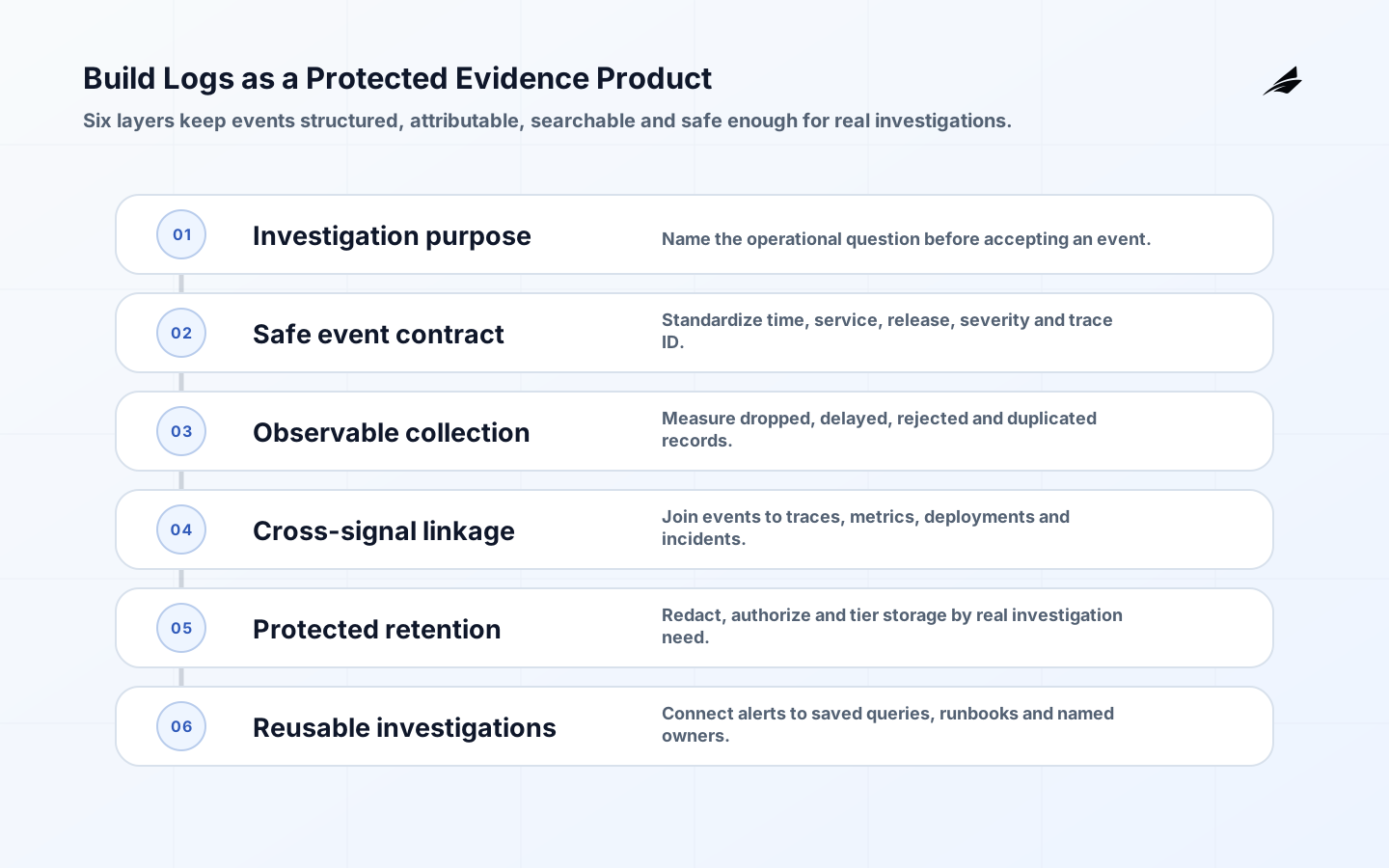
Log aggregation is useful when it helps a person answer an operational question without exposing sensitive data or guessing which service produced an event. Centralizing raw text is not enough. Before selecting a collector or retention tier, define the decisions logs must support: incident investigation, security review, audit evidence, capacity diagnosis, or product support.
Data contract
Give important events a structured contract: timestamp, severity, service, environment, release identifier, request or trace correlation, event name, and a bounded set of safe attributes. Record the purpose of each field and forbid secrets, access tokens, and unnecessary personal data.
Collection reliability
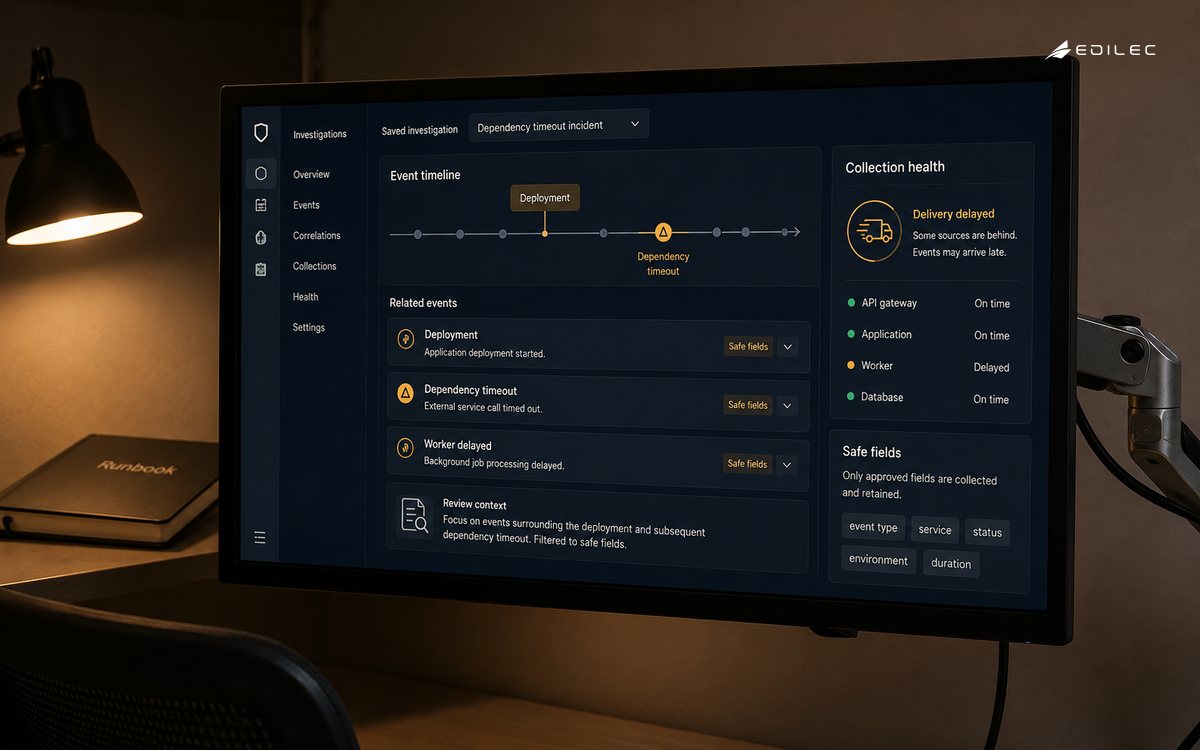
Collectors, agents, and pipelines can drop, delay, duplicate, or reorder events. Monitor the collection path itself, including source health, buffer pressure, rejected records, and delivery lag, so absence of logs is not mistaken for absence of failure.
| Field | Purpose | Protection |
|---|---|---|
| Timestamp | Order and correlate events. | Use a consistent time standard. |
| Service and release | Locate the emitting behavior. | Use controlled identifiers. |
| Trace or request ID | Join related evidence. | Avoid putting personal data in IDs. |
| Severity and event name | Support triage and analysis. | Use a documented taxonomy. |
Sensitive data
Minimize fields at the source, redact known patterns before export where practical, and restrict query access by operational role. Test error and debug paths because accidental disclosure often occurs when exceptions serialize request data.
Correlation and retention
Link logs to traces, metrics, deployments, and incident records with stable identifiers. Set retention according to investigation, legal, privacy, and cost needs; not every debug event needs the same duration or query accessibility.
| Question | Decision | Owner |
|---|---|---|
| What is logged? | Event contract and field allowlist. | Service owner. |
| Who can query it? | Role and purpose-based access. | Operations and security. |
| How long is it retained? | Tiered retention and deletion rule. | Data owner. |
| How is it used? | Runbook and alert linkage. | On-call owner. |
Operational use
Build saved investigations and runbooks around recurring incidents. An alert should link to the relevant context, not force an operator to search an unbounded index. Review noisy or unused events and remove them; observability quality improves when logs are purposeful.
Key takeaways
- Define event purpose before collection.
- Use structured, safe, consistent fields.
- Monitor loss and lag in the pipeline.
- Protect access and set intentional retention.
- Connect logs to traces, deployments, and runbooks.
Frequently asked questions
Should every request be logged? Not necessarily; cost, privacy, and signal quality matter. Are logs a replacement for traces? No. Logs provide event detail, while traces follow work across components. Who owns retention? The owner of the data purpose, working with security and legal requirements. What is a first improvement? Add release and correlation identifiers to a small set of high-value structured events.
Decision criteria for log aggregation
A team should make log aggregation decisions from a written comparison, not an intuition that a tool or pattern is generally safer. For an incident where operators need to connect a customer report to a deployment and a downstream timeout, state the baseline, the change being considered, the expected benefit, and the condition that would make the action unsafe. The decision record should name the event contract, collection path, and protected query surface; it should also identify the smallest reversible step. That creates a practical distinction between a hypothesis and an approved change. A useful reviewer can then ask whether a field change, retention adjustment, or investigation workflow update is possible without creating an unowned side effect, whether pipeline lag, dropped records, query usefulness, and access anomalies will be available in time, and whether the affected people understand the service consequence. The record does not need ceremony. A short change note with links to the release, owner, measurement, and recovery path is enough to make later investigation much faster.
Use an explicit example before automating the rule. Consider an incident where operators need to connect a customer report to a deployment and a downstream timeout. Walk through the normal case, the delayed case, and the failure case with the people who operate it. Identify which input is authoritative, what a missing or stale input looks like, and what an operator can safely do while evidence is incomplete. For log aggregation, this exercise often exposes a hidden assumption about timing, identity, or compatibility that a happy-path demonstration never reaches. It also clarifies what must be visible to support: current state, change owner, linked evidence, and the next action. Build those details into the workflow or runbook before increasing automation. A reliable default is useful only when its exceptions are observable and recoverable.
Failure analysis and recovery for log aggregation
Plan for shipping unstructured request dumps that leak secrets or cannot be joined to the affected release. Detection should route to the service owner, observability operator, and data-access administrator, but the alert or review item must contain enough context to start an investigation without manual archaeology. Include the relevant version or policy identifier, affected scope, timestamp, correlation reference, and the last known healthy comparison where available. The first response should reduce further harm while preserving evidence; the second should validate whether the apparent fault is data quality, a dependency condition, an operator change, or the design itself. Recovery does not always mean returning to the previous state. Sometimes it means a forward correction, an access restriction, a narrower cohort, or a temporary manual procedure. Document which action is safe for the case and who may authorize it.
- Define a precondition for a field change, retention adjustment, or investigation workflow update and test it with a representative non-production or limited-production case.
- Keep the identifiers needed to connect the event contract, collection path, and protected query surface to the change, investigation, and owner.
- Make pipeline lag, dropped records, query usefulness, and access anomalies visible at the point where a release or operator decision is made.
- Treat an exception as data: capture why it was needed, who approved it, and when it expires.
- Review recurring failures with the service owner, observability operator, and data-access administrator and convert the strongest lesson into a control, contract, or runbook improvement.
Operating review for log aggregation
Set a review cadence that matches the risk and rate of change. The review should ask whether the current approach still produces the promised outcome, whether pipeline lag, dropped records, query usefulness, and access anomalies is trustworthy, and whether the exception path is being used as a substitute for a missing capability. Examine a small number of real cases instead of only aggregate charts: one successful change, one delayed or rejected change, and one recovery. This evidence makes trade-offs concrete. If the pattern repeatedly depends on expert intervention, reduce the scope or improve the supported path before expanding it. If the outcome is stable, publish the decision criteria so adjacent teams can reuse the model without copying assumptions that do not apply to them.
Implementation evidence for log aggregation
Before scaling log aggregation beyond its initial boundary, verify the implementation evidence. Confirm that new operators can locate the current state, execute the approved recovery action, and explain the limits of the control. Compare the expected effect with pipeline lag, dropped records, query usefulness, and access anomalies; investigate material differences instead of silently changing the measure. This is also the point to test access removal, dependency failure, and a change made outside the normal path. The resulting evidence should be concise and reusable: a tested runbook, an ownership map, representative telemetry, and a decision record. That package makes the next adoption decision more credible than an assertion that the technology has been installed.
Advanced log aggregation practice
A logging design should be tested as a data product. Send representative successful requests, failures, malformed input, and dependency timeouts through the collection path, then confirm that the resulting records are searchable, correctly timestamped, and safe to share with the intended support role. Test access boundaries separately: a developer may need service diagnostics while an incident commander needs cross-service correlation, and neither role should automatically see raw customer content. When a field creates value, document its producer and format; when it does not answer a stated operational question, remove it. This discipline lowers storage cost and reduces the chance that a later query exposes information that never needed to be retained.
Retention needs more than a single number. Keep high-value security and audit events according to the applicable policy, retain detailed diagnostic events for the period operators actually use them, and downsample or delete noisy low-value records sooner. Verify deletion behavior, backup copies, and access changes as part of the plan. During an incident, preserve the relevant time window and release context before normal lifecycle rules remove it. Afterwards, use the investigation to improve the event contract: add a missing correlation field, remove a misleading severity, or link the alert to a saved query. That is how log aggregation becomes a dependable evidence system instead of a costly archive.
Conclusion
Log aggregation earns its cost when safe, structured events remain available and attributable for the decisions operators actually need to make.