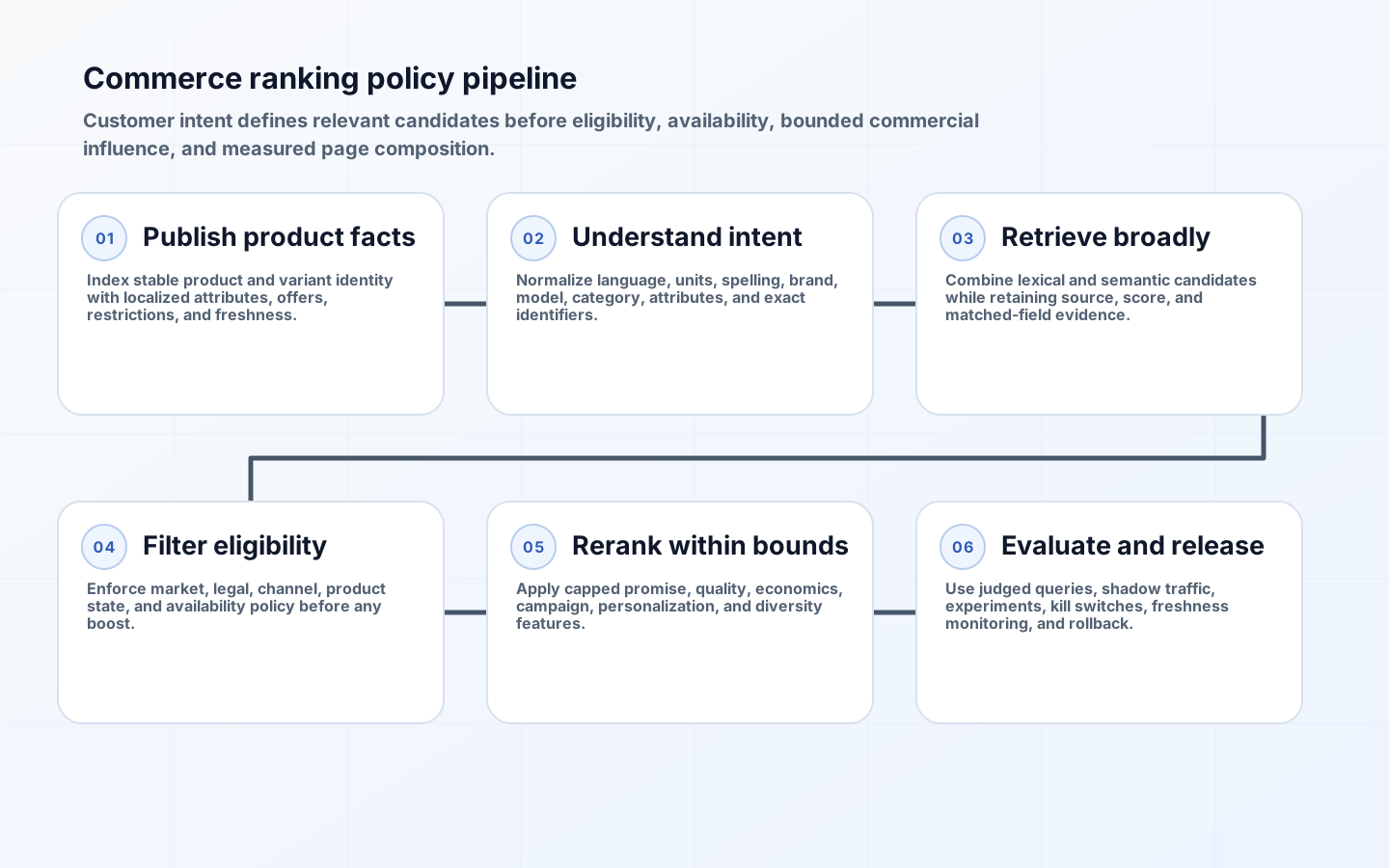
Ecommerce search and merchandising must answer a shopper's intent before advancing inventory, margin, launch, or campaign goals. A result page filled with high-margin products is commercially useless when those products are wrong for the query. Conversely, a textually relevant ranker that repeatedly promotes unavailable variants or ignores delivery constraints sends customers into dead ends. The system needs explicit precedence between eligibility, relevance, business value, and presentation.
Treat ranking as a versioned policy over trustworthy catalog and availability data. Retrieve a broad, relevant candidate set; apply hard constraints; compute auditable features; rerank within bounded influence; diversify the page; and measure outcomes with counterfactual discipline. Merchandisers should be able to express approved intent without editing opaque engine syntax or permanently pinning a stale product.
Build a searchable product and offer contract
Index stable product identity, variant identity, titles, descriptions, brand, category paths, attributes, normalized units, identifiers, locale, market, price, availability class, fulfillment promise, restrictions, launch and end dates, and content quality. Keep searchable text separate from filterable and sortable fields. Product families and variants need deliberate grouping so a page is not flooded by six sizes of one shoe while still allowing an exact color or model query to reach the matching variant.
Publish catalog changes through versioned events and build a replayable index. Record source revision and indexed time for each document. High-frequency offer facts can live in a joined or overlay store when full reindexing is too slow, but the query must expose freshness and fallback behavior. Schema.org Product and related Offer vocabulary provide useful external semantics for identity, price, and availability; the internal contract still needs richer operational fields and source ownership.
| Feature class | Examples | Use in ranking | Control |
|---|---|---|---|
| Intent relevance | Term match, phrase, semantic similarity, attribute match | Primary candidate and rank signal | Golden queries and judgments |
| Eligibility | Market, legal restriction, channel, sale window | Hard filter | Source-authoritative policy |
| Availability | Sellable variant, promise, stock confidence | Filter or bounded demotion | Freshness and fallback threshold |
| Economics | Margin band, return cost, fulfillment cost | Bounded rerank feature | Finance definition and cap |
| Campaign | Launch, sponsored placement, negotiated boost | Explicit rule within relevant set | Owner, dates, disclosure, audit |
| Experience | Diversity, duplicate suppression, personalization | Final page composition | Privacy, exploration, and guardrails |
Retrieve relevant candidates before applying commercial signals
Normalize query, language, units, spelling, and recognized entities. Use lexical retrieval for exact identifiers, brands, attributes, and familiar terminology; add semantic retrieval when it improves conceptual queries without weakening exact intent. Elastic's retriever overview describes composable lexical, vector, fusion, rules, and reranking stages. Regardless of engine, preserve each stage's candidate source and score so poor results can be diagnosed.
Filters define what may appear; scores define order among eligible candidates. Apply market, age, legal, channel, and product-status restrictions as filters. Availability policy can filter truly unsellable items while retaining backorder or preorder products with explicit promises. Avoid using zero score as a substitute for exclusion because later boosts can resurrect prohibited products. For sparse-result queries, define progressive relaxation that never removes safety or legal constraints.
Compose a ranking policy with bounded commercial influence
Start with relevance and add normalized features such as availability confidence, delivery promise, conversion evidence, quality, margin contribution, return propensity, and campaign boost. Use monotonic transforms and caps. A margin increase should not create unlimited score, and an item with no relevance should not win because it is profitable. Elastic's rank feature query illustrates efficient numeric influence, but feature meaning, freshness, missing values, and policy remain your responsibility.

Separate organic relevance, platform merchandising, and paid placement. Define tie-breaking and precedence: prohibited and unavailable exclusions; exact SKU or model intent; strong relevance; approved pin or boost; personalization; economics; deterministic fallback. Sponsored results need required labeling and must satisfy the same eligibility and reasonable relevance bar. Maintain policy revisions with approver, rationale, start, end, market, query conditions, affected products, and rollback.
| Priority | Rule | Allowed effect | Guardrail |
|---|---|---|---|
| 1 | Legal and channel eligibility | Exclude | Cannot be overridden |
| 2 | Exact identifier or navigational intent | Place exact eligible match first | Identity confidence threshold |
| 3 | Availability and delivery promise | Filter or demote | Use fresh sellable state and show promise |
| 4 | Campaign pin or boost | Move within a relevant candidate window | Expiry, owner, maximum positions |
| 5 | Margin or inventory objective | Bounded reranking | Minimum relevance and no hidden stock dump |
| 6 | Diversity and personalization | Reorder page composition | Preserve query intent and user controls |
Give merchandisers safe rules, previews, and expiry
A merchandising console should support query and category conditions, market and audience scope, pin, boost, bury, exclude, banner association, dates, priority, owner, rationale, and approval. Preview against production-like catalog and offer data, including mobile page size and filters. Detect overlapping rules and show the final explanation. Force expiry for campaigns and require review for open-ended exclusions. Keep an audit trail and one-click rollback to the previous policy revision.
Prefer declarative rules to manual ordinal positions. Elastic's query rules retriever can pin or exclude according to contextual criteria and evaluates configured rulesets in order. Build governance around that mechanism: bounded rule counts, precedence, automated stale-product checks, rule simulation, and ownership. A rule targeting a discontinued SKU should fail closed or degrade predictably, not leave an empty first slot.
Evaluate relevance offline and business value online
Maintain representative queries by frequency, revenue importance, tail, locale, device, no-result risk, safety, brand, category, and exact identifier. Collect graded judgments for query-product relevance and test recall, precision-oriented ranking measures such as NDCG, exact-match position, no-results, duplicate rate, filter correctness, availability, and latency. Add adversarial cases for prohibited products, unit ambiguity, synonym collisions, and campaign precedence. Compare every index and policy revision before rollout.
Online experiments should measure search success, reformulation, product detail engagement, add-to-cart, conversion, revenue or contribution, cancellation, return, out-of-stock contact, diversity, and latency. Interpret metrics together: conversion can rise by narrowing exposure while long-term discovery falls. Randomize at a stable user or session level, predefine primary and guardrail metrics, and preserve assignment. Google recommends accurate price and availability in its Product structured data guidance; align external product representations with the same authoritative offer facts used on-site.
Operate freshness, fallbacks, and explainability
Set freshness objectives by field. Product copy may tolerate minutes; price and market eligibility may require tighter bounds; fast stock can use availability classes rather than unstable exact counts. Monitor source lag, event backlog, index failures, overlay age, query errors, timeout fallbacks, cache keys, and result drift. During offer-data failure, choose a safe policy: retain last-known values for low-risk facts, suppress purchase for uncertain offers, and never expose another market's price.
For every displayed result, log policy version, retrieval path, matched fields, rule identifiers, major feature values, final rank, and experiment assignment under privacy controls. Provide merchandisers a human-readable explanation such as exact brand match, in-stock next-day, campaign boost capped at two positions, or duplicate variant collapsed. Explanation shortens incident diagnosis and reveals when a feature has become a proxy for seller size or another unintended effect.
Release ranking changes with shadow traffic and kill switches
Package analyzers, synonym sets, retrieval configuration, model, feature transforms, rules, and index schema into one release manifest. Replay judged queries, then shadow production requests without changing user results. Compare candidate overlap, top-rank changes, exclusions, latency, and no-result behavior. Canary by market or stable session cohort and retain the previous index alias and policy revision for fast rollback. A rules-only change can cause as much commercial harm as a code deployment and needs the same evidence.
Provide independent kill switches for semantic retrieval, personalization, economic features, and campaign rules so operators can fall back to a known lexical baseline. Test those switches before peak events. During rollback, keep query and click telemetry tagged with the policy actually served; otherwise post-incident evaluation mixes variants. Establish a freeze window for major campaigns, but retain an emergency path to remove prohibited, unavailable, or incorrectly priced products immediately.
Ecommerce search and merchandising takeaways
- Make product, variant, offer, market, and availability identity explicit in the search contract.
- Retrieve for intent first, apply hard eligibility filters, and bound commercial reranking.
- Publish rule precedence so an economic boost cannot override safety, legality, or zero relevance.
- Give merchandising rules owners, effective dates, previews, conflict detection, audit, and rollback.
- Evaluate with judged queries plus online customer and fulfillment outcomes.
- Monitor field-level freshness and preserve a reason trail for every significant rank change.
Ecommerce search and merchandising FAQ
Should margin influence product ranking?
It can influence order among sufficiently relevant, eligible products, but it should be normalized, capped, and measured against customer and return outcomes. A margin feature must never make an irrelevant or unavailable product appear to answer the query.
Should out-of-stock products always be hidden?
No. Hide products that cannot be sold and offer no useful alternative, but backorder, preorder, store-only, or soon-replenished items can remain with an accurate promise. Policy depends on query intent, substitution, and customer value.
Does semantic search replace lexical search in retail?
Usually not. Exact SKUs, brands, model numbers, sizes, and regulated attributes benefit from lexical matching. Semantic retrieval helps conceptual and descriptive queries. Hybrid candidate generation plus evaluated reranking is often more robust than selecting one method universally.
Conclusion
Commerce ranking earns trust when intent establishes the candidate set and business policy operates within explicit limits. A controlled product contract, transparent precedence, expiring rules, disciplined experiments, and fresh availability let merchandising shape demand without turning search into an arbitrary shelf. The strongest system improves relevance, economics, and fulfilled customer outcomes together.