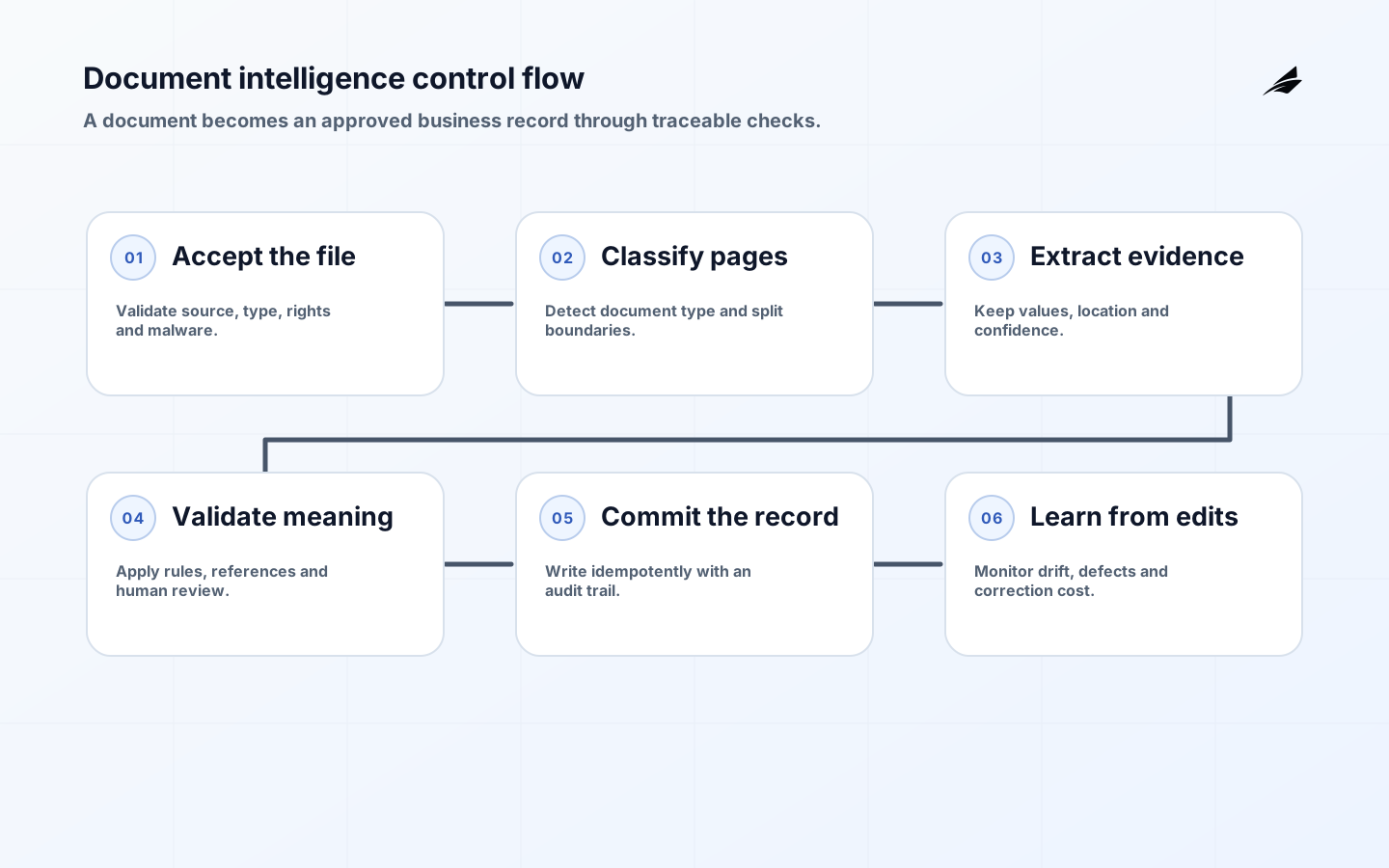
Document intelligence operations begin after the demo correctly reads one invoice. Production must accept varied files, preserve provenance, classify pages, extract useful fields, route uncertainty, post safely and learn from corrections. The system's product is not JSON; it is a trustworthy business record created with less effort and no hidden loss of control.
Related Edilec guides explain retrieval pipeline engineering, AI workflow approvals and an AI guardrails checklist. Apply those ideas around this document-specific operating path, especially when extracted content later feeds search or a generative model.
Key takeaways
- Define the downstream decision and field consequences before selecting a model.
- Keep source file, page location, model version and validation history with extracted values.
- Set review rules by field consequence and document condition, not one global confidence threshold.
- Commit downstream changes idempotently and reconcile every accepted document.
- Use corrections and drift signals to improve the whole pipeline, not only the model.
Define the document decision and acceptance boundary
Choose one document family and one downstream outcome. An accounts-payable pilot might extract supplier identity, invoice number, purchase order, currency, dates, lines and totals so a clerk can validate and post. Record accepted channels, formats, languages, page counts, handwriting, attachments, signatures and expected variants. Explicitly exclude cases the first release cannot process.
Assign consequence by field. A misspelled description may be tolerable; an incorrect bank account, patient identifier or tax amount may cause severe harm. Define required evidence, reviewer skill and automation authority accordingly. Use the NIST AI RMF to organize governance and measurement while retaining the domain controls that apply to finance, health, legal or identity records.
| Pipeline decision | Question | Evidence | Owner |
|---|---|---|---|
| Intake | Which files and senders are accepted? | Channel and file policy | Service owner |
| Classification | Which document type and page set is this? | Labeled confusion matrix | ML owner |
| Extraction | Which fields and structures matter? | Field-level evaluation | Process owner |
| Review | What requires a person and why? | Risk-tier routing rules | Control owner |
| Posting | What may be committed automatically? | Authorization and reconciliation | System owner |
Build a traceable processing pipeline
Validate source, file signature, size, encryption state and malware before parsing. Assign an immutable document identifier and checksum. Preserve the original under retention and access rules. Detect duplicates before creating work. Split combined packets only when page boundaries can be evaluated, and retain each page's relation to the original file.

Separate OCR, layout, classification and field extraction so defects can be located. Microsoft's Document Intelligence layout documentation illustrates outputs such as words, tables, selection marks and hierarchy. Google Cloud's Document AI processor catalog similarly distinguishes processor purposes. Product capabilities change, so pin API and model versions and test before upgrading.
Store every extracted value with source spans or polygons, normalized value, raw text, confidence when available, model version and validation result. Preserve table row and page context. A reviewer should be able to see why the system proposed a value without searching the whole file. Do not treat vendor confidence as a calibrated probability of business correctness across your document population.
Evaluate by slice and business consequence
Build a frozen evaluation set sampled across suppliers, templates, scanners, languages, image quality, page counts, handwriting and difficult exceptions. Keep a separate recent-production set for drift. Measure classification, field precision and recall, normalized-value accuracy, table structure and end-to-end posting outcome. Report by meaningful slice; one average can hide a failing supplier or script.
Test missing fields, ambiguous dates, swapped columns, repeated headers, negative amounts, decimal separators, stamps, skew, blank pages and adversarial content. The Amazon Textract best-practices guidance recommends using thresholds and greater human scrutiny for lower-confidence results. Calibrate local thresholds against error cost and combine confidence with deterministic checks and reference data.
| Validation layer | Example check | Disposition | Metric |
|---|---|---|---|
| File | Readable, supported and not duplicate | Reject or quarantine | Intake rejection rate |
| Field | Date and currency parse | Accept or review | Field error by type |
| Cross-field | Lines plus tax equal total | Review discrepancy | Arithmetic exception rate |
| Reference | Supplier and PO exist | Route to owner | Reference mismatch age |
| Outcome | Downstream record posted once | Reconcile or compensate | Unreconciled document rate |
Design efficient human review
Route review by reason: unsupported type, low-quality scan, identity ambiguity, amount discrepancy or policy exception. Show the page region beside the proposed and normalized values. Let reviewers correct, reject, split, reclassify and escalate. Record the reviewer, reason, old value and new value. Avoid presenting thirty fields when two caused the review.
Measure queue age, handling time, correction rate and reviewer agreement. Sample auto-accepted documents because a threshold can be confidently wrong after drift. Protect reviewers from malicious embedded instructions and unsafe links. The UK NCSC's secure AI system development guidance frames security across design, development, deployment and operation, which is the right lifecycle for this service.
Post and reconcile without losing evidence
Use deterministic validation after review and before posting. Check current authorization, duplicate business keys and downstream state. Submit with an idempotency key and persist the response. If a timeout makes success uncertain, query by stable key before retrying. Never let a model invent an account, vendor or approval to make a document pass.
Reconcile accepted documents to downstream records by identifier, status and critical values. Track stuck and partially processed items. Corrections after posting need a controlled reversal or amendment, not silent history edits. Keep source provenance for the full record-retention period when policy requires it, while restricting access to sensitive document content.
Monitor cost, drift and recovery
Monitor documents and pages by type, processing latency, failures, queue age, human-review rate, correction categories, straight-through completion, unreconciled records and cost per accepted document. Segment by source and template. A rising review rate may signal scanner degradation, a new supplier format, reference-data delay or model drift.
Rehearse provider outage, expired credentials, corrupt queues, model rollback and downstream unavailability. Keep a manual intake and prioritization path for critical documents. The NIST Generative AI Profile is relevant when generative models classify or interpret content; apply its evaluation and incident considerations to the complete application.
Worked example: invoice extraction with purchase-order matching
The first release accepts emailed PDF invoices from 25 suppliers for one legal entity. It excludes credit notes, handwritten invoices and multi-invoice attachments. Intake validates sender domain without treating it as proof of supplier identity, scans the file, calculates a checksum and records the mailbox message identifier. Duplicate checks use checksum plus supplier and invoice number.
The pipeline classifies the packet, extracts header and line fields, normalizes dates and currency, then matches supplier and purchase order from approved reference data. Every proposed field carries page coordinates, raw text and model version. Arithmetic checks compare lines, tax and gross amount. A mismatch routes the invoice to review even if every individual field has high reported confidence.
The review screen highlights only uncertain or inconsistent fields and shows the purchase-order balance. A clerk can correct, reject or escalate a suspected bank-detail change, but cannot create a supplier from the review screen. Corrections retain old value, new value, reason and reviewer. The system samples a small percentage of auto-accepted invoices to detect confident drift.
Posting creates a parked ERP document with an idempotency key and records the returned document number. A nightly reconciliation matches accepted document identifiers, supplier, currency, gross amount and status. Unknown timeouts are queried before retry. Reversals follow the ERP's controlled process and remain linked to the original document-intelligence record.
The team reports field error by supplier and scan type, review minutes, unreconciled documents and cost per accepted invoice. When a supplier redesigns its invoice, review rate rises before posting defects do. That leading signal lets operations add representative samples and re-evaluate the candidate model instead of lowering thresholds to clear the queue.
A production-readiness record captures accepted document variants, excluded cases, model and API versions, evaluation results by field, review thresholds, reference-data dependencies, retention, posting permissions and continuity owner. Accounts payable approves the monetary controls, not merely the extraction score. Security verifies intake and access; engineering proves replay and downstream recovery.
Quarterly review inspects a stratified sample of auto-accepted, corrected and rejected invoices. The team asks whether new suppliers or scan channels are underrepresented, whether reviewers disagree systematically, and whether a deterministic rule would prevent a recurring defect more safely than retraining. Model work is one option in an operations backlog that also includes forms, source guidance, reference data and workflow design.
Release checklist
- Document scope, field consequence and acceptance evidence are approved.
- Originals, page provenance, model versions and corrections remain traceable.
- Evaluation covers representative formats and adverse conditions by slice.
- Review queues have reason codes, owners, targets and secure interfaces.
- Posting is authorized, idempotent, auditable and reconciled.
- Operations can pause, replay, roll back and continue during outages.
Frequently asked questions
What confidence threshold should we use?
There is no universal threshold. Calibrate by field, document slice and consequence using labeled local data. Combine confidence with arithmetic, reference and policy checks.
Is straight-through processing the main goal?
Only with verified correctness. Track accepted records, downstream exceptions and correction cost. A lower automation rate can be rational for high-consequence fields.
Should every correction retrain the model?
No. Corrections can reflect reviewer error, reference-data defects or one-off files. Curate, label and approve training data, then evaluate the candidate model before release.
Conclusion
Document intelligence operations turn uncertain extraction into controlled evidence. Preserve provenance, validate by consequence, make review purposeful, commit idempotently and reconcile the business record. That is how a promising model becomes a dependable document-processing service. Keep improving intake, reference data, forms and workflow alongside extraction; the cheapest reliable correction may happen before the page reaches a model. Review production samples after every material source, policy, API or model change, and record the decision with accountable service owners. That evidence supports responsible ongoing operation.