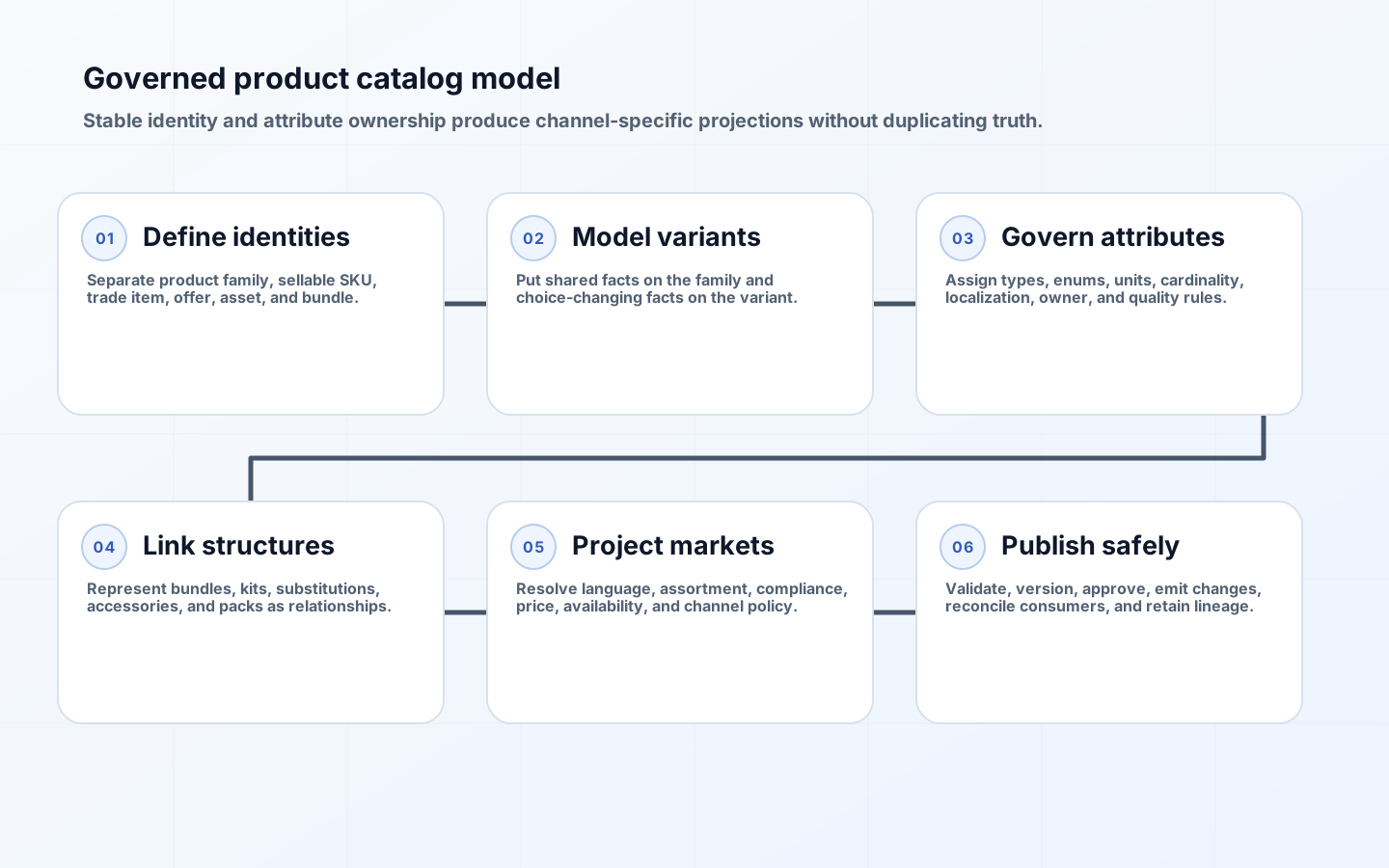
Ecommerce product catalog architecture is the design of identity, structure, governance, and publication contracts that let many systems agree on what is being sold. A catalog must support merchandising and rich product stories while remaining precise enough for search, pricing, inventory, checkout, tax, fulfillment, feeds, support, returns, and analytics. Problems appear when a product family, sellable SKU, offer, bundle, trade item, and market listing are treated as one record with one lifecycle.
The durable approach separates stable product truth from commercial and channel projections. Shared facts belong to a product family; choice-changing facts belong to a variant; a sellable SKU carries inventory and fulfillment identity; an offer adds market, price, seller, or terms; and a bundle represents an explicit relationship or its own trade item. Every layer needs an owner, identifier, version, validation rules, and lineage. That foundation makes localization, channel expansion, and platform migration manageable.
Define catalog identities and their lifecycle
Write definitions for product family, model, variant, SKU, GTIN or other trade identifier, offer, listing, asset, category, bundle, and fulfillment item. A SKU is an internal stable key for a sellable stock unit; a GTIN is a GS1 identification key assigned under its allocation rules and should not be invented as a display label. Do not reuse retired identifiers for a different item. Preserve aliases when source systems must transition, but choose one canonical key for each entity and make mappings governed data.

Separate identity from mutable presentation. Names, slugs, copy, images, category placement, and search terms change without creating a new product identity. A material change in the trade item, pack quantity, formulation, or consumer choice may require a new SKU or GTIN under the organization’s rules. Document creation, activation, replacement, discontinuation, and archival states. Orders and returns must continue resolving historical items after the current catalog changes, so retain an immutable order snapshot and reference to the version used.
| Entity | Represents | Authoritative owner | Must remain stable |
|---|---|---|---|
| Product family | Shared concept across customer-selectable variants | Product information or merchandising domain | Family key and relationship to variants |
| Variant / SKU | One sellable choice and stock unit | Product plus ERP/inventory governance | SKU key, option values, fulfillment identity |
| Trade item | Externally identified item under GS1 rules where used | Master-data governance | Assigned GTIN and allocation history |
| Offer | Price, seller, market, channel, terms, and validity | Commerce/pricing domain | Offer key and decision evidence |
| Bundle or kit | Commercial or physical composition | Merchandising with fulfillment governance | Component relationship, quantity, substitution policy |
| Market projection | Localized and channel-eligible view | Market and channel owners | Source lineage and publication version |
Model product families and variants around customer choice
Create a variant when a customer-selectable difference changes the sellable or fulfillable item, such as size, color, capacity, voltage, pack count, or material. Put facts common to every variant on the family and facts that differ on the variant. Avoid duplicating long descriptions and compliance statements across hundreds of SKUs unless the downstream system requires a projection; duplication creates drift. Conversely, do not place variant-specific dimensions or images on the family and expect every channel to infer the correct choice.
Define option order, valid combinations, uniqueness, and availability behavior. A theoretical Cartesian product of ten colors, ten sizes, and several fits can create hundreds of nonexistent combinations. Generate only valid variants or represent option constraints explicitly. commercetools’ current documentation distinguishes product-level and variant-level attributes and notes that large variant counts affect payload and search behavior. Treat platform limits and beta features as implementation constraints, not as the conceptual model. Test product pages and feeds at the largest realistic family.
Keep SKU stable even if copy or category changes. If an ERP creates SKUs and a PIM enriches them, define the creation handshake and required minimum data. If the commerce platform creates a temporary draft identity, reconcile it before publication. Prevent two systems from creating competing variants. Record variant predecessor and replacement relationships so redirects, reviews, warranty, subscriptions, and analytics can follow intentional continuity without merging distinct inventory.
Govern attributes as typed contracts, not arbitrary fields
For each attribute define machine name, label, description, data type, unit, allowed values, cardinality, required conditions, product types, level, localization, search and facet use, source, owner, validation, sensitivity, and deprecation plan. Use controlled enum keys independent of translated labels. Store measurements with explicit units and normalize for comparison while preserving source values where needed. Do not turn every supplier field into a customer facet; attributes have performance, quality, and governance cost.
Distinguish factual product data from merchandising claims and market-specific regulatory content. Ingredients, dimensions, compatibility, and materials may be global facts with controlled translations. Claims, warnings, energy labels, and disposal instructions can vary by jurisdiction and effective date. Maintain provenance and approval. For media, link assets to family, variant, locale, market, view, usage rights, and accessibility text. A filename is not enough to decide whether an image is valid for a channel.
| Decision | Example | Failure if omitted | Control |
|---|---|---|---|
| Level | Material shared by family; color on variant | Contradictory duplicates or wrong selected item | Family/variant schema rule |
| Type and unit | Length as decimal plus millimetres | Lexical sorting and impossible comparison | Typed value and canonical unit |
| Vocabulary | Enum key navy with localized labels | Synonyms fragment filters and feeds | Owned controlled vocabulary |
| Cardinality | One voltage or set of compatible devices | Consumers assume wrong scalar/list shape | Schema and contract tests |
| Market validity | Warning effective in one jurisdiction and date | Missing or unlawful market content | Effective-dated market rule and approval |
| Search use | Facet only for complete, discriminating fields | Empty filters and index bloat | Completeness threshold and search owner |
Represent bundles, kits, packs, and substitutions explicitly
Distinguish a virtual commercial bundle from a preassembled physical kit and a manufacturer pack. A virtual bundle may price several independently stocked SKUs together and explode into order lines for fulfillment. A physical kit can have its own inventory and trade identity. A pack may be one SKU with a fixed quantity. Define component quantities, required and optional selections, price allocation, tax treatment, inventory availability, returns, warranty, substitutions, and how the relationship changes over time.
Do not store bundle composition only as descriptive text or a comma-separated field. Use versioned relationships with effective dates. When components change, decide whether existing carts and subscriptions keep the old composition. Availability for a virtual bundle is derived from component availability and allocation policy; it should not be copied as an independent stock number without reconciliation. Analytics needs both sold bundle identity and component attribution so revenue, demand, and returns are not double-counted.
Project governed product truth into markets and channels
A market projection resolves assortment, language, currency and price context, tax category, regulatory content, units, assets, seller, fulfillment eligibility, and channel policy for a target audience. It should reference canonical product and variant identities rather than fork the product. Define fallback rules deliberately: a missing translation may use an approved base language for an internal channel but block publication in a regulated consumer market. Market overrides need owners and expiry or review, otherwise they become invisible product forks.
Different consumers need different shapes. Search wants denormalized searchable documents; product pages need family and selected-variant detail; feeds need strict attributes; checkout needs stable SKU, price context, and fulfillment facts; orders need an immutable snapshot. Build projections from governed events or versioned APIs and retain lineage to source fields. Schema.org ProductGroup and hasVariant can describe variant families for web markup, but structured data must match visible content and does not replace internal identity or inventory design.
Publish, version, and reconcile catalog changes safely
Use draft, validation, review, scheduled publication, withdrawal, and correction states. Validate required attributes by product type and market, identifier uniqueness, option combinations, dimensions, assets, relationships, translations, and downstream constraints. Emit change events with entity identity, version, changed fields, timestamp, and correlation. Consumers must handle duplicates, ordering, replay, and schema evolution. For large updates, stage and preview the affected assortment before release rather than flooding every channel with unreviewed records.
Reconcile counts and hashes or versions across PIM, ERP, commerce, search, feeds, and marketplaces. Monitor publication lag, rejected records, missing required fields, orphaned variants, invalid relationships, duplicate identifiers, stale price or availability references, and channel drift. Provide repair queues with business context. Measure catalog quality through findability, conversion, returns due to wrong information, feed acceptance, and time to publish, not only field completeness. Retire attributes and mappings with consumer evidence instead of leaving permanent ambiguity.
Key takeaways
- Separate product family, variant/SKU, trade item, offer, bundle, asset, and market projection identities.
- Put shared facts on the family and customer-choice or fulfillment differences on the variant.
- Govern attributes with types, units, vocabularies, cardinality, localization, source, owner, and lifecycle.
- Model bundles and substitutions as versioned relationships with explicit inventory, pricing, returns, and fulfillment behavior.
- Publish consumer-specific projections with lineage, validation, events, reconciliation, and historical order snapshots.
FAQ
Is a SKU the same as a GTIN?
No. A SKU is typically an organization’s internal stock identifier. A GTIN is a GS1 identification key governed by allocation rules. They may map one-to-one for some items, but keep their meaning and governance distinct.
When should a difference create a product variant?
When it represents a customer-selectable and sellable or fulfillable difference that needs its own SKU, availability, image, price context, or operational treatment. Pure copy or market presentation differences usually belong in content or a projection.
Should a bundle have its own SKU?
A physically assembled and stocked kit generally needs its own fulfillment identity. A virtual bundle may retain a commercial bundle ID while expanding to component SKUs. Decide from inventory, tax, fulfillment, returns, and external identification requirements.
Conclusion
A scalable catalog is a governed identity and projection system. Stable family and SKU keys preserve operational truth; typed attributes make data comparable; explicit relationships make bundles and substitutions computable; and market projections adapt that truth without copying it into disconnected records. With versioned publication and reconciliation, every commerce channel can move quickly while orders, inventory, feeds, and customers continue referring to the same products.