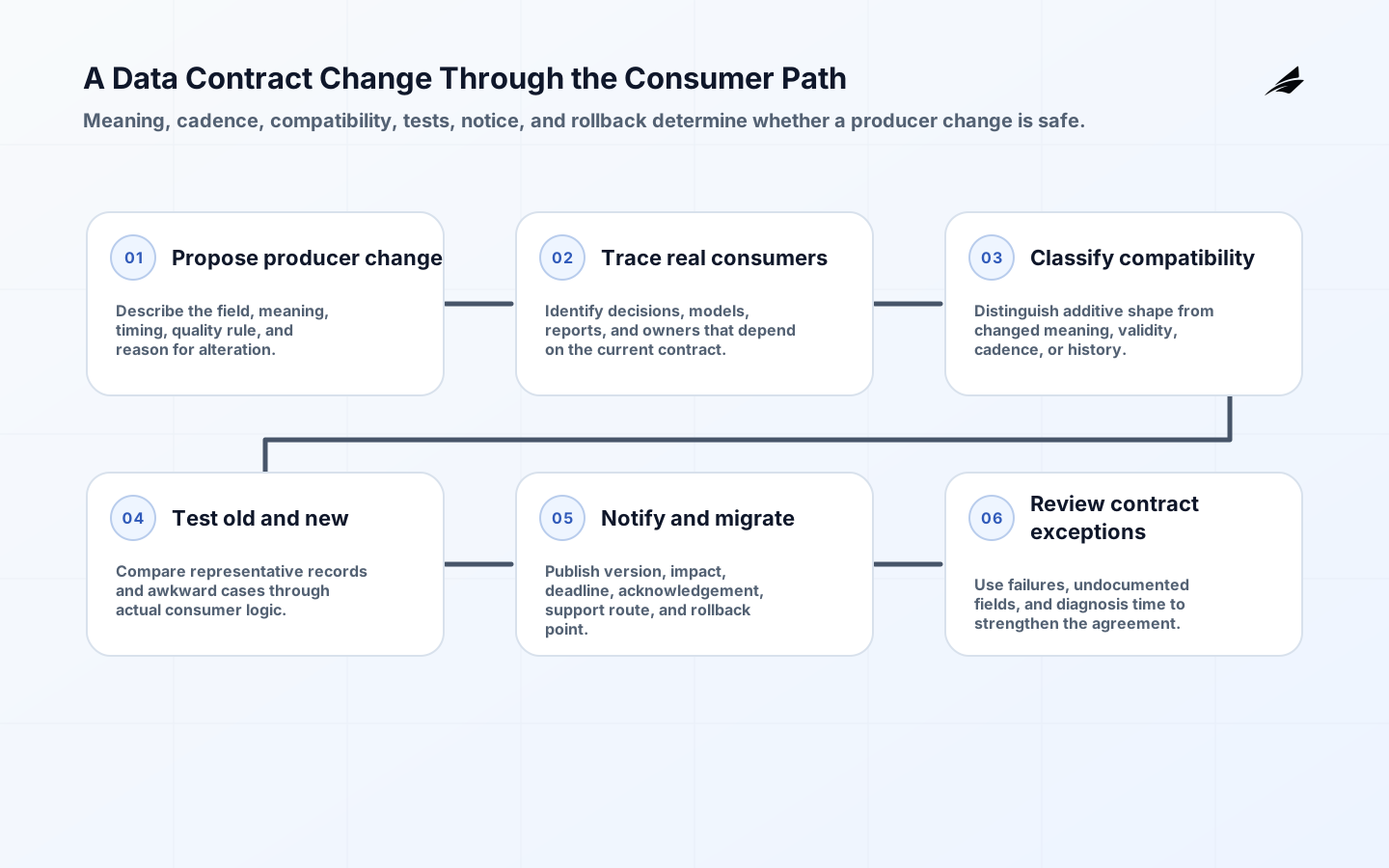
Data contracts are often treated as a tool choice, but the harder question is operational: whether a producer change is safe for the consumers that depend on its data. In this guide, data contracts mean an explicit, testable agreement about a dataset or event: its meaning, shape, allowed values, ownership, and the way changes are announced. That distinction matters because a technically correct implementation can still fail when readers cannot tell what a number means, who is allowed to act, or what happens when the evidence is late. Product teams should begin with a decision they already make, then design the data product around the evidence, timing, and handoff that decision requires.
Define the decision before designing data contracts
Write the decision as a sentence that includes a user, an action, a population, and a deadline. For data contracts, the essential inputs are a named producer and consumer, field-level meaning, expected cadence, quality rules, versioning policy, and an escalation owner. The exercise prevents teams from promising a universal solution when they really need a dependable answer to one recurring question. It also reveals constraints early: a measure may be correct at an account level but unsafe for an individual action; a result may be useful every morning but misleading during a source outage. The data lineage architecture guide is a helpful companion when the team needs to make that evidence trail inspectable.
- Name the person who can change an outcome after seeing the data contracts result, not merely the executive who requested it.
- State the unit of analysis and time basis in plain language; “customer,” “order,” and “active” rarely mean enough on their own.
- Record the source that is authoritative for each critical input and the maximum age at which it remains useful.
- Describe the exception route for missing, contradictory, or restricted records before people depend on the result.
- Choose one owner for meaning and one owner for technical operation; they may collaborate, but the responsibilities are different.
- Keep an example record or scenario that lets a new reader test whether the published definition matches the intended decision.
Design data contracts boundaries that readers can inspect
A durable design shows its limits. The most common failure is treating a schema file as sufficient while leaving business meaning and change communication implicit. Instead, make grain, time semantics, relationships, permissions, and freshness visible close to the result. This is not bureaucracy for its own sake; it lets a reader notice when a number is outside its intended use. Treat transformations and checks as part of the product. The data quality engineering guide explains why a quality check should test a declared promise, such as completeness or uniqueness, rather than merely count nulls after a complaint.
| Design question | Practical choice | Evidence to retain |
|---|---|---|
| Purpose | Which decision does this output support, and which decisions does it exclude? | A short decision statement, named audience, and example action. |
| Meaning | What is the grain, time rule, and inclusion logic? | Definitions, approved examples, and a link to transformation ownership. |
| Reliability | What happens when a source is late or an assumption fails? | Freshness threshold, visible status, and recovery procedure. |
| Access | Who needs detail and who only needs an aggregate? | Role-based scope, classification, and review record. |
Build the data contracts operating path
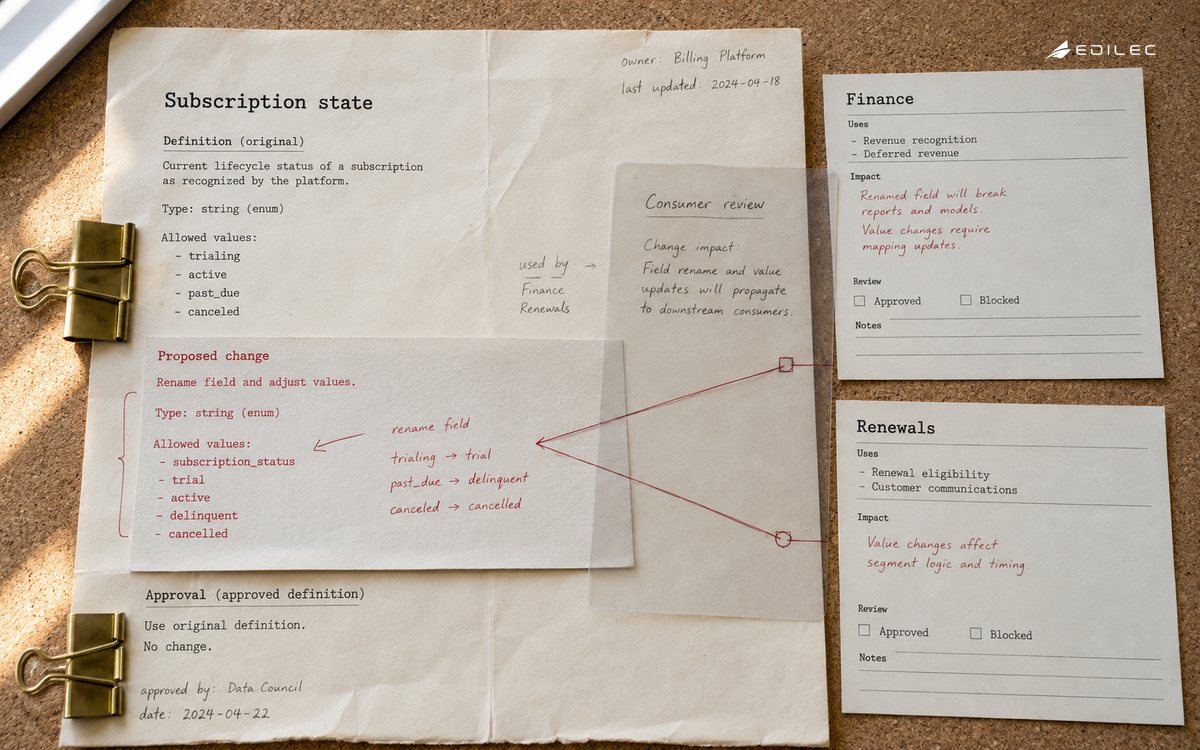
A practical first release should start with one high-value dataset that already causes incidents, express the checks close to the transformation, and agree the change path with its real consumers. Use a representative sample rather than only clean records. A product team adds a new subscription state. Finance uses the field for revenue reporting and customer success uses it for renewals. A contract identifies the producer, defines the valid states, records the effective date, and makes an incompatible rename visible before it reaches downstream models. Walk this situation with the people who will use the result, including the source owner and the team that handles exceptions. Their questions are design input: repeated requests to export data may signal a missing drill path; a dispute may reveal an unstated definition; a slow reconciliation may expose a time rule that needs to be explicit. Connect the work to the warehouse modeling fixes when relationship and history choices shape the answer.
| Operating moment | Control | Expected response |
|---|---|---|
| Normal publication | Check declared inputs and publish status with the result. | Readers can act and trace a material value to its evidence. |
| Late or failed input | Compare arrival against the agreed threshold. | Hold, qualify, or use an approved fallback; never silently substitute. |
| Definition change | Review a sample of old and new outputs before release. | Version the change, identify affected history, and notify dependent users. |
| Reader challenge | Capture the record, interpretation, and source evidence. | Resolve at the accountable layer and turn recurrent findings into a check or documentation update. |
Operate data contracts as a service
Ownership begins after the first release. Review access when roles change, test the promises readers rely on, and make incidents teach the next iteration. Governance is most useful when it appears inside the daily workflow: source status is visible, a definition has an owner, and a correction can be traced without a private spreadsheet. The NIST data governance profile frames governance as organizational roles, policies, and data-management practices working together. That is a stronger model than assigning a catalog owner and assuming the work is done. In data contracts, that discipline means treating the published output as a maintained service with its own scope, owners, and review cadence.
Measure whether data contracts improves the decision
Measure data contracts through behavior and operating outcomes, not page views or project completion alone. Useful signals include contract test failures, time to diagnose a breaking change, undocumented fields, and consumer acknowledgements before a release. Compare the baseline with the first controlled release and investigate both improvement and unexpected movement. More usage can mean the output is valuable, but it can also mean readers have no better route to reliable evidence. Pair activity signals with periodic qualitative review: ask a reader to explain a result, identify its limitations, and show what they would do if its main input were delayed.
Review the data contracts practice
For data contracts, the release rule should distinguish additive changes from changes that alter meaning, validity, or cadence. A new optional field may be safe only after consumers know its semantics; a renamed value or changed null rule deserves a planned migration. Keep the contract with the producer's delivery process, not in a separate folder that teams forget. A small change log, automated checks, and a named consumer contact make the agreement useful during an actual incident.
Work through a data contracts scenario
Consider a mobile product that changes its subscription event from a single status field to separate lifecycle and payment fields. The producer may regard that as a harmless cleanup, but a retention model that filters the old status can become silently wrong. Before release, compare sample events, declare how historical records are represented, add tests for allowed lifecycle values, and notify each known consumer of the migration window. Keep both representations only as long as a documented compatibility plan requires them. The useful outcome is not a perfect prediction of every future user; it is a repeatable way to detect material impact, give consumers time to adapt, and remove ambiguity after the change lands.
Key takeaways for data contracts
- Data contracts should start with a bounded decision and a real user action, not a generalized technology promise.
- Make meaning, source authority, freshness, access, and exception handling visible enough for a reader to challenge a result.
- Pilot difficult cases deliberately; clean happy-path data rarely reveals the controls an operating team will need.
- Give business meaning and technical operation clear owners, then use incidents and disputes to improve the data product.
- Use contract test failures, time to diagnose a breaking change, undocumented fields, and consumer acknowledgements before a release as signals for a review conversation, not as isolated targets that people can optimize without improving decisions.
Frequently asked questions about data contracts
Is data contracts mainly a software purchase? No. Software can support the work, but the durable asset is the agreement about decisions, definitions, ownership, and response to failure. How broad should the first release be? Narrow enough that one team can validate it with real work, yet complete enough to include sources, controls, and exceptions. Who should approve a change? The owner of the meaning and the owner of the implementation should both be involved; affected consumers need notice when a change alters an answer. When is it ready to scale? When the team can explain the output, recover from a known failure, and show evidence that the first decision improved.
Check data contracts before expanding
Before extending data contracts, select a producer change that looks minor and trace its effect through a real consumer. Confirm the owner, compatibility classification, test, communication route, and rollback point are all usable by people who did not author the dataset. A contract that works only for the original team is documentation; a contract that guides a cross-team change is operational control.
Conclusion: make data contracts explainable before expanding it
Data contracts becomes valuable when it helps a person make a timely, defensible decision without concealing the conditions behind the result. Begin with the smallest meaningful workflow, preserve evidence and uncertainty, and give the operating team a way to correct what it learns. That approach makes expansion calmer: each new user or use case inherits a clear model instead of another opaque layer of reporting.