Tenant-aware workload placement decides which deployment, stamp, cluster, database or region will serve a SaaS tenant. Round-robin allocation fails as soon as tenants differ in data residency, isolation tier, feature entitlement, demand or commercial commitment. A robust engine treats legal and security conditions as hard eligibility constraints, then optimizes among eligible destinations for headroom, noisy-neighbor risk, affinity and cost. It also preserves the evidence explaining why a tenant was placed and whether later movement remained compliant.
Placement belongs in the SaaS control plane. Microsoft's control-plane guidance identifies tenant placement and rebalancing as advanced responsibilities. Keep the decision centralized logically even if execution is regional: one authoritative assignment, versioned policy and idempotent provisioning workflow prevent two controllers from allocating the same tenant differently.
Model tenant requirements as governed facts
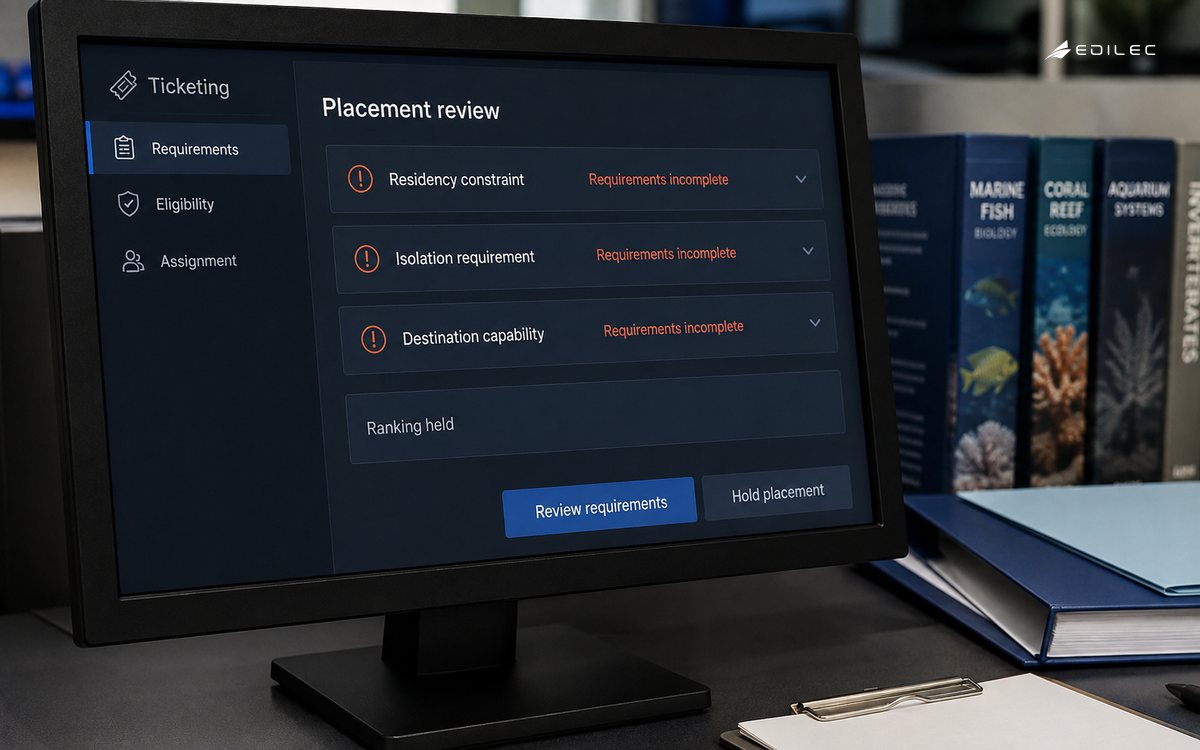
Store residency jurisdiction, permitted regions, isolation profile, product tier, encryption or key requirements, required features, latency geography, expected demand, maintenance window and recovery class. Record source, effective date and approval for each sensitive fact. Distinguish customer preference from contractual constraint. Reject incomplete high-risk profiles rather than defaulting to the cheapest region. Changes to residency or isolation create migration work, not a casual catalog edit.
Model current destination capability and capacity
A destination record needs region and jurisdiction, software version, enabled features, isolation type, security accreditation, available keys, quotas, capacity by limiting dimension, health, maintenance state, recovery pairing and unit cost. Update volatile capacity from trusted telemetry and reserve pessimistically during concurrent onboarding. Separate eligible from preferred: a healthy stamp may still be prohibited for a tenant.
| Placement input | Hard constraint example | Optimization example | Evidence |
|---|---|---|---|
| Residency | Data must remain in approved jurisdiction | Choose nearest approved region | Contract term and region inventory |
| Isolation | Dedicated database or stack required | Pool standard tenants efficiently | Tier policy and resource boundary |
| Capability | Required feature and key service available | Prefer current software wave | Capability manifest |
| Capacity | Projected peak fits with recovery headroom | Balance dominant resource | Reservation and telemetry snapshot |
| Commercial | Purchased service tier must be deliverable | Minimize unit cost within tier | Entitlement and cost model |
Filter eligibility before scoring candidates
Evaluate deny rules first: jurisdiction, isolation, incompatible tenant combinations, unsupported feature, maintenance lock, insufficient recovery or capacity floor. Return machine-readable reasons and keep the policy version. Only then score candidates. This ordering prevents a large cost weight from making a prohibited destination appear acceptable. Use deterministic tie-breaking so retries select the same candidate.
Microsoft's tenancy-model guidance presents isolation as a spectrum and warns about cost and management tradeoffs. Express targeted isolation by service where appropriate: a tenant may share compute while requiring a dedicated database. The placement object should identify each resource class, avoiding the false choice between fully pooled and fully siloed architecture.
Score headroom, affinity, risk and unit cost
Use predicted demand across CPU, connections, storage, throughput and external quotas, not tenant count alone. Penalize concentration of large or correlated tenants and preserve evacuation headroom. Reward affinity where latency or shared integrations benefit, but avoid concentrating an entire customer segment into one failure domain. Include fixed stamp cost and marginal service cost. Publish weights and test sensitivity; a placement algorithm is policy, not an opaque recommendation model.
Reserve, provision and route as one workflow
Use compare-and-set or a reservation ledger to prevent concurrent overcommit. Persist the selected destination and policy explanation before provisioning. Create tenant resources idempotently, apply isolation policy, restore or initialize data, verify negative cross-tenant access, then publish routing. If any step fails, retain a resumable state and expire capacity reservations safely. Never expose the route before the destination passes tenant-scoped readiness.
AWS SaaS design principles stress isolation at all layers and tenant-aware operations. Carry tenant and placement identifiers into authorization, telemetry, cost allocation and support tools. Placement is not an access-control substitute: pooled workloads still need enforcement that prevents one tenant reaching another tenant's resources.
Rebalance through an auditable migration state machine
Trigger rebalancing for sustained capacity pressure, changed residency, isolation upgrade, retirement, risk concentration or cost. Re-run eligibility for the target and reserve capacity. Copy data, synchronize deltas, quiesce or dual-write only under a proven model, verify counts and tenant operations, switch routing atomically, observe, and remove source data after retention and rollback conditions. Maintain chain-of-custody and regional location evidence throughout.
| Placement failure | Preventive control | Detection | Repair |
|---|---|---|---|
| Prohibited region selected | Eligibility deny before scoring | Policy decision audit | Block provisioning and investigate facts |
| Concurrent overcommit | Atomic capacity reservation | Reserved versus actual headroom | Queue placement or add stamp |
| Noisy tenant concentration | Risk and dominant-resource score | Tenant-normalized saturation | Migrate selected tenant |
| Stale capability manifest | Version and freshness requirement | Provisioning mismatch | Refresh inventory and retry idempotently |
| Partial migration | Checkpointed state and source retention | Target integrity and route version | Resume or roll back |
Prove residency, isolation and cost outcomes
Report eligible-candidate count, placement failures, capacity by limiting dimension, concentration, moves, policy exceptions and cost per tenant tier. Sample actual resource locations and access policies against catalog intent. Google Kubernetes Engine's multitenancy overview illustrates that isolation choices span clusters, namespaces and workloads; verify the concrete enforcement layer rather than assuming a label proves separation.
Simulate policy and demand before changing placement
Replay real decisions against the proposed policy
Before releasing a new weight, deny rule or capacity model, replay recent tenant arrivals and moves through both versions. Compare eligibility sets, selected destinations, concentration by failure domain, unused headroom, projected cost and migration count. Investigate every case where a formerly eligible tenant becomes prohibited or a premium isolation promise changes. Use production distributions rather than average tenants: a few connection-heavy or storage-heavy customers often determine whether the new policy is safe.
Run the candidate policy in shadow mode for new requests. It should produce a decision record without reserving or provisioning, allowing reviewers to compare its reasons with the active engine. Require a change budget for the number and risk of moves the policy would induce. A scoring improvement that triggers hundreds of marginal migrations may cost more and create more exposure than it saves. Apply hysteresis so small price or load changes do not move tenants repeatedly.
Forecast both growth and evacuation capacity
Ordinary headroom answers whether a stamp can absorb forecast demand. Resilience headroom answers whether eligible stamps can absorb tenants from a failed or retiring destination. Compute both under residency, feature and isolation constraints; fleet-wide spare capacity is irrelevant if it sits where the displaced tenants cannot run. Model the limiting resource and time to provision a fresh unit. If evacuation requires a new database quota or key ceremony, include that lead time in the recovery plan.
Publish placement service objectives such as decision latency, percentage of tenants with two eligible recovery destinations, reservation accuracy, policy-denial rate and age of destination inventory. Review fairness across service tiers so cost optimization does not systematically place one cohort on older or riskier capacity. These measures turn the engine from hidden allocation logic into a governable product whose security, reliability and commercial outcomes can be challenged.
Manage placement exceptions as temporary policy objects, not comments in a support ticket. Record the tenant, violated preference or overridden score, constraints that still passed, approver, reason, compensating capacity or isolation control, effective period and removal test. Re-evaluate the exception whenever destination health or tenant facts change. Alert before expiry and prevent an exception from weakening hard residency or access rules. Reporting exceptions by age and business owner exposes where a supposedly automated placement model depends on recurring manual judgment.
Retain enough placement history to explain capacity and cost outcomes without keeping sensitive contract text in operational logs. Store normalized policy facts, candidate reasons, reservation versions and final verification results. Limit access to commercial and residency attributes, and define retention from audit and dispute needs. This produces useful evidence while avoiding a new centralized repository of tenant-sensitive information. Periodically restore a sample decision from the retained record to confirm that reviewers can reconstruct its inputs, applicable rules, rejected destinations and final approval.
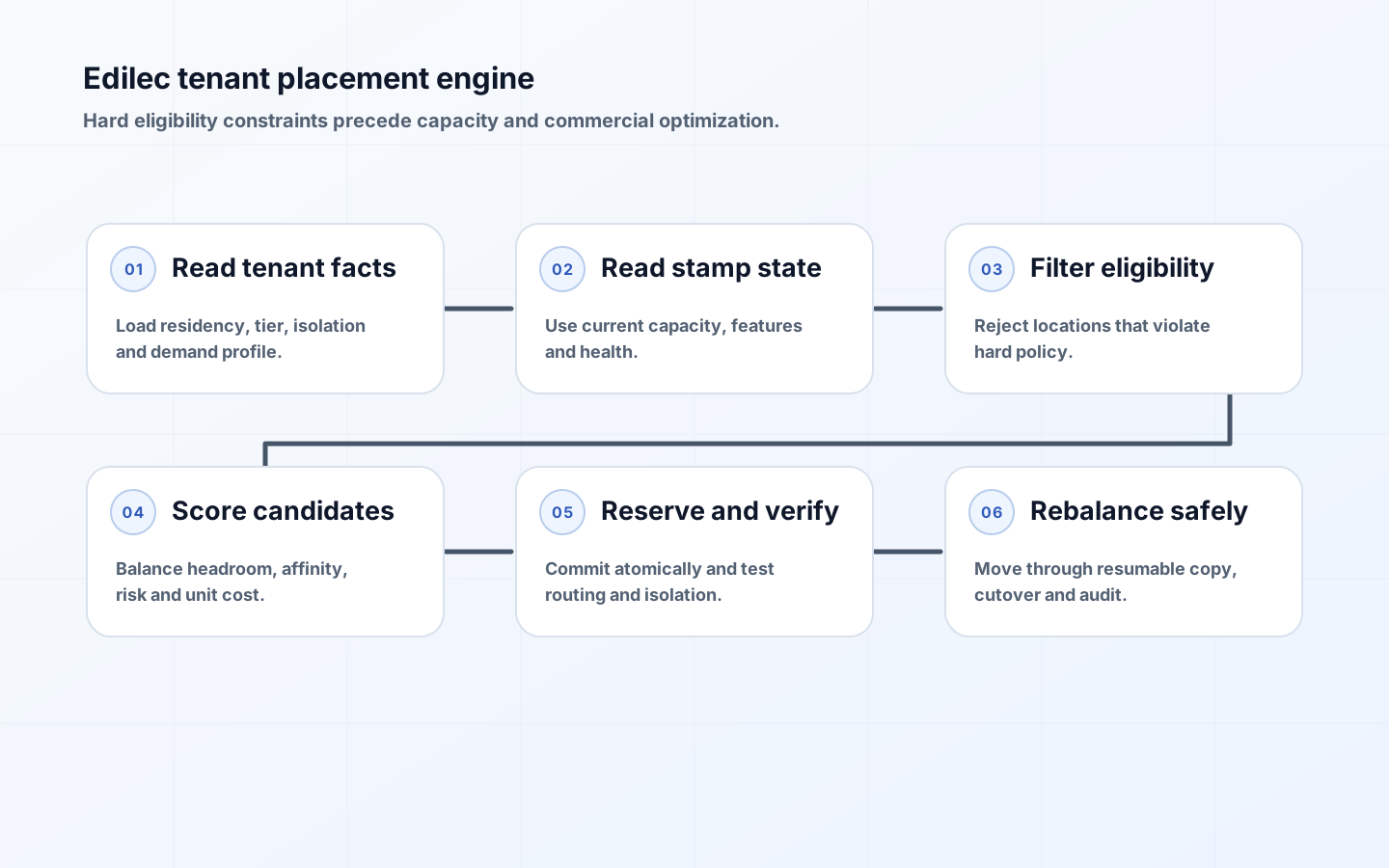
Use the six-stage Edilec tenant placement engine
Read governed tenant facts and fresh stamp state, filter hard eligibility, score candidates, reserve and verify, then rebalance safely. Preserve inputs, policy version, candidate reasons and outcome as the placement decision record.
Key takeaways
- Treat residency and isolation as hard constraints, never cost weights.
- Model capacity across the resource that actually limits each destination.
- Reserve atomically before provisioning and route only after tenant-scoped tests.
- Carry tenant placement context into access, telemetry, billing and support.
- Use a resumable migration workflow for every rebalance or policy change.
Frequently asked questions
Is placement just bin packing?
No. Bin packing can optimize eligible capacity, but legal, security, feature and recovery constraints determine eligibility first.
Can premium tenants be placed manually?
An authorized exception may select a destination, but it should still pass the same hard checks and create a versioned decision record. Manual routing bypass is unsafe.
When should a tenant move?
Move for durable policy, capacity, reliability or commercial reasons whose benefit exceeds migration risk. Avoid constant optimization; use thresholds and cooldown periods.
Conclusion
Tenant placement is a policy-enforcement and capacity-control system. By filtering hard constraints before optimization and coupling decisions to atomic provisioning, verification and migration, SaaS teams can offer residency and isolation tiers without losing fleet efficiency or defensible evidence.