Active-active multi-region architecture keeps useful application capacity serving in two or more regions. Buying a global load balancer and replicated database makes the topology available, but does not settle its hardest questions: where writes are authoritative, what users observe during delay or partition, which dependencies remain regional, and whether the continuity benefit justifies duplicate capacity and cross-region operations. A design is active-active only for the transactions both regions can complete correctly, not for every endpoint displayed as healthy.
Start with business scenarios. A public catalog may serve stale reads globally while checkout writes remain home-region. A collaboration product may require read-your-writes within a tenant but accept delayed global search. Define RTO and RPO per workflow and state the maximum inconsistent behavior. AWS recovery planning guidance ties recovery objectives to business need; use them to prevent a blanket active-active requirement from obscuring different transaction risks.
Justify active-active with a continuity model
Quantify outage cost, user geography, latency need and acceptable degraded capability. Compare active-passive, pilot-light, warm standby and active-active for each service. Active-active earns its premium where regional interruption must cause little or no traffic interruption, where both regions normally deliver latency or capacity value, and where data semantics support concurrent service. It is weak value when a single-region external provider, manual failover authority or nonreplicated identity system still controls completion.
| Workload property | Active-active fit | Alternative | Reason |
|---|---|---|---|
| Global reads, tolerant of bounded staleness | Strong | Read replicas with home-region writes | Both regions deliver daily value |
| Money movement with strict ordering | Conditional | Single writer plus warm standby | Conflict cost may exceed outage benefit |
| Regional data residency | Conditional | Tenant home regions with paired recovery | Global replication may violate policy |
| Batch back office | Weak | Restore or warm standby | Longer RTO may be economical |
| Stateless edge API | Strong if dependencies regional | Multi-region compute | Routing is simple only when state path survives |
Choose write semantics before replication technology
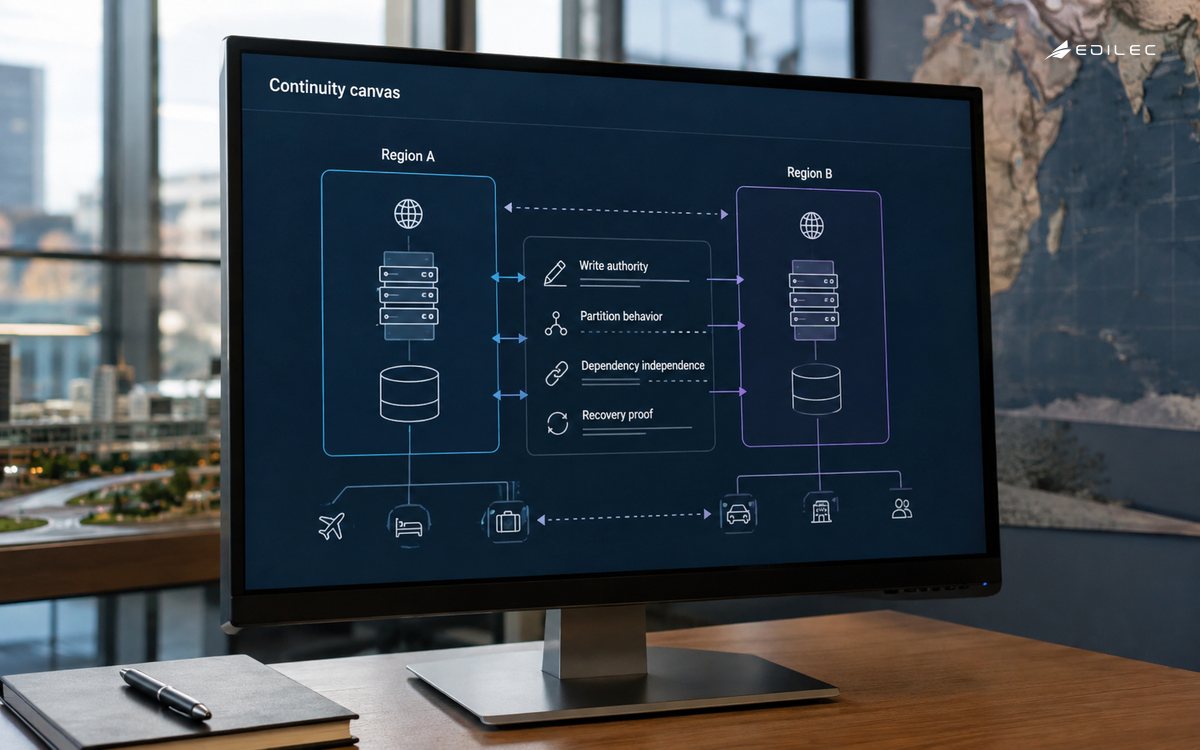
Select among one writer per dataset, one writer per tenant or key, and true multi-writer. Single-writer ownership simplifies ordering but needs rapid ownership transfer. Partitioned ownership lets both regions write different tenants while avoiding conflicts. Multi-writer improves locality but requires conflict semantics for every mutable entity. Last-writer-wins can silently discard valid updates; prefer domain rules such as immutable events, version preconditions, commutative counters or explicit human resolution.
Google's multi-regional archetype notes that low RPO or strong cross-region consistency requires synchronous replication, which couples write latency and availability to inter-region communication. Asynchronous replication reduces that coupling but permits lag and data loss at failover. Record the choice per store, including queues, object storage, caches and search indexes. A database guarantee does not cover an unreplicated message or webhook state.
Route on transaction health, not endpoint reachability
Health checks should execute a safe representative path against regional dependencies and detect whether the region can serve the tenant's data mode. Use locality and tenant affinity, preserve session and idempotency behavior, and drain before shifting writes when possible. DNS and global proxy timeouts, cache behavior and client retries affect realized RTO. Prevent oscillation with explicit thresholds and operator-visible state.
Azure's geode pattern describes nodes that can serve any client through replicated data. If your regions cannot do that, say which tenant or operation is region-bound. Never send traffic to an empty but healthy stack. Failover readiness includes data, secrets, certificates, quotas, third-party allowlists and enough capacity for the redirected workload.
Remove hidden regional and global singletons
Map identity, configuration, feature flags, key management, package registries, observability, support tooling, billing, email and external APIs. Classify each as region-local, replicated, safely cached or allowed to degrade. Existing sessions should often continue on last-known-good policy while high-risk administrative changes pause. A global control plane can coordinate regions, but serving paths should not require it synchronously for each request.
Test isolation, failover, failback and reconciliation
Exercises must remove a region or its dependencies, not merely change a routing weight. Observe in-flight writes, duplicate requests, replication lag, queue replay, scheduled work and customer-visible state. Measure detection, decision, traffic shift and data recovery separately. Failback is a second migration: establish authority, catch up data, verify divergence, shift gradually and retain rollback. Practice while both regions are healthy and during simulated partial partitions.
| Failure test | Expected behavior | Evidence | Failure signal |
|---|---|---|---|
| Region unreachable | Eligible traffic moves within RTO | Route timeline and successful transactions | Healthy endpoints but failed business path |
| Replication delayed | Writes follow declared consistency mode | Lag, rejected writes and user message | Silent stale overwrite |
| Control plane lost | Existing service continues; risky change pauses | Cached version and queued mutations | Serving path calls global control |
| Client retries during shift | Idempotent operation completes once | Idempotency record across regions | Duplicate order or payment |
| Failback | Authority and data converge before traffic | Reconciliation report | Unresolved divergent records |
Price the full topology and operating burden
Include minimum capacity in every region, synchronous or asynchronous transfer, replicated storage, global routing, observability, backups, licenses, test environments and engineering coverage. Capacity must survive a region loss, so steady-state utilization may be deliberately lower. Offset cost with daily latency value, release flexibility and avoided downtime. Azure redundancy guidance stresses tradeoffs; review cost per successful business transaction, not only infrastructure spend.
Scope active-active by business workflow
Separate read continuity from write continuity
A service can often deliver high-value regional continuity without accepting writes everywhere. Product browsing, document retrieval or status lookup may tolerate a replicated read model, while payment capture, inventory decrement or entitlement change retains a single write owner. Name the minimum useful behavior during regional isolation for each workflow. This creates a portfolio of patterns—active-active reads, partitioned writes, queued commands and deliberately unavailable high-risk mutations—instead of forcing one database mode across the product.
For each command, define an idempotency key, ownership rule, acknowledgement meaning and reconciliation authority. A successful response must tell the caller whether work is durably committed in one region, replicated to a quorum or merely accepted into a local queue. During isolation, prevent two regions from independently granting the same scarce resource unless the domain has an explicit escrow, partition or conflict rule. Ambiguous success semantics create a business incident even when infrastructure remains healthy.
Measure useful completion, not regional uptime
Regional health should reflect completion of a representative transaction through identity, policy, data and critical third parties. Track the percentage of workflows that remain useful during an exercise, stale-read age, conflict rate, queued-command age, lost acknowledgements and time to return to normal routing. Endpoint probes can stay green while authorization, keys or replication are unable to complete a customer action. Routing on those probes merely moves users toward a different failure.
Assign an owner to every deliberate asymmetry. Tax calculation may depend on a regional provider, a fraud model may update from one home region, or support tooling may show delayed state. Document what the user sees and how operators intervene. This makes partial continuity honest and testable. It also produces a better cost decision: duplicate only the components that increase completed business work, rather than paying for symmetrical infrastructure that still depends on one hidden service.
Treat failback as a data migration, not the reversal of a traffic switch. Identify records accepted while regions were isolated, compare ownership epochs, resolve conflicts through domain rules and verify that asynchronous side effects are not emitted twice. Hold source evidence until reconciliation and customer-impact review finish. Test the temptation to fail back early: an apparently recovered primary region may still have cold caches, replication lag or exhausted dependencies. Use progressive traffic and transaction-level health to earn normal routing again.
Keep a regional continuity ledger that records every exercise, observed dependency, achieved workflow objective and unresolved conflict. Trend it against the cost model so leaders can see whether additional symmetry produces real continuity. Retire duplicated components that never improve a tested workflow, and fund gaps that repeatedly block it. This evidence prevents an active-active label from surviving after the architecture's actual behavior has drifted.
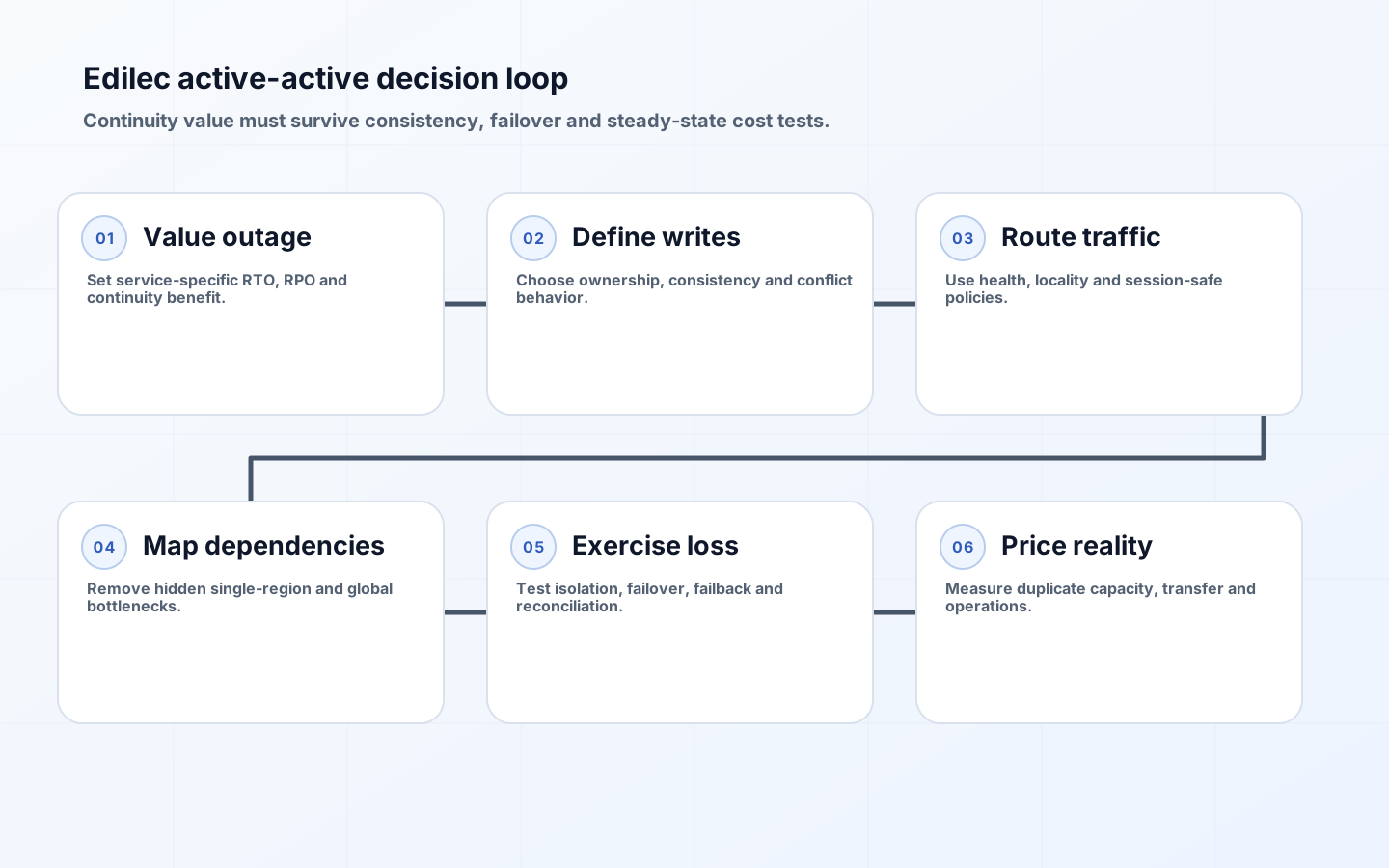
Use the six-stage Edilec active-active decision loop
Value the outage, define writes, route, map dependencies, exercise loss and price reality. A failed stage is a decision result: choose a narrower active-active scope or a less complex recovery pattern until the missing property is funded.
Key takeaways
- Define RTO, RPO and degraded capability per business workflow.
- Choose ownership and conflict semantics before selecting a replicated database.
- Route only to regions prepared with data, dependencies, policy and capacity.
- Exercise partial failure and failback, including retries and reconciliation.
- Count duplicate capacity, transfer and operational complexity against continuity value.
Frequently asked questions
Does active-active guarantee zero RPO?
No. RPO follows the replication and commit model. Asynchronous multi-region writes can lose acknowledged data when a region fails; synchronous commits trade latency and partition availability for stronger durability.
Must every service be active-active?
No. Scope the pattern to workflows needing it. Analytics, administration or batch services can degrade while critical transactions continue.
Is eventual consistency always required?
No. Strongly consistent multi-region services exist, but physics and failure tradeoffs remain. Match their latency, availability and cost to the transaction.
Conclusion
Active-active is a business continuity system, not a traffic-management feature. It succeeds when useful transactions preserve explicit data semantics through regional loss and when teams can prove failover, reconciliation and cost. Narrowing scope is often the soundest way to obtain the continuity that matters without making every workload globally coupled.