Deployment stamps and cells often describe similar pictures: multiple copies of infrastructure, each serving part of the workload. The useful distinction is intent. A deployment stamp is commonly a repeatable capacity and tenancy unit. A cell is explicitly a fault-containment unit with a bounded maximum and independent serving path. A stamp can be a cell when its contract includes those properties; a so-called cell can be merely a stamp when it shares critical state. The deployment stamps vs cells decision should therefore produce measurable boundaries, not a naming debate.
Microsoft's deployment stamp pattern describes independently deployed scale units that host subsets of tenants, support regional placement and implicitly shard data. AWS's cell guidance emphasizes capped complete instances, scope of impact and cell routing. Both require automation, placement and migration. Choose the stronger contract required by the risk.
Start with the goal of the repeatable unit
Choose a stamp-first framing when the immediate constraint is service quota, database scale, geographic deployment, tenant customization or deployment cadence. Choose a cell-first framing when the business must cap the tenants, requests or revenue affected by one software, configuration or dependency failure. Do not assume the objectives conflict. A mature SaaS platform often uses a stamp as both scale unit and cell, but it pays the engineering cost to prove independent failure behavior.
| Decision axis | Stamp-oriented answer | Cell-oriented answer | Architecture implication |
|---|---|---|---|
| Primary objective | Repeat capacity or tenant environment | Contain service impact | Cell requires explicit fault tests |
| Maximum size | May follow practical scale limits | Declared and load-tested cap | Admission stops before cap |
| Completeness | Can repeat selected components | Includes critical serving dependencies | Shared services must degrade safely |
| Tenant assignment | Capacity, region or product tier | Stable failure cohort plus capacity | Routing preserves assignment |
| Change strategy | Independent or ring deployment | Cell-bounded canary and rollback | Health gates operate per unit |
Compare data ownership and cross-unit work
A repeatable unit is easiest to reason about when it owns the authoritative data for its assigned tenants. Cross-unit transactions, global uniqueness and fleet analytics weaken independence. Decide whether such work can be asynchronous, partitioned by tenant or mediated through a service designed for degraded availability. If every request writes one global database, additional stamps improve compute capacity but do not create cellular containment.
Microsoft distinguishes stamps from the geode pattern, where every geographic node can serve any client using replicated data. Geodes suit active-active global access but require replication and consistency design. Stamps or cells usually keep stable tenant affinity. Mixing them is legitimate: a global edge may be geode-like while stateful application units remain tenant-bound. Document the boundary so failover does not violate residency or data ownership.
Compare routing and failover semantics
Stamp routing often begins as capacity allocation: resolve the tenant to its assigned instance. Cell routing adds a containment concern: never spread a toxic request pattern or broken release across healthy cells. Keep assignment data versioned and cacheable. Health-based failover is not automatically safe because another unit may lack data, keys, contractual eligibility or headroom. Define failover per workload, including read-only degradation and queued writes, instead of configuring one global traffic switch.
Price fleet operations, not only infrastructure
Both patterns duplicate minimum capacity, gateways, databases and monitoring. Cells may require more, smaller units to cap impact. Count control-plane development, routing, tenant migration, release waves, quota management, backup tests and incident coordination. Then credit benefits: smaller incidents, safer deployments, predictable load tests, tenant isolation tiers and linear capacity expansion. The decision is credible when cost is expressed per tenant or transaction and reliability value is linked to service objectives.
Azure's multitenant architecture guidance notes the tradeoff among isolation, cost efficiency, performance, complexity and manageability. Avoid dedicated units for every tenant unless contractual or workload needs justify them. Pool ordinary tenants in bounded units and reserve dedicated units for requirements that can fund the fixed footprint, while keeping one software and operations model.
Write a repeatable-unit contract
The contract should name included components, shared dependencies, assignment key, supported tenant profiles, maximum capacity dimensions, data ownership, routing inputs, allowed cross-unit calls, deployment wave, recovery objective and migration method. Add invariants: a unit cannot read another unit's tenant store; a global control outage cannot halt existing reads; one release wave cannot exceed the impact budget. Turn invariants into architecture tests and policy checks.
| Contract element | Required decision | Acceptance evidence | Review trigger |
|---|---|---|---|
| Capacity | Hard limit and admission threshold | Representative saturation test | New workload shape |
| Isolation | Failures expected to remain local | Network, quota and dependency fault tests | New shared component |
| Data | Tenant ownership and replication rule | Restore and integrity proof | Cross-unit feature |
| Routing | Stable assignment and stale-state behavior | Partial propagation test | New edge or identity flow |
| Fleet change | Wave size and stop signals | Failed-canary exercise | Deployment platform change |
| Migration | Resumable transfer and rollback window | Timed tenant move | Residency or tier change |
Choose an evolution path that preserves options
Start with two automated stamps even if traffic needs one, because the second exposes hidden singleton assumptions. Add tenant-aware routing and migration before scale pressure. If impact requirements rise, cap capacity, remove synchronous global dependencies and enforce cell-scoped change. Conversely, do not fragment a simple, low-risk workload merely to adopt the cell label. A scalable monolith with zonal redundancy may be easier to operate until tenant count, limits or incident impact justify repetition.
Score candidate units with workload evidence
Prototype one complete unit before choosing terminology
Build a thin but complete candidate around one representative tenant cohort. Provision it from an empty account or subscription, restore data, publish routing, deploy a change, exhaust a limiting quota and remove the unit. Measure manual steps, shared dependencies, startup time, minimum efficient capacity and the population affected by each injected fault. This exercise exposes whether the proposal is merely a repeated compute tier or a service slice with meaningful independence. It also reveals fixed per-unit costs that a conceptual comparison misses.
Score both patterns against weighted business needs: predictable capacity expansion, tenant isolation, regional placement, independent release, bounded incident population, migration frequency and operator skill. Keep hard constraints outside the weighted score. If a regulated tenant requires dedicated state, a cheap shared database cannot win through cost points. Record uncertainty ranges rather than false precision, especially for migration effort and on-call load that have not yet been observed.
Test the transactions that cross a unit boundary
Repeatable units become difficult at the seams. Identify workflows that search across tenants, aggregate fleet data, transfer ownership, share inventory or enforce a global limit. Decide whether they use asynchronous events, a purpose-built global service, fan-out queries or a separate analytical copy. Give each workflow a consistency expectation, timeout, partial-result rule and data owner. A unit model that works only for isolated request paths will surprise the business when reporting or administration couples the fleet again.
Revisit the score after the prototype has operated through a release and an incident. Stamps may acquire stronger containment as data and routing mature; cells may use stamp automation to add capacity. Preserve this evolution by keeping placement records, exportable state and versioned infrastructure definitions. The architecture decision is not a permanent vocabulary choice. It is a reviewed contract for how capacity, tenants, failures and changes are partitioned today.
Publish the selected contract as an architecture decision with measurable exit criteria. Include the maximum tenants or load per unit, permitted shared services, recovery expectation, routing owner, deployment sequence and cost floor. Link exceptions to an expiry date. When observed incidents or capacity tests violate those limits, reopen the unit design instead of increasing quotas informally. This keeps a repeatable scale unit repeatable as the service and organization grow.
Use the six-stage Edilec stamp or cell matrix
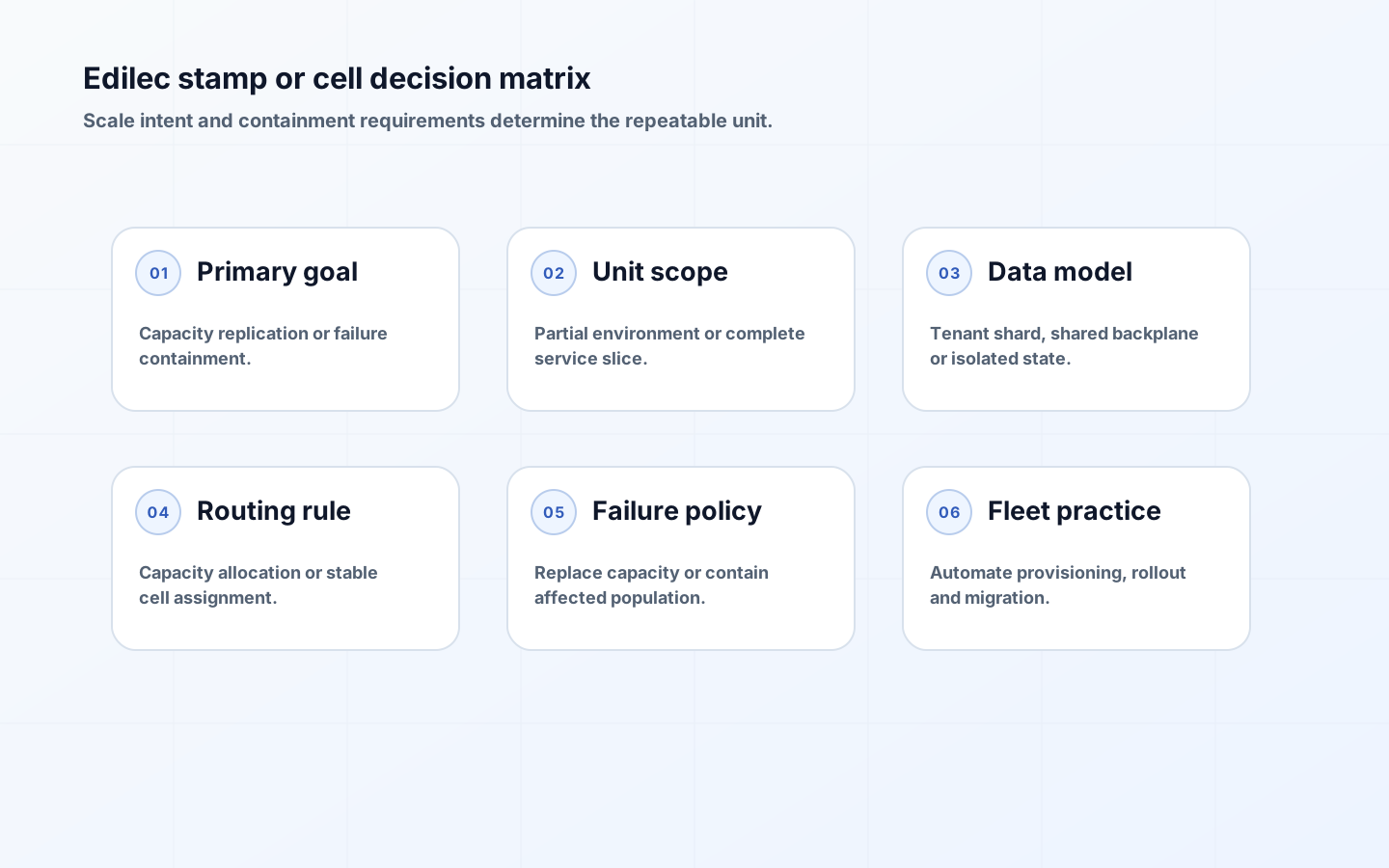
The matrix compares goal, scope, data, routing, failure policy and fleet practice. Use it in architecture review to expose a mismatch, such as claiming containment while retaining global state. Record the chosen unit contract and the improvements needed before a capacity stamp can be treated as a failure cell.

Key takeaways
- Stamps emphasize repeatable deployment and scale; cells add an explicit bounded-failure contract.
- Either label can implement both goals when data, dependencies and change remain independent.
- Stable tenant affinity is different from geode-style any-region service.
- Price routing, migration and fleet operations alongside duplicated resources.
- Start with a written unit contract and test its capacity and isolation invariants.
Frequently asked questions
Are stamps and cells synonyms?
Some documentation uses the words interchangeably. In a decision, define them by required properties. Calling a unit a cell is useful only if it has bounded size and tested containment.
Must one tenant occupy one stamp?
No. A stamp can pool many tenants or host one dedicated tenant. Placement should reflect isolation, capacity, residency and cost rather than an assumed one-to-one mapping.
Must every unit exist in every region?
No. Place units where tenants and recovery objectives require them. Replicating every tenant everywhere may increase cost and consistency complexity without adding justified continuity.
Conclusion
Choose the repeatable unit from the outcome. Use stamps to scale and segment deployments; require cellular properties when limiting customer impact is central. The best design often unifies them, but only after capacity, ownership, routing, failure and fleet operations are explicit enough to test.