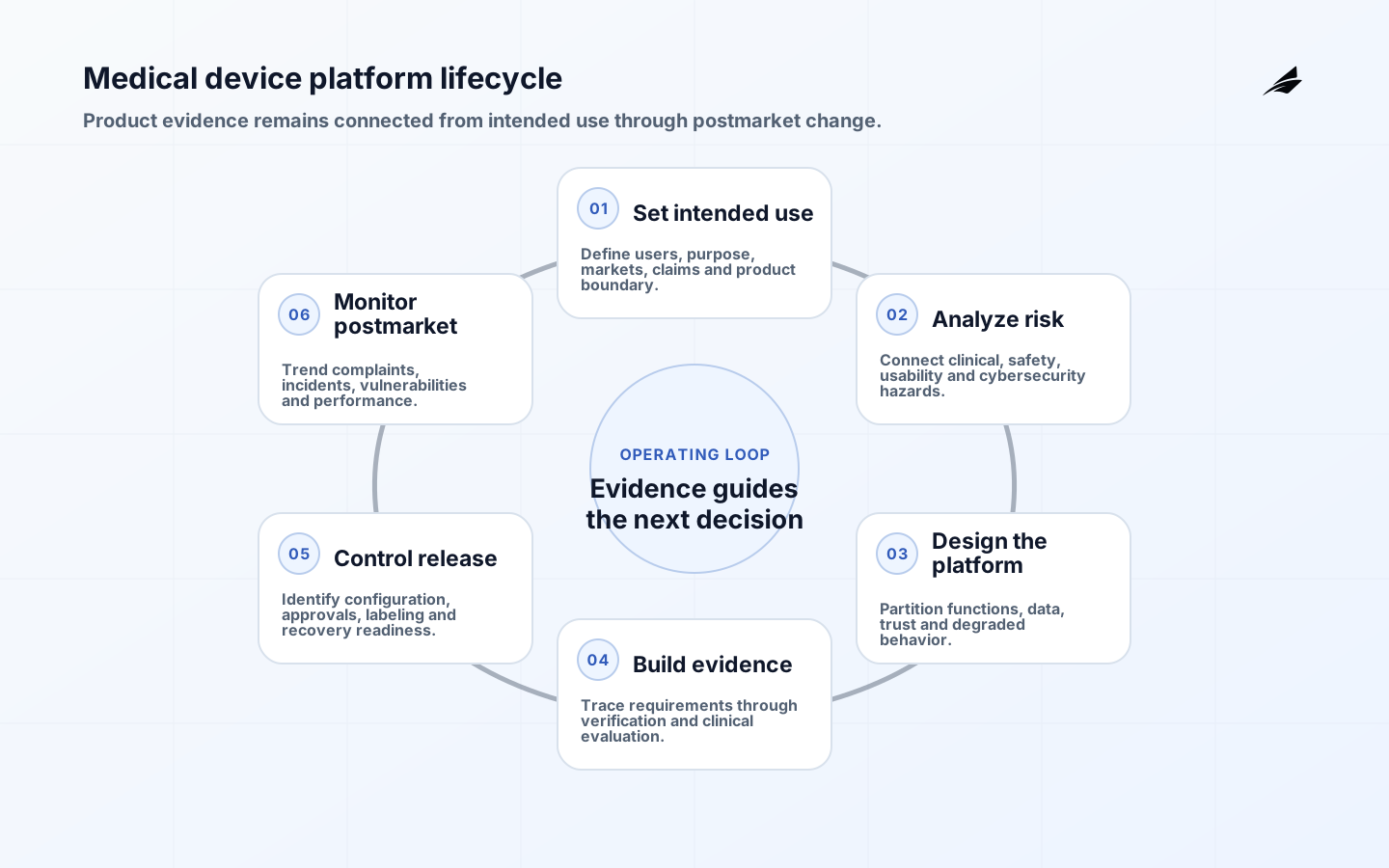
Medical device platforms connect device software, cloud services, clinician or patient applications, data pipelines and operating controls across a product lifecycle. Because platform failures can affect safety, privacy, clinical decisions and market authorization, architecture cannot be separated from intended use, risk management and the quality system. This medical device platforms FAQ helps product leaders distinguish reusable technical infrastructure from regulated product functions and plan evidence as carefully as features.
For a broader delivery view, see the medical device platform guide, the medical device platform implementation checklist and the products and platforms checklist. This article is educational and does not determine classification, submission strategy or legal compliance for a specific product; those decisions require the manufacturer’s qualified regulatory and clinical experts.
What is a medical device platform?
The phrase can describe several things: software embedded in a device family, a cloud backend shared across devices, a remote monitoring service, a data and integration layer, or internal tooling used to design and support regulated products. Not every component is itself a medical device. Classification follows the component’s intended purpose, claims, users, functions and jurisdiction. Establish a boundary diagram that identifies regulated functions, supporting infrastructure, external services, users, data flows and interfaces before selecting a lifecycle or architecture.
The FDA’s Medical Device Software Guidance Navigator organizes current guidance for device software functions, clinical decision support, mobile applications, cybersecurity and other topics. The European Commission maintains MDCG guidance covering medical device software, hardware combinations, cybersecurity, clinical evaluation and postmarket surveillance. Use the guidance applicable to every intended market; one global codebase can still have market-specific regulatory configurations and evidence.
| Platform layer | Typical responsibility | Evidence to plan |
|---|---|---|
| Device or edge software | Sensing, control, local computation, safe state and connectivity | Requirements, architecture, risk controls, unit and system verification |
| Cloud services | Identity, ingestion, processing, storage, alerts and update coordination | Threat model, interface tests, availability, integrity and recovery evidence |
| User applications | Clinical or patient workflow, visualization, notification and configuration | Use-related risk, accessibility, workflow validation and labeling |
| Data and integrations | Terminology, exchange, provenance, audit and external-system interfaces | Schema controls, traceability, reconciliation and interoperability tests |
| Lifecycle platform | Build, release, configuration, complaints, monitoring and records | Validated procedures, access controls, audit trail and retention |
Why must intended use lead platform design?
Intended use defines what the product does, for whom, in what environment and with what clinical significance. A wellness dashboard and software that drives treatment may use similar infrastructure but carry different hazards and evidence. Translate intended use into user needs, system requirements, claims and foreseeable misuse. Link each safety-related requirement to risk controls and verification. Keep experimental analytics or future claims outside the production boundary until their purpose, data and validation are approved.
For Software as a Medical Device, the IMDRF clinical evaluation framework separates valid clinical association, analytical or technical validation, and clinical validation. That is a useful discipline even when software is one component of a larger system. Correct code is not, by itself, evidence that an output has a valid association with the targeted condition or performs appropriately in the intended population and setting.
How does the quality system shape development?
In the United States, the FDA’s Quality Management System Regulation became effective on February 2, 2026. QMSR incorporates ISO 13485:2016 by reference and adds or clarifies FDA requirements. Finished-device manufacturers must establish and follow the applicable quality management system. Platform teams therefore need approved processes for design and development, suppliers, configuration, records, nonconformity, corrective action, complaints and change, with responsibilities aligned to the manufacturer’s system.
Do not confuse a ticketing tool with compliance. The records must demonstrate what was required, what risks were considered, what was built, how it was reviewed and tested, which configuration was released, and how issues were handled. Tool validation and electronic-record controls depend on intended use and risk. Define authoritative records, required approvals, retention, audit trails, electronic signatures where applicable, backup and access. Avoid duplicating the same requirement across disconnected systems with no controlled reconciliation.
What architecture decisions matter most?
Partition safety-critical functions from convenience features and define behavior when networks, cloud services, identity providers, clocks or external interfaces fail. Document trust boundaries and data transformations. Apply least privilege to patients, clinicians, support staff, manufacturers, service accounts and devices. Use unique device identity and credential lifecycle controls appropriate to the threat model. Establish compatibility rules across hardware, firmware, mobile applications, APIs and cloud services so a valid release combination can be identified and supported.
Multi-tenant designs need explicit isolation, authorization and operational evidence. Regional deployment needs documented data location, support and release behavior. For algorithmic functions, preserve data provenance, model or rule version, input constraints, output context and monitoring. A platform abstraction is helpful only when it does not hide clinically significant behavior. Interfaces should be versioned, testable and governed; consumers need notice, migration guidance and a safe response when an incompatible change is unavoidable.
- Maintain a system context diagram showing regulated boundaries, actors, external systems, data classes and trust boundaries.
- Trace intended use and hazards through requirements, controls, implementation, verification, labeling and postmarket monitoring.
- Define safe states and recovery behavior for connectivity loss, stale data, duplicate messages, clock drift and partial deployment.
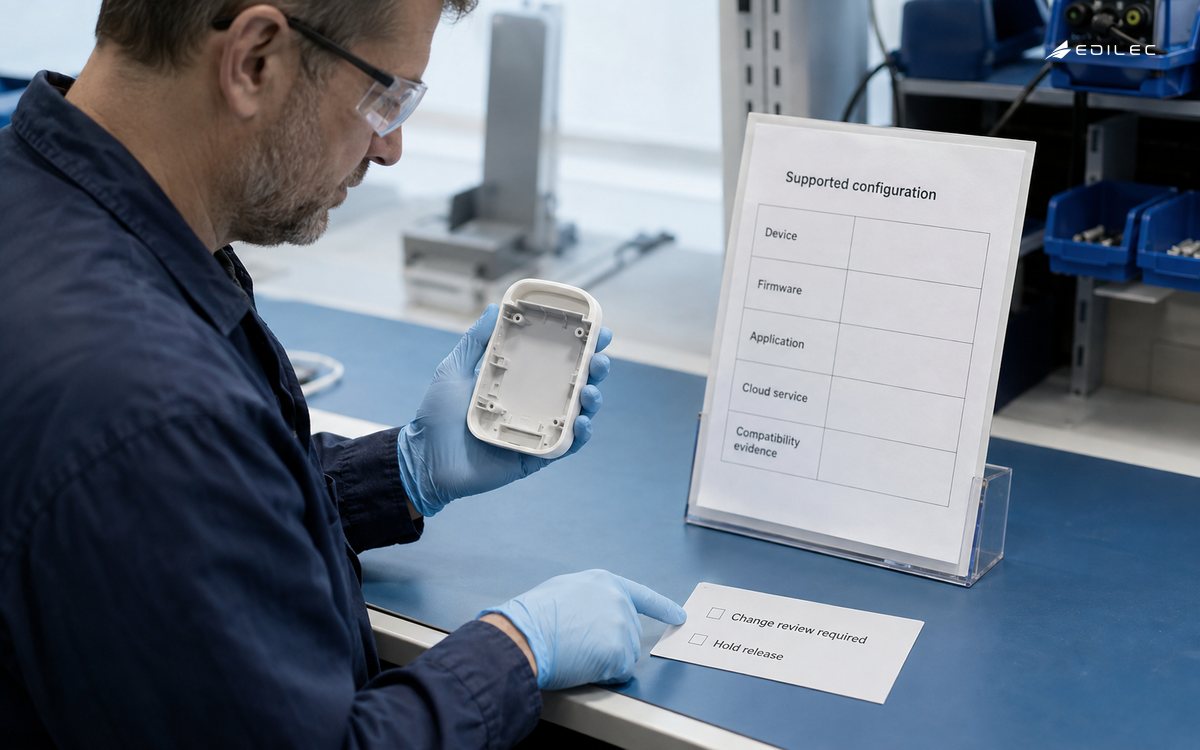
- Control the supported configuration matrix across device, firmware, application, API, model and cloud-service versions.
- Use synthetic or appropriately governed data in lower environments and test that production support access is attributable and revocable.
- Design telemetry to support safety, cybersecurity and service investigation without collecting data that lacks a defined purpose.
How should cybersecurity be integrated?
Treat cybersecurity as a product lifecycle responsibility. The FDA’s February 2026 premarket cybersecurity guidance addresses device design, labeling and recommended submission documentation for devices with cybersecurity risk, including expectations related to cyber devices. Build the threat model from system architecture and intended environment, identify security risks that can affect safety and essential performance, implement controls, and verify them under realistic attack and failure conditions.
Operational readiness includes a software component inventory, vulnerability intake, coordinated disclosure, monitoring, triage, remediation, update delivery and customer communication. Set support periods and update assumptions before launch. Protect signing keys and build infrastructure, verify software authenticity and integrity, and rehearse a security update. Suppliers must provide enough information to assess component risk and respond quickly; a contract that promises generic security without vulnerability and update obligations leaves the manufacturer exposed.
What testing and validation are required?
Verification asks whether specified requirements were implemented correctly; validation asks whether the resulting product meets user needs and intended use. Build a risk-based strategy spanning code, components, interfaces, system behavior, usability, cybersecurity, performance, recovery, installation and upgrade. Automate repeatable checks, but keep expert review and scenario testing where human behavior or clinical context matters. Test representative devices, networks, data distributions, languages, time zones, permissions and external-system failures.
Production-shaped evidence matters for platforms. Test sustained and burst load, delayed or out-of-order data, duplicate delivery, tenant boundary attempts, revoked credentials, expired certificates, failed updates and restoration from backup. Define expected results in advance and preserve objective evidence against the released configuration. Defect closure should show impact assessment, correction and regression scope. A passing test count is not sufficient when critical requirements, environments or negative scenarios are missing.
| Release gate | Required question | Example evidence |
|---|---|---|
| Regulatory boundary | Are intended use, claims, markets and regulated functions approved? | Approved intended-use statement and product boundary |
| Risk and requirements | Are hazards, security threats and controls traceable? | Reviewed risk file and bidirectional trace report |
| Configuration | Is the exact supported combination identifiable and reproducible? | Signed artifacts, bill of materials and configuration record |
| Verification and validation | Do results cover requirements, users and intended environments? | Approved protocols, results, deviations and summaries |
| Operations | Can support, monitoring, recovery and update paths work? | Runbook exercise, restore proof and update rehearsal |
| Release decision | Has an authorized role accepted residual issues and labeling? | Documented release approval and deployment authorization |
What changes after launch?
Launch starts postmarket evidence. Monitor complaints, adverse events, service incidents, cybersecurity reports, performance drift, update success, data-quality anomalies and use outside intended conditions. Define which signals require investigation, escalation, reportability assessment, field action or corrective and preventive action. Reconcile support tickets with formal complaint intake so safety-relevant reports are not stranded in operational tools. Trend by version, device family, customer environment and severity, while accounting for exposure.
Every change needs classification and impact assessment. Consider intended use, safety risk, cybersecurity, clinical evidence, interoperability, labeling, submissions, data migration and supported configurations. Use staged deployment only when cohort selection, monitoring, stopping rules and rollback are controlled. Emergency security remediation may require an accelerated path, but it still needs accountable decisions and records. The FDA’s device regulation overview is a starting point for current U.S. requirements; market-specific experts should assess the actual change.
How should a manufacturer select a platform partner?
Evaluate the partner inside the manufacturer’s supplier controls. Define whether it creates product software, infrastructure, validation evidence, quality-system tooling or operational services. Review competence for the device type, software lifecycle, cloud operations, security, human factors and required markets. Inspect sample requirements, architecture, risk traceability, test evidence and change records rather than relying on certifications alone. Confirm how subcontractors, open-source components, incident notification and vulnerability handling are governed.
The contract should identify deliverables, acceptance, quality responsibilities, records, intellectual property, environments, access, data processing, security, availability, audit support, change control, incident communication, vulnerability remediation, continuity and exit. Pricing depends on risk class, novelty, markets, integrations, hardware, evidence, validation and support life, not just feature count. Preserve manufacturer access to source, build instructions, infrastructure definitions, configuration, risk files, tests and operational evidence so product continuity does not depend on one supplier.
Key takeaways
- Define intended use and the regulated product boundary before choosing a platform architecture.
- Make lifecycle records, risk traceability and release configuration part of normal engineering work.
- Integrate clinical evidence, cybersecurity and usability with software verification rather than treating them as final reviews.
- Design device, cloud and application behavior for degraded conditions, version compatibility and safe recovery.
- Operate postmarket monitoring, change control and supplier oversight for the full supported life of the device.
Frequently asked questions
Can a medical device platform use public cloud services?
Yes, when the architecture, supplier controls, security, privacy, availability, validation and records are appropriate to the intended use and markets. The manufacturer remains responsible for the finished device. Document which controls are inherited, which are configured by the manufacturer, how provider changes are assessed, and how the product behaves when a regional or external service is unavailable.
Does every platform component require the same validation?
No. Apply a documented, risk-based approach based on intended use and potential effect on product quality, safety and records. A component that calculates a clinical output needs different evidence from an internal dashboard, although both may require controls. The component’s role, failure modes, interfaces and detectability should determine the assurance depth.
Can AI features share the same release process?
They can share controlled lifecycle infrastructure, but model data, performance, bias, drift, change protocol and clinical evidence may add requirements. Freeze and identify the released model or algorithm, define intended populations and limitations, and monitor relevant performance. Do not allow a continuously changing model to bypass the approved product configuration and change assessment.
Conclusion
A medical device platform succeeds when reusable engineering and disciplined evidence reinforce each other. Clear intended use sets the boundary; architecture contains hazards and supports change; the quality system preserves decisions; verification and clinical evaluation establish confidence; and postmarket processes keep the released product safe and supportable. Build those capabilities into the platform from the first design review, because reconstructing them after a product is ready to ship is slower, costlier and less credible.