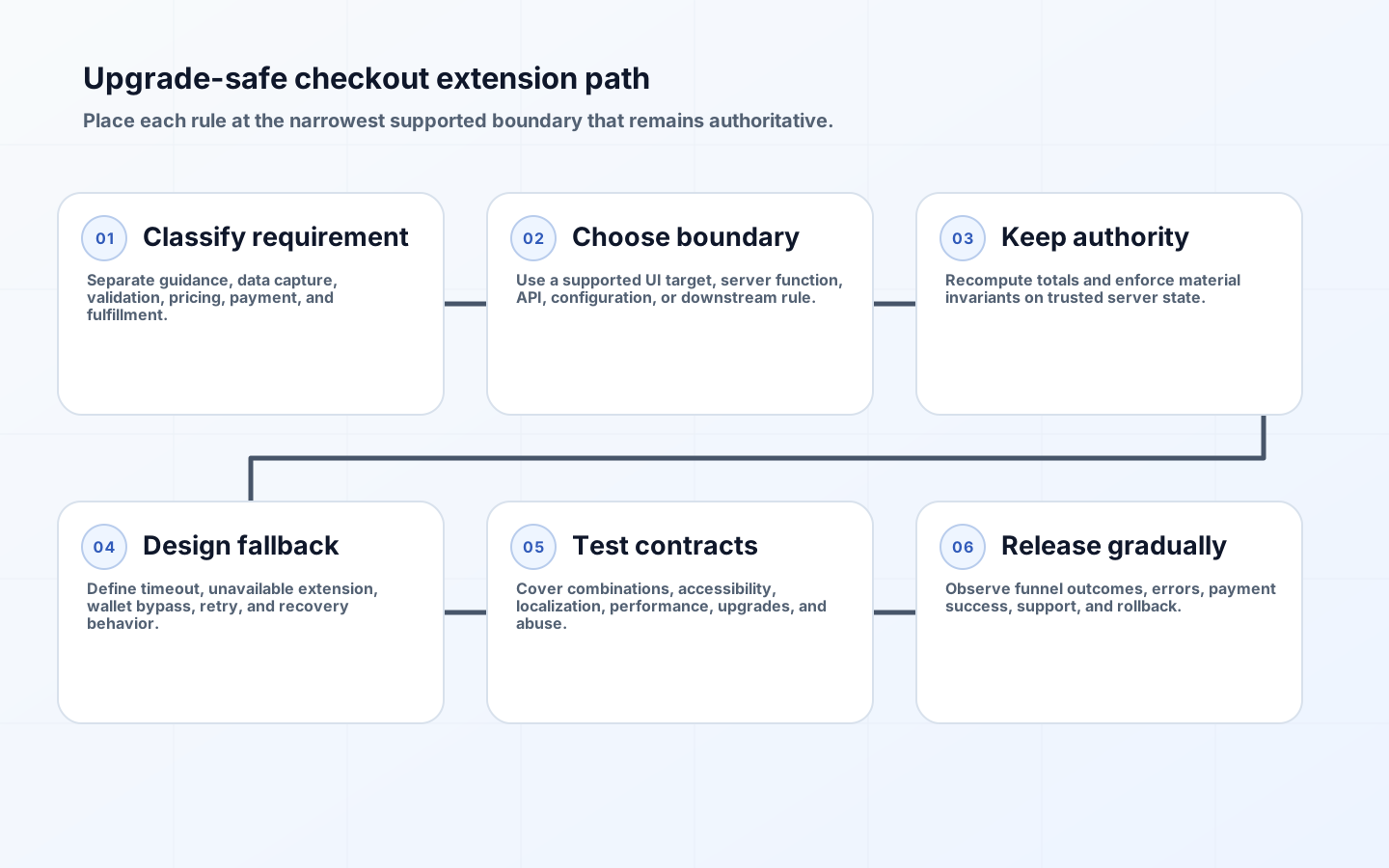
Checkout extensibility is the practice of adding differentiated commerce behavior through supported contracts instead of owning a permanent fork of the transaction surface. The distinction matters because checkout combines prices, discounts, tax, delivery, identity, payment, fraud, accessibility, performance, and order creation. A visual change can affect conversion; a logic change can alter the amount charged or whether an order can be fulfilled. Both must survive platform upgrades and alternative entry paths.
The design task is to classify each requirement, place it at the narrowest authoritative extension point, define degraded behavior, and test the complete purchase contract. On Shopify, for example, current documentation directs apps toward checkout UI extensions and Shopify Functions rather than direct template ownership. W3C Payment Request also demonstrates why browser or wallet payment surfaces cannot be assumed to render every merchant-controlled field. A customization strategy must cover express wallets, mobile clients, subscriptions, edits, and recovery, not just the default web form.
Classify the checkout requirement before choosing an extension
Write the business invariant and consequence first. Is the need informational guidance, optional preference capture, a legally required acknowledgment, address or eligibility validation, product-quantity policy, discount calculation, delivery promise, payment-method routing, fraud review, or downstream fulfillment data? Requirements that merely improve presentation should not become order-blocking server dependencies. Requirements that protect price, legal eligibility, stock, or fulfillment cannot rely only on client-side UI.
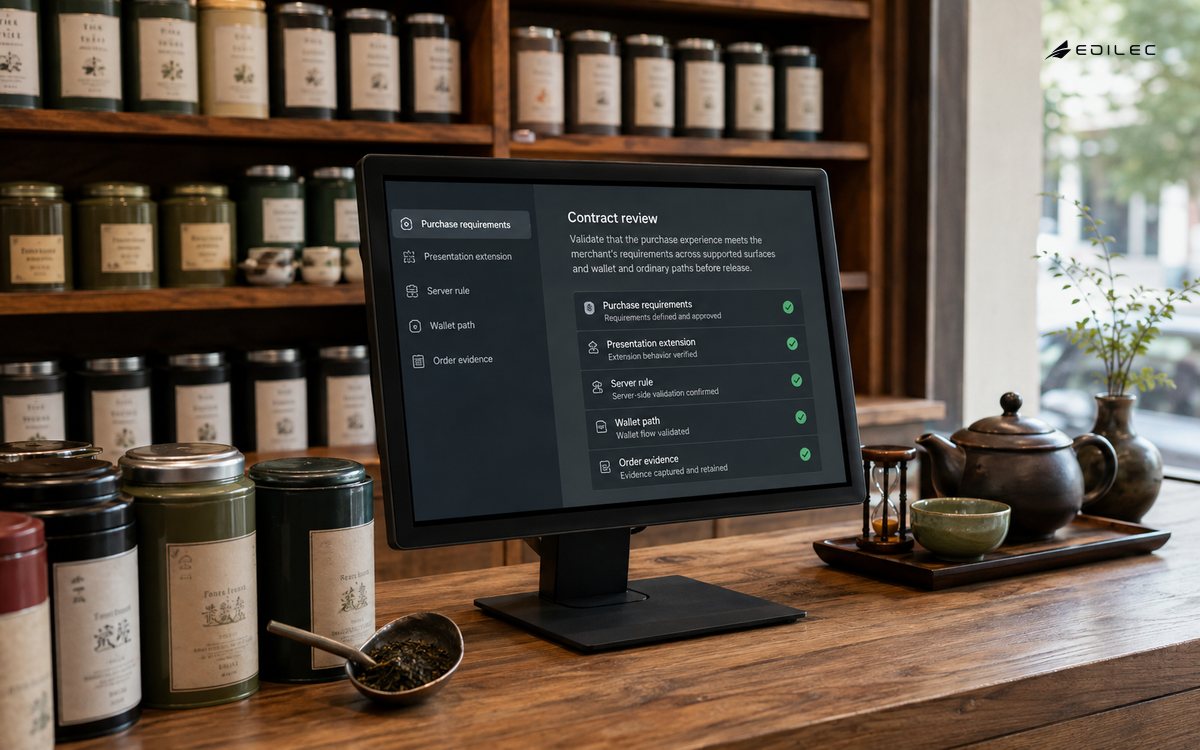
Identify all checkout paths and actors. Include cart-to-checkout, buy-now, accelerated wallets, draft or agent-assisted orders, subscription renewals, B2B buyers, native apps, marketplace or social channels, post-purchase edits, and API-created orders. Decide whether the invariant applies to all orders, a market, a product, a customer class, or one channel. If a path cannot render the desired UI, determine whether server-side enforcement, pre-checkout collection, downstream handling, or exclusion is correct. Do not silently create inconsistent commercial rules.
| Requirement | Preferred boundary | Authority | Failure behavior |
|---|---|---|---|
| Contextual message or optional input | Supported checkout UI extension | Platform state plus validated app data | Hide or defer without blocking payment |
| Cart or buyer eligibility | Server-side validation function or commerce API | Trusted cart, buyer, and market state | Return actionable validation; preserve cart |
| Discount or pricing policy | Platform discount/function contract | Server-calculated money and eligibility | No discount or approved fallback; never trust displayed client total |
| Delivery customization | Supported delivery option/function API | Address, inventory, fulfillment, and carrier policy | Offer safe methods or explain unavailability |
| Payment customization | Platform payment extension/configuration | Server order total, risk, market, and payment capability | Retain an approved payment route |
| Fulfillment-only metadata | Order or downstream workflow extension | Final order record | Queue repair without corrupting payment |
Choose supported UI, function, API, and configuration contracts
Prefer configuration for standard platform behavior, a UI extension for bounded presentation and interaction, a server function for deterministic logic in the platform transaction, an app service for external data or workflow, and a downstream integration for post-order operations. Keep a requirement out of checkout when it does not need to influence purchase completion. Every synchronous dependency adds latency and availability risk at the highest-value funnel step. Document allowed APIs, execution limits, data access, versioning, network behavior, and plan or market constraints.
Supported extension points impose boundaries intentionally. Shopify’s current checkout technology documentation describes defined UI targets and Function APIs. Those constraints reduce arbitrary document access and help the platform evolve its checkout. Treat missing DOM access or unrestricted scripts as a product constraint, not something to bypass. The Shopify documentation published a June 30, 2026 coexistence date for Shopify Scripts alongside checkout extensions; as of July 13, 2026, teams with legacy scripts should verify store-specific status and complete migration rather than design new dependence on the retired path.
Create an extension register with business owner, technical owner, platform surface, API version, deployment artifact, data used, network dependency, timeout, fallback, markets, channels, accessibility evidence, security review, monitoring, and retirement condition. This is especially important for installed apps: app deletion, permission change, expired credentials, or vendor outage can alter checkout. Make the merchant-visible configuration exportable and review changes as releases.
Keep money, eligibility, and order integrity authoritative on the server
The client may display estimates and collect input, but the trusted platform must recompute price, discounts, tax, delivery, inventory eligibility, and final order state. Bind validation to immutable product and offer identifiers, market, buyer context, quantities, and server-side configuration. Revalidate after material changes. W3C Payment Handler guidance explicitly recommends server validation and correlation with authoritative totals and accepted methods; the same principle applies to every checkout surface. Never accept a client-provided discount, total, or eligibility flag as authority.
Design idempotent side effects. Checkout retries, back-button navigation, payment authentication, webhook redelivery, and app timeouts can repeat calls. Use stable operation keys for reservations, gift-card debits, loyalty redemptions, and external approvals. Separate pure calculation from effectful commitment. Record the policy version and inputs that produced a decision so support can explain a rejected checkout or reconcile an order. If external data is unavailable, the fallback must be explicit: fail closed for a material prohibition, or proceed with a bounded review workflow where risk permits.
| Gate | Questions | Evidence | Stop condition |
|---|---|---|---|
| Correctness | Do all paths produce the same commercial invariant? | Scenario and contract tests across carts, markets, and channels | Price, eligibility, or order mismatch |
| Performance | What latency and payload does the extension add? | Percentile timing under representative load and cold starts | Checkout budget or platform limit exceeded |
| Resilience | What happens on timeout, uninstall, stale config, and vendor outage? | Fault injection and fallback test | Cart trapped or unsafe order accepted |
| Accessibility | Can keyboard, screen-reader, zoom, error, and focus flows complete? | Manual and automated accessibility evidence | Critical task or error is inaccessible |
| Security and payment | Are scripts, permissions, data, and totals controlled? | Threat model, platform review, server validation, script inventory | Unauthorized code or untrusted authority |
| Upgrade safety | Does it work on supported API and platform versions? | Preview/sandbox regression and compatibility matrix | Deprecated dependency or unowned change |
Design performance, degradation, and recovery behavior
Set a checkout latency budget and allocate only a small, measured portion to extensions. Cache stable reference data, precompute eligibility where safe, minimize payload, and avoid serial calls. Do not trade correctness for stale monetary or inventory state. Observe extension execution, platform API errors, external latency, timeouts, validation rates, and user completion by channel. Compare cohorts carefully: an extension may appear healthy while a particular market or wallet path fails completely.
Define states for extension available, slow, timed out, misconfigured, unauthorized, uninstalled, and returning invalid data. Preserve the cart and entered data after a recoverable failure. Give users actionable field-level errors for correctable input and avoid generic loops. For internal operators, expose correlation IDs and decision evidence without leaking payment or personal data. A kill switch should disable the extension or revert to an approved policy independently of a full storefront deployment. Test restoration as well as failure.
Protect payment-page scripts, privacy, and accessibility
Minimize code and data on payment surfaces. Inventory and justify browser-executed scripts, authorize their source, control changes, and monitor integrity according to the merchant’s applicable PCI DSS scope and assessment. PCI Security Standards Council guidance emphasizes managing payment-page scripts and detecting tampering; a hosted or extension-based model does not remove every merchant responsibility. Confirm scope with a qualified assessor rather than inferring compliance from architecture alone. Avoid sending personal or payment-adjacent data to analytics unless purpose and authorization are clear.
Use platform components and semantics, provide programmatic labels and errors, preserve focus, support keyboard and screen readers, and test zoom, localization, long text, right-to-left layouts where applicable, and high-contrast settings. Do not encode required information only in color. Payment and express-wallet surfaces may be controlled by the platform or user agent; make consent and totals accurate at the point users act. Accessibility regression belongs in release gates because checkout customization can create a direct barrier to purchase.
Release gradually and rehearse platform upgrades
Use development stores or sandboxes, synthetic orders, contract fixtures, and platform preview versions. Test combinations of discounts, taxes, shipping, currencies, markets, customer states, subscriptions, partial availability, payment authentication, retries, and edits. Include abuse cases and maximum cart sizes. Roll out by store, market, or cohort where supported, with stop criteria for payment success, checkout completion, errors, latency, support contacts, and order reconciliation. Keep configuration and code releases separately reversible.
Track platform changelogs, API versions, deprecation dates, extension reviews, and vendor releases. Assign an upgrade owner and test window before deadlines. Revalidate third-party apps after permission or data-contract changes. Periodically ask whether the customization still differentiates the business or whether the platform now supplies an equivalent standard feature. Removing an extension reduces checkout latency, security surface, testing combinations, and vendor dependence; retirement is a valuable outcome, not a failure of the original implementation.
Key takeaways
- Classify the invariant and every order path before selecting an extension point.
- Use supported configuration, UI, Function, API, and downstream boundaries; keep unrelated work out of checkout.
- Recompute money and material eligibility from trusted server state and make side effects idempotent.
- Design timeout, uninstall, stale configuration, and external outage behavior before launch.
- Treat accessibility, payment-page security, performance, and platform upgrade compatibility as release gates.
FAQ
Can a checkout UI extension enforce a business rule?
It can guide users and participate through supported APIs, but material price, eligibility, inventory, or legal rules should be enforced through an authoritative platform or server contract. Client UI can be absent, stale, bypassed, or unavailable in another checkout path.
Should checkout call an external API synchronously?
Only when the decision truly must occur before order completion and latency, availability, timeout, fallback, privacy, and rate limits are acceptable. Prefer cached reference data, platform functions, pre-checkout work, or post-order review where the business invariant permits.
When is owning a checkout fork justified?
Only when a supported platform cannot satisfy a material requirement and the organization intentionally accepts payment, compliance, accessibility, security, performance, and upgrade ownership. That decision should compare another platform or a hosted payment boundary, not assume a fork is merely a frontend project.
Conclusion
Upgrade-safe checkout customization comes from precise boundaries. Supported UI improves the experience, server functions and APIs protect commercial truth, downstream workflows keep noncritical work out of the funnel, and explicit degradation prevents one extension from trapping revenue. With a complete path inventory, quality gates, and active upgrade ownership, merchants can differentiate checkout without inheriting the platform’s entire transaction surface.