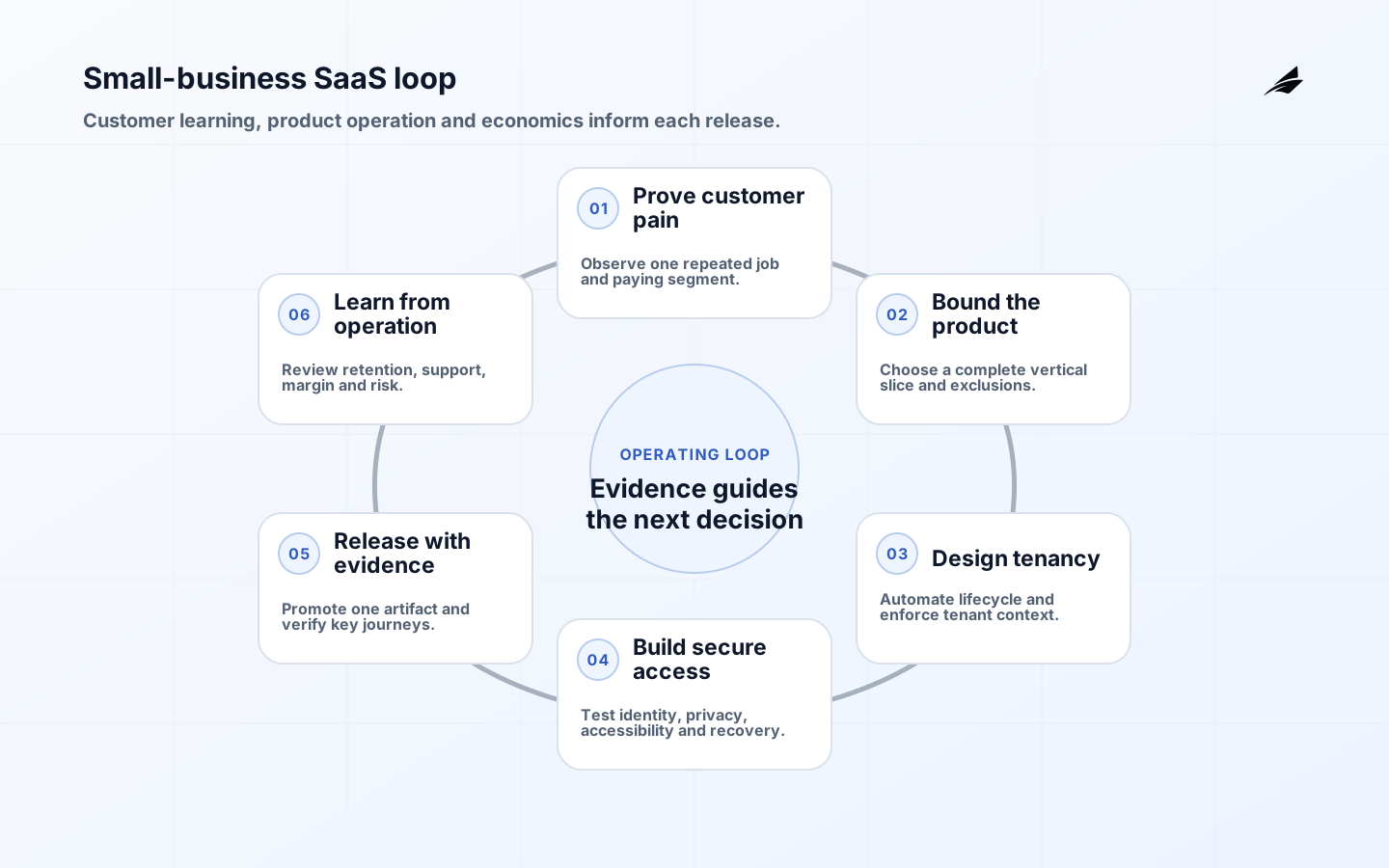
A SaaS product development company for small business should help create a repeatable product business, not an indefinitely customized software project. The implementation must join customer discovery, product scope, multi-tenant architecture, security, billing, support, analytics and commercial ownership. Small teams have less capacity to absorb operational complexity, so the best partner reduces the number of moving parts while leaving clear source, infrastructure, data and decision ownership with the business.
Use this checklist after reviewing Edilec's small-business SaaS company FAQ. The startup implementation checklist is useful for pre-market teams, while the startup partner guide covers selection questions. The stages below identify what should be decided and demonstrated before payment or scope expands.
1. Prove the customer problem and commercial boundary
Name the user, painful job, current workaround, trigger, desired result and person who pays. Interview and observe representative customers rather than validating a feature list. Quantify frequency, delay, error, labor or revenue impact. Identify alternatives, including spreadsheets and existing products. A viable first product solves one coherent workflow for a narrow segment and gives the team a way to learn whether usage and willingness to pay persist.
- Define the first segment and explicit non-target customers.
- Map activation, repeated value, upgrade, cancellation and data-export journeys.
- Set pricing hypothesis, usage limits and support promise.
- Choose one primary adoption and one retention measure.
- Record assumptions that could stop or reshape the build.
Translate the outcome into acceptance examples, not an exhaustive backlog. Prioritize the smallest vertical slice that includes identity, core data, the value-producing workflow, audit needs, basic administration, support and measurement. Avoid building enterprise options for hypothetical buyers. Keep a decision log for scope, architecture and commercial policy so later teams can distinguish deliberate constraints from omissions.
| Gate | Question | Evidence | Do not proceed when |
|---|---|---|---|
| Problem | Does a defined user have recurring pain? | Observed workflow and interviews | Need is vague or infrequent |
| Value | Can the release complete the core job? | Prototype task result | Only isolated features work |
| Commercial | Who pays and on what basis? | Pricing and unit hypothesis | No budget owner exists |
| Operational | Can a small team support it? | Support and ownership map | Every issue needs the vendor |
| Exit | Can the business retrieve and move assets? | Source, data and infrastructure transfer | Ownership is ambiguous |
2. Contract for product ownership and transparent delivery
The statement of work should identify outcomes, milestones, assumptions, roles, acceptance, change control, security, data handling, subcontractors, intellectual property, third-party licenses, warranty, support and termination assistance. Specify ownership and access for repositories, cloud accounts, domains, analytics, app stores, signing keys and vendor portals. Require routine delivery of source and infrastructure definitions into buyer-controlled systems, not a handover package assembled only at termination.
Pay against demonstrable increments and accepted evidence. A milestone can include a deployed workflow, automated tests, threat-model update, accessibility result, operating dashboard and current cost report. Define decision turnaround and what happens when buyer input is late. Keep a small contingency for validated learning rather than treating every discovery as chargeable surprise. Ensure support terms identify severity, response, restoration, communication and root-cause expectations.
3. Choose a simple, explicit tenancy model
Decide what a tenant represents, how users join it, how roles work, and where tenant context is enforced. Pooling usually improves small-business economics, but every query, cache, object, job, search index, export and log path must preserve isolation. AWS's SaaS design principles emphasize tenant isolation, unified onboarding and tenant-aware operations. Treat those as architecture concerns even on another platform.

Prefer a modular monolith and managed services when they meet scale and risk needs; microservices add deployment, data and observability burdens a small team may not need. Use stable APIs at external and meaningful module boundaries. Keep production and nonproduction identities and data separate. Automate tenant provisioning, suspension, plan changes and deletion. Test cross-tenant access with intentionally similar identifiers and background jobs, not only browser requests.
4. Build security, privacy and accessibility into acceptance
Adopt federated identity where appropriate, multi-factor protection for privileged roles, least privilege, secure sessions, encrypted transport, managed secrets, protected backups, dependency updates, audit events and tested account recovery. Use the OWASP ASVS to turn web-security expectations into verifiable requirements. Threat-model tenant escape, broken authorization, account takeover, malicious files, injection, support impersonation, billing abuse and data export.
Follow NIST's Secure Software Development Framework across organization preparation, artifact protection, secure production and vulnerability response. Maintain dependency and component records, scan without treating scanners as assurance, and define a vulnerability intake route. Map personal data purpose, access, retention, deletion and subprocessors. Make privacy choices visible in product behavior rather than relying only on policy text.
Set an accessibility target and test it throughout design and development. W3C WCAG 2.2 provides testable success criteria for web content, but automated tools cover only part of conformance. Review keyboard flow, focus, names and roles, contrast, error recovery, zoom, responsive layouts and representative assistive technology. Accessibility improves reach and usability and is cheaper to build into components than retrofit across finished screens.
| Control area | Minimum implementation | Acceptance exercise | Owner |
|---|---|---|---|
| Tenant isolation | Server-side tenant scope | Cross-tenant access attempts | Engineering |
| Identity | Strong admin authentication and recovery | Revoke and recover account | Security |
| Data | Purpose, retention, export and deletion | Complete tenant export and erase | Product and privacy |
| Accessibility | WCAG-aligned components and content | Keyboard and assistive-tech journey | Design and QA |
| Recovery | Protected backup and runbook | Restore and business reconciliation | Operations |
5. Establish a production delivery system
Use code review, automated checks, immutable builds, dependency and secret scanning, infrastructure as code, separate environments and controlled production access. Build once and promote the same artifact. Keep schema changes backward compatible through rollout and test rollback or forward repair. Use feature flags with owners and expiry. Seed nonproduction with synthetic data. A small pipeline should be understandable enough that the buyer's team can run and diagnose it.
Automate unit, component, contract and critical journey tests. Include billing state, role changes, tenant isolation, import and export, deletion and restoration. Run performance tests with uneven tenant sizes and define resource limits. Acceptance is not complete when a page loads; prove that an authorized customer can start, reach value, pay, obtain support, export data and leave without manual database editing.
6. Operate reliability, support and product economics
Define service-level indicators from customer journeys: sign-in success, core workflow completion, background-job freshness, billing correctness and export readiness. OpenTelemetry's observability primer distinguishes telemetry from the ability to answer system questions. Correlate metrics, logs and traces with safe tenant context. Alert on user symptoms and actionable capacity, route by owner and test that alerts reach someone able to respond.
Prepare incident, backup, restoration, customer communication and vulnerability runbooks. Exercise lost credentials, failed deployment, unavailable dependency, accidental deletion and tenant-impacting defect. Restore into an isolated environment and reconcile business records. Track support volume and recurring causes; productize repeated manual fixes. Keep status and support communication accurate to the affected cohort rather than declaring the entire service healthy or down.
Measure activation, time to first value, retained usage, conversion, churn, support load, gross margin and cost per active tenant or successful core transaction. Allocate shared infrastructure and vendor costs honestly. Review price and plan limits against actual resource and support demand. A low cloud bill can hide unprofitable manual service, while a higher managed-service bill may reduce labor and risk. The finance SaaS scope guide shows how requirements change in a higher-control domain.
Verify handover and ongoing vendor governance
Require a current architecture, data model, decision log, threat model, component inventory, environment inventory, test map, dashboards, runbooks, supplier list, cost model and open-risk register. Buyer-controlled administrators should deploy a release, rotate a secret, add a tenant, revoke a user, restore data and resolve a simulated incident while the vendor observes. Record gaps as acceptance work, not informal training notes.
After launch, review outcomes and risks monthly at first. Separate product roadmap, reliability debt, security work and support defects so urgent customer requests do not erase foundational maintenance. Reassess the partner using delivery predictability, escaped defects, evidence quality, staff continuity, transfer readiness and contribution to retained customer value. The goal is a healthy product and capable owner, not permanent dependency.
Plan customer data migration and exit before launch
Define import templates, validation, duplicate handling, reconciliation, cutover and rollback for the first customer segment. Preserve source identifiers and produce an exception report users can act on. For exit, provide a documented export in a durable format with attachments, relationships, audit history and clear field definitions. Test export and tenant deletion with a seeded account before general availability. These paths reduce onboarding friction, support trust and prevent the product from depending on manual vendor database work.
Small-business SaaS implementation FAQ
How long should an MVP take?
Duration depends on workflow, integrations and controls. Ask for a short discovery followed by a narrow, usable vertical slice with weekly evidence. A date is credible only when scope, decisions, dependencies and acceptance are explicit.
Should the vendor own the cloud account?
The buyer should generally control production accounts, billing, domains and root administration, granting the vendor least-privilege access. This improves continuity, visibility and exit readiness while preserving accountable change control.
Is fixed-price development safer?
It can control a well-understood increment, but early product work contains learning. Use fixed boundaries and acceptance for short stages, transparent rates and change rules, and stop or reshape work when evidence invalidates the premise.
Key takeaways
- Prove one repeated customer outcome before broad feature development.
- Keep source, accounts, data and operational assets under buyer control.
- Choose simple architecture with explicit tenant isolation and lifecycle automation.
- Make security, privacy, accessibility and recovery part of acceptance.
- Operate customer value and unit economics alongside technical reliability.
Conclusion: build a product the business can own
A SaaS product development company for small business should turn a validated customer problem into a secure, operable and economically understandable product. Contract for evidence and ownership, constrain complexity, prove complete customer journeys and rehearse transfer. The strongest engagement leaves the small business able to operate, learn and choose its next partner from a position of control.