SaaS integration services connect cloud applications to identity, data, workflows and controls that an enterprise already depends on. The visible task may look like moving a customer record or triggering an approval, but production integration also needs contract ownership, authorization, error handling, observability, reconciliation and a supported change process.
The answers below are designed for product, technology, security and operations leaders evaluating an integration program. They distinguish decisions that must be made by the enterprise from implementation work a delivery team can perform, and they avoid treating a connector catalog as proof that a workflow is ready for production.
What should SaaS integration services include?
A complete service should cover discovery, target architecture, API and event contracts, identity, data mapping, security review, testing, deployment, monitoring, support and change management. It may deliver direct point-to-point connections, an integration platform configuration, custom middleware or a combination. The correct shape depends on transaction criticality, reuse, latency, vendor limits and ownership.
The scope should name business processes, systems of record, consumers, data classifications, environments and service expectations. It should also identify exception work. If an invoice fails to post or a user is not deprovisioned, someone needs a queue, enough evidence to diagnose the case and authority to resolve it.
| Service area | Question the statement of work should answer | Expected evidence |
|---|---|---|
| Discovery | Which journeys, records and dependencies are in scope? | Workflow map and system inventory |
| Contracts | How are requests, events, schemas and errors defined? | Versioned API or event specifications |
| Security | How are identities, tokens, secrets and privileges controlled? | Threat model and access matrix |
| Reliability | How are retries, duplicates, limits and outages handled? | Failure policy and test results |
| Operations | Who monitors, supports and approves changes? | Runbook, dashboards and responsibility map |
Should we use point-to-point integration or an integration platform?
Point-to-point can be appropriate for a small number of bounded, low-change connections with clear ownership. A platform can add shared routing, transformation, policy, monitoring and connector management when many teams or systems participate. It also adds product dependency, platform skills and governance. Count logical contracts and operational responsibilities, not just visible connection lines.
Avoid centralizing every business rule in the integration layer. Keep authoritative domain decisions near the system that owns them, and use the integration layer for mediation, orchestration and cross-system policy where ownership is explicit. A platform should make contracts easier to govern, not become an undocumented second system of record.
How should APIs and events be specified?
Use a machine-readable contract and examples that cover success and failure. OpenAPI 3.2 provides a language-neutral description for HTTP APIs. For events, define the envelope, event type, producer, schema, ordering assumptions and delivery semantics; CloudEvents offers a common envelope. Version contracts in source control and test providers and consumers against compatible expectations.
Define errors as part of the contract. RFC 9457 supplies a standard problem-details structure for HTTP APIs, but teams still need stable problem types, safe detail, retry guidance and correlation identifiers. Never make consumers parse prose to decide whether to retry, correct data or escalate.
How should authentication and authorization work?
Separate user authentication, workload authentication and business authorization. OpenID Connect can provide interoperable user identity, while OAuth protects delegated API access. RFC 9700 updates OAuth security practice, including redirect protection, PKCE guidance and token replay defenses. Scope tokens to the resource and operation required; do not treat possession of a network location as trust.
For service accounts and machine clients, define credential issuance, rotation, revocation and ownership. Store secrets in managed facilities rather than deployment files. Log authorization decisions without recording credentials or unnecessary personal data. NIST's zero trust architecture is useful as a design lens: access is a resource decision based on identity and policy, not a permanent property of being inside a network.
When should we use SCIM?
Use SCIM when supported systems need standardized cross-domain provisioning of users and groups. RFC 7644 defines create, retrieve, replace, patch and delete operations, plus query and bulk behaviors. SCIM can reduce custom provisioning logic, but the enterprise must still define source authority, attribute mapping, group meaning, deactivation timing and reconciliation.
Test joiner, mover and leaver scenarios, including a partial outage. Deactivation is often more important than creation: a successful identity-provider update is insufficient if the downstream account remains active. Reconcile desired state against actual state and route unresolved differences to an owner.
Who owns data mapping and quality?
Business data owners decide meaning and acceptable quality; engineers implement and validate transformations. Name a source of truth for each field, including identifiers, status values, time zones and deletion state. Mapping workshops should use representative records and exceptions, not only empty schemas.
Do not silently repair ambiguous data in transit. Quarantine records that cannot be mapped safely, preserve the original payload under appropriate controls and expose a correction path. For bidirectional synchronization, define conflict rules explicitly. Timestamps alone rarely determine business authority.
How do integrations handle retries and duplicates?
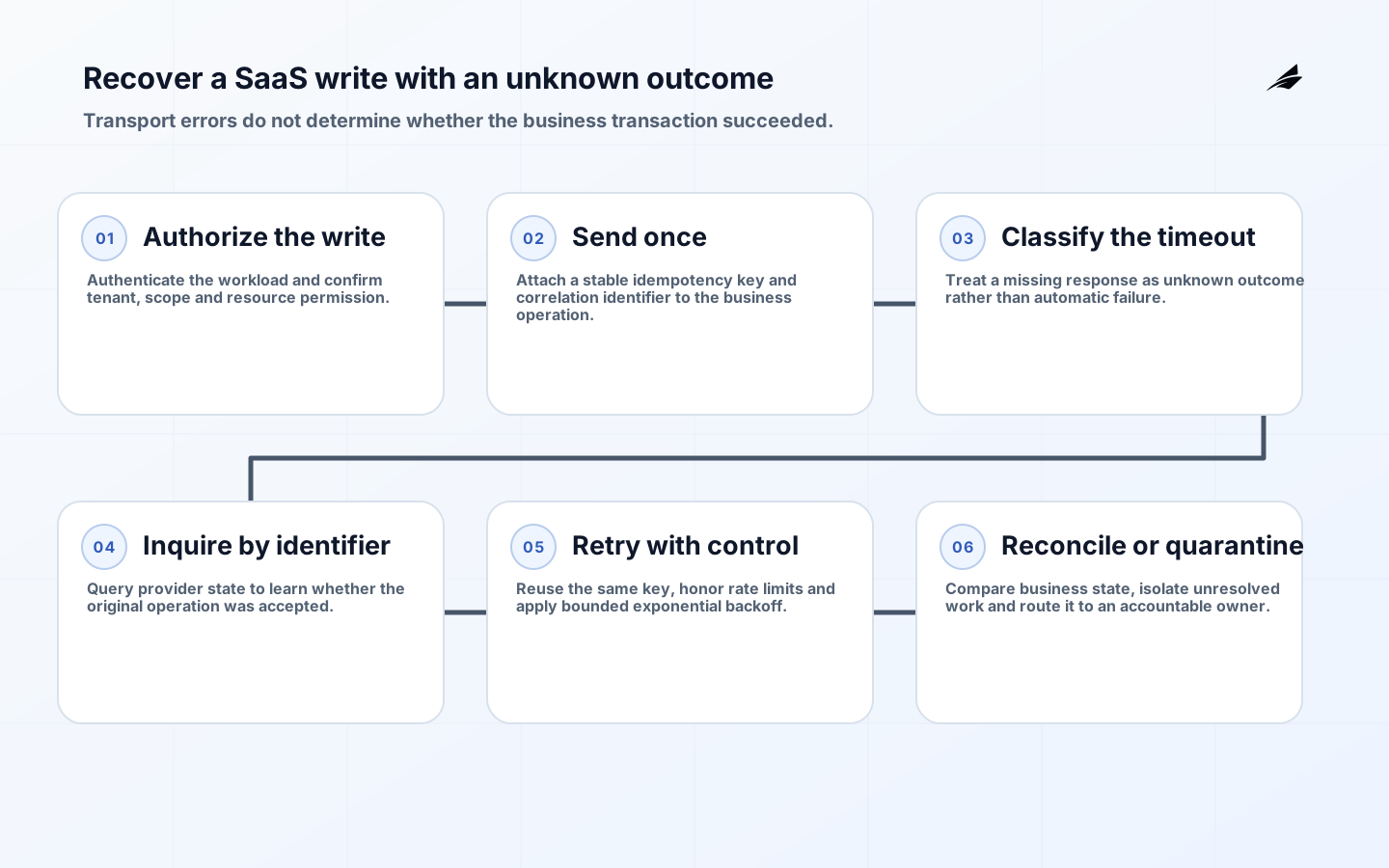
Classify operations by whether they are safe to repeat. Use idempotency keys or stable operation identifiers for retried writes, exponential backoff with limits, and a dead-letter or exception path for exhausted attempts. Honor provider rate limits and retry hints. A timeout is an unknown outcome, not proof that nothing happened; query status before repeating a consequential operation.

Choose consistency by workflow. A queued update may be acceptable for analytics enrichment, while an approval gate may need synchronous confirmation. Document maximum acceptable delay and the user experience during degradation. Reconciliation closes the gap between message delivery and business correctness.
| Failure | Required behavior | Operational proof |
|---|---|---|
| Timeout after write | Check outcome before retrying | Stable operation ID and status query |
| Rate limit | Back off, queue and protect priority traffic | Queue depth and retry schedule |
| Invalid data | Quarantine with actionable reason | Exception record and owner |
| Duplicate event | Detect and suppress repeated effect | Deduplication key and audit entry |
| Provider outage | Degrade or pause by business policy | Alert, backlog and recovery runbook |
What drives cost and timeline?
Cost follows uncertainty, contract quality, system count, security requirements, data complexity, test environments, transaction criticality and operational coverage. Prebuilt connectors can reduce protocol work but do not remove mapping, permissions, error handling or support. Vendor API limits and sandbox fidelity can dominate a schedule.
Estimate discovery, implementation, platform charges, testing, migration, training and recurring support separately. Use a proof connection to narrow assumptions before committing a broad program. A credible estimate states excluded systems, transaction volumes, environment access, client responsibilities and the handling of vendor changes.
What testing is necessary before production?
Test contract conformance, transformations, permissions, performance, rate limits, retries, duplicate delivery, timeouts, provider errors, recovery and reconciliation. Use production-like but appropriately protected data. Include negative authorization tests and verify that logs do not expose tokens or sensitive payloads.
Run an end-to-end business scenario with system owners present. Technical success does not prove that records landed in the correct state or that an operator can resolve an exception. Capture test evidence by contract version and deployed configuration.
How should enterprise integrations be rolled out?
Start with one bounded workflow and a small consumer or record cohort. Run in observe-only mode where possible, compare results, then enable writes with feature controls. Define go, hold and rollback criteria. Keep the previous path until reconciliation shows the new path is complete and support staff can operate it.
- Confirm production credentials and least-privilege scopes.
- Load-test within vendor policies and expected bursts.
- Exercise provider outage, timeout and token-revocation scenarios.
- Verify dashboards, alerts, escalation and exception queues.
- Reconcile old and new paths before retiring either one.
Who should own an integration after launch?
Assign a business owner for outcome and rules, a technical owner for the service, system owners for contracts and an operations owner for incidents. The delivery team may build the connection, but the enterprise must retain authority over access, risk acceptance and business semantics. Put vendor-notice review and credential rotation on an operating calendar.
How should provider changes be governed?
Subscribe to official release, deprecation and security notices for every provider and assign a named reviewer. Maintain an inventory linking provider operations and event types to enterprise consumers. When a notice arrives, assess contract compatibility, security impact, test-environment availability and migration deadline. Record the decision even when no implementation change is required.
Automated contract and consumer tests should run on a schedule as well as during enterprise releases because a SaaS provider can change independently. Test fixtures must include representative errors and permissions, not only successful responses. For events, monitor unknown event types and schema versions rather than discarding them silently. For APIs, capture deprecation headers or provider metadata where available and expose approaching deadlines on the service dashboard.
Commercial and operational owners should also review edition changes, quotas and support terms. A technically compatible API may become unavailable under a changed entitlement or impractical under a new limit. Keep a tested export and exit path for business-critical data, including pending exceptions and configuration. The objective is controlled adaptation, not the unrealistic promise that external dependencies will never change.
Review the dependency register at least at every material provider or enterprise release. Close obsolete connections by revoking credentials, clearing queues under policy and removing alerts and recurring platform cost. Decommissioning is part of integration governance because abandoned credentials and unnoticed data flows retain risk after their business purpose ends.
Key takeaways
- Scope SaaS integration around business journeys and exception handling.
- Treat API, event, identity and error contracts as versioned products.
- Design authorization, retry safety and reconciliation before enabling writes.
- Estimate mapping, assurance and operation in addition to connector work.
- Roll out progressively with explicit ownership, evidence and rollback criteria.
Frequently asked questions
Does every SaaS integration need to be real time?
No. Select latency from the business decision. Batch or queued delivery can be cheaper and more resilient when delay is acceptable; synchronous calls are appropriate when the next action genuinely requires an immediate answer.
What happens when a SaaS product is replaced?
Keep canonical business contracts independent where practical, preserve source identifiers and require export and deletion procedures. An exit rehearsal should prove that configuration, history and pending work can be reconciled.
How is integration success measured?
Track business completion, latency against expectations, failed and aged exceptions, reconciliation differences, unauthorized attempts, support burden and change failure. Message counts alone do not show whether the workflow is correct.
Conclusion
Enterprise SaaS integration is an operating capability, not a connector purchase. Clear authority, explicit contracts, security, failure semantics and progressive rollout turn application links into dependable workflows. The best evaluation asks how the integration behaves when data is imperfect, a provider changes or an outcome is uncertain.