SaaS integration services turn separate applications into a governed business workflow. The work can include API and event connections, identity federation, user provisioning, data synchronization, orchestration, migration and operational monitoring. Its value comes from a reliable outcome across systems, not from the number of connectors installed.
A sound plan defines who owns each decision, what state each system owns, how access is constrained and what happens when the provider is slow, unavailable or changes its contract. This guide helps enterprise teams compare scope and estimate effort without relying on generic per-connector prices.
Define scope around a business transaction
Choose a transaction with a clear start and finish, such as creating an approved supplier in a procurement platform and making it available to finance. Map actors, approvals, records, systems, timing and exceptions. Include read paths, writes, files, events, reports and manual repair. The first scope should be small enough to observe but consequential enough to expose production behavior.
Name authority at field and decision level. The identity platform may own a person's active status, the HR system their employment relationship and the SaaS product their application-specific preferences. A bidirectional label without conflict rules is not a design. For each direction, specify trigger, permitted fields, latency, validation and conflict outcome.
| Scope dimension | Decision to record | Example evidence |
|---|---|---|
| Workflow | Trigger, completion and exception states | Scenario map using representative records |
| Systems | Producer, consumer and system of record | Context and ownership diagram |
| Contracts | Operations, events, schemas and errors | Versioned OpenAPI or event definition |
| Service | Latency, volume, availability and recovery needs | Service objectives and failure policy |
| Governance | Access, retention, support and change authority | Role matrix and decision log |
Choose architecture from change and operating needs
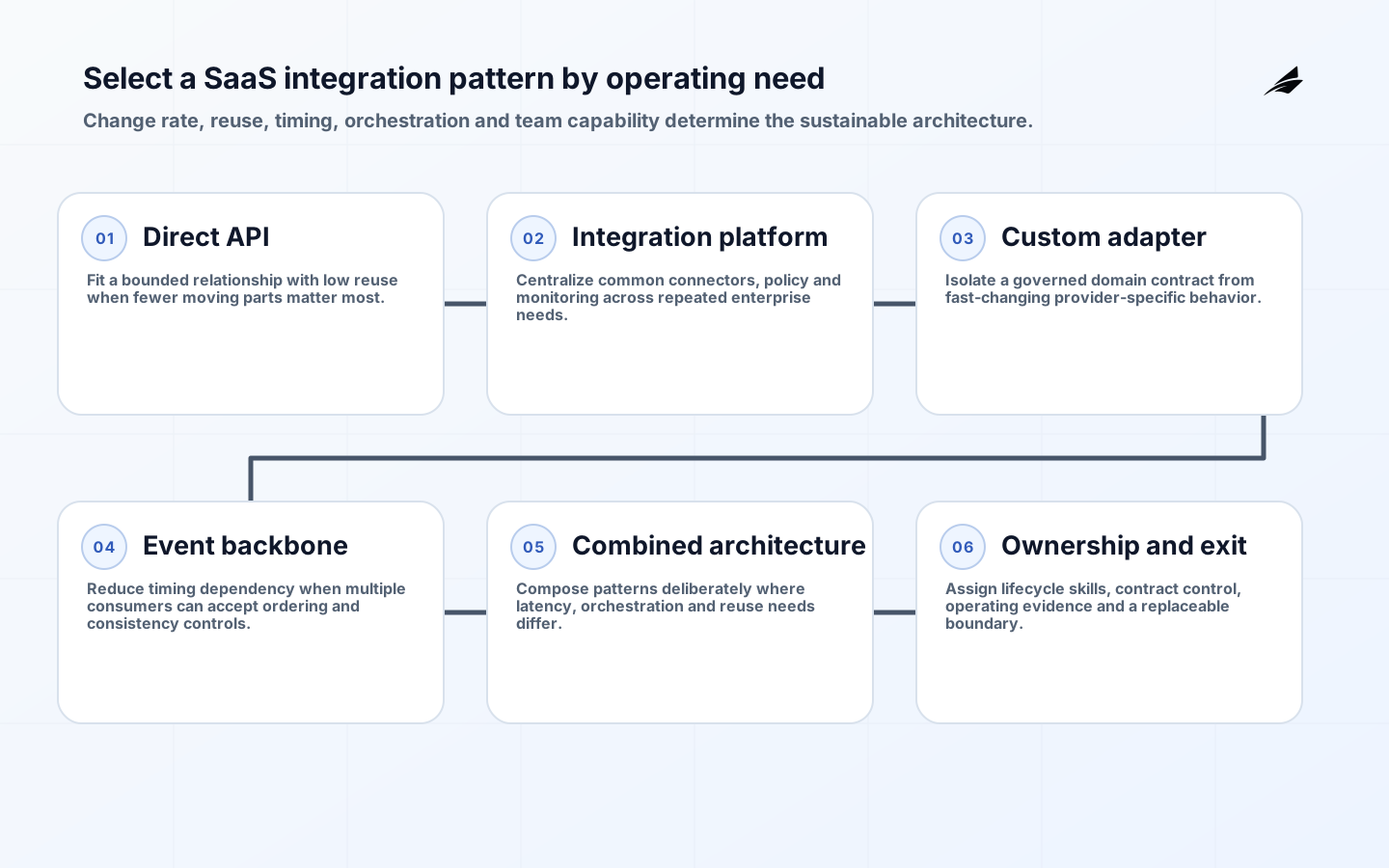
Direct integration reduces moving parts for a bounded relationship. An integration platform can centralize connectors, transformations, policy and monitoring. Custom middleware can isolate domain contracts from vendor-specific behavior. Event-driven designs can reduce temporal coupling but introduce ordering, duplication and eventual consistency. A mixed architecture is common; consistency of governance matters more than forcing one pattern.
Create a canonical model only for concepts the enterprise can govern. An oversized enterprise model becomes a translation project of its own. Preserve source-specific fields when meaning differs. Keep domain rules with the owning domain, and use the integration layer for routing, mediation and orchestration whose ownership is explicit.
Make contracts executable
Use OpenAPI for HTTP interfaces and define events with a stable envelope and schema. Contracts should include examples, pagination, rate behavior, idempotency, errors and deprecation. RFC 9457 can standardize the structure of HTTP problem details. Consumer and provider tests should run in delivery pipelines so incompatible changes are detected before release.
Version business mappings alongside code. Record whether a field is copied, derived, normalized or rejected. Build a quarantine path for unsafe records. Contract governance does not mean freezing change; it gives producers and consumers a visible compatibility and migration process.
Design identity, security and tenant boundaries
Separate authentication from authorization. OpenID Connect can provide user authentication, OAuth can protect delegated API access and SCIM can standardize provisioning. Apply RFC 9700's current OAuth security recommendations. Use least-privilege scopes, short-lived credentials where feasible, managed secret storage and explicit resource authorization.
Bind configuration to the intended tenant and environment. Cross-tenant mistakes can be more damaging than ordinary mapping errors because the payload may be valid in the wrong destination. Validate tenant identifiers at startup and request time, restrict production credentials, and test forbidden tenant combinations. Log actor, operation and correlation evidence without retaining tokens.
Build a complete SaaS integration cost model
There is no universal integration price. Effort varies with API maturity, mapping complexity, workflow criticality, provider limits, environment access, security review and support coverage. A connector can reduce protocol code while leaving most business and operating work unchanged.
| Cost area | Main drivers | How to narrow uncertainty |
|---|---|---|
| Discovery | Workflow ambiguity, system count, undocumented exceptions | Trace representative transactions and inventory contracts |
| Implementation | Operations, transformations, orchestration, UI for exceptions | Build one vertical slice with real schemas |
| Security and assurance | Data sensitivity, tenant model, identity pattern, review depth | Threat model and least-privilege proof |
| Testing and migration | Sandbox fidelity, volumes, historical data, parallel run | Rehearse with bounded production-like data |
| Recurring operation | Platform fees, logs, support, provider changes, reviews | Model run volumes and ownership calendar |
Separate fixed setup, volume-sensitive platform consumption and recurring engineering ownership. Include non-production tenants, network services, observability retention, support coverage, security reviews and exit. Estimate a range with assumptions, then narrow it after technical discovery. A schedule should identify external lead times for provider access and security approval.
Plan controls for the main risks
| Risk | Consequence | Control |
|---|---|---|
| Ambiguous ownership | Conflicting values overwrite valid state | Field-level authority and directional rules |
| Unknown write outcome | Retry creates duplicate business effect | Idempotency and status inquiry |
| Provider change | Consumer breaks without coordinated release | Contract monitoring and compatibility tests |
| Token or tenant misuse | Unauthorized cross-system action | Constrained access and tenant binding |
| Hidden exception backlog | Business process silently stalls | Owned queue, age metric and escalation |
| Lock-in without exit | Replacement loses history or configuration | Export, reconciliation and deletion rehearsal |
Maintain risks with triggers, owners and treatment dates. Do not mark a risk closed because a library exists; verify configured behavior. A retry library does not know whether the business operation is repeatable, and an OAuth library does not define application authorization.
Deliver in six controlled phases
Phase one frames the workflow, owners and service expectations. Phase two proves provider capabilities, access and sample data. Phase three defines contracts, mappings, threat model and failure policy. Phase four builds one vertical slice with observability and exception handling. Phase five pilots through shadow, read and bounded-write modes. Phase six expands cohorts and retires the old path after reconciliation.
- Frame: approve outcome, boundary, owners and acceptance measures.
- Prove: validate API entitlement, limits, tenant access and representative records.
- Design: version contracts, mappings, security and recovery decisions.
- Build: implement the happy path and operator-visible exception path together.
- Pilot: compare results, constrain writes and rehearse rollback.
- Expand: monitor cohorts, reconcile state and remove obsolete access and cost.
Use evidence gates. Before write pilot, require negative authorization tests, duplicate-safety evidence, dashboards and a staffed runbook. Before retirement, require empty or transferred backlog, reconciled records, retained audit evidence, disabled credentials and confirmed downstream consumers. A deployment complete signal is not a business completion signal.
Test failure and rollout as first-class behavior
Test malformed data, stale versions, throttling, token expiry, provider outage, timeout after write, duplicate and reordered events, partial batches and recovery. Confirm that support can find and resolve a failed transaction. Load tests should respect provider terms and model bursts, not only averages.
Roll back by business state, not just software version. Stopping a deployment may leave queued operations and provider-side writes. The rollback plan must say how to drain, cancel or reconcile them and how users learn which path is active. Progressive exposure limits both technical and operational uncertainty.
Establish the operating model before launch
Assign business, service, security and provider-relationship owners. Put credential rotation, access review, provider release notices, restore testing and contract reviews on a calendar. Define incident command and escalation across vendor boundaries. Preserve runbooks and mappings with the implementation so changes are reviewed together.
Measure completed business outcomes, latency against service expectation, error distribution, exception age, reconciliation differences, unauthorized attempts, provider-limit utilization and change failure. Review manual bypasses: they often reveal missing product behavior or a support path that is too slow.
Review commercial dependencies and exit terms
Integration architecture is affected by SaaS entitlements, quotas, environment availability and support response. Confirm which edition exposes each API, event, provisioning feature and sandbox. Model expected steady volume and bursts against documented limits, then identify who can approve capacity changes. Do not assume that a connector license includes provider fees or that a test tenant behaves like production.
Contract review should cover change notification, data use, subprocessors where relevant, retention, deletion, export, incident communication and termination assistance with qualified legal and procurement owners. Engineering should translate those terms into observable procedures. For example, an export promise should become a rehearsal that retrieves records, identifiers, attachments, configuration and unresolved work in a format the receiving system can reconcile.
| Dependency | Planning question | Evidence before commitment |
|---|---|---|
| Entitlement | Does the purchased edition expose every required operation and environment? | Tenant-specific capability proof |
| Capacity | Can quotas support normal, burst and recovery traffic? | Volume model and provider limit review |
| Change | How much notice precedes incompatible behavior? | Notice channel, owner and migration procedure |
| Exit | Can data, configuration and pending work be moved safely? | Export, reconciliation and deletion rehearsal |
Keep portability proportionate. Building an abstract layer over every provider feature can cost more than a future migration and may erase useful capabilities. Isolate credentials, mappings and vendor-specific failure behavior; preserve canonical enterprise identifiers; and document where the workflow intentionally depends on proprietary behavior. This makes future choices visible without pretending every SaaS product is interchangeable.
Procurement milestones should align payment and acceptance with usable evidence: capability proof, reviewed contract, production-like failure tests, pilot reconciliation and operational handoff. Avoid accepting a connection solely because a demonstration completed. Require source and configuration access, deployment instructions, known limitations and ownership of unresolved risks. When a managed service is included, define support hours, incident priority, change authority and the evidence available to the enterprise during an outage.
During vendor comparison, ask each team to work through the same failure scenario and representative mapping. Compare how assumptions, unknown outcomes, access and operations are handled. A polished happy-path demonstration reveals little about maintainability. The strongest proposal should make enterprise responsibilities visible and leave enough evidence for another qualified team to operate or change the integration later.
Key takeaways
- Scope integrations around bounded business transactions and authoritative state.
- Choose direct, platform and event patterns from change and operating needs.
- Estimate contracts, mapping, security, testing, transition and recurring ownership.
- Design unknown outcomes, tenant boundaries and exception queues before writes.
- Expand progressively and retire old paths only after business reconciliation.
Frequently asked questions
Is an integration platform required?
No. It is useful when shared connectors, policy and operations justify its cost. A direct connection can be simpler for bounded cases. Evaluate ownership, change rate and failure handling rather than connection count alone.
How long does an enterprise SaaS integration take?
Duration depends on access lead times, contract quality, mappings, review obligations and test environments. A representative slice is the best way to narrow a range. Publish assumptions instead of promising a generic timeline.
Should synchronization be real time?
Only when the business process requires it. Queued or scheduled flows can improve resilience and cost where delay is acceptable. Define maximum staleness and degradation behavior explicitly.
Should we buy a connector or build one?
Buy when the connector supports the required operations, security, failure behavior and support model. Build when differentiated rules or unsupported contracts justify ownership. In both cases the enterprise still owns semantics and risk.
Conclusion
A dependable SaaS integration program makes contracts, authority and failure visible. By proving one real transaction, estimating the complete operating model and rolling out through controlled cohorts, enterprise teams can gain automation without turning application dependencies into opaque operational risk.